
Flying Saucers and Common Sense
Core Thesis
Flying Saucers and Common Sense is British publisher and ufologist Waveney Girvan's 1955 book-length survey of the flying saucer controversy as it stood in the early-to-mid 1950s — written by a man who was, at the time, one of the most institutionally central figures in early British ufology. Girvan had personally published Desmond Leslie and George Adamski's bestselling Flying Saucers Have Landed in 1953, and within a year of this book's publication he would become the driving editorial force behind Flying Saucer Review, the long-running British journal he edited essentially single-handedly for roughly five years. Magonia reviewer John Harney's later assessment, drawing on decades of hindsight, called the book "generally a fair summing up of the state of the UFO controversy as it was in the early 1950s" while identifying its central weakness plainly: Girvan lacked the scientific grounding to critically evaluate the claims he surveyed, leaving him credulous toward contactee testimony he had no independent means of checking — a judgment this article treats as the fair and accurate frame for reading the book today.
About the Author
Waveney Girvan (1908–1964) was a British author and publisher whose day job — running a London publishing house, Frederick Muller Ltd. — placed him at the exact institutional center of early British ufology's publishing history rather than at its investigative fringe. In 1953 his firm published Desmond Leslie and George Adamski's Flying Saucers Have Landed, one of the commercial and cultural cornerstones of the 1950s contactee movement, before he wrote this book of his own two years later.
In 1954 a meeting at Frederick Muller's own Doughty Street offices led to the founding of Flying Saucer Review, with Derek Dempster serving as its first editor, assisted by Lewis Barton and by Girvan himself in a commercial and contacts-building role. Girvan subsequently took over as editor outright and ran the magazine single-handedly for roughly five years, making him one of the two or three individuals most responsible for British ufology's institutional continuity through the second half of the 1950s — a publishing and editorial authority this book, written at the very start of that run, both drew on and helped establish.
Per Magonia reviewer John Harney's assessment, Girvan held no scientific training or credentials, a real limitation given the book's subject matter: rather than independently testing the physical or photographic claims he surveyed, Girvan's method was closer to that of an engaged, sympathetic editor collecting and weighing competing claims — a method that served him well as a magazine editor coordinating many contributors' work, but left him without the tools to independently catch at least one of the specific hoaxes this book itself discusses.
Historical Context & Origins
The book arrived in the middle of the first great wave of British and international "contactee" literature, immediately following Adamski's own claimed 1952 California desert contact and the resulting publishing sensation of Flying Saucers Have Landed — a book Girvan's own firm had published and clearly believed in, a fact this article treats as relevant context for why Girvan's own book, per Harney's review, gives Adamski's photographs sympathetic treatment, describing them as images that "seemed to be pictures of some manufactured article" that remained unidentified despite skeptics' objections.
The book's discussion of the "Cedric Allingham" case situates it within one of 1950s ufology's most consequential and best-documented hoaxes: Allingham's own 1954 book claimed a Adamski-style Scottish contact experience, and Girvan, per Harney's review, accepted the story without independent verification. The claim was later established to be a fabrication, with the astronomer and broadcaster Patrick Moore identified by later researchers (including Christopher Allan and Steuart Campbell, whose 1986 investigation is the case's standard reference) as its most probable actual author — a specific, well-documented instance of exactly the credulity gap Harney's review identifies as the book's central weakness, made concrete rather than abstract.
The book also discusses the March 1951 sighting this site covers at The Mount Kilimanjaro Cigar-Shaped UFO Sighting — a cigar-shaped object reported over Mount Kilimanjaro in East Africa — giving it book-length treatment within five years of the event itself, while the original press record (a March 14, 1951 Natal Mercury report) was still comparatively fresh and long before later researchers had to reconstruct the case from archival fragments.
Core Arguments & Key Concepts
Girvan's central argument is that the accumulated body of flying saucer reports by 1955 — radar-visual military encounters, credentialed pilot sightings, and contactee testimony alike — deserved serious, sustained public and scientific attention rather than reflexive dismissal, a position that aligns him with the broader early-ufology consensus of contemporaries like Donald Keyhoe in the United States.
A second, more specific argument, per Harney's review, is Girvan's sharp skepticism toward conventional explanations offered for individual cases — the review notes Girvan "ridiculed conventional explanations for phenomena," including, in at least one case Harney cites, an incident that had nothing to do with flying saucers at all (ice blocks falling from aircraft, a mundane and separately well-documented aviation phenomenon). Notably, Harney's review observes that Girvan offered no positive alternative conventional explanation of his own in these instances — a one-sided critical posture (rejecting mundane explanations without independently verifying the anomalous alternative) that runs through the book's treatment of its strongest cases.
The book's implicit argument regarding government secrecy — that officialdom was withholding meaningful UFO-related information from the public — reflects Girvan's own later-stated belief, per the same Magonia review, that "governments were concealing the truth from us," and his acceptance of an interplanetary origin for the phenomenon generally, positioning this book within the more credulous, contactee-sympathetic wing of 1950s ufology rather than the more skeptical NICAP/APRO tradition that would develop later in the decade.
Key Cases & Evidence Discussed
This site's own The Mount Kilimanjaro Cigar-Shaped UFO Sighting (1951) cites this exact book directly on its own Further Reading and Sources lists, describing it as "an early, contemporaneous book-length treatment discussing this case within five years of the sighting itself, while the press record was still fresh" — a genuinely useful early secondary source for a case whose original photograph was not rediscovered and republished until researcher Barry Greenwood's 2015 work in UFO Historical Revue.
The book's treatment of George Adamski's contact claims and photographs connects it directly to this site's own George Adamski's Desert Center Contact case file (Case File #322, November 20, 1952, Debunked); Girvan's specific observation that Adamski's photographed object "seemed to be pictures of some manufactured article" reflects the same visual ambiguity later, more skeptical analysis of the Adamski photographs (widely believed by later researchers to depict a modified chicken incubator lid or similar small model) would resolve very differently than Girvan himself believed at the time, and very differently than this site's own Debunked rating for the underlying case.
Critical Reception & Controversies
The most substantive available critical assessment comes from Magonia reviewer John Harney, whose review calls the book "generally a fair summing up of the state of the UFO controversy as it was in the early 1950s" — a real, qualified endorsement of its value as a period historical snapshot — while identifying its central evidentiary weakness directly: Girvan's lack of scientific grounding left him credulous toward contactee accounts he had no independent means of testing, most consequentially in his uncritical acceptance of the Cedric Allingham hoax.
Harney's review also flags a specific methodological inconsistency worth restating for any reader today: Girvan was willing to sharply reject conventional explanations for individual incidents, in at least one case ridiculing a mundane aviation explanation (falling aircraft ice) for an event that had nothing to do with flying saucers in the first place, while offering no positive alternative account of his own — a one-sided skepticism (confident rejection of the mundane, uncritical acceptance of the anomalous) that this article's own research finds is a recurring pattern across much of the earliest wave of pro-UFO literature from this period, not unique to Girvan specifically.
This book has left a comparatively thin footprint in modern secondary literature and carries no visible Amazon customer rating at the time of this article's research (a 1956 first-edition-only marketplace listing, out of print for decades) — an honest reflection of a genuinely minor, if historically interesting, entry in the field rather than a widely read or contested modern touchstone. This article does not pad around that thinness; the book's real value, established directly above, is as an early institutional snapshot from one of British ufology's actual founding editors, not as a work with an extensive independent critical literature of its own.
Influence & Legacy
The book's most durable legacy runs through its author's subsequent institutional role rather than through the book's own arguments: within roughly a year of publication, Girvan became the editor who ran Flying Saucer Review — one of British ufology's most important and longest-running publications — largely single-handedly for approximately five years, making this book a documented early-career artifact from one of the field's genuinely consequential institutional figures.
The book's discussion of the Cedric Allingham hoax, however credulously presented at the time, is now part of the well-documented historical record of that specific case; later researchers Christopher Allan and Steuart Campbell's 1986 investigation, which identified Patrick Moore as the hoax's most probable author, retroactively demonstrates exactly the evidentiary gap Girvan's own sympathetic treatment left unaddressed.
On this site specifically, the book functions as a working early secondary source for the Mount Kilimanjaro case file, cited for documenting the case's contemporaneous press-era reception rather than for any broader claim this article endorses.
The Book
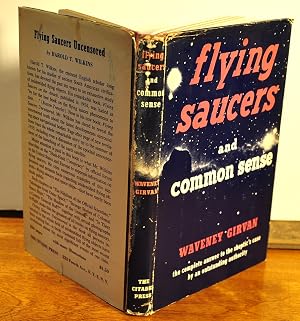
Flying Saucers and Common Sense
Find on Amazon →As an Amazon Associate, OverClassified may earn from qualifying purchases made through this link, at no extra cost to you.
Why This Is Essential Reading
Flying Saucers and Common Sense is not, on its own evidentiary merits, one of ufology's stronger books — its own most substantive critical review fairly credits it as a snapshot of its moment while flagging real, specific credulity (the Cedric Allingham hoax chief among them) that a more scientifically grounded author might have caught. It earns a place in this site's library instead for a narrower, more defensible reason: it is a genuine, contemporaneous period document from one of British ufology's actual founding institutional figures, written the year before he took over Flying Saucer Review, and it remains directly useful, as this site's own Mount Kilimanjaro case file uses it, as an early secondary source for a case whose original evidence had to be painstakingly reconstructed decades later. Read it as a period artifact rather than a reliable modern reference, and read the Cedric Allingham episode it discusses as a specific, documented cautionary example of exactly the sourcing discipline this site's own research standards exist to enforce.
Related Cases & Theories
Sources Cited
- Girvan, Waveney. Flying Saucers and Common Sense. Frederick Muller Ltd. (UK, 1955) / Citadel Press (US first edition, 1956). amazon.com
- Harney, John. "First Read: Waveney Girvan." Magonia Review of Books (pelicanist.blogspot.com), December 2013. pelicanist.blogspot.com
- "Flying Saucer Review." SourceWatch (founding history, Derek Dempster/Waveney Girvan editorial succession). sourcewatch.org
- Harney, John. "Magonia Review: The Life and Death of a UFO Magazine." Magonia Review of Books (pelicanist.blogspot.com), September 2017 (Flying Saucer Review institutional history). pelicanist.blogspot.com
- "Cedric Allingham." Wikipedia (1954 hoax, Christopher Allan and Steuart Campbell's 1986 investigation identifying Patrick Moore as probable author). en.wikipedia.org
- "Flying Saucers and Common Sense." AbeBooks (first-edition bibliographic listing and dust-jacket photograph, Citadel Press, 1956). abebooks.com
- This site's own resources library: Full Reading List, where this book is cited on the Mount Kilimanjaro case file's own Further Reading list.
- This site's own case file: The Mount Kilimanjaro Cigar-Shaped UFO Sighting, for the full case this book discusses contemporaneously.
- This site's own key-figures entry: George Adamski, for the contactee claims this book treats sympathetically.
- This site's own key-figures entry: Desmond Leslie, for Girvan's own 1953 publication of Flying Saucers Have Landed.
- This site's own case file: George Adamski's Desert Center Contact, for the full, Debunked-rated case this book treats sympathetically.
- "George Adamski." Wikipedia (biography, 1952 contact claim, later analysis of the photographed "scout ship" object). en.wikipedia.org
Have corrections, additional research, or peer-reviewed sources? Help improve this entry.
Suggest an Edit