
Close Encounter at Kelly and Others of 1955
Isabel Davis and Ted Bloecher's 1978 CUFOS Report on the Kelly-Hopkinsville "Goblins" and Five Other 1955 Humanoid Encounters
Core Thesis
Close Encounter at Kelly and Others of 1955 is not a trade book but a self-contained investigative report, issued as a monograph by the J. Allen Hynek-founded Center for UFO Studies in March 1978. Its first and larger half, written by Isabel Davis, reconstructs the night of August 21-22, 1955, when the Sutton and Taylor families reported repelling small, glowing, metallic humanoids around a farmhouse near Kelly, Kentucky -- the case this site's own Kelly-Hopkinsville Cabin Siege (Case File #035) treats as one of the best-documented Close Encounters of the Third Kind on record. Rather than retelling the story from press clippings, Davis builds her account from WHOP radio reporter Bud Ledwith's witness interviews conducted the very next morning and her own follow-up investigation the following year, then devotes a full chapter to systematically dismantling every hoax and mass-hysteria theory offered against it before reproducing the case's official Project Blue Book documents. Its second half, by Ted Bloecher, sets the Kelly case in context by surveying five other, far less famous 1955 American humanoid reports -- treating that single summer, not Kelly alone, as the real turning point in serious UFO-occupant research.
About the Author
Isabel Davis co-founded Civilian Saucer Intelligence of New York (CSI) in 1954 alongside Ted Bloecher and Alexander Mebane, and later worked as an associate of the National Investigations Committee on Aerial Phenomena (NICAP) into the 1980s. Ufologist and historian Jerome Clark's UFO Encyclopedia describes her as among the most intelligent and critically minded of the first generation of American UFO researchers, a reputation that matches the skeptical, evidence-first approach she brings to Part One of this book. Beyond her research record, Davis's personal biography is thinly documented in publicly accessible sources; this article does not assert unverified birth or death dates for her rather than guess at a match among records for a common name. What is well documented is her direct fieldwork on this case: she conducted her own interviews with the Sutton and Lankford family members starting in the summer of 1956, roughly ten months after the event, building on -- and in places correcting -- the record established immediately after the incident by local radio reporter Bud Ledwith, who is credited in the book's front matter for his assistance.
Ted Bloecher is considerably better documented. Born in 1929 in Summit, New Jersey, he supported a UFO-research career that spanned five decades with a parallel career as a professional singer and stage actor, appearing in Broadway and touring productions including Oliver! and Hello, Dolly! from the late 1950s through 1973, and later performing with the New York City Gay Men's Chorus from 1985 onward. He co-founded CSI of New York with Davis in 1954, joined NICAP as a staff member in 1968, and is independently notable in ufology for his own 1967 book-length study, Report on the UFO Wave of 1947, a chronology of more than 850 cases with an introduction by physicist James E. McDonald -- a landmark early-wave study this article flags as a plausible, separate future candidate for this site's Essential Reading list rather than covering it here. Bloecher's UFO research files were later donated to the Center for UFO Studies, and his personal papers and correspondence now reside in the New York Public Library's archives. He died on January 22, 2024, at age 94.
The book itself grew directly out of CSI's own institutional caution about UFO occupant reports. As Bloecher explains in his introduction, CSI's core investigators had spent the early 1950s watching the credibility of "occupant" claims collapse under sensationalized, poorly sourced books like Frank Scully's Behind the Flying Saucers and George Adamski's Flying Saucers Have Landed -- both covered elsewhere in this site's own Essential Reading list -- and had responded by treating nearly all such reports with default skepticism. It was only after a wave of more credible European and South American humanoid cases in late 1954, followed by a cluster of American reports across the summer of 1955, that CSI concluded the occupant question finally warranted the kind of systematic, first-hand field investigation Davis and Bloecher went on to conduct and, more than two decades later, finally publish in full through the Center for UFO Studies.
Isabel Davis received research assistance on Part One from Bud Ledwith, the WHOP radio newsman whose interviews and witness sketches, taken the morning after the siege, remain the closest thing to a contemporaneous record of the case. Ted Bloecher, in turn, credits Leonard Stringfield -- the Cincinnati-based UFO investigator and founder of Civilian Research, Interplanetary Flying Objects (CRIFO) -- with assistance on Part Two, particularly the sketches accompanying two of the Ohio-area cases Bloecher covers.
Historical Context & Origins
Bloecher's introduction opens not with 1955 but with 1947, tracing scattered, tongue-in-cheek newspaper reports of "little men" back to the very first wave of American flying-saucer sightings, and drawing directly on his own 1967 chronology of that wave. He walks through the sparse, mostly dismissed occupant reports of 1949 through 1953 -- the Death Valley "dwarfs," the Steep Rock Lake "robot-like figures," the Brush Creek water-taking humanoid -- and argues that the subject only got "off on two left feet" because of Scully's and Adamski's discredited bestsellers, which taught cautious researchers like CSI's own founders to treat occupant claims as automatically suspect.
The book frames late 1954 as the turning point: a cluster of far more detailed European humanoid reports from France and Italy, followed by several striking Venezuelan cases investigated by APRO's Coral Lorenzen, persuaded CSI's core investigators that the occupant question could no longer simply be shelved. When American domestic reports of small, glowing, clawed humanoids began arriving from Ohio, Georgia, and finally southwest Kentucky across the summer of 1955, Bloecher writes, it became "possible to find out how such stories would withstand first-hand investigation" -- and it is that investigation, not the original 1955 headlines, that this book actually documents.
The gap between the event and the book is itself part of the story the introduction tells. Davis's own interviews with the Sutton and Lankford family did not begin until the summer of 1956, roughly ten months after the siege, and the finished manuscript was not issued by the newly formed Center for UFO Studies until March 1978 -- twenty-three years after the encounter itself. That places the book's publication squarely within CUFOS's own early, Hynek-led push to professionalize UFO case investigation through rigorously documented, source-cited monographs rather than magazine sensationalism, the same institutional mission that produced the book's extensive footnoting, reproduced maps, and appended Project Blue Book documents.
Core Arguments & Key Concepts
Part One, Davis's "Close Encounter at Kelly," is organized as a five-chapter case build rather than a narrative retelling. Chapter I lays out the story as it reached the wire services and the skepticism it was met with; Chapter II reconstructs "What Happened at Kelly" from witness testimony; Chapter III, "Investigating What Happened," documents Davis's own inquiry and its sourcing; Chapter IV, "Weighing the Evidence," is the book's analytical core; and Chapter V reproduces the case's Project Blue Book paperwork in full, letting readers check the official record against Davis's own conclusions rather than take her word for it.
Chapter IV is where the book makes its actual argument, and it does so by process of elimination rather than by asserting an extraterrestrial explanation outright. Davis works methodically through the leading skeptical theories of her day -- that the family hallucinated the encounter under mass hysteria, or that the story was a deliberate hoax staged for self-protection after a gunfight with human intruders, for publicity, for profit, or simply "for fun" -- and argues each collapses under its own logic: no plausible "trigger" personality emerges among the eleven witnesses for a shared hallucination that recurred identically after a two-hour police search found nothing, and no coherent motive survives scrutiny once matriarch Glennie Lankford's character, the family's evident wish to be left alone, and their unremarkable, non-sensationalized background are accounted for. She closes the chapter with what she calls her "Hypothesis of Truth": six specific arguments for the story's substantial accuracy, including the internal consistency of independently given witness descriptions, parallels to contemporaneous humanoid reports the Kelly witnesses could not plausibly have known about, and the sheer duration and closeness of the sightings, which she argues makes casual misidentification unusually unlikely.
Part Two, Bloecher's "Other Encounters, 1955," is a comparative survey rather than a single deep case study: the Loveland Bridge case, the Hunnicutt encounter at Branch Hill, Mrs. Symmonds at Stockton, the "Hairy Little Man" of Edison, the "Grey Ghost of the Kinchafoonee," and a closing chapter on the summer's minor, more dubious reports. None of these six cases currently has its own dedicated case file on this site, and this article notes that plainly rather than manufacturing cross-links that do not exist. Structurally, Bloecher's approach -- tabulating each case's witnesses, described physical traits, and degree of correlation with other 1955 reports -- anticipates the kind of systematic, cross-referenced humanoid-case cataloguing he later contributed to directly, positioning this book as an early, hands-on prototype for that later comparative-catalogue methodology rather than a one-off case write-up.
Taken together, the two halves make a case that is more methodological than sensational: the book's real argument is that the Kelly case earns its outlier status not because it is uniquely dramatic, but because it was investigated more thoroughly, with more named, cross-checked witnesses and more surviving primary documentation, than almost any other humanoid report of its era -- a claim the book supports by simply showing its work, chapter by chapter, rather than asserting it.
Key Cases & Evidence Discussed
The book's entire first half is devoted to this site's own Kelly-Hopkinsville Cabin Siege (Case File #035, August 21-22, 1955), which lists this exact report in its own Further Reading section, linking directly to the CUFOS-hosted PDF, and describes it as "the definitive, exhaustive report on the Kelly-Hopkinsville case." Because Davis's account draws on interviews conducted far closer to the event than most later retellings, it functions as a primary investigative source underlying this site's own case-file narrative rather than a secondary synthesis of it.
Part Two's six cases -- the Loveland Bridge sighting, the Hunnicutt encounter at Branch Hill, Mrs. Symmonds at Stockton, the Edison "Hairy Little Man," the "Grey Ghost of the Kinchafoonee," and the closing survey of the summer's more dubious reports -- remain, as far as this site's own case-file index shows, uncovered by dedicated OverClassified case files at the time of this writing. They are recorded here as a factual account of the book's contents rather than linked to case files that do not exist.
This site's own Passport to Magonia entry, covering Jacques Vallée's 1969 comparative study of UFO entities and folkloric "little people," is cited directly in this site's own Kelly-Hopkinsville case file as recommended further reading alongside this very book, and the two works make a natural comparison: Vallée reads the Kelly "little men" against centuries of fairy and goblin folklore, where Davis and Bloecher instead build their case from courtroom-style witness cross-checking and official Blue Book paperwork -- two very different methodologies converging on the same conclusion that the Kelly witnesses were reporting something they genuinely experienced.
This site's own Behind the Flying Saucers entry, covering Frank Scully's discredited 1950 hoax book, is the direct foil Bloecher names in his own introduction as the reason CSI's founders spent years defaulting to skepticism on occupant reports in the first place -- making it, by the authors' own account, one of the books this report was written to answer.
Critical Reception & Controversies
As a self-published, source-heavy CUFOS field report rather than a trade release, the original 1978 monograph never received coverage from outlets like Publishers Weekly or Kirkus Reviews, and its critical record today rests almost entirely on reader response to the 2018 Flying Disk Press reprint. Goodreads shows the reprint at approximately 3.46 out of 5 stars across 13 ratings and a single written review, calling it essential reading for anyone serious about the case and specifically recommending readers "read someone who did the fieldwork close to when it happened" rather than relying on secondary retellings -- a small but genuinely positive niche-audience reception consistent with a specialist report rather than a mass-market book.
The book's most consequential critical engagement, however, did not arrive from a contemporary reviewer but from a much later re-investigation. In 2006, skeptical investigator Joe Nickell published "Siege of the 'Little Green Men': The 1955 Kelly, Kentucky Incident," proposing that the family misidentified great horned owls -- nocturnal, silent-flying, aggressive nest defenders with large yellow eyes, fan-like ear tufts, and grasping talons that match several of the witnesses' own descriptions -- compounded by the stress of night, alcohol, and Billy Ray Taylor's separately reported meteor sighting. Nickell's hypothesis directly contradicts the central conclusion of Davis's own Chapter IV "Hypothesis of Truth," and this article presents both without declaring a winner: Davis argues from the internal consistency and duration of the sightings that misidentification is implausible, while Nickell argues that stress, darkness, and an aggressive nocturnal predator are sufficient to explain testimony that seemed, to Davis writing in the 1970s, too consistent to be a mistake.
The book's citation record shows a smaller, more mundane discrepancy worth noting plainly: Wikipedia's own bibliography for the Kelly-Hopkinsville encounter cites this work only as "Davis, Isabel (1978). Close Encounters at Kelly. Chicago: Center for UFO Studies," omitting Bloecher as co-author, using a slightly different title than the book's actual title page, and giving a Chicago rather than Evanston, Illinois place of publication -- a modest cataloging inconsistency this article flags rather than resolves, since the book's own title page and the CUFOS-hosted PDF both confirm "Close Encounter at Kelly and Others of 1955," by Davis and Bloecher, published from CUFOS's Evanston, Illinois offices.
Influence & Legacy
The report's most durable legacy is as the primary investigative source underlying nearly every serious later treatment of the Kelly-Hopkinsville case, a status this site's own case file reflects directly by citing it in its Further Reading section alongside a link to the freely downloadable CUFOS-hosted PDF. Long unavailable outside CUFOS's own limited monograph run, the report returned to wider circulation through Flying Disk Press's 2018 unabridged paperback and Kindle reprint, and remains freely accessible today in full via the Center for UFO Studies' own website.
Ted Bloecher's own research career extended this book's methodology well beyond 1978: he went on to contribute to a later, more comprehensive academic humanoid-sightings catalogue effort, and his separate 1967 study of the 1947 UFO wave remains an independently cited landmark in the field -- a connection this article notes without covering that book itself, consistent with the scope of this entry.
Within the broader literature on Kelly-Hopkinsville, the book's role has been that of the record other writers build on or argue against rather than an analytical framework of its own: later popular treatments, from George Dudding's The Kelly-Hopkinsville UFO and Alien Shootout to Sutton descendant Geraldine Sutton Stith's family-perspective Alien Legacy -- both also cited in this site's own Kelly-Hopkinsville case file -- draw on the same witness record Davis was first to assemble and cross-check, and Joe Nickell's 2006 owl hypothesis engages directly with the same testimony this report was the first to publish in full, sourced form.
The Book
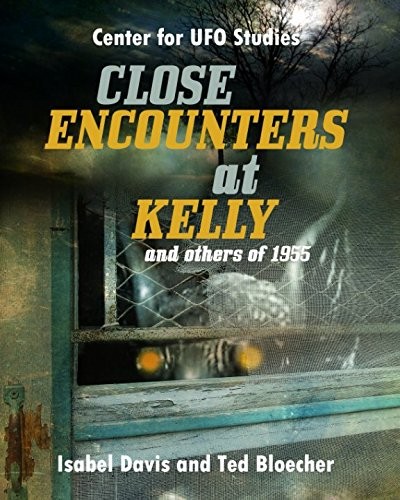
Close Encounter at Kelly and Others of 1955
Isabel Davis and Ted Bloecher's 1978 CUFOS Report on the Kelly-Hopkinsville "Goblins" and Five Other 1955 Humanoid Encounters
Find on Amazon →As an Amazon Associate, OverClassified may earn from qualifying purchases made through this link, at no extra cost to you.
Why This Is Essential Reading
Close Encounter at Kelly and Others of 1955 earns its place on this list for a reason distinct from most Essential Reading entries: it is not a popular retelling but the actual field report, produced by the Center for UFO Studies and grounded in Bud Ledwith's next-morning interviews and Isabel Davis's own 1956 follow-up investigation, behind a case this site's own Kelly-Hopkinsville Cabin Siege case file treats as one of the best-documented Close Encounters of the Third Kind in American UFO history. Its limitations are worth stating as plainly as its value: Isabel Davis herself remains a thinly documented figure outside her research record, the book's twenty-three-year gap between event and publication means its core interviews are reconstructions rather than same-week testimony, and its central "Hypothesis of Truth" has since been directly challenged by Joe Nickell's 2006 great-horned-owl hypothesis. Read together with Jacques Vallée's Passport to Magonia and against Nickell's later skeptical case, it remains the necessary starting document for the Kelly-Hopkinsville case -- the source every subsequent defense or rebuttal of what happened at that Kentucky farmhouse has had to engage with directly, because it is where the witnesses' own testimony was first gathered, cross-checked, and set down in full.
Related Cases & Theories
Sources Cited
- Davis, Isabel & Bloecher, Ted. Close Encounter at Kelly and Others of 1955. Center for UFO Studies, Evanston, IL, March 1978. Full text: cufos.org
- Davis, Isabel & Bloecher, Ted. Close Encounters at Kelly and Others of 1955. Flying Disk Press, 2018 unabridged reprint (ISBN 1980990131 / 9781980990130). amazon.com
- "CLOSE ENCOUNTERS AT KELLY AND OTHERS OF 1955." AbeBooks listing (2018 Flying Disk Press edition bibliographic details, cover design credit to Mark Randall). abebooks.com
- "Close Encounters at Kelly and Others of 1955" by Isabel Davis. Goodreads (aggregated rating and reader review). goodreads.com
- "Kelly–Hopkinsville encounter." Wikipedia (case chronology, skeptical explanations, and bibliography citation of Davis's report). en.wikipedia.org
- "Civilian Saucer Intelligence." Wikipedia (CSI's 1954 founding, core personnel Isabel Davis, Ted Bloecher, and Alexander Mebane, and the group's relationship to J. Allen Hynek and NICAP). en.wikipedia.org
- "Ted Bloecher papers, 1950-2000." New York Public Library Archives, finding aid (birth year, acting career, CSI and NICAP involvement, and donation of research files to the Center for UFO Studies). archives.nypl.org
- "Remembering Saucerologist/Ufologist Ted Bloecher." Podcast UFO, 2024 (birth and death dates, Broadway and Gay Men's Chorus career, NICAP staff role, and contributions to The Humanoid Catalogue). podcastufo.com
- "Report on the UFO Wave of 1947" by Ted Bloecher. Goodreads listing (1967 privately published edition details, introduction by James E. McDonald). goodreads.com
- Nickell, Joe. "Siege of the 'Little Green Men': The 1955 Kelly, Kentucky Incident." Investigation summarized in coverage of the great-horned-owl misidentification hypothesis. iflscience.com
- "The Kelley/Hopkinsville (Sutton) Encounter." NICAP.org, case summary citing the 1978/1979 CUFOS report by Davis and Bloecher and its comparative treatment of other 1955 CE3 cases. nicap.org
- This site's own case file: The Kelly-Hopkinsville Cabin Siege (Case File #035), which cites this book directly in its own Further Reading section.
- This site's own key-figures entry: Isabel Davis.
- This site's own key-figures entry: Ted Bloecher.
- This site's own key-figures entry: J. Allen Hynek, founder of the Center for UFO Studies, which published this report.
- This site's own key-figures entry: Leonard Stringfield, credited with assisting Ted Bloecher on Part Two of the book.
- This site's own essential-reading entry: Passport to Magonia, cited alongside this book in this site's own Kelly-Hopkinsville case file.
- This site's own essential-reading entry: Behind the Flying Saucers, named directly in this book's own introduction as a contributing reason for early CSI skepticism toward occupant reports.
Have corrections, additional research, or peer-reviewed sources? Help improve this entry.
Suggest an Edit