
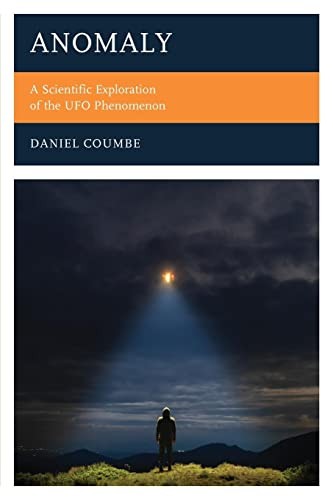
Anomaly
A Scientific Exploration of the UFO Phenomenon
Core Thesis
Anomaly makes a narrow, methodological argument rather than a sweeping one: that the UFO phenomenon can and should be screened using the same quantitative tools theoretical physicists use to evaluate any other anomalous data set — known aerodynamics, thermodynamics, materials science, and orbital mechanics — applied case by case to reports that carry genuine physical or instrumented evidence, rather than to the far larger body of uncorroborated eyewitness testimony that dominates most UFO literature. Daniel Coumbe, a theoretical particle physicist with a research background in quantum gravity, selects a small set of well-evidenced cases — radar returns, laboratory-analyzed physical fragments, ground trace evidence, and forward-looking infrared video — and works through what the reported luminosities, velocities, and accelerations would actually require if taken at face value, deliberately keeping the analysis in the register of testable physics rather than narrative plausibility. The book does not claim to prove an extraterrestrial or otherwise exotic origin for any of its cases; its argument is that a physics-first, criteria-based method, applied consistently and shown in full in the book's own appendices, is a more defensible way to separate genuinely anomalous reports from misidentifications than either credulous acceptance or blanket dismissal.
About the Author
Daniel Coumbe holds a Ph.D. in theoretical particle physics and built his academic career in quantum gravity research, holding postdoctoral and research positions at Syracuse University in New York, Jagiellonian University in Poland, and the Niels Bohr Institute at the University of Copenhagen, where his work focused on approaches to quantum gravity including causal dynamical triangulations and Weyl-invariant modifications of general relativity. He has published peer-reviewed research in leading physics journals, including Physical Review D ("Is Asymptotically Weyl-Invariant Gravity Viable?," 2021) and Classical and Quantum Gravity (on critical phenomena in causal dynamical triangulations), and authored the graduate-level physics monograph Magnifying Spacetime: How Physics Changes With Scale (Nova Science Publishers), which surveys scale-dependent approaches to quantum gravity from fractal geometry to the renormalization group. That publication record is independently verifiable and establishes him as a genuine working theoretical physicist, not a credential claimed solely on the strength of a UFO book — a distinction this site's own editorial standard treats as material, and one worth stating plainly given how often "physicist" is asserted loosely elsewhere in UFO literature.
What that background does not include is any formal training in aerospace engineering, radar systems analysis, sensor forensics, or the eyewitness-testimony methodology that dominates most of the case files this site catalogues. Anomaly is, by its own structure, a public-data project: Coumbe works from previously published radar records, chain-of-custody laboratory reports, government investigative files, and released government video rather than original sensor access or new field investigation, applying a theoretical physicist's quantitative toolkit to evidence that was gathered, and in some cases already contested, by others. That is a meaningfully different position from an aerospace engineer reverse-modeling a flight envelope from raw telemetry, and this entry treats it as such throughout — Coumbe's contribution is the rigor and transparency of the calculation, shown in the book's appendices, not new primary evidence.
Coumbe's move into UFO research followed the same public-disclosure window that reshaped the field for every other physicist on this site's list: the book's own framing opens from the U.S. government's June 2021 acknowledgment that UAP are real physical objects that have penetrated restricted military airspace since at least 2004, and Anomaly was written and published squarely inside the resulting surge of credentialed-scientist engagement with the subject. As of this writing, publicly available information about Coumbe's career and views is limited almost entirely to his physics publication record, this book's own front matter, and the handful of bookseller and academic-review listings this entry draws on; no personal website, extended interview, or media profile could be independently verified, which this entry states plainly rather than filling with inference.
Historical Context & Origins
Anomaly arrived in the same narrow publishing window as several other Essential Reading titles on this site — including Avi Loeb's Extraterrestrial two years earlier — that share a common origin: the October 2017 New York Times reporting on the Pentagon's Advanced Aerospace Weapon System Applications Program, the Navy pilot videos it produced, the Pentagon's April 2020 confirmation of their authenticity, and the Office of the Director of National Intelligence's June 2021 Preliminary Assessment on Unidentified Aerial Phenomena, which the book cites directly as its starting premise. Unlike Loeb, whose book concentrates on a single new astronomical data set ('Oumuamua), Coumbe works in the opposite direction: rather than generating new observations, he re-examines a small set of already-published, decades-spanning cases through a consistent quantitative framework, treating the existing evidentiary record as the raw material for a physics screening exercise.
The book's institutional moment also includes the Pentagon's creation of the All-domain Anomaly Resolution Office (AARO) in July 2022, the first standing government body since Project Blue Book explicitly tasked with resolving individual UAP reports using the government's own sensor and intelligence resources — a parallel, official-channel version of the same case-by-case evidentiary screening Anomaly attempts from public data. That parallel became a direct, retroactive test of one of the book's own four cases: AARO's March 2025 case resolution report concluded that the Aguadilla, Puerto Rico infrared footage Coumbe analyzes most likely showed two drifting sky lanterns, a resolution published roughly two years after the book itself and one this entry's Key Cases section addresses directly.
Within UFO literature specifically, Anomaly sits in a smaller, more technical lineage than most titles on this list — closer to the quantitative flight-characteristics work presented at venues like the Scientific Coalition for UAP Studies and the Alternative Propulsion Engineering Conference by physicists such as Kevin Knuth and Matthew Szydagis than to narrative-driven UFO books aimed at a general trade-press audience. Massimo Teodorani, reviewing the book for the Journal of Scientific Exploration, situated it as advancing what he termed "anomalistic physics": using standard physical analysis, not new exotic theory, as the discipline's basic filter.
Core Arguments & Key Concepts
The book's organizing method is a set of quantitative evaluation criteria that Coumbe applies consistently across cases: the strength and independence of corroborating instrumentation (radar, infrared, multiple witnesses with different vantage points), the survivability and chain of custody of any physical trace evidence, and, where reported flight characteristics are specific enough to calculate, whether the implied velocity, acceleration, or energy output is physically consistent with any known or hypothesized propulsion and structural engineering. Reviewer Massimo Teodorani's Journal of Scientific Exploration notice describes this combination as Coumbe proposing "anomalistic physics" as an approach in its own right — quantitative evaluation and statistical interpretation applied ahead of anecdotal narrative, without discarding the psychosocial dimension of witness testimony entirely, but subordinating it to whatever instrumented or physical data exists.
Coumbe organizes the book's case-study section, per its own table of contents, around four specific incidents chosen for the relative strength of their non-testimonial evidence: Japan Air Lines Cargo Flight 1628 (1986), for its radar corroboration and instrument-panel paper trail; the Ubatuba magnesium fragments (1957), for their decades-long chain of independent laboratory materials analysis; the Socorro landing (1964), for its physical ground trace evidence; and the Aguadilla CBP FLIR encounter (2013), for its government-sourced infrared video record. In each case the book works forward from the available physical measurements toward the implied kinematics, rather than backward from a witness's verbal account, and states its methodology and calculations openly enough — including the underlying equations, presented in the book's appendices — for a reader to check the arithmetic rather than take the conclusion on faith.
A recurring finding across the case studies is that several of the reported values, evaluated on their own terms, sit well outside ordinary aerospace performance envelopes: available third-party summaries of the book cite figures including luminosities estimated as high as roughly 30,000 megawatts, velocities exceeding 12,000 kilometers per hour, and accelerations as high as roughly 5,000 g in at least one case Coumbe examines. Coumbe's argument is not that such figures prove exotic technology, but that a rigorous physical accounting of what they would actually require — in structural loading, acoustic signature, and energy dissipation — is a more useful starting point for evaluating a case's credibility than either the raw eyewitness account or a reflexive skeptical dismissal.
The book's closing section, titled "The Bigger Picture" in its own table of contents, steps back from individual cases to ask broader, more statistical questions about the UFO phenomenon — addressing patterns in when and where credible reports cluster — a structural move that pairs it, on this site, with the analytical, base-rate-driven approach of this site's own Seasonal Sightings Analysis theory page, which already cites this exact book directly.
Key Cases & Evidence Discussed
Anomaly is unusual among this site's Essential Reading titles in that its entire case-study section maps directly onto this site's own catalogue: all four of the incidents Coumbe selects for quantitative analysis already have dedicated case files here, making this book one of the most directly cross-referenceable titles on the list rather than a general survey.
Japan Air Lines Cargo Flight 1628 (Case #150, 1986) supplies the book's clearest radar-corroborated case: Captain Kenju Terauchi's fifty-minute encounter over Alaska generated same-night FAA interviews, an internal radar review, and a public retraction, giving Coumbe a case with an unusually well-documented instrumentation record to work from — and one this site's own file rates DISPUTED given the retracted radar analysis and the FAA's own account of the episode.
The Ubatuba Magnesium Fragments (Case #157, 1957) is the book's clearest materials-science case: independent spectrographic and isotope analyses spanning a Brazilian government lab in 1957, Oak Ridge National Laboratory in 1958, the U.S. Condon Committee in 1968, and a peer-reviewed 2022 Journal of Scientific Exploration isotope study have consistently found the recovered fragments to be unusually pure magnesium — physical evidence Coumbe can evaluate on its own chemical terms independent of the anonymous letter that accompanied it, which this site's own file notes remains entirely unverified.
The Socorro UFO Landing (Case #029, 1964) is this site's own highest-rated case among the four, stamped CREDIBLE for its landing-gear impressions, scorched creosote, and soil vitrification — physical trace evidence investigated at the time by Project Blue Book, the FBI, and the U.S. Army, and the kind of ground-truth data set that a physics-first evaluation method is best positioned to test.
The Aguadilla CBP FLIR Encounter (Case #221, 2013) is the case history has moved on from since the book's 2023 publication: the Pentagon's All-domain Anomaly Resolution Office issued a formal case resolution in March 2025 — roughly two years after Anomaly went to print — concluding the footage most likely showed a pair of drifting sky lanterns rather than a single high-performance craft, a real-world postscript to exactly the kind of quantitative reassessment this book's method calls for, even though it lands against the reading Coumbe's analysis implies.
Critical Reception & Controversies
As a specialized, recently published title from a physicist without a prior public UFO-research profile, Anomaly has a genuinely thin critical record, and this entry reports that honestly rather than inflating it. Extensive searching turned up no trade-press coverage from outlets like Kirkus Reviews, Publishers Weekly, or major newspaper book sections — a real contrast with higher-profile 2020s UAP titles like Loeb's Extraterrestrial or Pasulka's American Cosmic, both of which drew substantial mainstream review attention.
The one verifiable, substantive review located is Massimo Teodorani's notice in the Journal of Scientific Exploration, Vol. 37, No. 3 (2023), pp. 550–551 — a peer-reviewed journal specializing in anomalistics and frontier science, itself a niche venue but a legitimate one for evaluating a book of this kind. Teodorani, an astronomer, characterized the book's central contribution as proposing "anomalistic physics" as a genuine methodological approach, praised its combination of quantitative rigor with an acknowledgment of the phenomenon's psychosocial dimension, and noted that Coumbe does not shy away from confronting the sheer physical strangeness the data implies, including reported speeds, accelerations, and apparent transmedium (air-to-water) travel that resist conventional explanation on the numbers alone.
Reader-level reception, so far as it is publicly measurable, is negligible in volume rather than negative in tone: as of this writing, the book's Goodreads listing shows only a small handful of ratings and no written reviews, a sample far too small to characterize as any kind of consensus. This entry treats that thinness as itself informative — a recent, technically dense physics title from an independent press without a major marketing push has, predictably, not yet generated the kind of broad public engagement or organized skeptical rebuttal that shaped the reception histories of several other books on this list.
Influence & Legacy
Published in 2023, Anomaly is too recent and too narrowly circulated to have an established influence or legacy in the way older or higher-profile titles on this list do, and this entry states that plainly rather than overstating a footprint the available record does not support. No citation trail in subsequent UAP-research literature, no follow-up book, and no broader media moment comparable to the Galileo Project's emergence from Extraterrestrial could be independently verified.
What can be verified is that the book already functions as working citation infrastructure on two fronts. Academically, it received a serious notice in the Journal of Scientific Exploration, the same peer-reviewed venue that has also published the 2022 isotope-ratio study of the Ubatuba fragments this book itself discusses — placing Anomaly inside the same small, specialized citation ecosystem as one of its own case studies. On this site specifically, the book is already cited as a source on this site's own Seasonal Sightings Analysis theory page and in the sources list of this site's own Socorro UFO Landing case file, with this new Essential Reading entry and key-figures card extending that same cross-referencing further.
More broadly, Anomaly belongs to a small but growing cluster of physics-trained researchers — including Kevin Knuth, a physicist who has worked with UAPx analyzing UAP flight characteristics, and Matthew Szydagis, an experimental physicist at the University at Albany researching dark matter and UAP propulsion physics in parallel — who have begun applying credentialed, quantitative physics methodology to UAP evidence in the years following the 2021 disclosure wave. Coumbe's contribution sits inside that same emerging current rather than ahead of or apart from it; whether it proves durable is, honestly, not yet knowable from a two-year-old book with a still-thin citation record.
The Book
As an Amazon Associate, OverClassified may earn from qualifying purchases made through this link, at no extra cost to you.
Why This Is Essential Reading
Anomaly earns its place on this list for a narrower reason than most of the titles around it: it is the one book here whose entire evidentiary core — all four case studies — maps directly onto cases this site already catalogues in detail, from the Socorro landing's physical trace evidence to the Ubatuba fragments' decades of laboratory chemistry. Daniel Coumbe's genuine, independently verifiable background in theoretical physics gives that overlap real analytical weight: rather than retelling these cases as narrative, the book works each one as a quantitative physics problem, showing its arithmetic in the open rather than asserting a conclusion. That approach does not, and does not claim to, resolve any of the four cases — and history has already moved past one of them, with AARO's 2025 sky-lantern resolution for Aguadilla landing against the reading the book's own analysis implies. What the book offers instead, read alongside this site's own files on the same four incidents, is a disciplined worked example of what a physics-first evaluation actually looks like when applied to specific, well-evidenced reports rather than to the UFO phenomenon in the abstract — a useful, honestly modest companion to this list's more institutionally influential physics-adjacent title, Loeb's Extraterrestrial.
Related Cases & Theories
Essential Viewing
UAP Flight Characteristics: The Five Observables | Kevin Knuth
Tim Ventura — Not a Coumbe interview, but a directly relevant companion piece: physicist Kevin Knuth's own quantitative walkthrough of UAP flight-performance claims — including the same kind of extreme-acceleration and transmedium analysis this book applies to Socorro, JAL 1628, and Aguadilla — verified here via YouTube oEmbed before inclusion.
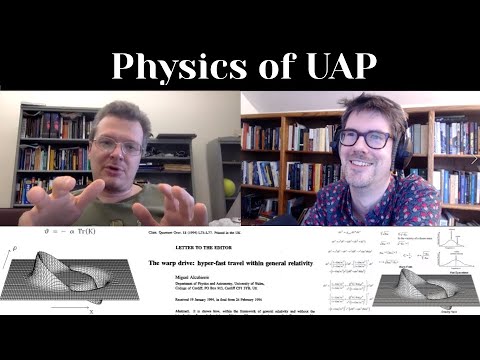
Physics of UAP/UFO, Alcubierre Warp Drives, & Spacetime Metric Engineering with Dr. Matthew Szydagis
Kent Bye — No verifiable video of Coumbe himself discussing this book could be located, so this entry includes this general, credentialed-physicist discussion of what UAP flight claims would require of known and hypothetical physics instead — the same evaluative spirit this book applies case by case, confirmed via YouTube oEmbed.
Sources Cited
- Teodorani, M. "ANOMALY – A Scientific Exploration of the UFO Phenomenon." Journal of Scientific Exploration, Vol. 37, No. 3 (2023), pp. 550–551. DOI: 10.31275/20232991 (peer-reviewed book review; source for critical reception and the "anomalistic physics" characterization). journalofscientificexploration.org
- "Anomaly: A Scientific Exploration of the UFO Phenomenon." Google Books listing for Daniel Coumbe (publisher, table of contents including the four case-study chapter titles and "The Bigger Picture" section). books.google.com
- "Anomaly: A Scientific Exploration of the UFO Phenomenon." Amazon.com product listing for ISBN 1538172143 / 9781538172148 (edition cited on this site). amazon.com
- "Anomaly by Daniel Coumbe." Goodreads (reader ratings and edition record). goodreads.com
- "Daniel Coumbe." Nova Science Publishers author page (institutional affiliation: Niels Bohr Institute postdoctoral research fellow; quantum gravity research focus). novapublishers.com
- Coumbe, D. P. "Is Asymptotically Weyl-Invariant Gravity Viable?" Physical Review D, 103, 084050 (2021) (peer-reviewed physics research verifying Coumbe's academic credentials). journals.aps.org
- Coumbe, D. P., et al. "Critical Phenomena in Causal Dynamical Triangulations." Classical and Quantum Gravity, Vol. 36, No. 20 (2019) (further peer-reviewed physics research by the author). iopscience.iop.org
- "Anomaly: A Scientific Exploration of the UFO Phenomenon." AbeBooks bibliographic listing (ISBN 9781538172148 record, edition and pagination detail). abebooks.com
- This site's own case file: The Socorro UFO Landing, one of the four cases Anomaly analyzes, and the page on which this book is already cited as a source.
- This site's own case file: The Ubatuba Magnesium Fragments, the book's materials-science case study.
- This site's own case file: Japan Air Lines Cargo Flight 1628, the book's radar-corroborated case study.
- This site's own case file: Aguadilla CBP FLIR Encounter, including the March 2025 AARO case resolution reached after this book's publication.
- This site's own theory file: Seasonal Sightings Analysis, which already cites this exact book (ISBN 1538172143) as a source.
- This site's own resources library: Full Reading List, where this edition is cited against the Seasonal Sightings Analysis theory page.
- This site's own key-figures entry: Daniel Coumbe, for his physics credentials and case connections.
Have corrections, additional research, or peer-reviewed sources? Help improve this entry.
Suggest an Edit