
Alien Contact
Top-Secret UFO Files Revealed — the Middle Book of Timothy Good's Trilogy, and the One He Later Had to Walk Back
Core Thesis
Alien Contact is the American edition of the book British readers know as Alien Liaison: The Ultimate Secret, published by Century in 1991 and by William Morrow in the United States in 1993. It is the middle volume of Timothy Good's informal trilogy — between Above Top Secret (1987) and Alien Base (1998) — and it is the hinge on which Good's whole method turns. Above Top Secret had built its reputation on declassified and leaked government documents; Alien Contact abandons that footing almost entirely in favor of first-person testimony, and specifically the testimony of two named sources, Bob Lazar and the former NASA contractor Bob Oechsler. Its argument is that the documentary cover-up Good had already established is only the outer layer, and that beneath it lies actual physical possession of extraterrestrial craft, an operational reverse-engineering program, and a contact relationship at the highest levels of U.S. government. The book carries a commentary by Admiral of the Fleet The Lord Hill-Norton GCB, Chief of the Defence Staff from 1971 to 1973 — genuine institutional weight from a genuine former head of Britain's armed forces — and it rests, underneath that weight, on sources Good himself later acknowledged were not what they claimed to be. Both facts belong in any honest account of it.
About the Author
Timothy Good's biography — his career as a professional violinist, his 1955 and 1961 encounters with the writing of Keyhoe and Ruppelt, and the 1987 commercial breakthrough of Above Top Secret — is covered in full in this site's breakdowns of that book and of Alien Base. What matters here is where this particular book sits in that arc.
Above Top Secret earned Good a serious hearing precisely because it was document-driven: FOIA releases, leaked memoranda, correspondence with named officials. It was, whatever one thought of its conclusions, checkable. The book that followed four years later abandoned that discipline. Its central material is interview testimony from living sources whose claims Good could not independently corroborate, and its most sensational chapters — on Area 51, on S-4, and on an alleged operational reverse-engineering program — stand or fall entirely on whether Lazar and Oechsler were telling the truth.
The most important thing to say about Good in connection with this book is to his credit rather than against him: he did not defend those sources indefinitely. Some of the more sensational claims in Alien Liaison involving both Bob Lazar and Bob Oechsler have subsequently been shown by Good himself to be spurious or bogus. A researcher publicly retracting his own book's load-bearing testimony is rare enough in this field to be worth stating plainly, and it is the single most useful piece of context a reader can carry into these pages.
British press reaction to Good in this period was correspondingly split and unusually quotable. The Daily Telegraph wrote that "It is painful to turn to the shrill yappings of Timothy Good's Alien Liaison"; the Sunday Telegraph called him "a breathtakingly credulous young man"; the Western Morning News, reviewing the same book, praised his "objectiveness, clearness of writing and prodigious research." The range is not evidence of anything except that Good's reputation was genuinely contested at the moment this book appeared, and that the contest was about method rather than about whether he was sincere.
Historical Context & Origins
The book belongs entirely to the early 1990s and cannot be understood outside them. Bob Lazar had gone public in November 1989 on Las Vegas station KLAS-TV, describing work on recovered extraterrestrial craft at a facility he called S-4 near Papoose Lake, south of the Groom Lake complex. That interview did more than any single event since Roswell's 1978 rediscovery to move the crash-retrieval hypothesis from a fringe historical claim to a live, contemporary, testable one, and it is the event that made a book like this commercially inevitable. This site's own Bob Lazar case file assesses those claims on their own evidence.
The second contemporaneous wave the book sits inside is Mexican. In July 1991, during the total solar eclipse visible across central Mexico, hundreds of people independently videotaped stationary metallic objects over Mexico City and surrounding states — the footage that made Jaime Maussan an international figure. This site's 1991 Mexico City Eclipse UFO Wave case file cites this book specifically for situating that Mexican case inside the broader early-1990s international research landscape that carried Maussan's footage worldwide. Good's book was published in the immediate aftermath of the wave and is one of the earliest English-language treatments to place it in an international frame.
Third, the book arrives at the peak of the cattle-mutilation revival. The phenomenon had been investigated officially in the late 1970s — the 1980 Rommel Report for New Mexico's First Judicial District remains the most thorough government examination of it — and by the early 1990s it had been folded into UFO literature as evidence of an ongoing alien biological program. Good's treatment includes a Colorado ranch case involving anomalous radio broadcasts, and it reflects the era's willingness to treat mutilation and UFO reports as a single phenomenon rather than two separately-caused ones.
The Hill-Norton commentary is the book's most genuinely unusual feature and deserves a note of its own. Admiral of the Fleet The Lord Hill-Norton was Chief of the Defence Staff of the United Kingdom from 1971 to 1973 and Chairman of the NATO Military Committee thereafter — the most senior serving officer in the British armed forces. His willingness to attach his name to Good's work, here and in Alien Liaison's foreword, is a real fact about how the subject was regarded at the top of the British defence establishment in this period, and it is independent of whether Good's specific sources were reliable.
Core Arguments & Key Concepts
The cover-up is operational, not merely archival. Good's central escalation from Above Top Secret is the claim that the U.S. government is not simply withholding UFO records but actively running a program built on recovered non-human hardware. This is the argument the Lazar material exists to support, and it is why the book's evidentiary standing rises and falls with him.
Confirmation from former intelligence officials. The book's publisher summary promises "confirmations from former U.S. intelligence directors and other intelligence personnel that extraterrestrial craft are in government possession." Reading these passages critically is essential: what Good has are recollections and private statements, generally from retired officials, generally unaccompanied by documents. That is a materially weaker class of evidence than the FOIA releases that made his reputation, and the book does not flag the downgrade.
The NORAD visit. A former NASA engineer's account of a visit to a top-secret North American Aerospace Defense Command installation is presented as corroborative. Like the intelligence-director material, it is a single uncorroborated recollection; unlike it, the source is named, which at least makes the claim addressable.
Animal mutilations as part of the same phenomenon. Good treats the mutilation reports as evidence of an ongoing biological program rather than as a separate, largely agricultural and predation-driven phenomenon with its own literature. The Colorado ranch case with its accompanying radio anomalies is the showcase. Readers should note that the most rigorous government investigation of mutilations — Kenneth Rommel's 1980 District Attorney report — reached the opposite conclusion, and that Good's book does not engage with it.
The claim the book is least defensible on. Kirkus' 1993 review flagged a speculative suggestion in the book that "Jesus may have been a 'genetically engineered' alien." Whatever one thinks of the ancient-astronaut literature generally, a passage like this in a book whose argument depends on being taken seriously by defence and intelligence readers is a self-inflicted wound, and it is representative of the book's editorial looseness rather than an isolated lapse.
Key Cases & Evidence Discussed
Bob Lazar and S-4 (Nevada, 1988–89). The book's spine. Lazar's account of working on recovered craft at S-4, Papoose Lake, including his description of an alleged 1979 laboratory "incident" causing 66 deaths, is presented substantially at face value. Two things need saying. First, Kirkus noted at the time that Lazar's credibility had been "shaken by a recent conviction" in an unrelated criminal matter — a real contemporaneous fact about the book's principal source. Second, and more importantly, Good himself has since described some of the sensational Lazar-derived claims in this book as spurious. Readers who want this site's own evidence-based assessment of Lazar should go to the Bob Lazar case file, which weighs the verifiable elements of his account against the unverifiable ones directly.
Bob Oechsler. The former NASA contractor whose claimed contacts and recovered-technology testimony form the book's second pillar. Good's subsequent acknowledgment that Oechsler-derived material in this book was unreliable is, if anything, more significant than the Lazar retraction, because the Oechsler material was less independently scrutinized at the time and therefore less likely to have been corrected by anyone else.
The 1991 Mexico City eclipse wave. This is the book's most durable contribution and the reason it is cited on this site. The July 11, 1991 total solar eclipse produced independent video from many separate locations across central Mexico, an evidentiary situation genuinely unlike single-witness testimony. This site's case file credits Good's book with placing that wave inside the broader international research landscape at a moment when almost no English-language treatment existed.
Roswell. The 1947 events appear here as established background rather than as an argument — a reflection of how completely the crash-retrieval hypothesis had been absorbed into UFO literature by 1993, a decade and a half after Stanton Friedman's interviews reopened it. This site's Roswell case file treats it as the contested question it remains.
Aircraft–UFO encounters. Scattered through the book and generally its most solidly grounded material, drawing on the aviation reporting that had been Good's strength since Above Top Secret. Where the book is reporting a pilot's account of an air encounter with a documented flight and date, it is doing the thing it does well.
Critical Reception & Controversies
Kirkus Reviews, on February 15, 1993, delivered the assessment that has stuck: the book is an "erratically organized, incredible report" that "will convert few to the cause," and it is a marked step down from Good's earlier, well-documented case for clandestine federal involvement in UFO research. The reviewer's closing recommendation — that readers wanting grounded analysis go to Jacques Vallée instead — is a fair one and remains good advice.
British reviewers of the 1991 Alien Liaison edition split along predictable lines but with unusual vehemence. The Daily Telegraph's "shrill yappings" and the Sunday Telegraph's "breathtakingly credulous young man" are as dismissive as mainstream British press coverage of a UFO book got; the Western Morning News' praise for Good's "objectiveness, clearness of writing and prodigious research" shows that a serious regional paper read the same book and found the opposite. The disagreement is not really about the evidence; it is about whether a researcher's evident sincerity and industry can compensate for uncorroborated sourcing.
The most consequential criticism, though, is the author's own. Good has himself since indicated that sensational claims in this book deriving from Bob Lazar and Bob Oechsler were spurious or bogus. Nothing a hostile reviewer wrote in 1993 damages the book as much as that, and nothing a sympathetic reviewer wrote redeems it. It is also, genuinely, to Good's credit: the alternative — quietly leaving a retracted claim in print and moving on — is far more common in this literature.
For balance, one thing the hostile reviews get wrong: the Hill-Norton commentary is not window dressing. A former Chief of the Defence Staff and Chairman of the NATO Military Committee lending his name to a UFO book is a datum about the British defence establishment's private view of the subject, and it does not become less real because the book it appears in has sourcing problems.
Where this leaves the book: it is not a reliable account of what is inside Area 51, and it never was. It is a reliable account of what a serious, industrious, badly-sourced researcher believed in 1991, of what a former head of the British armed forces was willing to say publicly at the time, and of how the Lazar story propagated through the international UFO literature in its first eighteen months.
Influence & Legacy
The book's largest measurable effect was to internationalize the Lazar story. Lazar's 1989 KLAS-TV interviews reached an American audience; Alien Liaison and its U.S. reissue carried the account into British and European bookshops with a former Chief of the Defence Staff's name on the cover. Essentially every subsequent European treatment of Area 51 and S-4 traces back through this book, and that includes treatments that are considerably less careful than Good was.
Its second legacy is cautionary and specific enough to be genuinely useful. Above Top Secret and Alien Contact were written by the same researcher four years apart, and the difference between them is almost entirely a difference in evidence class: documents in the first, testimony in the second. The first book's conclusions have largely held up as a description of official secrecy; the second book's have not. Anyone deciding how much weight to place on a UFO book can do worse than to ask which of those two categories its load-bearing material falls into.
Within this site's library, Alien Contact is used the way its record supports: as a period source for the 1991 Mexican wave and for the early international reception of the Lazar claims, never as authority for what the U.S. government does or does not physically possess. Where it makes a factual claim, this site goes to the underlying case file — Lazar, Mexico City, Roswell — rather than to Good's rendering of it.
The Book
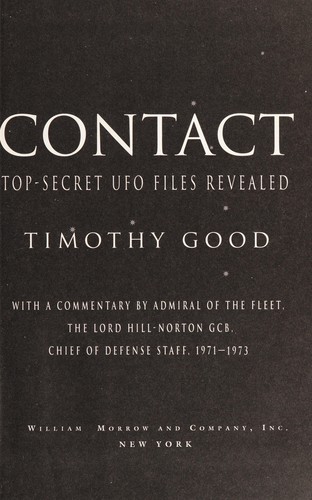
Alien Contact
Top-Secret UFO Files Revealed — the Middle Book of Timothy Good's Trilogy, and the One He Later Had to Walk Back
Find on Amazon →As an Amazon Associate, OverClassified may earn from qualifying purchases made through this link, at no extra cost to you.
Why This Is Essential Reading
Read it as the middle panel of a triptych, not on its own. Alien Contact matters because it is the exact point at which the most document-disciplined popular UFO researcher of the 1980s switched to uncorroborated testimony, and because the results are so clearly visible: a book carrying a former Chief of the Defence Staff's commentary, built on two sources its own author later described as spurious. Its lasting value is period documentation — the 1991 Mexico City eclipse wave, the international propagation of the Lazar story, and the British defence establishment's willingness to engage with the subject at the highest level. Its claims about recovered craft and reverse-engineering programs should be read as what Good believed in 1991, not as findings. Start with Above Top Secret; read this one to understand what happened next.
Related Cases & Theories
Sources Cited
- Good, Timothy. Alien Contact: Top-Secret UFO Files Revealed. New York: William Morrow & Co., 1993 (288 pp.), with a commentary by Admiral of the Fleet The Lord Hill-Norton GCB. ISBN-10 068812223X / ISBN-13 9780688122232. amazon.com
- Good, Timothy. Alien Liaison: The Ultimate Secret. London: Century, 1991 — the original British edition of the same book. andrewlownie.co.uk (Good's own literary agency, source of the collected press quotations and of the note that Good has since shown some of the Lazar and Oechsler claims to be spurious)
- Kirkus Reviews, "Alien Contact" by Timothy Good, February 15, 1993 — source of the "erratically organized, incredible report," "convert few to the cause," the Colorado ranch mutilation and radio-broadcast material, the 1979 S-4 "incident" claim, the note on Lazar's contemporaneous conviction, and the recommendation to read Jacques Vallée instead. kirkusreviews.com
- Internet Archive, scanned copy of Alien contact (Good, Timothy; W. Morrow, 1993). archive.org
- Wikipedia, "Timothy Good" — bibliography, publication history of the Alien Liaison / Alien Contact title change, and the record of contested reliability. en.wikipedia.org
- Goodreads edition record, Alien Contact: Top-Secret UFO Files Revealed — printing and page-count data. goodreads.com
- Goodreads edition record, Alien Liaison: The Ultimate Secret — the 1991 British edition. goodreads.com
- The Daily Telegraph ("the shrill yappings of Timothy Good's Alien Liaison"), Sunday Telegraph ("a breathtakingly credulous young man"), and Western Morning News ("objectiveness, clearness of writing and prodigious research") — contemporaneous British press reviews, quoted via the author's literary agency page above.
- Rommel, Kenneth M., Jr. Operation Animal Mutilation: Report of the District Attorney, First Judicial District, State of New Mexico, 1980 — the most thorough government investigation of the mutilation phenomenon, reaching conclusions this book does not engage with.
- Good, Timothy. Above Top Secret: The Worldwide UFO Cover-Up. Sidgwick & Jackson, 1987 — the document-driven predecessor. OverClassified breakdown
- Good, Timothy. Alien Base: Earth's Encounters with Extraterrestrials. Century, 1998 — the third book of the trilogy. OverClassified breakdown
- OverClassified case file, 1991 Mexico City Eclipse UFO Wave — cites this book for situating the Mexican case within the early-1990s international research landscape.
- OverClassified case file, Bob Lazar & Area 51 / S-4 — this site's own evidence-based assessment of the book's principal source.
- OverClassified case file, The Roswell Incident — this site's treatment of the 1947 events the book presents as settled background.
Have corrections, additional research, or peer-reviewed sources? Help improve this entry.
Suggest an Edit