
The Kōfu Incident
On the evening of February 23, 1975, two second-grade cousins, Masato Kawano and Katsuhiro Yamahata, were walking home near a public housing estate in Kōfu, Yamanashi Prefecture, Japan, when they say an orange object chased them into hiding before landing in a nearby vineyard. What followed — a silver, dome-topped disc marked with unfamiliar characters, and a roughly four-foot-tall, wrinkled, brown-skinned humanoid with metal fangs that approached one boy from behind and tapped his shoulder twice — became one of Japan's three most famous UFO cases. The boys' account survived a month of on-site radiological testing, a 2001 hypnotic-regression session, a contested third-party disclosure seven years after the fact, and a 48th-anniversary retrospective in which one of the two men, now in his fifties, added new detail never previously on the public record. Fifty years on, the case remains formally unsolved.
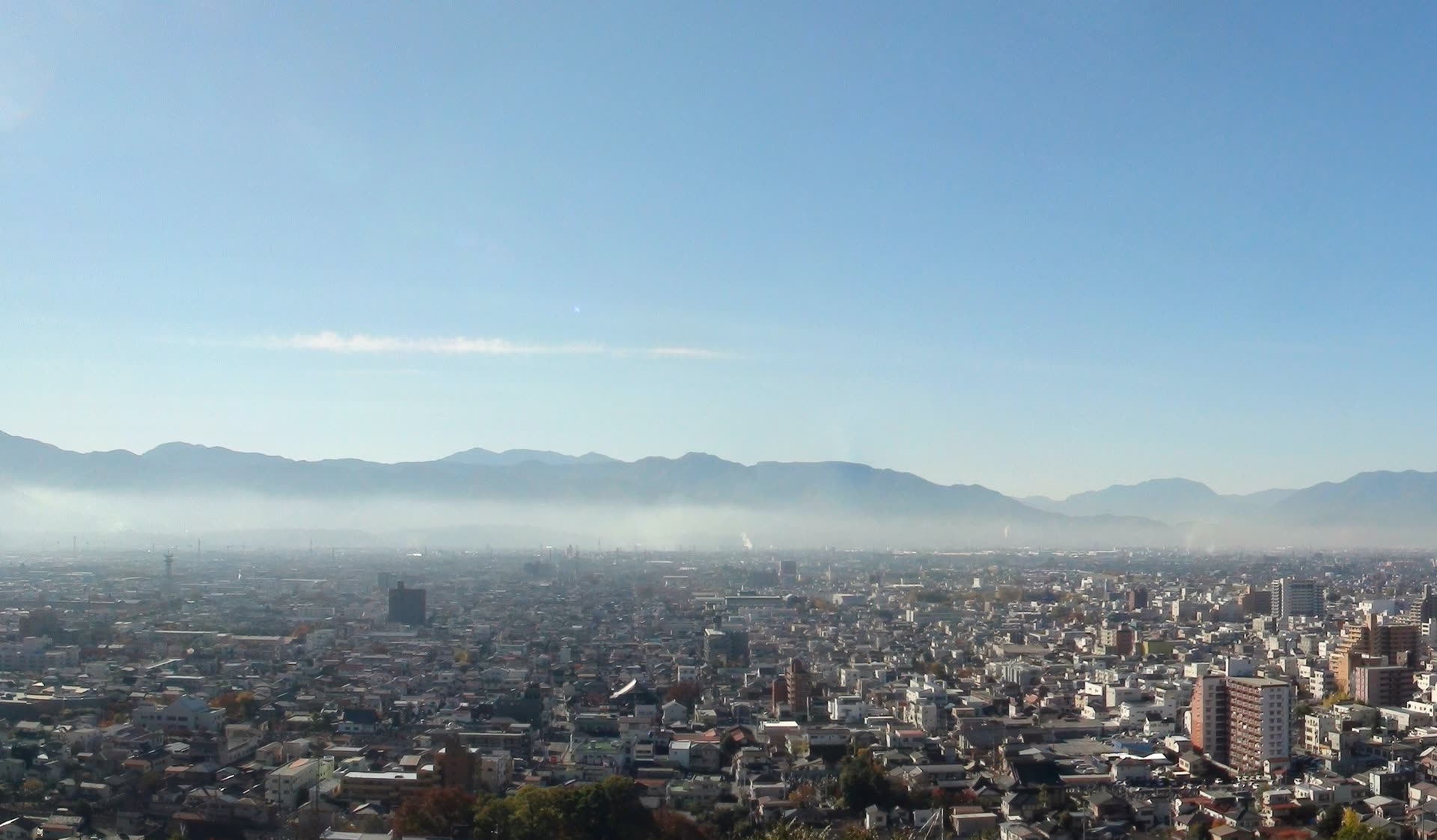
Pictured: the Kōfu Basin as seen from Mt. Atago — the same mountain the boys said one of the two orange objects flew toward before the second craft landed in the vineyard below. This is not a photograph of the incident itself; no photograph of the craft, the vineyard landing site in 1975, or the humanoid occupant is known to exist. No press photographer reached the site before it was disturbed by investigators, and the boys' own testimony survives only as sketches and written/verbal accounts.
Theoretical Alignment
The Kōfu Incident aligns moderately with the classic Extraterrestrial Hypothesis template — a landed metallic disc, a humanoid occupant, physical ground traces — but the entire evidentiary record rests on the testimony of two seven-year-old boys with no independent adult witness to the landing or the being itself. That combination of a textbook CE3 narrative with a uniquely fragile evidentiary base is exactly why this case scores moderately on ETH and unusually high on the Psycho-Social Hypothesis: 1975 Japan was in the middle of a nationwide UFO and science-fiction boom, and skeptical researchers have identified specific contemporary media (a 1974 Shōnen Magazine feature and a dubbed rerun of the 1963–65 American series The Outer Limits) whose creature designs bear a resemblance to the boys' sketches. Interdimensional framing finds essentially no support in a case built entirely around a conventional, physically-landed craft.
Background
By the mid-1970s, Japan was in the grip of its own UFO boom, driven by a wave of "great mysteries" television specials, contactee paperbacks, and monthly UFO magazines that ran alongside the country's science-fiction and tokusatsu entertainment industry. Television personality Junichi Yatsugi's investigative segments on the late-night variety program 11PM brought UFO reports to a mainstream national audience, and specialist magazines such as UFO to Uchū ("UFO & Space") gave ordinary witnesses, including children, a real outlet to publish sketches and firsthand accounts. It was into this environment that the Kōfu case landed — literally, according to its two child witnesses.
Kōfu, the capital of Yamanashi Prefecture roughly 100 km west of Tokyo, sits in a mountain-ringed basin that is one of Japan's principal wine-growing regions; vineyards run directly up against residential housing estates on the city's periphery, including the Hinode public housing complex in the Kamimachi district where the incident began. Mt. Atago, a modest peak on the city's northeastern edge popular for its night view of the basin, is named directly in the boys' original account as the direction one of the two objects flew off toward before the second descended into the vineyard behind their housing estate.
Three days before the main event, a resident of nearby Tsuru City independently reported seeing two orange, glowing objects in the sky — a detail cited by later researchers as mild circumstantial context for unusual aerial activity in the region that week, though it was never conclusively tied to the February 23 sighting.
The broader media environment matters to any honest assessment of this case. Japanese television in the early-to-mid 1970s carried a heavy rotation of dubbed American science-fiction and mystery programming alongside a homegrown boom in "world's greatest mysteries" specials, and children's manga and magazines of the period regularly ran features on UFOs, cryptids, and the occult as straightforward entertainment content rather than fringe material. A seven-year-old in Kōfu in February 1975 would have grown up entirely within this environment, with ready visual exposure to exactly the kind of wrinkled, large-headed humanoid imagery the boys later sketched, months or years before their own reported encounter. This context does not by itself explain away the case — genuine encounters can and do happen to people who are also consumers of contemporary media — but it is essential background for weighing the Psycho-Social candidate discussed later in this file, and it is a large part of why Japanese skeptical researchers have focused so heavily on tracing the specific visual sources the boys may have already seen.
Complete Timeline
| Date | Event |
|---|---|
| Feb. 20, 1975 | A resident of Tsuru City, roughly 25 km from Kōfu, independently reports seeing two orange, glowing aerial objects — cited afterward as regional context, not confirmed to be connected. |
| Feb. 23, 1975, ~18:00 | Second-graders Masato Kawano and Katsuhiro Yamahata, cousins and classmates at Kōfu Municipal Yamashiro Elementary School, are walking/skating home near the Hinode housing estate when they see two orange, "glittering" objects in the eastern sky. |
| ~18:05–18:10 | One object makes a low pass overhead, emitting a clicking or crackling sound the boys compared to a camera shutter. Frightened, they run and hide near a graveyard and the Fukuoji temple grounds. |
| ~18:10–18:15 | One object departs toward Mt. Atago; the boys watch the second descend into a vineyard directly behind their housing estate. |
| ~18:15–18:30 | The vineyard encounter. The boys approach and find a landed, silver, dome-topped disc roughly 2.5–5 meters in diameter with unfamiliar characters on its hull and glowing, blue-tinted rectangular windows. A hatch opens; a wrinkled, brown-skinned humanoid roughly 120–135 cm tall, with rabbit-like ears, four-fingered hands, and three downward-pointing metal fangs, descends a short ladder. It approaches from behind and taps Yamahata twice on the shoulder while emitting sounds the boys likened to a tape recording played backward. Kawano pulls Yamahata away and both boys flee. |
| Feb. 23, 1975 (evening) | The boys tell their families. Parents note both children are visibly shaken; an environmental-center manager roughly 300 meters east of the site separately reports a yellow, tailed light in the sky around the same time. |
| Feb. 24, 1975 | The boys report the encounter at school. Their homeroom teacher walks them to the vineyard at midday and finds a broken concrete support post and disturbed ground. The school notifies the Yamanashi Nichinichi Shimbun (Yamanashi Daily News), which begins its own field investigation. |
| Late Feb.–Mar. 1975 | Maeda Susumu, an electrical-engineering teacher at Kizan Technical High School and a licensed radiological handler, begins roughly a month of Geiger-counter soil surveys at the site with his school's science club. |
| Spring 1975 | Maeda reports detecting weak beta radiation with a measured half-life of approximately 14–15 days at the landing site, which he argues is inconsistent with natural background radioactivity. |
| June 1975 | The national magazine UFO to Uchū ("UFO & Space") publishes the boys' own sketches of the craft, the occupant, and a hand-held device they described as resembling a ray gun, bringing the case to a national readership. |
| 1975 | Japan's Civil Aviation Bureau (Ministry of Transport) offers a conventional explanation for the initial aerial sighting, noting that scheduled YS-11 turboprop airliner traffic passed through Kōfu airspace between 6 and 7 PM that evening under clear skies. |
| 1975–1980s | The case is featured on Junichi Yatsugi's 11PM segments and in multiple UFO magazines and books; researcher Namiki Shin'ichirō and the Japan Space Phenomena Research Society document it in detail, eventually classing it alongside the Kera (1972) and Nikoro (1974) incidents as one of Japan's "Big Three" UFO cases. |
| Dec. 1982 | An insurance saleswoman identified in later reporting as Midori Sato publicly discloses — for the first time, seven years after the fact — her own claimed sighting of two child-sized, wrinkled-faced figures on a road near the site. She states her encounter occurred on the same evening as the boys', roughly an hour before theirs. Her account is contested; family members of the original witnesses have stated they have no memory of meeting her. |
| 2001 | Kawano and Yamahata separately undergo hypnotic-regression interviews. Investigators report both accounts reproduce their original 1975 testimony without material deviation. |
| 2020 | Independent researcher Tsuneo Kira re-examines Maeda's original 1975 radiological data and proposes the readings are consistent with phosphorus-32, theoretically possible from neutron-irradiated agricultural fertilizer — while acknowledging no neutron source was ever identified at the site. |
| 2020s | Skeptical investigator Tatsuya Honjō of ASIOS commissions an independent re-analysis of Maeda's data by prefectural environmental radioactivity officials and a Gifu University professor emeritus, who conclude no firm conclusion can be drawn from the surviving measurements. Honjō also evaluates and partly disputes the YS-11, bolide, and bonfire explanations for the aerial sighting. |
| Feb. 23, 2023 | A 48th-anniversary retrospective event is held at the original site. Yamahata discloses a detail not previously on the public record: that the craft did not fly away but appeared to vanish in place. |
| 2025 | The 50th anniversary of the case is marked by the founding of the nonprofit organization UFOKOFU1975, which trademarks a "Kōfu-seijin" ("Kōfu alien") character, produces a soft-vinyl collectible figure, and runs public walking tours and symposiums at the site. |
The Sighting and the Chase
Around six o'clock on the evening of February 23, 1975, Masato Kawano and Katsuhiro Yamahata, both seven-year-old second-graders and cousins at Kōfu Municipal Yamashiro Elementary School, were making their way home near the Hinode public housing estate in the city's Kamimachi district. February dusk in the Kōfu Basin comes early and cold, and by the boys' account the sky to the east was already darkening when they noticed two orange, "glittering" points of light moving with a manner they described as playful — approaching, separating, and closing again — rather than moving in a straight line consistent with normal air traffic.
One of the two objects made a low pass close enough that the boys reported hearing a rhythmic clicking or crackling sound, which they compared in later interviews to a camera's motor-drive shutter. Frightened, they ran and took shelter near a nearby graveyard and the grounds of Fukuoji temple, watching from partial cover as the lights continued to move overhead. After several minutes, one object flew off to the northeast, in the direction of Mt. Atago; the second began a slow, controlled descent and disappeared from view behind the housing estate, toward a vineyard the boys knew well from playing in the area.
The Vineyard Landing and the Humanoid Encounter
Curiosity overcoming fear, the two boys made their way to the vineyard and, by their account, found the second object sitting on the ground amid the rows of grape vines.
The Craft
Both witnesses described a metallic, silver-colored disc with a raised dome on top, standing on some form of landing support and marked along its hull with rows of unfamiliar characters — one boy compared them to Chinese-style script, the other to a looser sequence resembling Latin letters. Estimates of its size varied between the two accounts and across different interviews over the years, ranging from roughly 2.5 to 5 meters in diameter and up to about 2 meters in height. Several rectangular, faintly glowing blue-tinted panels along the side were described as windows. A hatch or panel opened on one side, and a short ladder or set of steps extended to the ground.
The Occupant
A single humanoid figure descended the steps: by the boys' consistent description, roughly 120 to 135 centimeters (four feet) tall, with unnaturally long arms, dark brown, deeply wrinkled skin that gave the face a mask-like, almost featureless appearance, long pointed ears sometimes compared to a rabbit's, four-fingered hands, and — the case's most frequently reproduced single detail — three silver, downward-pointing fang-like projections in its mouth. It wore what the boys described as a silvery, reflective jumpsuit, in some accounts with a belt or a gun-like device at its side. A second figure was reported visible inside the craft, apparently monitoring instruments or a screen.
The being approached from behind and tapped Yamahata twice on the shoulder while emitting a series of vocalizations the boys likened to a tape recording played in reverse — a squeaking, warbling sound unlike any language they recognized. Yamahata froze; Kawano pulled him away, and the pair fled the vineyard, leaving the object and its occupant behind. When family members later reached the area, nothing remained at the site except, by one account, a faintly smoldering or glowing object briefly visible before it too disappeared.
Aftermath: School, Newspaper, and the Radioactivity Claim
The boys told their families that same evening, and both were described as visibly shaken. The following school day, February 24, they reported the encounter to their homeroom teacher, who walked with them to the vineyard at midday and found physical signs of disturbance: a concrete grapevine-support post snapped, an adjacent post damaged, and the wire mesh used to train the vines flattened outward in a way that suggested something heavy had rested on it, along with several depressions in the soil. The school notified the Yamanashi Nichinichi Shimbun, the prefecture's largest daily newspaper, which sent reporters to the site and began covering the story — the channel through which the case first reached a wider public.
The Radiological Survey and Its Re-Examination
Maeda Susumu, an electrical-engineering teacher at Yamanashi Prefectural Kizan Technical High School who held a certified radiological-handler qualification, took an interest in the case and, together with students from his school's science club, spent roughly a month running Geiger-counter surveys across dozens of soil samples taken from the landing site. He reported measuring weak beta radiation with an apparent half-life of approximately 14 to 15 days — a figure he and later commentators argued was inconsistent with naturally occurring background sources, and consistent, in principle, with an artificial or non-terrestrial origin.
That claim has been revisited twice since. In 2020, independent researcher Tsuneo Kira re-examined Maeda's original experimental records and proposed that the measured half-life was numerically close to that of phosphorus-32 (roughly 14.26 days), a radioactive isotope that does not occur naturally but can, in principle, form when ordinary phosphorus-31 in agricultural fertilizer is exposed to neutron radiation — the implication some researchers drew being that the craft's reported power source might have irradiated the surrounding soil. Kira himself flagged the central problem with his own hypothesis: producing phosphorus-32 this way requires a genuine neutron source, and none was ever identified at or near the site by any independent instrument. A graphical review of Maeda's sample-to-sample results also showed excessive variation between readings, too great, by Kira's own account, to reliably fix a precise half-life at all.
Separately, skeptical investigator Tatsuya Honjō, founder of the Japanese skeptics' organization ASIOS, arranged for Maeda's underlying data to be reviewed by prefectural environmental radioactivity officials and by Kazuo Tanaka, a professor emeritus at Gifu University. Their conclusion was more cautious still: the surviving measurements showed enough internal inconsistency that, in their assessment, no clear conclusion could be drawn from the data at all — neither confirming an artificial source nor definitively ruling one out.
National Attention and Japan's "Big Three"
By June 1975 the case had reached a national audience through the specialist magazine UFO to Uchū ("UFO & Space"), which published the boys' own hand-drawn sketches of the craft, the occupant, and the hand-held device one boy described as resembling a ray gun. Television personality Junichi Yatsugi, whose UFO-focused segments on the late-night variety program 11PM had already made him one of the most recognizable UFO investigators in the country, featured the case in his broadcasts, and researcher Namiki Shin'ichirō, founder of the Japan Space Phenomena Research Society and the Japan Fortean Society, documented it extensively in books and magazine features over the following decades. It was Namiki and other researchers of his generation who established the case's now-standard place alongside the 1972 Kera incident (Kōchi Prefecture) and the 1974 Nikoro incident (Hokkaidō) as one of Japan's "Big Three" UFO cases — a designation still used in Japanese media coverage of the case's 50th anniversary in 2025.
The Contested 1982 Disclosure
The record contains a second, separate claim that is frequently — and, this site concludes, inaccurately — conflated with the original two-boy account. In mid-December 1982, roughly a week after Steven Spielberg's E.T. the Extra-Terrestrial premiered in Japan (December 4, 1982), an insurance saleswoman identified in subsequent reporting as Midori Sato came forward publicly for the first time with her own claimed encounter. Sato stated that she had been driving on a rural road near the vineyard on the evening of February 23, 1975 — the same evening as the boys' encounter, by her account roughly an hour before it — and had seen two child-sized figures with dark, wrinkled faces at the roadside. She produced her own illustrations of what she said she saw only when she disclosed the story seven years later, in December 1982.
Some retellings of the Kōfu case compress this into a claim that the original two boys themselves returned to the site seven years later, at age fourteen, and had a second experience there. Based on the most detailed and directly sourced accounts located for this case file — including the Japanese-language primary summary of the case and a multi-part English-language investigative series that reproduces Sato's own account in detail — that compressed version does not appear to be accurate. The 1982 date refers to when Sato's account became public, not to a second visit by Kawano and Yamahata; her claimed sighting, if it occurred as she describes it, would place it on the original 1975 date, involving a different, unrelated adult witness. Her account itself remains disputed on independent grounds: in a 2021 online interview, a relative of Kawano's stated that the family had no recollection of ever meeting a woman matching Sato's description, and skeptical researchers have noted that her drawings, produced and shown publicly only after E.T.'s Japanese release, bear a resemblance to that film's own creature design. This case file treats Sato's claim as a separate, contested, and unverified addendum to the record rather than as confirmed fact, and treats any characterization of it as "the original witnesses returning to the site" as an error that should not be repeated.
Later Testimony: The 2001 Hypnosis Sessions and the 2023 Disclosure
In 2001, more than a quarter-century after the original event, Kawano and Yamahata separately participated in hypnotic-regression interviews conducted as part of a renewed media examination of the case. According to the investigators involved, both men's regressed accounts reproduced their original 1975 testimony — craft description, sequence of events, and details of the humanoid encounter — without significant deviation, a consistency researchers on both sides of the case have treated as noteworthy, whatever its ultimate evidentiary weight (see Observer Credibility & Occupational Profile below for the limits of hypnotically-refreshed testimony as corroboration).
The most recent addition to the public record came at a 48th-anniversary retrospective event held at the original site on February 23, 2023, at which Yamahata, by then in his fifties, offered a detail that had not previously appeared in any published account of the case: that the craft, in his recollection, did not fly away in the conventional sense but appeared to vanish in place at the landing site. He has also stated that he has continued to observe and document aerial phenomena in the years since, maintaining video records of his own. The case remains an active subject of local interest in Kōfu; the 2025 fiftieth-anniversary nonprofit UFOKOFU1975 has since trademarked a "Kōfu-seijin" character based on the described occupant, commissioned a collectible soft-vinyl figure, and organized public walking tours and symposiums retracing the 1975 events.
Key Witnesses
Masato Kawano
Kawano and his cousin Yamahata were the two original witnesses to the sighting, chase, and vineyard landing. By both boys' account it was Kawano who pulled Yamahata away and led their escape once the humanoid figure made contact. He reported the encounter to school officials the following day, was interviewed extensively by the Yamanashi Nichinichi Shimbun, national UFO magazines, and researchers including Namiki Shin'ichirō over the following decades, and participated in a 2001 hypnotic-regression session that investigators reported reproduced his original account. He has generally maintained a lower public profile than his cousin in the case's more recent anniversary coverage.
Katsuhiro Yamahata
The boy the humanoid figure is reported to have approached and touched twice on the shoulder. Yamahata's account, like Kawano's, remained consistent through decades of separate interviews and the 2001 hypnotic-regression session. He is the source of the case's most recent addition to the public record, disclosed at a February 23, 2023 anniversary event: that the craft appeared to vanish in place rather than fly away. He has stated he continues to observe and document aerial phenomena and has taken a more visible public role than Kawano in the case's ongoing 50th-anniversary commemoration.
The Five Observables Assessment
The Five Observables framework, developed by former AATIP director Luis Elizondo to classify UAP encounters by performance characteristics that exceed known technology, was designed for instrumented, sensor-documented modern encounters and applies only awkwardly to a 1975 testimonial-only case with no radar, camera, or instrument record of any kind.
Assessment: Only the 2023 disclosure that the craft "vanished in place" rather than departing conventionally speaks to any of the Five Observables at all, and only speculatively — it would, if accepted at face value, imply a form of instantaneous departure inconsistent with any conventional propulsion, but it is a single, uninstrumented, decades-later verbal recollection, not a documented performance characteristic. No radar, photographic, or other instrumented data exists for any phase of the encounter. The case is properly assessed almost entirely on witness testimony and the disputed physical trace evidence discussed below, not on the Five Observables framework, which is far better suited to modern sensor-documented cases.
Evidence Assessment
Supporting an Anomalous Encounter
- Two independent child witnesses gave a mutually consistent account of the sequence of events from the initial sighting through the vineyard encounter, sustained across separate interviews by teachers, journalists, and researchers for nearly five decades.
- Physical disturbance at the site — a broken concrete support post, a second damaged post, flattened wire mesh, and ground depressions — was documented by a teacher within roughly 18 hours of the reported encounter, before the story had reached any wider public audience that could have staged it.
- A licensed radiological handler measured elevated, short-half-life beta radiation at the site using standard Geiger-counter methodology, a genuine anomaly that neither the original investigator nor two later independent re-analyses have been able to fully explain away.
- An unrelated adult (the environmental-center manager roughly 300 meters east of the site) independently reported an aerial light around the same time as the boys' initial sighting.
- Both boys' 2001 hypnotic-regression accounts reproduced their original 1975 testimony without material deviation, a form of longitudinal consistency uncommon among contested child-witness cases.
- Neither boy is known to have profited financially from the case or sought sustained media attention in the manner of some contactee-era witnesses, reducing (though not eliminating) one common motive for fabrication.
Supporting a Conventional or Psycho-Social Explanation
- Japan's Civil Aviation Bureau identified scheduled YS-11 propeller-airliner traffic through Kōfu airspace between 6 and 7 PM that evening under clear skies as a plausible source for the initial aerial lights, though route analysis has since raised questions about whether the reported flight path matches any single documented YS-11 route.
- Independent re-analysis of Maeda's radiological data by prefectural officials and a Gifu University professor emeritus found the readings too internally inconsistent to support any firm conclusion, undercutting the strength of the radioactivity claim as anomalous evidence.
- The boys' sketches of the humanoid bear a resemblance, identified by skeptical researchers, to creature designs from a 1974 Shōnen Magazine feature and a Japanese-dubbed rerun of the 1960s American series The Outer Limits, both plausibly seen by seven-year-olds in 1975.
- Yamanashi Prefecture has recorded roughly 192 bright bolide (fireball meteor) sightings over a 40-year survey period, with documented meteorite falls near Kōfu, offering an alternative mundane source for at least the initial "orange light" phase of the sighting.
- The physical ground disturbance, while genuine, is also consistent with ordinary vineyard damage (a fallen or weather-damaged support post, animal activity, or prior maintenance) that a frightened family and excited investigators arriving after the fact could easily have reinterpreted as a landing trace.
- Testimony obtained under hypnosis is not considered reliable corroborating evidence by mainstream psychological research; hypnotic regression is well documented to reinforce a witness's existing narrative (including any post-event contamination already present in memory) rather than reliably recovering suppressed, more accurate detail.
Why "Disputed"
The Kōfu Incident is stamped DISPUTED because it combines two things that pull its credibility in opposite directions: an unusually well-documented physical and testimonial record for a 1970s child-witness case, and an evidentiary foundation that, at its core, still rests entirely on the accounts of two seven-year-olds with no adult eyewitness to the landing or the occupant. The ground disturbance was documented within a day by a teacher acting independently of the boys' families; the radiological measurements were taken by a credentialed investigator using real instrumentation rather than being invented after the fact; and the boys' testimony has proven remarkably stable across five decades of separate interviews, including a formal hypnotic-regression session. None of that is nothing. But none of it rises to independent adult corroboration of the central claim, either: the "orange light" phase of the sighting has a genuinely plausible conventional explanation in scheduled aircraft or bolide activity; the radiological anomaly, on its most careful independent re-examination, cannot be confidently distinguished from measurement noise; and the specific imagery of the occupant maps uncomfortably well onto contemporary children's media a seven-year-old in 1975 Kōfu would very plausibly have already seen. The contested 1982 disclosure by a third party, often mischaracterized in secondary sources as the original boys returning to the site, further muddies rather than strengthens the record. This case file's assessment is that the physical and radiological evidence is genuinely anomalous enough, and the witnesses' consistency genuinely durable enough, that a purely dismissive reading is not well supported — but neither is the case strong enough, on current public evidence, to be rated higher than Disputed.
Sensor & Instrumentation Detection Profile
No radar, photographic, film, or other instrumented sensor data exists for any phase of this case. The only instrumented measurement taken at any point was Maeda Susumu's post-hoc Geiger-counter soil survey, conducted beginning the day after the reported encounter and continuing for roughly a month — a genuine instrument reading, but one taken after the fact and never independently cross-validated at the time by a second team or a second instrument on site.
Environmental & Geospatial Context
The Kōfu Basin is a mountain-ringed agricultural valley in Yamanashi Prefecture, roughly 100 km west of Tokyo, whose terraced hillsides and valley floor are given over extensively to vineyards — Yamanashi produces a large share of Japan's domestic wine. The reported encounter took place at dusk on a clear, cold late-February evening, consistent with regional climate norms for the date, in a residential-agricultural transition zone where public housing estates back directly onto working vineyards. Mt. Atago, the peak named in the boys' account as the direction one object departed toward, sits on the basin's northeastern rim and is a well-known local vantage point over the city.
Observer Credibility & Occupational Profile
The case's central weakness and its central strength are the same fact: its only direct witnesses to the landing and the occupant, Masato Kawano and Katsuhiro Yamahata, were both seven years old at the time. Child witnesses are neither uniquely unreliable nor uniquely trustworthy as a category; developmental psychology research generally finds young children capable of accurately reporting simple, concrete, personally salient events shortly after they occur, while also finding them more susceptible than adults to suggestion, to absorbing surrounding adult and media narratives into their own memory over time, and to peer influence between two witnesses who discuss an event together before either is interviewed separately — a real risk here, since Kawano and Yamahata were cousins, classmates, and present together throughout. Their professional-adult investigators carry more conventional credentials: Maeda Susumu held a genuine radiological-handler qualification and taught electrical engineering at a technical high school, giving his radiation measurements more procedural legitimacy than an amateur reading, even though later peer re-analysis could not fully validate his conclusions. On the skeptical side, Tatsuya Honjō and the researchers he engaged (a Gifu University professor emeritus and prefectural environmental radioactivity officials) bring comparable institutional standing to the case's re-examination.
A further factor specific to this case is the role of hypnosis in the 2001 re-interviews. Clinical and forensic psychology research generally treats hypnotically-refreshed memory with considerable caution: hypnosis reliably increases a subject's confidence in their recollection and can produce vivid, internally consistent detail, but it does not reliably improve the underlying accuracy of that recollection, and it can just as easily reinforce a narrative the subject already holds — including one shaped by decades of retelling, prior media exposure, and repeated interviews with sympathetic researchers — as it can recover genuinely suppressed detail. That the 2001 sessions reproduced Kawano's and Yamahata's original 1975 accounts is therefore better read as evidence that their narrative had become stable and well-rehearsed by that point, not as independent scientific confirmation that the narrative was accurate to begin with. Neither man is known to have received formal, ongoing psychological support after the 2001 sessions, and no clinical case study of either witness has been published in any peer-reviewed venue.
Physical & Material Assays
The only physical trace evidence associated with this case is agricultural infrastructure damage — one snapped and one further damaged concrete grapevine-support post, wire-mesh vine training material flattened outward as though something heavy had rested on it, and several ground depressions interpreted by early investigators as possible landing-gear impressions — documented by a teacher on February 24, 1975, roughly 18 hours after the reported encounter, and the disputed soil radioactivity readings taken by Maeda Susumu over the following month. No metal, fiber, or other recovered material sample from the craft itself has ever been produced or subjected to laboratory analysis; unlike cases such as Roswell or the Ubatuba fragments, there is no chain-of-custody physical object at the center of the Kōfu record at all, only soil measurements and agricultural damage.
Historical Precedents & Archive Matches
Japanese researchers, beginning with Namiki Shin'ichirō's generation, have long grouped the Kōfu case with two other 1970s Japanese CE3-type reports as the country's "Big Three." The first, the Kera incident, occurred in September 1972 in the Kera district on the eastern edge of Kōchi City, Shikoku, where several local junior-high-school-age boys reported repeatedly capturing a small, seamless, silver-colored disc-shaped object roughly 15 to 18 centimeters in diameter — small enough to hold in both hands, with a rough, cast-metal-like texture — that the boys said had been seen flashing and hovering low over nearby rice paddies before it landed. According to their account, the object vanished from where it was being kept on more than one occasion, only to reappear and be recaptured nearby, before disappearing for good. The second, the Nikoro incident, occurred on April 6, 1974, near Kitami City, Hokkaidō, where a 28-year-old farmer reported being woken before dawn by a barking dog and a knock at his door, encountering a group of small humanoid figures roughly one meter tall outside, and being drawn up into an orange, roughly 8-meter-diameter craft hovering over his field, whose interior he described as containing large screens and machinery on two levels, before escaping when the object attempted to land a second time; he was later found by a search party. Neither the Kera nor the Nikoro incident is yet documented as its own case file on this site. Within OverClassified's own existing catalogue, the closer procedural precedents are The Haneda Air Base Radar-Visual Sighting (1952) and Japan Air Lines Cargo Flight 1628 (1986) — both Japan-based cases, though both involving trained adult professional observers (control-tower personnel, a GCI radar station, and an airline flight crew) rather than child witnesses, and both possessing instrumented radar data Kōfu entirely lacks. The deeper cultural precedent is this site's own Utsuro-bune account, an 1803 record of a strange vessel and its unknown occupant washing ashore on a Japanese beach — a reminder that landed-craft-with-occupant narratives have a documented history in Japanese folklore well over a century before the modern UFO era began, and that Kōfu's basic narrative shape (a landed vessel, an encountered occupant, a small circle of witnesses) recurs across very different eras of Japanese source material rather than being a purely modern invention.
Material Analysis
Because no physical fragment of the reported craft was ever recovered, Kōfu's material record consists entirely of secondary trace evidence: the vineyard's own infrastructure damage, and the soil samples taken from the site over the following month.
The Vineyard Damage
The broken and damaged concrete support posts and the flattened wire-mesh vine training visible on February 24, 1975 are the case's least ambiguous physical evidence in the sense that they were photographed and documented by a professional adult (the boys' teacher) independent of the family, within a day of the reported event, before wider publicity could plausibly have motivated staging. What the damage does not do is uniquely implicate a landed craft: concrete vineyard posts fail under a range of ordinary conditions (freeze-thaw stress, prior storm damage, animal activity, routine agricultural wear), and no forensic examination at the time attempted to date the specific failure to February 23 rather than some earlier point, or to rule out a mundane cause.
The Radioactivity Claim
Maeda Susumu's month-long Geiger-counter survey remains the case's most scientifically interesting, and most contested, piece of evidence. His reported short-half-life beta radiation (approximately 14–15 days) is a genuinely unusual field measurement for an ordinary agricultural site, and Tsuneo Kira's 2020 phosphorus-32 hypothesis at least offers a physically coherent (if evidentially unsupported) mechanism by which such an isotope could theoretically appear. But phosphorus-32 formation from fertilizer phosphorus-31 requires a real neutron source, and no instrument, contemporary or retrospective, has ever detected one at the site; and the independent 2020s re-analysis commissioned by Tatsuya Honjō found the underlying sample-to-sample data too inconsistent to support a confident half-life determination at all. The honest assessment is that the radioactivity claim is neither confirmed nor debunked: it is a real, once-measured anomaly that has never been either independently replicated or conclusively explained away.
Supporting Non-Terrestrial or Unexplained Origin
- Ground disturbance was documented by an independent adult (the boys' teacher) within roughly 18 hours of the reported encounter, before wider publicity existed.
- A credentialed radiological handler measured genuinely anomalous short-half-life beta radiation using standard field instrumentation, a result no re-analysis has definitively explained as either instrument error or a known natural source.
- No financial or sustained publicity motive has been identified for either original child witness across five decades.
Supporting Terrestrial or Mundane Origin
- Vineyard support-post failure and flattened wire mesh are consistent with a range of ordinary agricultural causes never formally ruled out at the time.
- Independent 2020s re-analysis of the radiological data by prefectural officials and a Gifu University professor emeritus found the readings too inconsistent to support a firm conclusion.
- No neutron source consistent with the proposed phosphorus-32 explanation was ever identified at or near the site.
- No physical fragment, sample, or recovered material from the craft itself has ever been produced for any form of laboratory analysis.
The Conventional Explanation Candidate
No single conventional explanation accounts for the entire Kōfu Incident. Japan's Civil Aviation Bureau, skeptical investigator Tatsuya Honjō, and other researchers have instead proposed several partial candidates, each addressing a different phase of the reported encounter rather than the case as a single unified event. This is itself a meaningful analytical finding: a genuinely fabricated or wholly imaginary account would not obviously need to be explained by three or four separate, only loosely compatible conventional mechanisms stitched together, while a real but multi-stage event — an initial mundane aerial sighting, amplified by fear and unfamiliar terrain during the chase, resolving into an elaborated close-encounter narrative shaped by contemporary media imagery — is exactly the shape a case like this would be expected to take if no single tidy explanation exists.
Scheduled Aircraft (YS-11 Misidentification)
Japan's Ministry of Transport Civil Aviation Bureau noted that scheduled YS-11 turboprop airliner traffic passed through Kōfu airspace between roughly 6 and 7 PM on February 23, 1975, under clear skies in which an aircraft's navigation and tail lights would have been clearly visible to the naked eye from the ground — a plausible source, in principle, for the initial "orange light" phase of the sighting. Subsequent route analysis by Honjō, however, found that while a documented YS-11 route between Haneda and Okayama did pass near Kōfu that evening, the specific directional changes and behavior the boys described — two objects moving independently, approaching and separating — do not cleanly match the probable flight path of any single aircraft on a fixed route.
Bolide (Meteor) Misidentification
An adult witness roughly 300 meters from the site independently described a yellow, tailed light, a description more consistent with a bright meteor than an aircraft. Yamanashi Prefecture has recorded approximately 192 bright bolide sightings over a 40-year survey period, with documented meteorite falls in the vicinity of Kōfu, making a meteor a genuinely plausible source for at least part of the initial aerial phase — though a bolide's brief, seconds-long transit does not by itself explain the boys' report of a controlled, minutes-long approach, separation, and landing.
Media-Influenced Childhood Imagination (Psycho-Social Hypothesis)
Skeptical researchers have identified a specific resemblance between the boys' sketches of the humanoid occupant and creature designs from a 1974 Shōnen Magazine feature and a Japanese-dubbed rerun of the 1963–65 American television series The Outer Limits, both plausibly viewed by seven-year-old boys in Kōfu the year before the incident. In this reading, a genuine but mundane aerial sighting (aircraft or meteor) combined with the pre-existing fear of the graveyard/temple chase to produce, in two young and mutually reinforcing witnesses, an elaborated close-encounter narrative built partly from contemporary media imagery. This explanation accounts well for the humanoid's specific visual details but does not, on its own, explain the independently documented physical trace evidence or the radiological measurements.
YS-11 Aircraft Misidentification
Plausible (initial lights only)Plausible as a partial explanation for the "orange lights" phase specifically, given confirmed scheduled traffic through the area at the reported time — but the boys' described flight behavior does not cleanly match any single documented route, and it explains nothing about the landing, the humanoid encounter, or the physical trace evidence.
Bolide (Meteor) Misidentification
InconclusiveA genuinely plausible source for a brief, bright aerial light given Yamanashi's documented bolide frequency, but a meteor's transit is too brief to account for the sustained, multi-minute approach-and-landing sequence the boys described.
Media-Influenced Childhood Imagination
InconclusiveA credible explanation for the specific visual design of the reported occupant, given identified contemporary media parallels, but does not on its own account for the independently documented ground disturbance or the disputed radiological readings.
Deliberate Hoax by the Boys
ImplausibleUnsupported by the record: two seven-year-olds staging a snapped concrete post and flattened wire mesh, sustaining an identical account under separate interviews for nearly 50 years including hypnosis, and doing so with no identified financial or attention-seeking motive, is a considerably less economical explanation than a genuine (if conventionally sourced) fright experience later elaborated by memory and media influence.
Related Cases
Primary & Secondary Documentation
The Japanese skeptics' organization founded by Tatsuya Honjō that commissioned the most recent independent re-analysis of the case's radiological data and evaluated its conventional-explanation candidates.
Japan's national land-survey imagery portal, source of the contemporary 1975 aerial photography of Kōfu used elsewhere in researcher documentation of the case's geography.
Search Government & National Archives Directly
Further Reading — Recommended Literature
The UFO Encyclopedia (3rd Edition)
The standard English-language reference work on the global UFO phenomenon, covering worldwide close-encounter cases including Japan's, and essential comparative context for placing Kōfu among other 1970s CE3 reports.
Confrontations: A Scientist's Search for Alien Contact
Vallée's worldwide survey of physical-trace, close-encounter reports, providing the methodological framework for evaluating a child-witness landing case like Kōfu against the broader international CE3 record.
The Japan UFO Files
A dedicated survey of Japan's UFO history, covering close encounters, landing traces, humanoid reports, and military sightings across decades — the most directly relevant English-language single-country study available for this case's national context.
The Mystery of Utsuro-bune: Ancient UFO Encounter in Japan?
An examination of Japan's most famous historical "strange vessel" account, useful comparative reading for the deep folkloric roots of landed-craft-and-occupant narratives in Japanese tradition that predate the modern UFO era.
Strange Japan: Hauntings, Cults, Unsolved Mysteries, UFOs, True Crime and Bizarre Accounts of Unexplained
A broader survey of Japan's unexplained and paranormal history, situating the Kōfu case within the country's wider tradition of contested modern mysteries.
DISCLOSURE: Some links above are affiliate links. If you purchase through them, OverClassified receives a small commission at no additional cost to you. This helps support independent research.
Essential Viewing
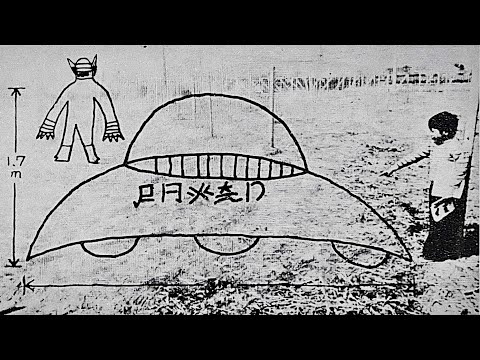
During the 1975 Kofu UFO Incident, Japanese Schoolboys Had a Close Encounter With Fanged Humanoids
Case-specific narrated coverage from Eyes On Cinema walking through the sighting, the vineyard landing, and the humanoid encounter in detail.
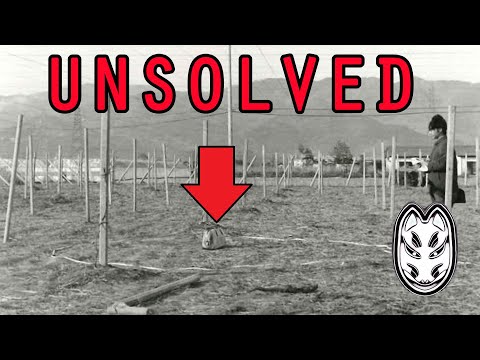
Unsolved Japan: The Kōfu UFO Incident
A dedicated Japan-focused mystery channel's episode-length treatment of the case, covering the sighting, the investigation, and the decades of follow-up testimony.
Sources
- "The Terrifying Aliens of Japan's Kōfu Incident," Historic Mysteries. historicmysteries.com
- "甘府事件" (Kōfu Incident), Japanese Wikipedia. ja.wikipedia.org
- "Kofu Incident: A Creepy Alien Got off a UFO to a Vineyard and Tapped a Japanese Boy on the Shoulder in 1975 [Part 1]," My Dad Is an OTAKU. otakupapa.net
- "Kofu Incident ... [Part 4]," My Dad Is an OTAKU (radiological survey, skeptical explanations, and the 1982 disclosure). otakupapa.net
- Namiki, Shin'ichirō. "疑星人接近遭遇「甘府事件」と現場に残されたUFOの残留物質の裂," webムー. web-mu.jp
- "「甲府事件」48年目の新証言で明らかになった「UFOの消え方」とは?," webムー / 山梨奇譚. web-mu.jp
- "UFO事件簿: 甲府事件," UFO Jikenbo. ufojikenbo.blogspot.com
- "【甲府UFO事件】は作り話じゃない?目撃場所・証言・痕跡を追った50年目の真実," Jungle Time. jungle-time.com
- Marronnier. "世界的なUFO事件!甲府事件50周年に寄せて," note.com. note.com
- UFOKOFU1975 (official 50th-anniversary commemorative organization site). ufokofu1975.net
- "Kofu UFO Incident," The UFO Database. theufodatabase.com
- "Japan 1975: The Kofu UFO Incident," Time For Disclosure. timefordisclosure.com
- "Kofu Fanged Humanoids: Two Japanese Boys Meet Strange-Looking Aliens," Anomalien. anomalien.com
- "並木伸一郎," Japanese Wikipedia (biography of the case's principal Japanese researcher). ja.wikipedia.org
- "本城達也," Japanese Wikipedia (biography of ASIOS founder and skeptical investigator Tatsuya Honjō). ja.wikipedia.org
- ASIOS (Association for Skeptical Investigation of Supernatural), official site. asios.org
- "【日本三大UFO事件】甲府UFO事件・介良事件ともうひとつは?," OVO (Kyōdō News lifestyle vertical), on the "Big Three" Japanese UFO case classification (Kōfu, Kera, Nikoro). ovo.kyodo.co.jp
- "日本三大UFO事件の一つ・1975年の「甲府事件」の当事者が証言," Tokyo Sports (東京スポーツ). tokyo-sports.co.jp
- "During the 1975 Kofu UFO incident, Japanese schoolboys had a close encounter with fanged humanoids," Eyes On Cinema, YouTube. youtube.com
- "Unsolved Japan: The Kofu UFO Incident," KyotoRobato, YouTube. youtube.com
- "Category:Kōfu, Yamanashi," Wikimedia Commons (source of this case file's hero photograph). commons.wikimedia.org
- "Yamanashi Wine Country: Japan's Beautiful Vineyard Heartland," Sakuraco. sakura.co
- "Kōfu," Wikipedia (city geography and background). en.wikipedia.org
See something inaccurate? Have additional information or sources?
Suggest an Edit →Last Updated: August 2026