
The Mystery of Utsuro-bune
Ancient UFO Encounter in Japan? — Kazuo Tanaka's Archival Investigation of the 1803 Hollow Ship, Published Under a Pen Name
Core Thesis
The Mystery of Utsuro-bune: Ancient UFO Encounter in Japan? is the only full-length treatment of one of the strangest documentary problems in the history of anomalous reports, and it was written by a computer engineering professor who concluded the event probably did not happen. In February 1803, according to a cluster of Edo-period manuscripts, fishermen on the Hitachi coast found a circular vessel of lacquered rosewood, glass and metal plate washed ashore, containing a young woman with red hair who spoke no comprehensible language, clutching a small box she would let nobody touch, in a cabin whose walls bore an unknown script. Kazuo Tanaka — publishing this book in Japanese in 2009 under the pen name Shoichi Kamon, and reaching English readers only through Flying Disk Press's 2019 translation — tracked down eleven separate documents recording the story, compared them line by line, established that the place they all name never existed on any Edo-period map, and argued that the whole thing is 'a literary mixture of folklore and imaginations.' Then, in 2014, he found the beach. The book is indispensable precisely because it is not advocacy: it is the archival argument itself, by the researcher who did the archival work.
About the Author
Kazuo Tanaka is a Japanese academic in electronics and computer engineering — his 2000 Skeptical Inquirer article carries a Gifu University Department of Electronics and Computer Engineering byline, while some later reference sources place him at the University of Electro-Communications in Tokyo — and he came to the utsuro-bune problem in 1997 as a documentary puzzle rather than as a UFO case. That framing governs everything about the book. His method is textual: locate every surviving manuscript that records the story, establish each one's date, provenance and copying relationship to the others, compare their internal details for divergence, and test their geographic and administrative claims against the official Edo-period record.
The pen name matters more than it might appear. Tanaka published the Japanese original in 2009 as Shoichi Kamon, and the English translation carries that name on its cover — which is why the book's catalogue records, this site's own library entry, and most online references treat 'Shoichi Kamon' as a distinct author. Readers tracing the scholarship should know they are the same person; a great deal of confusion in the English-language discussion of this case comes from that split identity.
Tanaka's most-cited English-language output on the subject is "Did a Close Encounter of the Third Kind Occur on a Japanese Beach in 1803?", published in Skeptical Inquirer vol. 24 no. 4 (July/August 2000), and his position there and here is consistent: the vessel in the accounts 'never flies or moves on its own, nor does it show any signs of extraordinary technologies.' He is not the researcher who made utsuro-bune a UFO case. He is the researcher who established what the documents actually say, which turned out to cut against the UFO reading in most respects while making the accounts far more interesting as historical objects.
He also did the single most consequential piece of positive work on the case. On May 26, 2014, The Ibaraki Shimbun reported Tanaka's identification, from paleographic documents held by Jinichi Kawakami, of the landing site as 'Hitachihara Sharihama' — corresponding to the modern Sharihama beach at Hasaki, Kamisu city, a location that appears in an 1801 coastal survey and on Inō Tadataka's Dai Nihon Enkai Yochi Zenzu coastal maps. Having shown that the traditionally-named site was fictitious, he then found a real one.
Historical Context & Origins
The accounts belong to the closing decades of sakoku, Japan's roughly two-century policy of restricted foreign contact, and that context supplies most of what is interesting about them. Edo-period Japanese readers had almost no direct experience of Westerners, considerable curiosity about them, and a well-developed appetite for accounts of the strange — yūrei, onibi, hitodama, yōkai — circulating in manuscript among literate urban readers. A story about an incomprehensible foreign woman washing ashore in an impossible vessel sits exactly at the intersection of those interests.
The manuscripts themselves are real, datable objects held in identifiable Japanese collections, which is the fact that makes this case different from most pre-modern anomaly claims. The principal texts are Oushuku Zakki (1815) by Komai Norimura; Toen shōsetsu (1825), compiled by the major novelist Kyokutei Bakin and held at the Mukyū-Kai-Toshokan in Machida, Tokyo, which carries the most detailed version; Hyōryū kishū (1835), author unknown, at the Tenri University Library in Nara Prefecture; and Ume-no-chiri (1844) by Nagahashi Matajirō, at the Iwase-Bunko-Toshokan in Nara. Tanaka's own count of documents recording the story runs to eleven.
Bakin's involvement is worth dwelling on because it establishes that the story was being investigated, not merely repeated, within decades of its supposed occurrence. Writing in 1844, Bakin compared the woman's description — red hair, white powder on the eyebrows, unfamiliar dress — against Roshia bunkenroku, Kanamori Kinken's record of things seen and heard from Russia, and noted the parallels to Russian women's fashion. He observed that those details would have been outdated by 1803, and speculated the woman might be 'a Russian, British or even American princess.' A nineteenth-century Japanese novelist doing comparative source-criticism on an anomalous report is an unexpectedly modern piece of scholarship.
The twentieth-century interpretive baseline was set by the folklorist Yanagita Kunio, who examined the accounts in 1925 and again in 1962 and argued that round boats were an ordinary part of Japanese tradition — that only 'western-like details, such as the windows made of glass' made this one exotic, and that earlier versions of the story probably described a simple wooden log-boat to which brazen plates and glass windows were added later to make oceanic travel plausible. This site's own Utsuro-bune 'Hollow Ship' entry treats the documents and the event as separate questions on the same principle.
Core Arguments & Key Concepts
The documents are real; the event is a separate question. Tanaka's governing distinction, and the one this site's own ancient entry adopts. Eleven datable Edo-period manuscripts recording a story is a fact about the manuscripts. Whether anything happened on a beach in 1803 does not follow from it.
The place named in the accounts did not exist. The book's single strongest finding. Tanaka showed that 'Harayadori' and 'Haratono-hama' appear in no official Edo-period record, no territorial mapping, and not in Japan's first complete national survey of 1907 — and that the daimyō associated with the story, Ogasawara Nagashige, though a real historical figure, held heartland holdings with no Pacific coast connection at all. A story whose location and jurisdiction are both fictitious is not reporting an event.
The accounts disagree with each other in ways copies of a true report should not. Tanaka catalogues internal inconsistencies across the manuscripts — the water supply in the vessel varies between 3.6 and 36 litres depending on the text, and the illustrations diverge in ways that suggest artistic reconstruction rather than shared observation.
The vessel does nothing a craft would do. The point Tanaka makes most bluntly, and the one UFO retellings almost always omit: the utsuro-bune never flies, never manoeuvres, never demonstrates any capability at all. It washes ashore and is pushed back out to sea. Whatever the accounts are, they are not descriptions of an aircraft.
The symbols have a plausible mundane source. The unknown script on the cabin walls, the most evocative single detail, has been read by the author Hideki Satō as matching alchemical notation — the symbol for copper saffron among others — of a kind circulating among Edo scholars of Dutch learning. That does not prove the derivation, but it locates the imagery firmly within what an educated Edo writer could have encountered.
And yet: there is a real beach. Tanaka's 2014 identification of Hitachihara Sharihama, from paleographic documents and cross-checked against an 1801 coastal survey and Inō Tadataka's national coastal maps, restores a verifiable geography to a story he had otherwise dismantled. He does not treat this as vindication of the event, and readers should not either — but it is a real finding, made by the case's most sceptical investigator, that cuts partly against his own conclusion.
Key Cases & Evidence Discussed
The February 22, 1803 landing. The central account: a vessel roughly 3.3 metres high and 5.45 metres across, likened to an incense burner or a rice-cooking pot, its upper section of red-lacquered rosewood with resin-sealed glass windows and its lower hull protected by metal plate. Inside, a woman of about eighteen to twenty, roughly 1.5 metres tall, with red hair and eyebrows extended with white material, unintelligible speech, and a small box about 0.6 metres across that she would not let anyone touch. The cabin held two bed sheets, a bottle of water, cake and kneaded meat, and its walls bore an unknown script. This site's Utsuro-bune 'Hollow Ship' entry carries the full treatment.
The manuscript corpus. Tanaka's document-by-document comparison of the surviving texts is the book's real content and the reason it cannot be substituted by any English-language retelling. Toen shōsetsu (Bakin, 1825) is the fullest; Ume-no-chiri (1844) describes the vessel as resembling a rice pot with a thickened rim, black paint and four windowed sides.
Bakin's Russian hypothesis (1844). The earliest serious attempt to explain the woman, comparing her description against Kanamori Kinken's Russian ethnographic record. Bakin's own doubts — that the fashion details were outdated for 1803, and that the symbols might instead match British whaler evidence — are as valuable as his conclusion.
The Harayadori problem. The demonstration that the story's named location and its administrative jurisdiction are both absent from the official record. Tanaka's linguistic point here is technical and important: the kanji 原舎 can be read 'Harasha' in modern transcription but appears as 'Hara-yadori' in kana and 'Haratono-hama' in furigana across the manuscripts, meaning the variant names refer to one place rather than several.
The 2014 Sharihama identification. Reported by The Ibaraki Shimbun on May 26, 2014: paleographic documents held by Jinichi Kawakami name the site as 'Hitachihara Sharihama,' matching the modern Sharihama beach at Hasaki in Kamisu city, a place attested in an 1801 coastal survey and on Inō Tadataka's coastal maps.
The modern Japanese comparison case. This site's Kōfu Incident file — two child witnesses, a disc-shaped craft, a fanged humanoid, disputed radiological readings and fifty years of consistent testimony — is cited alongside this book as the modern Japanese counterpart, and the contrast in evidentiary structure between a 1975 case with living witnesses and an 1803 case with only manuscripts is instructive in both directions.
Critical Reception & Controversies
The book's reception is best understood through its two audiences. Among UFO readers, Tanaka is an inconvenience: the researcher who did the archival work everyone cites and reached a conclusion almost nobody quotes. The utsuro-bune is routinely presented in English-language UFO media as an 1803 flying-saucer landing, and the man who located the eleven documents underpinning that claim thinks it is folklore.
Among historians and folklorists his conclusion is close to consensus, and it builds directly on Yanagita Kunio's much earlier reading. The specific findings — the non-existent place name, the fictitious jurisdiction, the divergent water volumes, the alchemical-symbol derivation — are the kind of concrete textual results that settle questions rather than open them.
The most substantive criticism of the sceptical position is that it explains the documents' unreliability without explaining their existence. Eleven separate manuscripts, copied and recopied across four decades by identifiable people including a major novelist, is a substantial documentary event in its own right, and 'someone made it up' is a thin account of why it propagated as it did. Tanaka's own answer — that Edo readers had an appetite for the strange and an anxiety about Western intrusion — is plausible and unproven.
The 2014 Sharihama identification complicates the sceptical reading more than its author acknowledges. Having established that the traditional location was fictitious, Tanaka then found a documented coastal place name matching a variant reading, attested in a contemporaneous survey. That is either a genuine correction to his earlier finding or an artefact of searching hard enough for a match, and the honest position is that it has not been settled.
A limitation on the English edition specifically: it is a translation published by a small UFO press, without academic apparatus, and it has not been reviewed in any scholarly venue. A reader wanting the argument in a citable form should also consult Tanaka's Skeptical Inquirer article, which covers the core findings in a peer-adjacent publication.
Influence & Legacy
This book is the reason the utsuro-bune is discussable in English at all as something other than a picture. Before the 2019 translation, English-language coverage consisted almost entirely of reproductions of the famous circular-vessel illustration with a paragraph of narration attached, and no access to the underlying manuscript problem. This site's own ancient entry cites it as the indispensable source for anyone who wants the actual archival argument rather than the retellings.
It also models something this field badly needs: a researcher who does the primary-source work and publishes the results regardless of which side they favour. Tanaka located the documents, found the fatal geographic problem, published it, then found the confirming beach and published that too. Neither finding was suppressed because it was inconvenient to the other.
Its wider significance is as a test case for the entire ancient-astronaut method. The utsuro-bune is among the strongest pre-modern candidates anyone has: real documents, real dates, real archives, a genuinely disc-shaped vessel, an incomprehensible occupant, unknown writing. Subjected to a serious archival examination, it turned out that the location was invented, the jurisdiction was invented, the accounts disagree with each other, and the object does nothing. Anyone inclined to accept a much thinner pre-modern claim should ask what would survive the same treatment.
Within this site's library the book sits alongside the case files it informs — the ancient entry and the Kōfu Incident — as the source of record rather than as an argument to be adopted. The site's own position on the accounts, stated in its ancient entry, is Tanaka's: the documents are real and datable; whether the event happened is a separate and far less certain question.
The Book
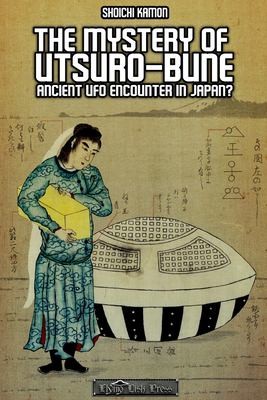
The Mystery of Utsuro-bune
Ancient UFO Encounter in Japan? — Kazuo Tanaka's Archival Investigation of the 1803 Hollow Ship, Published Under a Pen Name
Find on Amazon →As an Amazon Associate, OverClassified may earn from qualifying purchases made through this link, at no extra cost to you.
Why This Is Essential Reading
Essential, and not what most readers expect. This is the only book-length study of the utsuro-bune manuscripts in English, and its author — a Tokyo engineering professor writing under a pen name — concluded after more than a decade of archival work that the 1803 hollow-ship story is 'a literary mixture of folklore and imaginations,' on the strength of findings that are hard to argue with: the place named in every account appears on no Edo-period map, the daimyō whose jurisdiction the story invokes held no coastal land, the manuscripts disagree with each other on measurable details, and the vessel never once behaves like a craft. Then in 2014 he identified a real, surveyed beach matching a variant reading of the name, which is the sort of thing that keeps a case alive. Read it for the documents, read it for a demonstration of what serious archival scrutiny does to a strong pre-modern anomaly claim, and note that the most sceptical person who ever studied this case is also the one who found the beach.
Related Cases & Theories
Sources Cited
- Kamon, Shoichi [Kazuo Tanaka]. The Mystery of Utsuro-bune: Ancient UFO Encounter in Japan? Flying Disk Press English translation, 2019 (Japanese first edition 2009). ISBN-10 1797793144 / ISBN-13 9781797793146. amazon.com
- Blackwell's bibliographic record, The Mystery of Utsuro-Bune by Shoichi Kamon, ISBN 9781797793146 — independent bookseller verification. blackwells.co.uk
- AbeBooks bibliographic record, The Mystery of Utsuro-Bune: Ancient UFO Encounter in Japan?, ISBN 9781797793146. abebooks.com
- Wikipedia, "Utsuro-bune" — source for the vessel's stated dimensions, the four principal manuscripts (Oushuku Zakki 1815, Toen shōsetsu 1825, Hyōryū kishū 1835, Ume-no-chiri 1844) and their holding libraries, Kyokutei Bakin's 1844 comparison against Roshia bunkenroku, Tanaka's Harayadori/Ogasawara Nagashige findings and 3.6-vs-36-litre discrepancy, Yanagita Kunio's 1925 and 1962 analyses, Hideki Satō's alchemical-symbol reading, and the May 26, 2014 Ibaraki Shimbun report of the Hitachihara Sharihama identification. en.wikipedia.org
- Nippon.com, "'Utsurobune': A UFO Legend from Nineteenth-Century Japan" — a Japanese-institutional English-language treatment of the accounts and their scholarship. nippon.com
- Open Culture, "When a UFO Came to Japan in 1803: Discover the Legend of Utsuro-bune" — reproduces the manuscript illustrations and summarises the documentary record. openculture.com
- Tanaka, Kazuo. "Did a Close Encounter of the Third Kind Occur on a Japanese Beach in 1803?" Skeptical Inquirer, vol. 24 no. 4 (July/August 2000) — Tanaka's own English-language statement of the archival findings, published under his real name with a Gifu University Department of Electronics and Computer Engineering byline. skepticalinquirer.org
- Kyokutei Bakin, Toen shōsetsu (1825), Mukyū-Kai-Toshokan, Machida, Tokyo — the fullest surviving account, and the manuscript Tanaka's comparison is anchored to.
- Nagahashi Matajirō, Ume-no-chiri ("Dust of the Plum," 1844), Iwase-Bunko-Toshokan, Nara — the variant account describing the vessel as a rice pot with a thickened rim, black paint and four windowed sides.
- Yanagita Kunio, analyses of the utsuro-bune accounts (1925 and 1962) — the folkloric reading that round boats were an ordinary Japanese tradition to which western-seeming details were later added.
- My Modern Met, "Utsuro-bune: Japan's Mysterious 1803 UFO Legend" — general coverage including the manuscript illustrations. mymodernmet.com
- Enigma Labs case record, "Utsuro-bune, Japan, February, 1803" — an independent modern database entry for the account. enigmalabs.io
- OverClassified ancient record, The Utsuro-bune "Hollow Ship" — this site's own treatment, which cites this book as the indispensable source for the archival argument and adopts its separation of the documents' reality from the event's.
- OverClassified case file, The Kōfu Incident — the modern Japanese comparison case.
- AV Club, "In 1803, Japan had an encounter with an unidentified floating object" — an example of the popular English-language framing this book's findings correct. avclub.com
Have corrections, additional research, or peer-reviewed sources? Help improve this entry.
Suggest an Edit