
Ladakh / Demchok UFO Sightings
Beginning August 1, 2012, an Indo-Tibetan Border Police (ITBP) unit stationed at Thakung, near Pangong Tso Lake on the India-China border in Ladakh, began reporting yellowish spherical objects that appeared to rise from the horizon on the Chinese side and drift across the sky for three to five hours before disappearing. By February 2013 the Indian military had logged 329 such sightings, and a separate incident on August 4, 2013 near Demchok's Lagan Khel area drew a formal report from the Army's 14 Corps to Army Headquarters. The Indian Army deployed a mobile ground radar unit and a spectrum analyzer to the area, which detected no metallic signature. A team from the Indian Astronomical Observatory at Hanle studied the phenomena directly over three nights and assessed the objects as "non-celestial," explicitly ruling out both meteors and planets — while a separate team from the Indian Institute of Astrophysics later concluded the objects were simply Jupiter and Venus, appearing unusually bright due to Ladakh's thin, high-altitude atmosphere. Defence Minister A.K. Antony told Parliament there was no conclusive proof of UFOs, without directly resolving the contradiction between the two government scientific findings.

Pictured: Pangong Tso, a high-altitude Himalayan lake in Ladakh, near where the 2012–2013 sightings were concentrated. Photo by dipak123, Wikimedia Commons (CC BY 1.0).
Theoretical Alignment
This file departs from the standard ETH/IDH/PSH split, substituting a "Man-Made / Foreign Technology" category more relevant to a militarily sensitive border region, since a genuinely plausible non-exotic hypothesis for this case is an undisclosed or classified foreign (or even domestic) technology rather than either extraterrestrial visitation or simple misperception. This file weights Psycho-Social/Mundane highest because the officially adopted explanation (Jupiter and Venus) is scientifically coherent and consistent with the reported gradual horizon-to-sky movement and multi-hour visibility. It assigns meaningful weight to the technology category specifically because a separate government astronomical team, studying the same phenomena directly rather than retrospectively, explicitly ruled out planets and meteors and called the objects "non-celestial" — a finding the later, more widely publicized celestial explanation never appears to have directly addressed or reconciled.
The technology-demonstration hypothesis is not this file's invention; it was raised at the time by at least one retired senior Indian Army officer directly familiar with the sector (see Key Figures, below), and it draws whatever plausibility it has less from any specific technical evidence than from the sheer improbability, on priors, that a scientifically literate modern military would mistake Jupiter and Venus for hostile aircraft for the better part of a year without at some point noticing the pattern. That the misidentification, if that is what it was, persisted across 329 logged events before a dedicated astronomical team was finally brought in to check is itself part of the case's evidentiary texture, and this file treats that persistence as mildly supportive of the technology and non-celestial categories even while assessing the celestial explanation as ultimately the single most probable account of the majority of sightings.
Background
Ladakh, in India's northernmost region, sits along the Line of Actual Control (LAC), the disputed and heavily militarized de facto border between India and China. The area's extreme altitude (Pangong Tso sits at approximately 4,225 meters/13,862 feet), thin atmosphere, and status as an active zone of periodic military tension make it both a genuinely unusual observational environment and a location where any unexplained aerial activity carries immediate security significance, a combination this file finds directly relevant to both the case's evidentiary weight and its eventual government handling.
The sightings began August 1, 2012, when an ITBP unit stationed at Thakung, near Pangong Tso, started reporting what personnel described as "Unidentified Luminous Objects" (ULOs) — yellowish spheres that appeared to rise from the horizon on the Chinese side of the lake and drift slowly across the sky for three to five hours before disappearing, visible both by day and by night. By October 15, 2012, the unit had logged over 100 such sightings, reported through channels reaching the Prime Minister's Office; by February 2013, the cumulative total across the wider monitoring effort had grown to 329 documented sightings, with some accounts describing the objects as appearing to cross the LAC itself as many as 155 times.
A Border Written in Contested Lines
Understanding why 329 recurring lights over a Himalayan lake became a matter for the Indian Army, the Indian Space Research Organisation, the Defence Research and Development Organisation, the National Technical Research Organisation, and eventually Parliament requires understanding what the Line of Actual Control actually is. It is not an internationally recognized border. It is a ceasefire line, and a contested one: the product of China's unilateral withdrawal at the close of the October–November 1962 Sino-Indian War, a monthlong conflict fought substantially over this same region and triggered by disputes over the British-era Johnson Line and McDonald Line boundary proposals, China's road-building through Aksai Chin to connect Tibet with Xinjiang, India's "Forward Policy" of establishing outposts in disputed territory, and the broader rupture in relations following India's decision to grant asylum to the 14th Dalai Lama in 1959. China's ceasefire left it in control of roughly 38,000 square kilometers of Aksai Chin in the western sector, immediately adjacent to Ladakh; India has never recognized that control as legitimate, and the resulting LAC — unlike a surveyed and mutually agreed international boundary — is not marked on the ground with any consistent physical demarcation for long stretches of its length, a fact that has produced recurring, low-level "transgression" incidents on both sides for decades, entirely independent of anything anomalous in the sky. Reporting on the 2012–2013 sightings noted that more than 500 such transgressions were logged in the region between 2010 and 2012 alone, the ordinary background rate of friction against which the ULO reports arrived. This file finds that background essential context: in a zone where the two nations cannot even agree on where the ground itself divides, an unexplained light appearing to originate from the other side of an unmarked line is never going to be treated as a curiosity to be shrugged off, however mundane its eventual explanation.
The scale of the ambiguity is easy to understate. India and China have never exchanged officially agreed maps of the roughly 3,488 kilometers (by India's count; China's own reckoning puts the figure closer to 2,000 km, itself a sign of how differently the two sides frame the same border) of Line of Actual Control running through Ladakh and beyond, and the LAC is neither depicted on any bilaterally accepted map nor physically demarcated with boundary markers along most of its length. The one significant exception is the comparatively calm middle sector further east, where India and China have exchanged maps on which they broadly agree; the western sector through Ladakh, where Demchok, Pangong Tso, and Thakung all sit, is not one of the sectors where that has happened. Read against that backdrop, this file finds it unsurprising, rather than suspicious, that a recurring nocturnal light near Pangong Tso would trigger an institutional response several orders of magnitude larger than a comparable sighting would draw almost anywhere else in the world: the underlying uncertainty about where the border itself even runs makes any unexplained activity in the sky above it a standing security question first, and a curiosity second.
Ladakh's Optical Extremes
The atmospheric argument at the center of the celestial explanation rests on real, well-established astronomical physics rather than post-hoc rationalization. Atmospheric extinction — the dimming of light from any celestial object as it passes through Earth's atmosphere — is a direct function of the amount of air the light must traverse and the aerosols and water vapor suspended in it. At Pangong Tso's elevation of roughly 4,225 meters (and higher still at some of the ridgeline observation posts used by ITBP and Army personnel, one of which the Indian Institute of Astrophysics team logged at approximately 4,715 meters), the column of atmosphere overhead is dramatically thinner and drier than at sea level, and Ladakh's cold-desert climate keeps humidity and airborne dust unusually low for a Himalayan region. Both factors reduce extinction sharply, which is precisely why India's premier professional observatory sits at Hanle, roughly 150 kilometers south of Pangong Tso and part of the same high-altitude Changthang plateau — the site was chosen specifically because the sky there is among the clearest and most transparent available anywhere on the subcontinent. A planet that would appear as an unremarkable point of light over Delhi or Bangalore can appear startlingly vivid from a ridge above Pangong Tso. Separately, atmospheric scintillation — the turbulence-driven "twinkling" most familiar from ordinary starlight — is generated primarily by high-altitude atmospheric turbulence, and observers who are themselves already at high altitude have less turbulent air remaining above them to scintillate through; planets, unlike true point-source stars, also twinkle far less to begin with because their resolvable disks average out the turbulence-driven brightness fluctuations across many points rather than one. The practical result is a planet that, from a high Himalayan ridge, can appear not as a twinkling star-like point but as an unusually bright, steady, non-scintillating light — a description that maps uncomfortably well onto witness accounts of a slow-moving "craft."
Not the First Wave
The 2012–2013 sightings were not Ladakh's first brush with unexplained aerial reports, though the earlier incidents are of a different character and this file treats them as background color rather than evidence bearing directly on the Pangong/Demchok case. Press coverage of the 2012 sightings noted that an earlier round of unusual lights reported in the same general border region in 2010 had been explained at the time as Chinese sky lanterns — a mundane, low-cost explanation for a genuinely different phenomenon (small, buoyant, fire-lit paper lanterns are a real and recurring source of nocturnal-light reports along the China border generally) that nonetheless meant Ladakh's ITBP and Army units already had a recent institutional memory of "lights over the border that turned out to be nothing" by the time the August 2012 wave began. Separately, and considerably more removed from the core case, a 2004 account attributed to a geologist named Sunil Dhar described an encounter elsewhere in the wider Himalayan border region with a small, color-changing, humanoid figure that reportedly hovered briefly before vanishing; no government findings on that incident were ever released, and this file has found no reporting connecting it substantively to the 2012–2013 ULO wave beyond both being invoked by journalists as evidence of the region's longstanding reputation for unusual reports. Readers should not treat the 2004 account as corroborating evidence for the Pangong/Demchok sightings; it involved a wholly different kind of claim (a physical humanoid figure at close range, rather than a distant aerial light observed for hours) reported by a different class of witness in a different specific location, and this file includes it here strictly as regional context, not as part of the evidentiary record for Case File #307 itself.
First International Notice: The November 2012 Wire Report
The sightings first reached a wide international audience through a wire report, credited to the Los Angeles Times and published November 8–9, 2012, that was subsequently syndicated by numerous outlets. That report is also the earliest located source in which named individuals outside the military chain of command offered on-the-record theories about the objects, and it is worth engaging with those theories directly rather than only in summary, since they represent the earliest public airing of the two poles this file's own Theoretical Alignment assessment is built around. A.K. Antony's eventual parliamentary statement and the Indian Institute of Astrophysics's planetary finding both came later; in November 2012, with barely 100 sightings logged and no astronomical team yet dispatched, the field was more genuinely open. A retired Northern Army commander who had overseen the same sector, Lieutenant General B.S. Jaswal, told the paper that such sightings had not occurred during his own tenure and offered a blunt alternative to both extraterrestrial and celestial readings:
"If there has been some sightings, I wouldn't be surprised if it's a technology demonstration by the Chinese."
Nandivada Rathnasree, director of New Delhi's Nehru Planetarium (identified in period reporting by the byline "N. Ratnashri"), offered a different, still-mundane candidate explanation that has received far less attention than the eventual Jupiter/Venus finding — ordinary balloons, rather than planets, drifting with the ambient light of the horizon reflecting off their surface — while cautioning against overreading the available photographic evidence:
"They could be some sort of balloon-borne objects that reflect ambient light... I wouldn't put much faith in photographs of a shape that could be anything."
This file notes that Rathnasree's balloon hypothesis was never, as far as this file's research could determine, formally tested or ruled out in the same instrumented way the metallic-drone and celestial hypotheses eventually were, and treats it as a second, lower-profile conventional candidate sitting alongside the Jupiter/Venus finding rather than as a competitor that was ever actually adjudicated against it.
The case's sourcing trail is also worth noting on its own terms. The November 2012 wire story was picked up by outlets ranging from major American papers to niche technology and defense-industry blogs, each adding little independent reporting of its own but collectively building the paper trail this file relies on; the more technical, astronomy-specific reporting on the IIA's theodolite methodology and the Hanle Observatory's specific findings arrived later, mostly in mid-2013, and largely from specialist and international technology press covering the story once the "Army mistook Jupiter for a Chinese drone" angle proved to have wire-service appeal. This file has not identified any single, comprehensive, contemporaneous Indian government or Ministry of Defence press release walking through the full chronology in one place; the case's public record is instead assembled, as it is for many of the older files in this archive, from a patchwork of independent press accounts written by different reporters at different points across nearly a full year, a structural feature that itself explains why so many of the case's individual details (the precise theodolite dates, the identities of the Hanle team's astronomers, whether Rathnasree's balloon theory was ever formally tested) remain harder to pin down than the broad outline of the case as a whole.
Complete Timeline
| Date | Event |
|---|---|
| 2004 | A geologist, Sunil Dhar, reports a separate, unrelated encounter elsewhere in the wider Himalayan border region with a small, color-changing figure; no government findings are ever released, and this incident is not part of the core 2012–2013 evidentiary record. |
| 2010 | An earlier round of unusual light sightings in the same general border region is reported and, at the time, explained as Chinese sky lanterns. |
| Aug. 1–Oct. 15, 2012 | An ITBP unit at Thakung, near Pangong Tso, logs over 100 sightings of yellowish luminous spheres; reports reach Delhi headquarters and the Prime Minister's Office. |
| Sept. 2012 | The Indian Army deploys a mobile ground-based radar unit and a spectrum analyzer to a mountaintop near Pangong Lake to attempt instrumented detection of the objects. |
| Late Sept. 2012 | A team of astronomers from the Indian Astronomical Observatory at Hanle, roughly 150 km south of Pangong Lake, studies the phenomena directly over three nights, describing the objects as "non-celestial" and ruling out meteors and planets, without reaching a conclusive identification. |
| Nov. 8–9, 2012 | The Los Angeles Times publishes the first major international wire report on the sightings, quoting retired Northern Army commander Lt. Gen. B.S. Jaswal and Nehru Planetarium director Nandivada Rathnasree; the story is widely syndicated. |
| Aug.–Feb. 2012–2013 | The Indian military's cumulative sighting log at Thakung reaches 329 documented events. |
| Early 2013 | Astronomers from the Indian Institute of Astrophysics (IIA), Bangalore, are dispatched to Ladakh at the Army's request; their analysis concludes the objects are most likely Jupiter and Venus, appearing unusually bright due to increased atmospheric transparency at high altitude. |
| Feb. 17–22, 2013 | IIA senior astronomer Tushar Prabhu has Army personnel record the two objects' horizontal and vertical position each night with a theodolite; the resulting dataset is used to match their motion to Jupiter and Venus. |
| Apr. 15–May 5, 2013 | In a separate, unrelated incident elsewhere in Ladakh, Chinese troops establish a camp in the Depsang Bulge roughly 30 km south of Daulat Beg Oldi, reported as 10–19 km inside territory India considers its own side of the LAC, producing a three-week standoff resolved through flag-meeting diplomacy; the episode underscores how fraught the wider border theater was during the same months as the ULO investigation. |
| July 2013 | Reporting on the case, and the apparent contradiction between the Hanle team's and the IIA's findings, draws wider international press attention. |
| Aug. 4, 2013 | A separate sighting occurs in the Lagan Khel area of Demchok, Ladakh; Army troops of the 14 Corps submit a formal report to Army Headquarters. |
| 2013 (parliamentary session) | Defence Minister A.K. Antony tells Parliament there is "no conclusive proof of sighting of unidentified flying objects (UFOs) over the Sino-Indian border." |
The Instrumented Investigation
What distinguishes this case from most nocturnal-light reports in this archive is the scale and technical seriousness of the government response while the sightings were still ongoing. Beyond the Army's own personnel, the investigation drew in the Indian Space Research Organisation (ISRO), the Defence Research and Development Organisation (DRDO), and the National Technical Research Organisation (NTRO), each of which reviewed available data and reportedly ruled out unmanned aerial vehicles, Chinese drones, and low-orbit satellites as explanations. In September 2012, the Army physically relocated a mobile ground-based radar unit and a dedicated spectrum analyzer — equipment specifically intended to detect radio-frequency emissions from any object — to a mountaintop position near Pangong Lake. According to reporting on the investigation, the equipment detected no signal from the objects, a result some officials interpreted as indicating the ULOs were non-metallic, which is consistent with either a celestial explanation or with certain classes of non-metallic aerial devices, but does not by itself resolve which.
Ruling Out the Conventional Suspects
Before any astronomer was involved, the elimination process itself was methodical. Reporting on the case describes Indian military officials directly examining the hazy photographs ITBP personnel had taken of the objects and using them, alongside the radar and spectrum-analyzer data, to work through the conventional suspect list one at a time: commercial and military unmanned aerial vehicles, a hypothetical Chinese reconnaissance drone, and low-Earth-orbit satellites were each considered and set aside as inconsistent with either the objects' multi-hour visibility, their apparent point of origin, or their complete absence from radar and RF detection. At least one attempt was reportedly made to close the distance and get a direct look: an Army reconnaissance drone sent to investigate is described in contemporary reporting as losing contact with the object, or losing altitude capacity to continue pursuit, before a positive identification could be made — an inconclusive result that, whatever its cause, meant the case remained open rather than closing on a mundane technological explanation at that early stage.
Why ISRO, DRDO, and NTRO
The specific choice of agencies pulled into the review is itself informative about how seriously the Indian government treated the case while it was still unresolved. ISRO is India's civilian space agency, responsible among other things for the country's satellite-tracking and launch infrastructure, which made it a natural body to assess whether the objects could be a known satellite, re-entering space debris, or a launch-related artifact rather than anything airborne. DRDO is India's principal defense research and weapons-development organization, spanning radar, missile, and sensor programs, and its involvement points toward assessing whether the objects could represent a new class of aerial or missile-adjacent hardware, foreign or domestic. NTRO is a comparatively young and less publicly discussed technical intelligence agency, formed in the early 2000s and generally understood to handle satellite imagery, signals intelligence, and other technical surveillance disciplines relevant to border security; its inclusion suggests the case was, at least for a period, handled with some of the same institutional seriousness as a genuine technical-intelligence question about a potential foreign platform, not merely referred to a single skeptical agency for a quick dismissal. This file has not located a published, detailed account of what each individual agency concluded beyond the general "ruled out UAVs, drones, and satellites" summary common to the period's press coverage, and would treat any more granular breakdown, were one to surface, as a meaningful addition to the case's evidentiary record.
Two Theories From Retired Command
The elimination of the obvious technological suspects left officials and outside commentators to speculate more openly, and two retired senior figures quoted in contemporary reporting staked out positions that anticipated this file's own Theoretical Alignment framework months before any astronomical team was involved. Air Chief Marshal (retired) P.V. Naik, a former chief of the Indian Air Force, argued the sightings could not simply be waved away:
"We can't ignore these sightings. We need to probe what new technology might have been deployed there."
Naik's framing — treating the ULOs as a plausible signal of undisclosed technology rather than either a joke or an extraterrestrial claim — is precisely the "Man-Made / Foreign Technology" category this file uses in place of the standard IDH designation, and this file finds it notable that the call to take the sightings seriously as a possible technology signal came from a former service chief rather than from a UFO researcher or outside commentator. Lieutenant General B.S. Jaswal's separate remark, quoted above in Background, pointed in the same direction from the Army side rather than the Air Force. This file does not treat either officer's speculation as evidence that a Chinese platform was actually involved — neither offered any specific technical basis for the claim beyond the sightings' unexplained persistence — but records both as a measure of how seriously experienced, retired senior officers were willing to entertain a technology explanation before the celestial finding closed the question for most observers.
It is also worth registering what neither officer's public comments actually claimed. Neither Jaswal nor Naik asserted direct knowledge of a specific Chinese program, named any platform, or offered any technical specification consistent with the reported behavior of the objects; both statements, read closely, amount to institutional caution rather than substantive intelligence — a considered refusal to rule out a serious possibility, phrased by officers whose careers had made them accustomed to taking unexplained activity near a contested frontier seriously by default, rather than a claim that either man knew or suspected something specific. This file finds that distinction important, because it is easy for secondary and tertiary coverage of a case like this one to compress "a retired general said we shouldn't rule this out" into something closer to "a retired general said this was Chinese technology," which is a meaningfully stronger and less well-supported claim than either officer is on record as having actually made. Readers encountering more sensationalized summaries of this case elsewhere should treat that gap between institutional caution and substantive claim as a recurring feature of how military-adjacent UAP cases are often reported, not a feature unique to Ladakh/Demchok.
The Contradictory Scientific Findings
This file treats the case's central evidentiary puzzle as the direct, largely unreconciled contradiction between two separate Indian government-affiliated astronomical investigations. A team from the Indian Astronomical Observatory at Hanle, one of the world's highest-altitude professional observatories and located only about 150 km from the sighting area, spent three nights directly observing the phenomena and explicitly assessed the objects as "non-celestial," specifically ruling out both meteors and planets as explanations — a direct, on-site, professional astronomical finding that the objects were not simply misidentified stars or planets. A separate team, from the Indian Institute of Astrophysics in Bangalore, dispatched roughly 1,400 miles to Ladakh at the Army's later request, subsequently concluded the objects were most likely Jupiter and Venus, whose apparent brightness is significantly amplified by Ladakh's thin, high-altitude atmosphere and low horizon obstruction.
Measuring the Sky: Prabhu's Theodolite
The IIA's method was straightforward, low-tech, and — on its own terms — rigorous. Senior astronomer Tushar Prabhu, who led the two-person team sent to Ladakh, described the assignment plainly: "Our task was to determine whether these unidentified objects were celestial or terrestrial." Rather than relying on witness description alone, the team had Army personnel take nightly positional readings of the two recurring objects using a theodolite — a basic surveying instrument that measures horizontal and vertical angles — over a six-night window from February 17 to 22, 2013. Plotting those angles night over night let the team compare the objects' apparent motion directly against the known, predictable diurnal paths of Jupiter and Venus, rather than resting the identification purely on brightness or color. The two objects tracked separately: the first was visible roughly from 6 p.m. to 5 a.m. and matched Jupiter's expected path and rise/set timing for that window; the second was visible roughly from 4 a.m. to 11 a.m. and matched Venus, then in its role as a conspicuous "morning star." One ITBP observer's own field notes, cited in period reporting, recorded that the objects rose a few minutes later each successive night — a pattern one soldier, Lance Naik Sheminderpal Singh, is reported to have specifically logged, and which happens to track the real astronomical fact that any given celestial object rises roughly four minutes earlier each day relative to local clock time as Earth moves along its orbit (the difference between a 24-hour solar day and a very slightly shorter sidereal day). If accurately reported, that specific, ground-level observation is arguably the single most persuasive piece of evidence for the celestial explanation in the entire case, because it is a subtle, technical signature of orbital motion that a soldier watching lights in the sky would have had no reason to invent or expect, and no obvious way to produce by observing anything other than an actual celestial body.
What the Theodolite Data Doesn't Explain
The theodolite method's strength — precise, repeatable angular tracking against known planetary ephemerides — is also the boundary of what it can speak to. It was applied only to the specific two recurring objects the IIA team was shown and briefed on in February 2013; it says nothing directly about the roughly 327 other entries in the 329-sighting log compiled over the preceding seven months, nor about the specific events the Hanle Observatory team observed and called "non-celestial" during their own three-night investigation the previous autumn, months before the IIA was ever dispatched. This file has not located any published source indicating the Hanle team's specific observation nights, or the specific objects they tracked, were later cross-checked against the IIA's planetary ephemeris data, or vice versa — the two investigations appear, from available reporting, to have operated independently, at different times, with no documented coordination or shared dataset between them.
This file has not located any published source that directly reconciles these two findings, and treats the contradiction as a genuine, unresolved element of the case rather than assuming the later, more widely reported celestial explanation simply supersedes the earlier "non-celestial" finding. It is possible both teams were correct about different subsets of the 329 logged sightings — that some events genuinely were bright planets misidentified by border personnel unfamiliar with the region's unusual atmospheric optics, while the Hanle team's direct three-night observation targeted different, specific events that behaved in ways inconsistent with a fixed celestial object. This file finds that reading more scientifically honest than treating either single finding as a complete explanation for the entire 329-event dataset.
Key Figures
A.K. Antony
Told Parliament there was no conclusive proof of UFO sightings over the Sino-Indian border, the Indian government's official position on the case.
Jayant Narlikar
A prominent Indian astrophysicist who publicly stated there was no evidence of extraterrestrial origin for the sightings, representing the mainstream Indian scientific community's skeptical assessment. Narlikar was blunter in at least one contemporary account, characterizing extraterrestrial claims about the case as "fancy, not fact."
Tushar Prabhu
Led the two-astronomer IIA team dispatched to Ladakh at the Army's request in early 2013. Directed nightly theodolite tracking of the two recurring objects and concluded, based on their measured motion, that they were Jupiter and Venus. No matching key-figures.html card exists for Prabhu at this time.
Lt. Gen. B.S. Jaswal (Ret.)
Told the Los Angeles Times in November 2012 that such sightings had not occurred during his own tenure overseeing the sector and suggested a Chinese technology demonstration as one possible explanation. No matching key-figures.html card exists for Jaswal at this time.
Air Chief Marshal P.V. Naik (Ret.)
Publicly argued the sightings should not be dismissed and called for an investigation into what new technology might have been involved, one of the earliest on-the-record calls to treat the case as a possible technology signal. No matching key-figures.html card exists for Naik at this time.
Nandivada Rathnasree
Offered a second, lower-profile conventional hypothesis — ambient-light-reflecting balloons rather than planets — and cautioned publicly against over-interpreting the available photographic evidence. Identified in some 2012 reporting under the byline "N. Ratnashri." No matching key-figures.html card exists for Rathnasree at this time.
The Five Observables Assessment
The Five Observables framework applies only loosely, since the case describes a recurring wave of individually mundane-scale sightings rather than a single observed craft with measured performance:
Assessment: No investigation of this case, by any of the multiple agencies involved, has documented any of the Five Observables. The objects' reported behavior (slow rise, multi-hour drift, gradual disappearance) is consistent with either a celestial object's apparent motion across the sky or a very-high-altitude, slow-moving aerial platform, and inconsistent with any anomalous performance claim. This file finds the total absence of any Five Observables claim to be itself a meaningful data point when the case is set against others in this archive: cases built substantially around performance anomalies (instant acceleration, trans-medium travel, hypersonic maneuvering without a sonic signature) tend to resist conventional explanation precisely because those specific behaviors are hard for any known natural or man-made object to replicate. A case whose entire anomalous content consists of "a light appeared, moved slowly and predictably for hours, and eventually vanished below the horizon" is, by contrast, a profile that ordinary celestial motion satisfies without requiring any exotic explanation at all — which is a structural reason, independent of the specific Hanle/IIA dispute, that this file rates the celestial explanation as the single most probable account of the case's overall sighting volume even while treating the Hanle team's specific "non-celestial" finding as a genuine, unresolved exception.
Evidence Assessment
Supporting Genuine, Documented Uncertainty
- A direct, on-site, multi-night investigation by professional astronomers from a major high-altitude observatory explicitly ruled out meteors and planets and called the objects "non-celestial" — a specific, credentialed finding in direct tension with the case's eventual public explanation.
- The scale of the multi-agency government response (Army, ISRO, DRDO, NTRO, two separate astronomical teams, radar and spectrum-analyzer deployment) is unusually large for a phenomenon officials ultimately characterized as a simple celestial misidentification.
- The radar and spectrum analyzer's failure to detect any signal is a genuine instrumented data point, even though its interpretation (consistent with either explanation) does not decisively favor one hypothesis over the other.
- A reconnaissance drone reportedly sent to investigate one of the objects failed to achieve a positive identification before losing contact, a detail contemporary reporting does not resolve and which this file has been unable to further clarify.
- Two named, retired senior officers — one Army, one Air Force — were willing to be quoted on the record treating an undisclosed-technology explanation as plausible, rather than dismissing the reports outright.
Supporting a Largely Conventional Explanation
- The Indian Institute of Astrophysics's celestial explanation is scientifically coherent, directly matches the reported horizon-to-sky drift pattern over several hours, and was reached by credentialed professional astronomers with direct access to the sighting location's specific atmospheric conditions.
- No physical trace, recovered material, or confirmed foreign-nexus evidence has ever been produced despite the scale and duration of the investigation.
- Defence Minister Antony's parliamentary statement represents the Indian government's own considered official position that the sightings did not constitute confirmed UFOs.
- The IIA's theodolite-based tracking produced a measured, repeatable dataset matching known planetary motion — a materially stronger form of evidence than the photographic and eyewitness material most of the case otherwise rests on.
- A field-level observation of the objects' rise time shifting by several minutes each night, attributed to an ITBP observer, independently matches the predictable sidereal-day drift of real celestial bodies rather than anything characteristic of a controlled craft.
Why "Disputed"
This case is rated Disputed because two separate, credentialed Indian government-affiliated scientific teams reached genuinely different conclusions about the same underlying phenomenon, and no source located for this file directly reconciles that contradiction. The Hanle Observatory team's direct, multi-night, on-site assessment that the objects were "non-celestial" — explicitly ruling out the very explanation (planets) the case's later, more widely reported resolution settled on — is a specific and significant piece of evidence this file does not consider fully answered by the subsequent Indian Institute of Astrophysics finding, however scientifically sound that finding may be for the specific events it examined.
This file's own reading is that the case most likely involves a genuine mixture: the majority of the 329 logged sightings across an extended, months-long period probably did involve Jupiter and Venus, whose unusual brightness at high altitude plausibly confused observers unfamiliar with the region's atmospheric optics over many separate nights, while the specific events the Hanle team directly studied over their three-night investigation may represent a smaller, genuinely distinct subset the celestial explanation does not adequately cover. Absent a published reconciliation of the two findings, this file treats the case as legitimately unresolved rather than fully explained.
There is a second, quieter reason this file resists collapsing the case into a single tidy explanation, and it has less to do with astronomy than with institutional behavior. Two named retired senior officers (an Air Force chief and an Army commander), a planetarium director offering a competing conventional theory the record shows was never formally tested, an Army drone that reportedly failed to close on the object it was sent to identify, and a defence minister's parliamentary answer that stopped short of endorsing either scientific team's finding by name, all sit alongside the eventual Jupiter/Venus conclusion without ever being folded into a single, internally consistent official narrative. A case this well-documented, involving this many named officials and institutions, ordinarily produces more institutional convergence than this one did; the persistence of loose ends of this specific kind — not dramatic anomalies, but simply unreconciled statements from credible people — is itself part of why this file declines to downgrade the rating to Explained.
Observer Credibility & Occupational Profile
The case's evidentiary weight rests on multiple layers of credentialed observation: trained ITBP and Army border security personnel whose professional responsibilities specifically include monitoring and reporting unusual activity along a militarily sensitive frontier; a formal multi-agency review involving India's space, defense research, and technical intelligence organizations; and, critically, two separate teams of professional astronomers with direct, on-site access to the sighting locations, rather than a purely retrospective analysis. This file finds the direct involvement of working astronomers physically present at high-altitude observation sites during the relevant period to be an unusually strong evidentiary feature for a case of this kind.
The occupational range of the individuals on record is also unusually broad for a single case file in this archive. It spans conscripted and career enlisted border personnel (the specific, technical field observation attributed to Lance Naik Sheminderpal Singh being a good example of a rank-and-file witness contributing genuinely useful data rather than merely a raw sighting report); senior professional astronomers from two separate national institutions; two retired flag-rank officers, one from each of the Army and Air Force, willing to speak on the record; a civilian planetarium director; and, at the apex, a sitting cabinet minister answering directly to the elected Parliament of India. Few cases in this archive draw testimony from a range this wide while still converging, however imperfectly, on a single incident. This file treats that breadth as a genuine credibility asset even where it does not resolve the case's central contradiction — a wide range of credible observer types independently engaging with the same phenomenon is a meaningfully different, and generally stronger, evidentiary situation than a single witness type reporting in isolation.
Historical Precedents & Archive Matches
This case connects to other recurring border-region and military-adjacent light phenomena this archive documents, particularly cases combining sustained institutional investigation with a genuine, unresolved tension between specialist findings, a pattern distinct from cases where a single skeptical explanation goes largely unchallenged.
The clearest direct precedent in this archive is The 1968 CIA Himalayan Border UFO Sightings, which documented six separate sightings strung along the same broader Himalayan frontier — including Ladakh itself — in the immediate aftermath of the 1962 Sino-Indian War, and which similarly drew a formal government (in that instance, American CIA and Air Force) investigation rather than being dismissed out of hand. The parallel is instructive: both cases involve unexplained aerial phenomena reported along the same contested Himalayan frontier by military-adjacent observers, both drew a level of institutional investigative resources well beyond what the underlying reports alone would typically warrant, and in both cases the government response is arguably as evidentially interesting as the original sightings, since it demonstrates that the reporting states involved took the possibility of a real security threat seriously enough to commit scarce technical and scientific resources to resolving it. More broadly, this case also sits within a much larger, well-documented global pattern — military and government observers misidentifying Venus, in particular, as an unidentified craft is one of the most recurring themes in UFO investigation history, a pattern this file's research for other cases in this archive has repeatedly encountered; what distinguishes the Ladakh/Demchok case within that broader pattern is less the misidentification itself, which is common, than the unusual scale of the resulting multi-agency, multi-team scientific response and the genuine, unreconciled tension between two separate professional astronomical findings.
Material Analysis
The case's evidentiary base consists of hazy photographs taken by ITBP personnel, radar and spectrum-analyzer telemetry (negative for metallic signature), and the direct observational reports of two separate professional astronomical teams. No physical trace, debris, or recovered material of any kind has ever been associated with the case.
It is worth being explicit about what each category of evidence can and cannot establish. The photographs, described in reporting as hazy and inconclusive, are consistent with almost any bright point-source light photographed at night with period-appropriate consumer equipment at long range and cannot, on their own, discriminate between a planet, a balloon, or a genuinely anomalous object; Nandivada Rathnasree's on-record skepticism about reading too much into "a shape that could be anything" applies as much to the case's own photographic record as to any other UFO case built on comparable imagery. The radar and spectrum-analyzer telemetry is a stronger category of evidence in the narrow sense that it is instrumented and repeatable, but its negative result (no detected signal) is symmetrically compatible with both leading hypotheses: Jupiter and Venus would obviously produce no radar return or RF emission, and a genuinely advanced, low-observable foreign platform is, by definition, exactly the kind of object built to produce the same null result. The theodolite dataset is the single piece of evidence in the case that is genuinely discriminating rather than merely consistent with multiple explanations, because it plots measured angular motion against known orbital mechanics rather than relying on brightness, color, or witness impression — which is precisely why this file weights the IIA's specific February 2013 findings more heavily than the photographic or radar evidence, while still declining to extend that same weight to the separate, earlier Hanle Observatory dataset the theodolite method was never applied to.
Supporting Continued Legitimate Interest
- The Hanle Observatory team's direct, credentialed, on-site "non-celestial" finding is a genuine data point this file's research could not locate a published rebuttal or reconciliation for.
Supporting a Largely Conventional Explanation
- The Indian Institute of Astrophysics's celestial explanation directly accounts for the reported horizon-to-sky drift pattern and Ladakh's documented atmospheric optics, and no physical evidence contradicts it.
The Conventional Explanation Candidate: Predominantly Celestial Misidentification, With a Genuine Residual Discrepancy
The leading, and this file's assessed, explanation is that the great majority of the 329 logged sightings involved Jupiter and Venus, whose apparent brightness was significantly amplified by Ladakh's high-altitude, thin-atmosphere viewing conditions, misidentified over many separate nights by observers without specialized astronomical training. This file rates the celestial explanation Highly Plausible for the bulk of the case's overall sighting volume, while explicitly declining to extend that rating to the specific subset of events the Hanle Observatory team directly examined and assessed as non-celestial.
High-Altitude Atmospheric Amplification of Planetary Brightness
The Indian Institute of Astrophysics's finding that Ladakh's thin atmosphere and high altitude significantly amplify the apparent brightness of Jupiter and Venus is a well-established astronomical phenomenon and directly explains the pattern of border personnel, unfamiliar with the region's specific optical conditions, mistaking bright planets for unidentified objects. This file finds the specific supporting details particularly strong: the objects' recorded visibility windows (roughly 6 p.m. to 5 a.m. for the first object, and 4 a.m. to 11 a.m. for the second) align with the expected rise-and-set behavior of Jupiter and Venus respectively for the relevant season and latitude; the reported gradual rise from the horizon and multi-hour drift across the sky is exactly the apparent motion any celestial object exhibits due to Earth's rotation; and the reported night-over-night drift in rise time is consistent, in direction and rough magnitude, with the sidereal/solar day discrepancy that governs how celestial objects' rise times shift relative to a fixed clock. None of these three signatures would be expected from an aircraft, drone, or balloon, which strengthens this file's confidence in the celestial explanation for the specific subset of events the IIA team directly measured.
A Second Conventional Candidate Left Untested
This file also flags Nandivada Rathnasree's balloon hypothesis as a conventional candidate that, on available reporting, was never formally tested against the theodolite method or any comparable instrumented approach. Reflective or lit balloons drifting at altitude are a documented source of nocturnal-light misidentifications elsewhere in this archive's case files, and there is no specific reason to assume Rathnasree's proposal was less plausible than the eventual planetary finding purely because it received less follow-up attention; it may simply be that the Army's chain of contact ran more naturally to the Indian Institute of Astrophysics, a fellow scientific-establishment institution the military had an existing relationship with, than to a metropolitan planetarium director. This file does not rate the balloon hypothesis as a serious rival to the celestial explanation for the specific, theodolite-verified events, since a planet's measured diurnal motion is a much harder signature to produce accidentally than a balloon's, but treats it as a reminder that "conventional explanation" and "instrumentally verified explanation" are not automatically the same thing in this case.
The Unresolved Hanle Observatory Finding
The Hanle team's specific, credentialed, on-site conclusion that certain observed events were "non-celestial" is not adequately explained by the later planetary finding, and this file treats it as the case's single most significant open evidentiary question. It is worth noting explicitly what would be required to actually close this gap: a published, dated account of exactly which nights and which specific reported events the Hanle team observed, cross-referenced against a planetary ephemeris for those same nights and the observation site's exact coordinates, the same rigor the IIA team applied five months later with a theodolite. Absent that specific comparison ever having been publicly performed, this file regards the claim that "the sightings were explained" as an overstatement of what the public record actually supports, even while agreeing that the celestial explanation is very likely correct for most of the 329 total events.
Predominantly Celestial Misidentification, With a Genuine Residual Discrepancy — Plausibility Rating: PLAUSIBLE FOR MOST SIGHTINGS; UNRESOLVED FOR THE HANLE-STUDIED SUBSET
Related Cases
Record Status
No formal Indian government report specific to this case has been publicly released. Defence Minister A.K. Antony's parliamentary statement remains the government's most direct public position on the matter; the underlying ITBP, Army, ISRO, DRDO, and NTRO investigative records have not been released to the public.
Search Government Archives Directly
Further Reading — Recommended Literature
The Scientific Edge: The Indian Scientist from Vedic to Modern Times
By the astrophysicist quoted skeptically in this case, exploring the Indian scientific establishment's relationship with pseudoscience and unverified claims.
Understanding the India-China Border: The Enduring Threat of War in High Himalaya
Essential background on the Line of Actual Control's military and political context, directly relevant to why this case drew such an unusually large government response.
The UFO Experience: A Scientific Inquiry
The foundational text on scientifically rigorous UFO classification, directly relevant to weighing the Hanle Observatory team's professional assessment.
The UFO Encyclopedia: The Phenomenon from the Beginning (3rd ed.)
The standard comprehensive reference work on UFO history, including international military and border-region cases.
Watch the Skies! A Chronicle of the Flying Saucer Myth
A skeptical history of military UFO investigations, useful comparative context for how government agencies have historically handled similar sighting waves.
DISCLOSURE: Some links above are affiliate links. If you purchase through them, OverClassified receives a small commission at no additional cost to you. This helps support independent research.
Essential Viewing

The UFO Hunters of Ladakh
101 India — a documentary profile of Ladakh's local UFO-watching culture and the region's reported sightings.
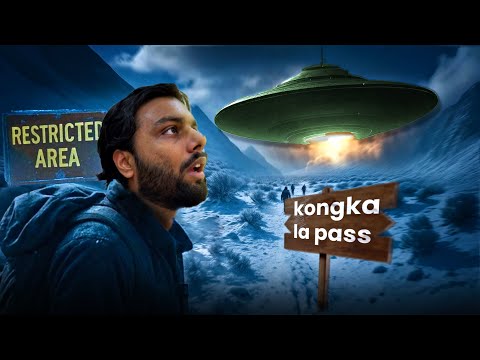
I Tried to Solve India's Biggest UFO Mystery
An independent investigation into the Kongka La Pass / Ladakh border region UFO reports.
Sources
- "Mysterious UFO sighted in Ladakh on India-China border by army," India TV News. Read online →
- "Indian Army 'sight UFO' in Ladakh again," Millennium Post. Read online →
- "UFO Sightings At Indo-China Border Leave Indian Army Astounded," IBTimes. Read online →
- "Indian Army Mistook Venus and Jupiter for Chinese Spy UAS," UAS Vision. Read online →
- "India and the war of the worlds: Are those UFOs, or just Jupiter and Mars?" The Register. Read online →
- "UFO Sightings: After Chinese, Russian Sightings Indian Troops Saw Them," UFO Chronicles. Read online →
- "Ladakh," The UFO Timeline. Read online →
- "UFO sightings in India," Wikipedia. Read online →
- "UFO sightings by Army personals in Ladakh," Dbuster. Read online →
- "Indian troops report seeing UFOs," The Spokesman-Review (syndicated Los Angeles Times report), Nov. 8, 2012. Read online →
- "100 UFOs On India-China Border Cause Official Concern," HuffPost (syndicated Los Angeles Times report), Nov. 9, 2012. Read online →
- "India UFO," Ghost Theory (syndicated Los Angeles Times report), Nov. 12, 2012. Read online →
- "Line of Actual Control," Wikipedia. Read online →
- "2013 Depsang standoff," Wikipedia. Read online →
- "Sino-Indian War," Wikipedia. Read online →
- Narlikar, Jayant V. The Scientific Edge: The Indian Scientist from Vedic to Modern Times. Penguin Books India, 2003.
- Joshi, Manoj. Understanding the India-China Border: The Enduring Threat of War in High Himalaya. Hurst Publishers, 2022.
- Hynek, J. Allen. The UFO Experience: A Scientific Inquiry. Da Capo Press, 1998 (orig. 1972).
- Clark, Jerome. The UFO Encyclopedia: The Phenomenon from the Beginning, 3rd ed. Omnigraphics, 2018.
- Peebles, Curtis. Watch the Skies! A Chronicle of the Flying Saucer Myth. Smithsonian Institution Press, 1994.
- "File: Pangong Tso lake.jpg," Wikimedia Commons, photo by dipak123 (CC BY 1.0). View file →
See something inaccurate? Have additional information or sources?
Suggest an Edit →Last Updated: August 2026