
The Jafr "Alien Invasion" Hoax
On the morning of April 1, 2010, the Jordanian daily Al-Ghad ran a front-page article claiming that three UFOs had landed in the desert outside Al-Jafr, a remote town roughly 300 km southeast of Amman, and that ten-foot-tall creatures had emerged, disabled the region's electronics, and terrorized residents before departing. It was an April Fools' joke — a satirical convention with little established tradition in Jordan — and much of Al-Jafr believed it. Parents kept children home from school, security forces searched the surrounding desert for aliens who did not exist, and Mayor Mohammed Mleihan came within reach of ordering an evacuation of the town's roughly 13,000 residents before Al-Ghad managing editor Moussa Barhoumeh apologized, saying the paper "meant to entertain, not scare people." No UFO sighting occurred. What this case documents, and what makes it a legitimate subject for a UAP research archive, is the real institutional panic response a single fabricated news story was able to generate.
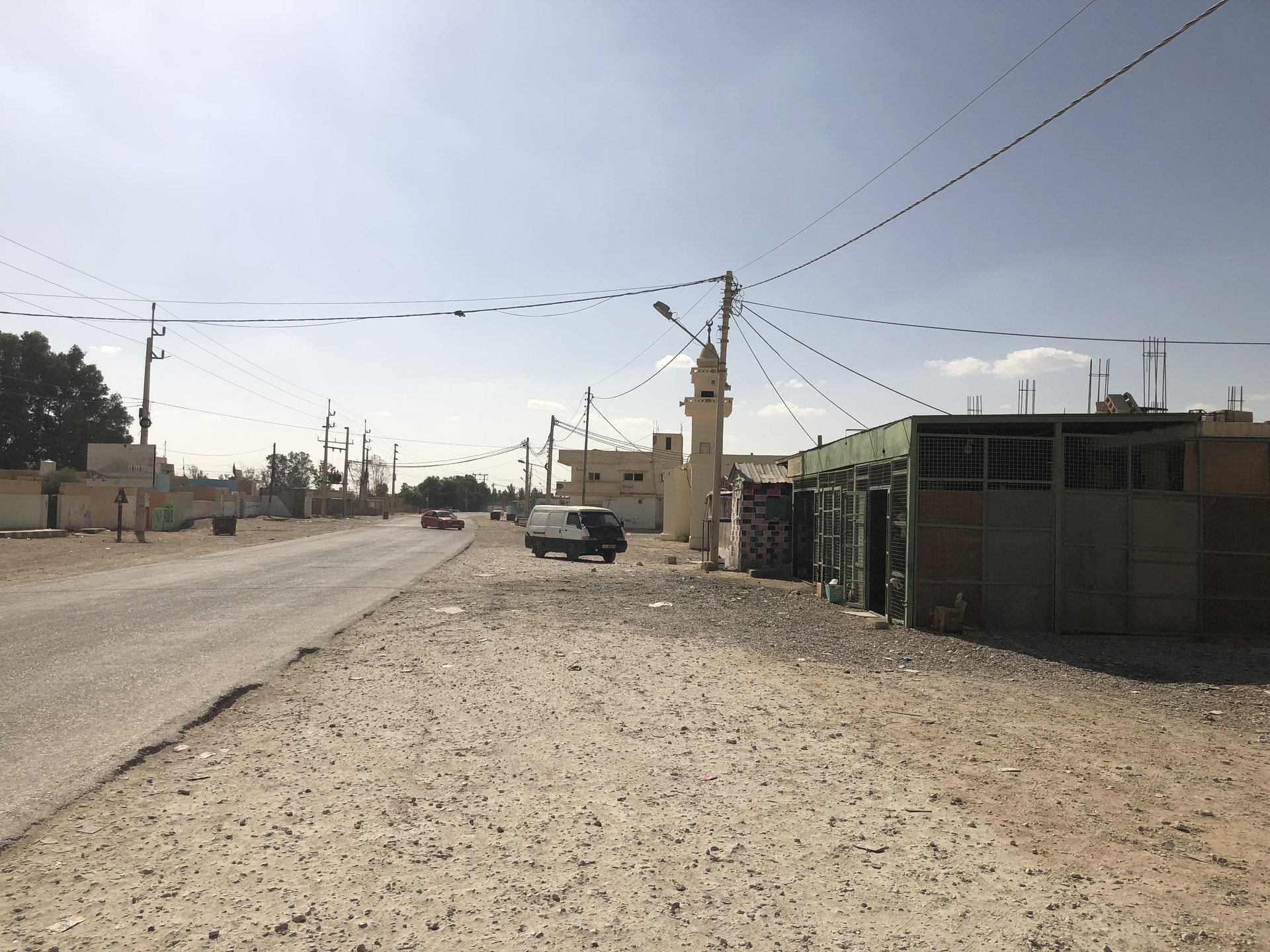
Pictured: the main road through the town of Al-Jafr, Ma'an Governorate, Jordan — not a photograph of the fabricated "landing" itself, since no such event occurred and no image of any kind accompanied the original 2010 article. No rights-clear scan or photograph of Al-Ghad's actual April 1, 2010 front page is known to be publicly available online; this real photograph of the town the hoax targeted is offered instead, consistent with this site's tiered sourcing standard.
Theoretical Alignment
This case aligns almost entirely with the Psycho-Social Hypothesis, and does so in an unusually direct, self-admitted way: there is no disputed witness testimony to weigh and no ambiguous photograph to analyze, because the publisher of the claim confirmed, within days, that it had invented the story. What makes the file worth documenting is not any residual question about extraterrestrial involvement — there is none — but the fact that an entire town's civil institutions (schools, a mayor's office, regional security forces) responded to a piece of satire as though it were a live emergency, in a media environment where the specific genre convention being used (the April Fools' newspaper prank) was itself unfamiliar to much of the audience.
Background
Al-Jafr is a small town in Jordan's Ma'an Governorate, roughly 300 km (185 mi) southeast of the capital, Amman, sitting at approximately 865 meters elevation on the edge of a large, extremely flat, hard-packed desert mudflat. The town itself is modest — Jordan's 2015 national census recorded a population of 6,390 for the built-up settlement proper, considerably below the roughly 13,000 residents Mayor Mohammed Mleihan cited in his own contemporaneous 2010 statements to wire reporters, a figure this file treats as the mayor's own working estimate of his administrative reach (likely including surrounding Bedouin-affiliated communities under the wider Qasabah Ma'an district, which itself held roughly 87,652 residents in the 2015 count) rather than an independently verified census figure for the town core. The discrepancy is noted here rather than silently resolved one way or the other, consistent with this site's standard for reporting population figures precisely.
The area has a real, if UFO-unrelated, history of drawing outside attention because of its physical geography rather than anything paranormal. The Al-Jafr mudflat's exceptional flatness and hardness made it a genuine test site for supersonic land-speed-record attempts: the British ThrustSSC team, driven by Andy Green, ran test sessions on the flat in late 1996 and early 1997 ahead of that October's official record runs at Black Rock Desert, Nevada, with the team's own account, published in February 1997 describing runs completed the preceding November, recording a test run that reached 320 mph on the cockpit airspeed gauge — a new project-best speed at that stage of development. The ThrustSSC engineering team's own site describes the desert's extreme heat by reference to a different, unrelated production: "Jafr is the desert where Omar Sharif comes riding out of the mirage," a nod to David Lean's 1962 film Lawrence of Arabia, whose desert cinematography drew on this general stretch of the Jordanian and Arabian desert corridor. Al-Jafr is also home to a long-standing Jordanian correctional facility, and the wider area has hosted joint U.S.-Jordanian military training activity for decades — a profile that, according to the BBC's own 2010 reporting on this case, made the region "notorious" for its military bases well before the hoax, a real-world security backdrop this file returns to when assessing why local officials treated the fabricated report as seriously as they did.
The newspaper responsible for the hoax, Al-Ghad ("Tomorrow"), is a private, Amman-based Arabic- and English-language daily founded on August 1, 2004 by publisher Mohammad Alayyan through Al Faridah Specialized Printing, generally regarded as politically liberal by regional standards. By 2010 its website ranked among the ten most-visited news sites in the Middle East/North Africa region, making it a genuinely prominent, mainstream outlet rather than a fringe tabloid — a detail directly relevant to why its April Fools' story was taken as a serious news report rather than dismissed as an obvious joke. Al-Ghad would go on to earn a further, unrelated distinction in November 2011, when militants stormed its Amman headquarters and attacked staff, an incident that led to the resignation of a later editor-in-chief the following month; that episode has no substantive connection to the 2010 hoax beyond illustrating that this was, and remains, an outlet operating in a genuinely high-stakes regional media environment, not an obscure local sheet.
Central to understanding why the story produced real panic rather than a shrug is a point multiple outside journalists covering the story explicitly flagged at the time: April Fools' Day newspaper pranks are not an established cultural convention in Jordan, in contrast to countries such as the United States, the United Kingdom, and France, where readers have decades of accumulated experience treating April 1 news with reflexive suspicion. Al-Ghad's editorial staff appears to have imported a Western media-satire format into a readership that had little built-in reason to expect it, without providing the kind of unmistakable interior signal (a "APRIL FOOLS" banner, an absurdist tone impossible to mistake for real reporting) that would have made the joke legible on its own terms.
Complete Timeline
| Date | Event |
|---|---|
| April 1, 2010 (AM) | Al-Ghad's print edition hits newsstands with a front-page story reporting that three extraterrestrial spacecraft had landed in the desert near Al-Jafr overnight, piloted by roughly 3-meter (10-foot) tall creatures whose presence disabled regional electronics and communications. |
| April 1, 2010 (morning) | Word of the article spreads through Al-Jafr largely by word of mouth rather than direct readership; many residents, unfamiliar with the April Fools' convention, take the report at face value. |
| April 1, 2010 (day) | Frightened parents keep children home from school; residents reportedly gather in the streets in a state of fear. Mayor Mohammed Mleihan is alerted and notifies regional security authorities. |
| April 1–2, 2010 | Jordanian security personnel conduct a real search of the desert surrounding Al-Jafr for the reported "aliens," finding nothing. Mleihan states he came close to activating a formal evacuation plan for the town's residents. |
| ~April 2–4, 2010 | Al-Ghad managing editor Moussa Barhoumeh responds to the fallout, characterizing reports of the panic as "blown out of proportion" while acknowledging the story's real-world effects; the paper issues a formal apology. |
| April 5, 2010 | BBC News publishes an English-language report on the incident, titled to reflect the mayor's anger at the newspaper, introducing the story to an international audience. |
| April 6–9, 2010 | The Associated Press wire story is picked up and republished by CBS News, ABC affiliates, The Globe and Mail, Ynetnews, Slashdot, and numerous other outlets; Mleihan is quoted internationally stating he "almost evacuated the town's 13,000 residents" and considered legal action against the newspaper for its "big lie." |
| April 7, 2010 | USA Today runs its own coverage of the incident (Michael Winter, "'Alien invasion' April Fools prank causes public panic"). |
| 2010 onward | The case becomes a recurring reference point in roundups of April Fools' hoaxes that caused genuine public panic, frequently compared to Orson Welles's 1938 War of the Worlds radio broadcast. |
| 2010s–present | Wikipedia establishes a dedicated article, "Jafr alien invasion," and the case is catalogued in the Museum of Hoaxes' searchable April Fool's Day Hoax Database under both its "Extraterrestrials" and "April Fool's Day in the Middle East" categories. |
The Article Itself
Al-Ghad's front-page story described, in ordinary reportorial prose rather than an obviously satirical register, three extraterrestrial spacecraft touching down in the open desert on the outskirts of Al-Jafr. According to the accounts of the article that survive in secondary reporting (this file was unable to locate an archived scan or full verbatim reproduction of the original Arabic text), the story described creatures roughly three meters — about ten feet — tall emerging from the craft, communicating in a language variously rendered in English-language summaries as "squawking," and radiating sufficient heat to be felt at a distance. The article reported that all electronics and communications equipment in the surrounding area stopped functioning during the encounter, and that the visitors remained on the ground for approximately one hour and forty minutes before departing, leaving three large scorch marks burned into the desert floor as the only physical trace of their visit.
No photograph, illustration, or other visual evidence accompanied the text as far as this file's research could determine — a detail that distinguishes this case structurally from most fabricated-evidence hoaxes documented elsewhere on this site (compare the doctored photographic evidence at the center of the Alex Birch and Roswell Slides cases). This was purely a work of invented prose reportage, styled to read as straight news, with none of the paratextual signals — an "April Fool's" label, a deliberately absurd photo, a byline known locally for humor writing — that might have telegraphed its satirical intent to an unfamiliar readership. The specific narrative details (giant humanoid creatures, disabled electronics, scorch marks, a bounded and specific duration of "visit") are recognizable as stock elements drawn from decades of American and European UFO-crash fiction and B-movie tropes, suggesting the piece was written by someone familiar with that genre's conventions for an audience largely unfamiliar with them.
Panic Spreads Through Al-Jafr
The mechanism by which the story caused real fear is itself instructive and well-documented across multiple independent wire reports. Rather than spreading primarily through direct readership of the newspaper itself, accounts consistently describe the story propagating through word of mouth within Al-Jafr — a pattern that closely mirrors how the 1938 War of the Worlds radio panic in the United States is understood to have spread disproportionately among people who had not heard the original broadcast themselves but received a garbled, decontextualized secondhand account of it. This secondhand transmission likely stripped away whatever internal cues (a joking headline font, a wink at the reader, publication-date awareness) might have survived a direct reading of the original article, leaving only the bare, frightening claim: aliens have landed nearby.
Mayor Mohammed Mleihan's own subsequent public statements provide the clearest first-person account of the panic's practical effects. As he told wire service reporters in the days following the story: "Students didn't go to school, their parents were frightened and I almost evacuated the town's 13,000 residents. People were scared that aliens would attack them." This is a specific, falsifiable claim from an accountable public official speaking on the record, not an anonymous or embellished secondhand account, and it has been consistently repeated across every independent outlet that covered the story — the BBC, the Associated Press wire (redistributed via CBS News, ABC affiliate stations, and other outlets), The Globe and Mail, and Ynetnews all quote Mleihan making substantially the same statement.
The specific, concrete effects described — school absences driven by parental fear, residents visibly frightened enough to be noted by their own mayor, and a real, if ultimately unexercised, evacuation contingency being seriously weighed — place this case in a genuine, if smaller-scale, lineage with other documented instances of mass media-driven public alarm, discussed further in this file's Historical Precedents section below.
The Desert Search and the Near-Evacuation
What separates this case from a purely social or psychological panic is that Jordan's own security apparatus responded with a genuine, physical search operation. Multiple independent sources confirm that security personnel were dispatched into the desert surrounding Al-Jafr specifically to look for the reported alien visitors and their craft. This was not merely crowd control or a symbolic show of official concern; it was a literal field search for a threat the authorities, at least initially, treated as potentially real, undertaken by trained personnel in a region the BBC's own contemporaneous reporting described as already carrying a heightened, "notorious" military-security profile due to its history hosting joint U.S.-Jordanian training exercises. The search, unsurprisingly, found nothing — there was no landing site, no craft, and no creatures to locate, because none had ever existed outside the newspaper's own invented text.
Separately and more consequentially, Mayor Mleihan's own account establishes that a full civil evacuation of the town's population was seriously and specifically contemplated at the municipal level, not merely feared by ordinary residents. An evacuation order affecting a reported 13,000 people is not a minor administrative gesture; it implies transportation logistics, temporary sheltering, coordination with regional authorities, and public communication — the kind of emergency-management apparatus a mayor does not begin to activate over a rumor he privately doubts. Mleihan's own later anger, and his stated consideration of legal action against Al-Ghad for what he called its "big lie," reflect a public official who had been placed, however briefly, in the position of preparing a genuine civil emergency response to an event that turned out to be a piece of newspaper fiction.
The Editor's Response and the Apology
Al-Ghad managing editor Moussa Barhoumeh became the newspaper's public face in the aftermath. His initial framing, as quoted across multiple wire accounts, characterized the scale of the public reaction as having been "blown out of proportion" — a phrase that reads, in context, as a mild deflection of institutional responsibility even as the paper moved to formally apologize. His fuller and more frequently quoted statement was more directly contrite: "We meant to entertain, not scare people." That single sentence has become the case's most widely repeated quotation, appearing in nearly every subsequent English-language summary of the incident, from contemporaneous 2010 news coverage through the Museum of Hoaxes' permanent database entry and Wikipedia's own dedicated article.
The apology itself, while sufficient to defuse Mayor Mleihan's stated interest in pursuing legal action, did not include (in any source located by this file's research) a detailed public accounting of the paper's internal editorial process — who wrote the piece, whether senior editors reviewed it before publication with any real understanding of the risk of it being taken literally in a market unfamiliar with the format, or what changes, if any, Al-Ghad made to its own April Fools'-style content policy afterward. This file was unable to confirm that the paper ever again attempted a comparable April 1 hoax story in subsequent years, which this file treats as circumstantially consistent with the incident having functioned as a genuine, lasting editorial lesson, though it cannot confirm that inference directly.
International Media Reaction
The story's transition from a local Jordanian panic into an internationally reported news item followed a familiar wire-service pattern. BBC News published an English-language report on April 5, 2010, four days after the original article, under a headline emphasizing the mayor's anger at the newspaper — the framing that introduced the incident to a global English-reading audience for the first time. Within the following days, the Associated Press moved its own wire version of the story, which was picked up and republished with only minor variation by CBS News, an ABC-affiliate outlet, Canada's The Globe and Mail, Israel's Ynetnews, and numerous smaller outlets and blogs; USA Today ran its own coverage on April 7. Slashdot's technology-community audience discussed the story on April 6 under a headline emphasizing Mayor Mleihan's anger, drawing dozens of comments that, per the record preserved in that thread, largely focused on the broader question of why a satirical newspaper convention common in the West had produced a genuine public-safety response in a market where the convention itself was unfamiliar.
Nearly every one of these international write-ups independently reached for the same historical comparison: Orson Welles's October 1938 War of the Worlds radio broadcast, whose own contested-but-real degree of listener panic has become the default cultural reference point for any story about fiction mistaken for a genuine emergency. This file treats that repeated comparison as itself a meaningful piece of evidence about how journalists covering the story understood its significance — not as another disputed UFO sighting to be weighed on its evidentiary merits, but as a media-sociology case study about the conditions under which fiction gets mistaken for fact.
A Cultural Mismatch: April Fools' Day and Regional Media Culture
Several of the contemporaneous news accounts explicitly framed the incident's underlying cause as a cultural-format mismatch rather than unusual credulity on the part of Al-Jafr's residents specifically. April Fools' Day newspaper pranks are a deeply embedded convention in much of the English- and French-language press, with readers acculturated from childhood to treat April 1 news with automatic, reflexive skepticism regardless of how a given story is framed. That specific cultural training does not transfer automatically to a readership without an equivalent tradition, and multiple sources covering this case explicitly noted that April Fools'-style newspaper hoaxes were not, at the time, an established practice in Jordan or more broadly across Arabic-language print media.
This file treats that cultural-format explanation as the single most important causal factor behind the panic's scale, more significant than any individual editorial failure by Al-Ghad or any particular credulity on the part of Al-Jafr's residents. A story written in a straight, unmarked news register, published by a genuinely prominent and generally trusted regional outlet, delivered into a readership with no learned reflex for treating April 1 stories with suspicion, is close to a worst-case scenario for producing exactly the kind of literal, good-faith belief this case documents. The same article, run in an outlet and a media culture with decades of accumulated April Fools' convention behind it, would very plausibly have been read, correctly, as an obvious joke.
Key Witnesses
This case has no genuine eyewitnesses to any craft, creature, or anomalous phenomenon, because none occurred. The individuals documented below are not observers of a UFO but the two central figures in the hoax and its institutional response — the newspaper editor responsible for the fabricated story, and the municipal official who had to respond to its real-world consequences. This file lists them under the standard "Key Witnesses" heading for structural consistency with the rest of the site, while being explicit that neither witnessed anything anomalous.
Mohammed Mleihan
The town's mayor at the time of the hoax, and the case's central accountable public official. Mleihan notified regional security authorities, who conducted a real desert search for the reported "aliens," and has stated on the record that he came close to ordering a full evacuation of the town's roughly 13,000 residents as parents kept children home from school and residents visibly panicked. He publicly considered pursuing legal action against Al-Ghad over what he called its "big lie" before the matter was resolved with the paper's formal apology. His detailed, specific, repeatedly corroborated public statements are the single strongest evidentiary anchor for the scale of the real-world response this fabricated story produced.
Moussa Barhoumeh
The newspaper's managing editor, and the individual whose public statements constitute the case's own confirmation that the story was intentionally fabricated satire rather than a genuine, mistaken, or third-party-sourced report. Barhoumeh characterized the scale of public reaction as "blown out of proportion," while separately and more directly stating that the paper "meant to entertain, not scare people" — language that functions as an explicit editorial acknowledgment of authorial intent, removing any ambiguity about whether this was a hoax versus a good-faith but mistaken news report. No source located by this file identifies Barhoumeh as the story's actual writer, only as the editor who spoke publicly on the paper's behalf in its aftermath.
The Five Observables Assessment
The Five Observables framework, developed by former AATIP director Luis Elizondo, is used to classify UAP encounters based on performance characteristics that exceed known technology. It has no meaningful application to this case, since no craft of any kind was ever observed by anyone; the article's own narrative claims (a craft that "landed," creatures that emerged) describe a static, grounded scene rather than any flight performance, and even those claims are fictional.
Assessment: None of the Five Observables apply, because the case contains no genuine flight event of any kind — only a fabricated print narrative and a real, separately documented social panic response to it. This file includes the standard framework for structural consistency with every other case on this site, while stating plainly that it has no evidentiary bearing here.
Evidence Assessment
Supporting Anomalous Origin
- None. No photograph, physical trace, radar return, or credible independent eyewitness account of any craft or creature has ever been produced in connection with this case.
Supporting Conventional Explanation
- Al-Ghad managing editor Moussa Barhoumeh publicly and directly confirmed the story was intended as an April Fools' joke, stating the paper "meant to entertain, not scare people"
- The article was published specifically on April 1, the internationally recognized date for satirical newspaper hoaxes
- No photograph or physical evidence of any kind was ever produced, published, or claimed to exist beyond the article's own descriptive text
- A real security search of the desert surrounding Al-Jafr found no craft, no creatures, no scorch marks, and no debris
- The narrative content (ten-foot humanoid creatures, disabled electronics, a fixed one-hour-forty-minute visit duration, scorch marks) closely tracks generic UFO-fiction tropes rather than any pattern seen in genuinely disputed sighting cases
- Multiple fully independent news organizations (BBC, AP/CBS/ABC affiliates, The Globe and Mail, Ynetnews, USA Today) covered the story specifically as a hoax-and-panic story, not as an unresolved UFO report
- The event is catalogued by the Museum of Hoaxes' April Fool's Day Database as a confirmed hoax, alongside dozens of other verified newspaper pranks
Why "Debunked"
This case receives this site's DEBUNKED classification with the lowest practical confidence score this site assigns, and for a narrower, more direct reason than most of the other hoax cases in this archive: there was never an investigative process required to reach that conclusion. Cases like the Roswell Slides Hoax or the Alex Birch UFO Photograph Hoax required independent researchers to do real forensic and archival work — deblurring a photograph, tracing a museum provenance record, obtaining a signed confession decades later — before the underlying claim could be confidently overturned. This case required none of that. The publisher itself confirmed, within days of publication, that the story had been invented for entertainment. There is no competing account, no promoter continuing to insist on the story's truth, and no unresolved chain-of-custody question left open. The only genuinely open analytical question this file addresses is not "did aliens land near Al-Jafr" — they did not — but "why did a self-admitted work of newspaper fiction produce a real municipal security and evacuation-planning response," which is the actual subject of most of this file's analytical sections.
This file rates the case's numerical credibility score at the extreme low end of this site's scale specifically because there is zero genuine ambiguity about the central claim, in contrast to cases scored slightly higher where at least some contested or partially corroborating evidence exists. What earns the case a place in this archive at all — rather than exclusion as simply not a UFO case — is the genuinely well-documented, multiply-sourced, on-the-record institutional panic response: a mayor's own public statements about a near-evacuation, a real desert security search, and school closures driven by parental fear. That response is real, verifiable, and analytically interesting in its own right as a case study in how a fabricated UAP claim can generate consequences indistinguishable in kind (if smaller in scale) from those following a genuine security incident.
Sensor & Instrumentation Detection Profile
No radar, FLIR, acoustic, or any other instrumented sensor data exists in connection with this case, and none was ever claimed by the original article itself — even the fabricated narrative did not assert any instrumented detection, only a purely visual, ground-level "landing" account and a claim that unspecified regional electronics and communications equipment stopped functioning during the visit. That specific claim (a UFO disabling nearby electronics) is itself a stock trope recurring across decades of fictional and hoaxed UFO accounts and was never independently tested, measured, or corroborated by any telecommunications provider, power utility, or other technical authority in Jordan; no source located by this file's research documents any actual verified equipment failure in or around Al-Jafr on or around April 1, 2010.
The only real "detection" apparatus involved in this case was entirely human and institutional: a mayor's phone call to regional security authorities, and the subsequent physical desert search those authorities conducted using standard ground personnel rather than any specialized sensor equipment. That search, per every source describing it, found nothing — consistent with there having been no craft, no creatures, and no landing site to detect in the first place.
Environmental & Geospatial Context
Al-Jafr sits within a semi-arid desert zone at roughly 865 meters elevation, with a mean annual temperature around 17.5°C (63.5°F) and minimal annual precipitation of roughly 36mm, per Jordanian meteorological summary data for the town. Early April falls within the region's transitional spring period: daytime temperatures are typically warm, skies are generally clear with low average cloud cover, and the desert's famously flat, hard-packed terrain (the same physical property that made it attractive to the ThrustSSC land-speed-record program in 1997) offers essentially unbroken sightlines to the horizon in every direction, with no natural terrain features nearby that would produce the kind of ambiguous visual stimulus (mirages excepted, and even those are a daytime heat phenomenon rather than a plausible night-landing misidentification) that sometimes seeds a genuine, good-faith misperception-based UFO report elsewhere in this site's case files.
This file emphasizes that geospatial context specifically because it weakens, rather than supports, any residual argument that the panic might have been triggered or reinforced by some independent, genuinely anomalous environmental stimulus coincidentally occurring the same week (an unusual meteor, an unscheduled military flare exercise, or similar). No source located in this file's research identifies any such independent trigger event; every account traces the panic directly and exclusively to the newspaper article itself, with no claim that any resident reported seeing lights, hearing sounds, or observing anything unusual in the sky independent of having read or heard about the Al-Ghad story first. The causal chain here runs entirely from text to belief to institutional response, without any intervening genuine sensory anomaly.
Observer Credibility & Occupational Profile
Because this case involves no genuine sighting, the standard witness-credibility analysis this site applies to disputed cases does not transfer directly; instead, this section assesses the credibility of the sources establishing what actually happened during the panic response, which is the case's real evidentiary content.
Mayor Mohammed Mleihan is an elected or appointed municipal official speaking on the record, under his own name, to multiple independent wire-service and newspaper reporters, making specific, falsifiable, consistently repeated claims about his own administrative actions (notifying security authorities, considering an evacuation order, weighing legal action). This is a comparatively high-credibility source category on this site's own standards: a named, accountable public official describing his own documented official conduct, with no apparent financial or reputational incentive to exaggerate the panic's severity (if anything, publicly admitting he "almost evacuated" a town over a newspaper hoax exposes him to some degree of ridicule, which argues against embellishment).
Al-Ghad managing editor Moussa Barhoumeh is likewise a named, on-the-record institutional source, in his case directly confirming his own organization's culpability rather than deflecting it entirely — a party-admission that this file treats as carrying particular evidentiary weight, since an editor with an incentive to minimize his paper's liability nonetheless chose to publicly state the story was invented rather than defend it as a genuine, mistaken report from an anonymous source.
The broader international press corps that covered the story — the BBC, the Associated Press and its wire subscribers, The Globe and Mail, Ynetnews, and USA Today — represent mainstream, editorially accountable news organizations rather than tabloid or UFO-community outlets, and their independent, mutually corroborating coverage (each citing substantially the same Mleihan and Barhoumeh quotations, gathered through separate reporting chains) provides the kind of cross-source convergence this site treats as strong corroboration elsewhere in its evidentiary standards.
Physical & Material Assays
No physical material of any kind was ever recovered, tested, or even claimed to exist in connection with this case. The original article's own fictional narrative asserted that the departing craft left "three large scorch marks" on the desert floor, but no source located by this file's research documents any Jordanian authority, journalist, or independent investigator actually visiting a specific claimed scorch-mark location, photographing it, or testing it — the claim appears to have simply been abandoned once the story's fabricated nature was confirmed by the newspaper itself, rather than independently chased down and formally debunked the way this site's genuinely disputed physical-trace cases (soil anomalies, metallurgical samples) typically are. This file treats the absence of any follow-up physical investigation as itself consistent with how quickly and completely the hoax was resolved: once Barhoumeh's public confirmation removed any ambiguity about the story's origin, there was no remaining reason for anyone to conduct forensic fieldwork chasing a fictional detail.
Historical Precedents & Archive Matches
This case belongs to a well-documented broader category of media-originated hoaxes that produced genuine, disproportionate public panic — a category with a much longer history than UFO reporting specifically, and one this site's Museum of Hoaxes source material catalogues extensively.
Orson Welles and the 1938 War of the Worlds Broadcast
The default comparison reached for by nearly every journalist who covered this story, Welles's October 30, 1938 Mercury Theatre radio adaptation of H.G. Wells's novel used a fictional-news-bulletin format convincing enough that some fraction of its audience — the precise scale remains debated by media historians — believed a real Martian invasion was underway. The structural parallel to the Jafr case is direct: both involve a fictional work styled closely enough after a genuine news format to be mistaken for real reporting by an audience unfamiliar with (or that missed) the framing that marked it as fiction, and both produced real, if short-lived, panic responses among people who received the claim secondhand rather than through the original source material itself.
The 1950 Hawaiian Flying Saucer Hoax
Per the Museum of Hoaxes' own April Fool's Day Database, the Honolulu Star-Bulletin published an April 1, 1950 story reporting a flying saucer crash into Honolulu's Punchbowl crater; the story was picked up and broadcast as genuine fact by a ham radio operator, causing real confusion that spread across the mainland United States before the Associated Press identified it as a newspaper prank. This is arguably the closest direct precedent to the Jafr case in the extraterrestrial-hoax category specifically: a print April Fools' joke, relayed through a secondary channel that stripped away its original framing, producing wider public confusion than the original publication alone would have caused.
The 1989 Alton Towers "UFO Lands Near London" Hoax
Also documented in the Museum of Hoaxes database, an April 1, 1989 stunt involving a hot-air balloon built to resemble a flying saucer (reportedly designed with British entrepreneur Richard Branson's involvement) descending in a field in Surrey, prompted genuine police investigation before its promotional/prank nature was revealed. Like the Jafr case, it demonstrates that a sufficiently convincing staged UFO stimulus can mobilize real institutional (in that case, law-enforcement) resources even in a media market — the United Kingdom — with a far more established April Fools' tradition than Jordan's, suggesting format familiarity reduces but does not eliminate the risk of a hoax producing genuine institutional response.
Other April Fools' Extraterrestrial Hoaxes
The Museum of Hoaxes' "Extraterrestrials" category catalogues a recurring pattern across decades: a 1950 Pennsylvania newspaper's fake flying-saucer photograph, near-simultaneous 1950 hoaxes in German outlets (Cologne Neue Illustrierte and Wiesbadener Tagblatt) depicting crashed alien beings, a 1959 claim about artificial satellites around Mars (which Soviet scientist Dr. Iosif Shklovsky reportedly took seriously at the time), and a 1996 AOL "life on Jupiter" news-flash hoax that generated over 1,300 user messages and hundreds of calls to NASA's Jet Propulsion Laboratory. The Jafr case is the most recent, and among the most severe in terms of documented real-world institutional response, entry in this specific decades-long genre.
Comparison to This Site's Other Documented Hoax Cases
Unlike the Roswell Slides Hoax and Alex Birch UFO Photograph Hoax, both of which involved a fabricated or misidentified physical artifact (a photograph) that took genuine investigative effort to expose, the Jafr case involved no artifact requiring forensic analysis at all — only invented prose narrative, confirmed as fiction by its own author's institution within days rather than years or decades. This makes it the fastest-resolved and least evidentially ambiguous of the three hoax cases currently documented on this site, while producing arguably the most severe immediate real-world institutional consequences (a near-evacuation of an entire town) of any of them.
Material Analysis
Because no physical evidence was ever produced, collected, or preserved in connection with this case, this section addresses the case's genuine documentary material — the textual and testimonial record establishing what happened — rather than any physical trace analysis.
The Textual Record
This file was unable to locate a full archived scan or verbatim reproduction of Al-Ghad's original April 1, 2010 Arabic-language article, despite genuine search effort across the newspaper's own archives, general web search, and the secondary sources that quote and summarize it. The case's textual record therefore consists entirely of secondary English-language summaries and paraphrases published by the BBC, the Associated Press and its wire subscribers, and the Museum of Hoaxes' database entry, all of which independently converge on substantially the same narrative details (three craft, roughly ten-foot creatures, disabled electronics, a bounded visit duration, scorch marks). This convergence across independently reported secondary sources gives this file reasonable confidence in the accuracy of the summarized narrative content even without direct access to the Arabic original, though this file explicitly flags the missing primary-source scan as a genuine research gap rather than treating the secondary-source convergence as fully equivalent to it.
The Testimonial Record
By contrast, the testimonial record documenting the panic's real-world effects is considerably stronger: Mayor Mleihan's and editor Barhoumeh's public statements were independently gathered and reported by multiple separate news organizations rather than relayed through a single wire feed alone, and the substance of their quotations is consistent across every version this file located. This file treats the testimonial record of the panic response as the case's genuinely solid evidentiary core, in deliberate contrast to the fictional content of the original article itself, which requires no independent verification at all since its own publisher has confirmed it was invented.
Supporting Non-Terrestrial/Anomalous Origin
- None. No party to this case, including the newspaper responsible for the original claim, has ever asserted the story was anything other than fabricated satire.
Supporting Terrestrial/Fabricated Origin
- Direct, on-the-record confirmation from the newspaper's own managing editor that the story was intended as an April Fools' joke
- Publication date (April 1) matching the internationally recognized date for satirical newspaper hoaxes
- Total absence of any photograph, physical trace, radar return, or independently verified equipment malfunction
- A real security search of the surrounding desert that found no craft, creatures, or scorch marks
- Independent cataloguing of the case as a confirmed hoax by the Museum of Hoaxes' specialist April Fool's Day Database
- Narrative content matching generic, decades-old UFO-fiction tropes rather than any pattern distinctive to genuinely disputed sighting reports
The Conventional Explanation Candidate: A Deliberately Fabricated April Fools' Article
Unlike most case files on this site, where the Conventional Explanation Candidate section weighs a mundane hypothesis against a genuinely live anomalous alternative, this case has no anomalous alternative to weigh at all — the newspaper's own managing editor confirmed the story was intentionally invented satire within days of publication, and no subsequent party has ever disputed that account. The analytical question this section actually addresses is therefore not "what really happened in the desert" (nothing did) but "what combination of factors turned an intended joke into a genuine municipal security response," which this file treats as the case's real subject matter.
Deliberate April Fools' Satire (Confirmed Primary Mechanism)
The story was written and published specifically on April 1, styled as straight news, by a real, named editorial institution that subsequently and directly confirmed its satirical intent. This is not an inference or a probabilistic judgment call; it is the case's own confirmed, admitted origin, stated on the record by the responsible party. Every other candidate explanation below concerns not whether this was the mechanism, but why that mechanism produced the specific, severe real-world consequences it did.
Cultural Unfamiliarity With the April Fools' Format
As discussed at length in this file's own "Cultural Mismatch" section above, multiple contemporaneous journalists explicitly attributed the panic's scale to the fact that April Fools' newspaper pranks were not an established convention in Jordan at the time, leaving readers without the reflexive skepticism a comparable story would likely have triggered in a market with decades of accumulated exposure to the format. This file treats this as the single strongest contributing factor behind the panic's unusual severity relative to how most April Fools' hoaxes are received in markets where the convention is well established.
Secondhand Word-of-Mouth Transmission
Multiple accounts describe the story spreading through Al-Jafr primarily by word of mouth rather than direct newspaper readership, a transmission pathway that plausibly stripped away whatever contextual cues (publication date awareness, a recognizably joking tone in the original text) might have survived a direct first-hand reading. This mirrors the well-documented pattern behind the 1938 War of the Worlds panic, where secondhand, decontextualized accounts of the broadcast are understood to have driven a disproportionate share of the resulting public alarm.
Pre-Existing Regional Security Sensitivity
The BBC's own 2010 reporting specifically described the area around Al-Jafr as "notorious" for hosting military bases used in joint U.S.-Jordanian exercises. This file considers it a genuine, if secondary and unprovable, possibility that a population already accustomed to unusual military and security activity in their immediate vicinity may have found a report of unidentified activity in the desert somewhat more plausible on its face than residents of a more purely civilian area might have — though this file explicitly flags this candidate as the most speculative of the four, since no source directly documents residents citing the area's military history as a reason they found the UFO story credible.
The Assessment
Deliberate April Fools' Satire
ConfirmedNot a candidate weighed against alternatives but the case's directly confirmed origin, stated on the record by Al-Ghad's own managing editor within days of publication. This is the established fact the rest of this section's candidates seek to explain the consequences of, not an open question in its own right.
Cultural Unfamiliarity With the Format
Highly PlausibleExplicitly cited by multiple independent contemporaneous journalists as the central reason the joke was taken literally; consistent with the absence of any comparable panic response documented for April Fools' hoaxes published in markets with an established satirical-newspaper tradition.
Secondhand Word-of-Mouth Transmission
PlausibleDirectly supported by multiple accounts describing the story spreading through the town by rumor rather than direct readership, and consistent with the well-documented mechanism behind the comparable 1938 War of the Worlds panic.
Pre-Existing Regional Security Sensitivity
InconclusiveA genuine, real-world contextual factor (the area's documented military-exercise history) that plausibly contributed to residents' willingness to believe an unusual-activity report, but never directly cited by any resident or official as a specific reason for taking the story seriously in any source located by this file's research.
Related Cases
No Government Records Exist for This Case
This case involves no U.S. or allied government investigation, program, or classified record of any kind — it is a purely civilian print-media hoax and its own newspaper publisher's confirmed fabrication, handled entirely by Jordanian municipal and security authorities rather than any national intelligence, defense, or aviation agency. No FBI, CIA, NARA, or Project Blue Book file, and no equivalent Jordanian government record, has ever been associated with this incident in any source located by this file's research. The declassified-archive search links below are provided for general reference and cross-case research consistency with the rest of this site, not because any record specific to this case is known or expected to exist within them.
Search Government Archives Directly
Further Reading — Recommended Literature
The Panic Broadcast: Portrait of an Event
Written by the actual screenwriter of Orson Welles's 1938 War of the Worlds broadcast, this firsthand account of the original panic-inducing media hoax remains the essential primary-source comparison point for any later case, including Jafr, in which fiction was mistaken for a genuine emergency.
The Museum of Hoaxes
Written by the creator of hoaxes.org — the specialist April Fool's Day Database this file cites directly as its own primary catalog source for the Jafr case — this survey traces documented hoaxes from the Middle Ages to the present, including the specific tradition of newspaper April Fools' pranks the Jafr article belongs to.
Broadcast Hysteria: Orson Welles's War of the Worlds and the Art of Fake News
A rigorously researched reassessment of how much genuine panic the 1938 broadcast actually caused, and why the story of mass hysteria became a durable American myth in its own right — directly relevant to critically evaluating claims of "mass panic" in any later media-hoax case, this one included.
The Invasion from Mars: A Study in the Psychology of Panic
The original scholarly field study of the 1938 broadcast's audience reaction, conducted by a Princeton psychologist in its immediate aftermath. Its central finding — that panic concentrated most heavily among listeners who received a garbled secondhand account rather than the broadcast itself — maps closely onto how the Jafr hoax is documented to have spread.
A Colorful History of Popular Delusions
A wide-ranging survey of mass hysteria and media-driven panic episodes across history and cultures, written by two sociologists specializing in collective delusions — provides the broader comparative framework for understanding the Jafr hoax as one instance of a recurring, well-studied social phenomenon rather than an isolated curiosity.
DISCLOSURE: Some links above are affiliate links. If you purchase through them, OverClassified receives a small commission at no additional cost to you. This helps support independent research.
Essential Viewing
No Videos Available
A reasonable search effort (multiple query angles across general and video-specific search) found no video content genuinely, primarily dedicated to this specific 2010 incident — only unrelated content sharing keyword overlap with "Jordan," "alien," or "UFO." Consistent with this site's editorial policy, no off-topic or loosely related video has been substituted.
Sources
- "Jafr alien invasion." Wikipedia. en.wikipedia.org
- "Al-Jafr, Jordan." Wikipedia. en.wikipedia.org
- "Al Ghad." Wikipedia. en.wikipedia.org
- "Alien Invasion of Jafr (April Fool, 2010)." The Museum of Hoaxes, April Fool's Day Database. hoaxes.org
- "April Fool's Day Extraterrestrials Hoaxes." The Museum of Hoaxes. hoaxes.org
- "April Fool's Day in the Middle East." The Museum of Hoaxes. hoaxes.org
- "Newspaper's UFO Prank Causes Mayhem in Jordan." CBS News / Associated Press, April 6, 2010. cbsnews.com
- "Newspaper's April Fool's UFOs cause panic." The Globe and Mail (Associated Press), April 2010. theglobeandmail.com
- "Jordan: Newspaper's April Fools' UFOs cause panic." Ynetnews, April 2010. ynetnews.com
- "Jordanian Mayor Angry Over 'Alien Invasion' Prank." Slashdot, April 6, 2010. news.slashdot.org
- "Jordanian paper's April Fool's UFOs spark panic." Associated Press, republished via ABC7/6abc archive. 6abc.com
- "The Jafr Alien Invasion: The Scary Extraterrestrial Visit to Jordan." Commonplace Fun Facts, March 16, 2019. commonplacefacts.com
- "Ten Foot Tall Aliens In Jordan Not So Funny." Whales in Space, April 6, 2010. whalesinspace.com
- The Jordan Experience — ThrustSSC 1997 desert test program, official team account. thrustssc.com
- "Al-Jafr (Qasabah Ma'an, Ma'an Governorate, Jordan)." Population statistics, 2015 census. City Population. citypopulation.de
- File: Al-Jafr main road.jpg. Photograph by Davide Mauro, October 19, 2018, CC BY-SA 4.0. Wikimedia Commons. commons.wikimedia.org
- "King Faisal Air Base shooting." Wikipedia (regional military-security context for Al-Jafr, unrelated to the 2010 hoax itself). en.wikipedia.org
- Cantril, Hadley. The Invasion from Mars: A Study in the Psychology of Panic. Princeton University Press, 1940 (historical-precedent comparison source).
- Schwartz, A. Brad. Broadcast Hysteria: Orson Welles's War of the Worlds and the Art of Fake News. Hill and Wang, 2015 (historical-precedent comparison source).
- "Ma'an Governorate." Wikipedia (regional administrative context). en.wikipedia.org
- The Global Intelligence Files — Stratfor internal republication of the AP wire story on the Jafr hoax. WikiLeaks. wikileaks.org
See something inaccurate? Have additional information or sources?
Suggest an Edit →Last Updated: August 2026