
Micro Black Hole Propulsion Hypothesis
Proposes that UAP propulsion or power generation could exploit microscopic black holes — either engineered on demand or captured intact from the early universe's own population of primordial black holes — harnessing Hawking radiation, a rigorously derived, mainstream theoretical prediction of quantum field theory in curved space-time, as an onboard energy source or thrust mechanism.
Rigorous Theoretical Physics, Unbuildable Propulsion DeviceCore Thesis
Hawking radiation is not a fringe idea. It is a rigorously derived prediction of quantum field theory applied to the curved space-time around a black hole, worked out in 1974, and it rests on the same theoretical bedrock — general relativity married to quantum mechanics — that underlies the rest of modern black hole physics, including the Bekenstein-Hawking entropy law it grew out of. A black hole should not be perfectly black: it should radiate a faint thermal glow, shrink as it does, and grow ever hotter and brighter as it shrinks, all the way to a final, explosive burst of radiation as it winks out of existence. This theory's speculative leap begins exactly where the established theoretical physics runs out: proponents propose that a microscopic black hole — manufactured by concentrating an enormous quantity of energy into an infinitesimally small volume, or, far more speculatively, captured intact from the early universe's own surviving population of primordial black holes — could be fed, contained, and steered well enough to serve as a starship's power source or propellant. The honest problem is twofold. First, no direct astrophysical observation of Hawking radiation from a real black hole exists anywhere in the confirmed scientific record; the effect remains a theoretical prediction, albeit one with genuine, if since-disputed, indirect support from a 2016 laboratory analogue experiment. Second, every serious calculation of what it would actually take to manufacture, contain, and usefully harness an artificial black hole — even one deliberately engineered to survive years rather than a fraction of a second — describes an energy budget and containment-engineering problem many thousands of times beyond the entire world's current annual energy production, a gap recent theoretical work suggests quantum physics itself may forbid closing by the most obvious route.
Origin & History
The Micro Black Hole Propulsion Hypothesis proposes that some UAP could generate onboard power, or even thrust, from a black hole scaled down to the size of a proton or smaller — a device that would draw its energy not from chemical combustion, nuclear fission, or fusion, but from the black hole's own evaporation. Unlike most speculative propulsion theories catalogued on this site, this one does not begin with a UAP sighting, a leaked patent, or a disputed laboratory claim; it begins with one of the most celebrated results in twentieth-century theoretical physics, developed with no reference to UAP research at all, and only much later picked up by a small number of physicists asking whether the underlying physics could, in principle, be turned into an engine.
The chain of ideas runs through three separate, individually uncontroversial pieces of mainstream physics before it ever touches propulsion speculation. The first is Jacob Bekenstein's 1972–1973 proposal, made while he was a doctoral student under John Archibald Wheeler at Princeton, that a black hole must possess entropy proportional to the area of its event horizon — an idea initially resisted by much of the field, including by Stephen Hawking himself, on the grounds that a body with entropy should also have a temperature, and a black hole with a temperature above absolute zero should, by the ordinary laws of thermodynamics, radiate. The second piece is Hawking's own 1974 response to that objection: rather than refuting Bekenstein, Hawking's calculation confirmed he had been right, deriving that black holes do indeed emit a thermal spectrum of particles — what the field has called Hawking radiation ever since — and are consequently losing mass and, given enough time, will evaporate completely. The third piece, decades later, is the recognition that if quantum gravity becomes strong at an energy scale within reach of a large particle accelerator — a live, if now largely excluded, possibility under certain “large extra dimension” models of space-time — a facility like CERN's Large Hadron Collider could conceivably manufacture black holes of subatomic mass for a fraction of a second, giving experimentalists a real search target rather than a purely theoretical curiosity.
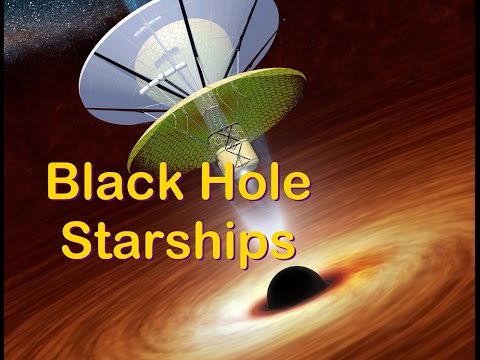
The propulsion-specific extension of this physics is comparatively recent and comparatively obscure. In a 2009 paper posted to the arXiv preprint server, mathematician Louis Crane and his then-doctoral student Shawn Westmoreland, both at Kansas State University, asked directly whether a starship could be powered by an artificially manufactured black hole feeding its own Hawking radiation into a parabolic reflector for thrust. Their paper's central appeal — and the reason this site catalogues the idea at all, rather than dismissing it alongside less physically grounded propulsion schemes — is that it proposes no new physics whatsoever: every ingredient (general relativity, quantum field theory, black hole thermodynamics) is already mainstream and, in the case of Hawking radiation's underlying mathematics, essentially unchallenged. What Crane and Westmoreland's paper does not claim, and what no credible source anywhere in the literature this file surveys claims, is that any UAP case file provides evidence such a device has ever been built. This file exists to examine that real, if narrow, body of physics on its own terms, and to be equally honest about the enormous engineering gap — considerably larger, on the numbers, than the gap documented in this site's own Gravitomagnetic Frame-Dragging Propulsion Hypothesis file — that separates the confirmed theoretical physics from anything resembling a flyable device.
Scientific Foundations
The physics behind this theory divides cleanly into two tiers: a body of rigorously derived, broadly accepted theoretical physics, and a much smaller, more contested, and more recent set of results bearing on whether that physics has ever been, or could ever be, observed and engineered. Both tiers are laid out here in the order the underlying science actually developed.
1. Black Hole Thermodynamics & the Bekenstein-Hawking Entropy
Before Hawking radiation could be derived, someone had to notice black holes needed a thermodynamics at all. Jacob Bekenstein's 1973 paper, “Black Holes and Entropy,” published in Physical Review D, proposed that a black hole's entropy is proportional not to its volume, as ordinary matter's entropy is, but to the surface area of its event horizon — a genuinely strange result that would later become the seed of the much broader “holographic principle” in theoretical physics. The precise relationship, now called the Bekenstein-Hawking entropy formula, states that a black hole's entropy equals its horizon area multiplied by a small collection of fundamental constants and divided by four. Bekenstein's proposal was controversial when it appeared, not because anyone doubted the horizon-area calculation itself, but because a body with real thermodynamic entropy should also have a real temperature above absolute zero — and a black hole, by the classical definition that nothing escapes its horizon, was assumed to have no temperature and radiate nothing at all.
2. Hawking Radiation: The 1974 Discovery
Stephen Hawking initially set out to show why Bekenstein's proposal could not be literally true. Applying quantum field theory to the curved space-time surrounding a black hole — treating the vacuum itself as a sea of constantly appearing and annihilating virtual particle pairs, one of which can occasionally fall past the horizon while its partner escapes as real, detectable radiation — Hawking found the opposite of what he expected: black holes really do have a well-defined temperature, inversely proportional to their mass, and really do radiate. His result appeared as a two-page paper, “Black Hole Explosions?,” in Nature in 1974, with the fuller mathematical derivation following in a 1975 paper in Communications in Mathematical Physics. The consequence Hawking drew out explicitly in his title is the one most relevant to this theory: a sufficiently small black hole, radiating a large amount of energy relative to its own tiny mass, should shrink, heat up further as it shrinks, radiate still faster, and eventually reach a final, explosive burst of radiation as it evaporates out of existence entirely — the literal “explosion” of the paper's title. For an ordinary stellar-mass or larger black hole, this process is so slow as to be functionally irrelevant (a black hole with the mass of the Sun would take vastly longer than the current age of the universe to evaporate); the effect only becomes dramatic, on any human timescale, for a black hole many, many orders of magnitude less massive than a star.
3. Primordial Black Holes & the “Naturally Captured” Question
Hawking's interest in very low-mass black holes did not begin with the 1974 radiation paper; it began three years earlier, in 1971, when he proposed that sufficiently large density fluctuations in the hot, early universe could have collapsed directly into black holes of essentially arbitrary mass, entirely independent of the stellar-collapse process that produces every black hole astronomers have since directly observed. These hypothetical primordial black holes are the theoretical anchor for the “naturally captured,” rather than artificially manufactured, half of this theory's title: if primordial black holes exist and survive at asteroid-scale or smaller masses, then in principle — though with no supporting evidence of any kind that this file's research was able to identify — an extraordinarily advanced civilization might capture and harness one rather than building it from scratch. The physics here cuts sharply against convenient scale: a primordial black hole with an initial mass around 5 × 10¹¹ kilograms (roughly the mass of a mountain) would be completing its evaporation, in a final burst of gamma radiation, at just about the present cosmic age, which is precisely why astronomers have searched gamma-ray sky surveys for exactly this signature; a black hole massive enough to survive stably for a genuinely useful operational lifetime would radiate too faintly to power much of anything, while one radiating powerfully enough to be useful would, by the same physics, be finishing its own evaporation on a timescale far too short for any capture-and-use scheme to matter. No confirmed detection of any primordial black hole, evaporating or otherwise, exists in the observational record.
4. Could a Particle Collider Make One? Large Extra Dimensions and the TeV-Scale Hypothesis
Under the ordinary four-dimensional general relativity used everywhere else in this file, manufacturing a black hole requires concentrating mass-energy at the Planck scale — roughly 1019 billion electron-volts — a factor of roughly a quadrillion beyond anything the Large Hadron Collider's 13.6 TeV collision energy can reach, which is why nobody seriously worried about collider-made black holes before the late 1990s. That changed with a specific, falsifiable proposal: in 1998, Savas Dimopoulos, working with Nima Arkani-Hamed and Gia Dvali, proposed that space-time might contain additional, compactified spatial dimensions large enough to dilute gravity's apparent weakness at everyday distances while leaving it genuinely strong at distances comparable to a proton's size — the “large extra dimensions” or ADD model. If true, quantum gravity's effective energy scale could sit as low as a few trillion electron-volts, squarely within reach of the LHC. Dimopoulos, together with Greg Landsberg, and separately Steven Giddings, together with Scott Thomas, each published papers in 2001 and 2002 respectively working out the striking consequence: under this model, a high-energy collider could become, in Giddings and Thomas's own memorable phrase, a “black hole factory,” producing microscopic black holes at a rate of one or more per second once collision energies crossed the relevant threshold.
5. The Search and the Null Result
A serious theoretical possibility that a major, already-funded experiment might produce black holes — even ephemeral, subatomic ones — drew genuine public concern and, briefly, litigation, addressed in full in Government & Military Programs below. Once the LHC began colliding protons in 2010, the ATLAS and CMS collaborations both built dedicated search programs looking for the distinctive experimental signature a microscopic black hole's near-instantaneous evaporation would leave: an unusually high-multiplicity spray of energetic particles emerging from a single collision point, rather than the more collimated jets ordinary Standard Model physics produces. Every search has come back negative. Early analyses of 8 TeV collision data excluded microscopic black holes below roughly 5–6 TeV in mass; by 2016, ATLAS and CMS searches using the LHC's upgraded 13 TeV collision energy had pushed that exclusion limit past 9 TeV. No candidate event, in any search to date, has shown the predicted signature. This is a genuinely informative null result rather than a non-finding: it directly constrains, and substantially disfavors, the large-extra-dimension models that made a TeV-scale black hole factory a serious hypothesis in the first place, without ruling out large extra dimensions altogether at every possible scale.
6. The Honest Engineering Gap
This is the section where this theory's rigorous theoretical physics ends and its genuinely speculative engineering literature begins, and — as with every other confirmed-physics-plus-speculative-leap theory this site catalogues — the scale of that gap is the central fact any honest treatment must state plainly, in concrete numbers rather than left abstract. Crane and Westmoreland's own 2009 calculation, chosen deliberately to favor the proposal's feasibility as much as the physics allows, describes a black hole of roughly 606,000 metric tons — comparable to a large aircraft carrier — with a Schwarzschild radius of about 0.9 attometers, ten thousand times smaller than a proton, radiating some 160 petawatts of power and lasting on the order of 3.5 years before evaporating completely. Converting that black hole's own rest mass into energy via E=mc² alone, before any consideration of containment or feeding, requires concentrating on the order of 5 × 1025 joules into a volume far smaller than an atomic nucleus — roughly ninety thousand times the entire world's total annual energy consumption, delivered not over a year but in the instant of the black hole's formation. Crane and Westmoreland's own proposed mechanism for supplying that energy is a spherical gamma-ray laser array surrounding the target volume from every direction at once, a device with no existing prototype at any scale and no established physical pathway from present laser technology, which remains many orders of magnitude short in both total energy and focusing precision.
Even that heroic assumption may not be enough. A 2024 theoretical paper by Álvaro Álvarez-Domínguez and collaborators, published in Physical Review Letters, examined the related “kugelblitz” concept — a black hole formed purely from concentrated light, a term coined in a different context by John Archibald Wheeler in his 1955 “geons” paper — and found that while general relativity alone permits it, quantum electrodynamic effects (particle pairs spontaneously created by the intense light itself bleeding energy back out of the collapsing region) may prevent the required energy density from ever actually accumulating in any physically realistic scenario, a claim that has already drawn a published scholarly response and remains an active, unsettled area of research rather than a closed question. Layered on top of the raw energy problem is a second, independent one Crane and Westmoreland's own paper does not shy away from: a black hole this small radiates in every direction at once, and reflecting even a large fraction of that output into directed thrust with a mirror requires optics operating at temperatures and radiation intensities with no engineering precedent whatsoever, on a ship that must also continuously manufacture replacement black holes as each one evaporates. No peer-reviewed proposal exists describing a credible pathway to any of these three separate problems — energy concentration, thrust-conversion optics, and continuous resupply — let alone all three simultaneously, and the small body of speculative literature that exists treats this triple gap as the concept's defining, unresolved obstacle rather than a detail to be waved away.
Government & Military Programs
No declassified U.S. military or intelligence document that this file's research was able to identify describes a program investigating micro black holes specifically as a UAP-propulsion mechanism, in contrast to this site's Pais Effect and Vacuum Polarizability files, both of which document real, named Navy patents and internal test programs. The genuine government involvement with this subject runs through an entirely different channel: public safety oversight of CERN's Large Hadron Collider itself, an international scientific facility funded by more than twenty member states rather than any single national government or military.
When the LHC's black-hole-factory possibility (see Scientific Foundations above) reached wider public attention ahead of the collider's 2008 start-up, CERN convened the LHC Safety Assessment Group, whose report — led by theoretical physicist John Ellis, then head of CERN's Theory Division, together with four co-authors — concluded there was “no basis for any conceivable threat” from LHC collisions, reasoning in significant part from an independent astrophysical argument: cosmic rays with energies far exceeding anything the LHC produces have been striking Earth's atmosphere, the Sun, and other astronomical bodies for billions of years without producing any observed catastrophic effect, a natural experiment already run at a vastly larger scale than any collider could reproduce. A separate, methodologically distinct theoretical paper by physicist Steven Giddings and Michelangelo Mangano, published in the peer-reviewed Physical Review D, reached the same conclusion via direct calculation of the astrophysical consequences even in the deliberately conservative, worst-case assumption that a produced black hole was stable rather than rapidly evaporating — a second, independent line of reasoning arriving at the same safety conclusion, in a structural echo of how this site's own Gravitomagnetic Frame-Dragging file treats Gravity Probe B and the LAGEOS satellites as two independently confirming measurements.
The concern was serious enough to reach a real American federal courtroom. In March 2008, Walter Wagner, a former radiation safety officer with a physics background from the University of California, Berkeley, and Spanish journalist Luis Sancho filed suit in the U.S. District Court for the District of Hawaii against the U.S. Department of Energy, the National Science Foundation, Fermilab, and CERN, seeking to halt LHC operations pending a full National Environmental Policy Act review of the collider's hypothetical black-hole and “strangelet” risks. Judge Helen Gillmor dismissed the case in September 2008, ruling that the American government's minority funding share made the LHC too small a piece of U.S. federal action to trigger NEPA review; a subsequent appeal was dismissed for a related jurisdictional reason in 2010, and the case closed without any court ever ruling on the safety question itself. The episode is a genuine, if unusual, example of a real government process — federal environmental law, not any UAP-related statute — being formally tested against exactly the physics this theory's confirmed half rests on, even though neither party to the suit ever raised UAP propulsion as an issue.
Physical Evidence
No recovered UAP hardware or crash debris anywhere in this site's catalogue is identified as, or claimed to function as, a micro black hole reactor or drive, and this theory predicts no distinctive metallurgical or chemical material signature the way this site's metamaterial or exotic-alloy theories do — a black hole is a region of curved space-time, not a substance, and leaves behind no physical sample to recover or assay. What physical apparatus does exist in this theory's confirmed-physics half is real, operating scientific hardware: the ATLAS and CMS detectors at CERN, each a multi-story particle detector recording roughly a billion proton-proton collisions per second in search of, among many other things, the microscopic black hole signature described above, and Technion's atomic physics laboratory, home to the Bose-Einstein condensate apparatus used in the 2016 analogue-gravity experiment discussed in Historical Precedents below.
The theory's speculative propulsion half predicts a physical signature that would, if it existed, be strikingly different from every other exotic-propulsion theory this site catalogues: intense, hard gamma-ray and high-energy particle radiation, concentrated at whatever point the device is operating, rather than a chemical exhaust plume, a combustion byproduct, or an electromagnetic field signature. This is the one theory on this site whose predicted physical trace would most plausibly correlate with a radiological injury to a nearby observer — a genuinely distinctive prediction discussed further in Material Analysis below — rather than with an aerodynamic, chemical, or purely visual trace.
Supporting Case Files
Theoretical Alignment
This hypothesis aligns only weakly and incidentally with the Extraterrestrial Hypothesis specifically, for the same reason this site's other confirmed-physics-based propulsion theories do: nothing about black hole thermodynamics requires or implies a non-human origin, and the theory's own genuine engineering literature (Crane and Westmoreland's paper) was written by credentialed human academics with no UAP framing at all. Its strongest and most honest alignment is with this site's broader category of speculative-but-physics-literate human engineering proposals, alongside the Pais Effect, Vacuum Polarizability, and Gravitomagnetic Frame-Dragging files — though rated somewhat lower than Frame-Dragging's own 45% figure, reflecting the additional, unresolved uncertainty (unlike frame-dragging, which has been directly measured) over whether Hawking radiation itself has ever actually been observed outside a disputed laboratory analogue. Its alignment with a distinct “Energy / Radiation Anomaly” category — rather than this site's more usual Sensor/Kinematic Misidentification axis — reflects this theory's genuinely unusual predicted signature: unlike most propulsion theories catalogued here, which predict either a kinematic trace or an aerodynamic/electromagnetic one, this theory's clearest hypothetical physical signature is radiological, a category most other propulsion theories on this site do not predict at all.
Sensor & Instrumentation Detection Profile
A genuine, operating micro black hole power source would, in principle, be one of the more detectable exotic-propulsion mechanisms this site catalogues, precisely because its predicted signature — hard gamma-ray and high-energy particle emission — is exactly the kind of signal existing scientific instrumentation is already built to register, in sharp contrast to this site's Alcubierre and Frame-Dragging files, both of which predict signatures that are close to invisible to any fielded sensor. Gamma-ray astronomy satellites such as NASA's Fermi Gamma-ray Space Telescope routinely search the sky for exactly the kind of sharp, localized gamma-ray burst a small evaporating black hole's final moments would produce, originally motivated by the search for naturally evaporating primordial black holes rather than any engineered device; no fielded UAP-investigation sensor suite, however, carries comparable gamma-ray or high-energy particle detection capability, meaning that even a genuine event would very likely go undetected by the radar, FLIR, or visual-spectrum instruments that produced most of this site's own high-credibility case files.
This creates a real evidentiary asymmetry worth stating plainly. A visual or infrared sensor could, at most, register the intense light and heat a large release of radiation would produce as it interacts with surrounding air — a signature this theory shares, non-uniquely, with several of this site's other high-energy propulsion theories — without being able to distinguish a black hole's specific radiation spectrum from an intense but conventional energy release of some other kind. A dosimeter or Geiger counter, carried by a witness or first responder after the fact, is the one instrument class genuinely capable of registering this theory's most distinctive predicted signature, which is precisely why this file's Material Analysis section below treats reported post-encounter radiation exposure, however rare and however each specific case's cause remains independently disputed, as this theory's single most relevant category of physical evidence, more relevant here than to almost any other theory this site catalogues.
Environmental & Geospatial Context
As a proposed universal physical mechanism rather than a location-specific phenomenon, this theory carries no dedicated UAP sighting geography of its own; its confirmed-physics half is anchored entirely to laboratory and accelerator-physics infrastructure — CERN's Large Hadron Collider straddling the Swiss-French border near Geneva for the collider-physics half, and Technion – Israel Institute of Technology in Haifa for the 2016 laboratory analogue experiment. Its three supporting case files span markedly different settings with no shared geography: the Cash-Landrum incident occurred on a rural East Texas roadway; the Malmstrom Air Force Base missile shutdowns took place at a Minuteman ICBM launch-control complex outside Great Falls, Montana; and the RB-47 Bomber Chase unfolded across a multi-state flight path stretching from the Gulf of Mexico to Oklahoma, tracked by an Air Force reconnaissance aircraft's own onboard radar and signals-intelligence equipment rather than any ground-based sensor network.
No environmental or geophysical variable proposed anywhere in the sourced literature — altitude, latitude, local magnetic field, or atmospheric density — is predicted to meaningfully affect a hypothetical micro black hole device's operation, since neither Hawking radiation nor the energy required to produce it depends on any property of the surrounding atmosphere. This is a meaningful contrast with this site's electromagnetic and plasma-propulsion theories, several of which do predict altitude- or atmosphere-dependent behavior, and consistent with how this site's other general-relativity-based theories (Alcubierre, Frame-Dragging) are similarly environment-independent.
Observer Credibility & Occupational Profile
This theory's confirmed-physics chapter carries an exceptionally strong credentialing record, arguably the strongest of any theory this site catalogues. Stephen Hawking held Cambridge University's Lucasian Professorship of Mathematics, a position once held by Isaac Newton, from 1979 to 2009; Jacob Bekenstein earned his doctorate under John Archibald Wheeler at Princeton before a long career at Ben-Gurion University and the Hebrew University of Jerusalem; Wheeler himself supervised 46 doctoral students at Princeton, more than any other physics professor in the university's history, including Bekenstein, Richard Feynman, and Kip Thorne. Savas Dimopoulos holds an endowed chair at Stanford; Steven Giddings, a Princeton-trained theoretical physicist at UC Santa Barbara elected a Fellow of the American Physical Society for his work on quantum black hole physics, co-authored both the original TeV-scale black hole prediction and the independent safety analysis discussed above; John Ellis, the most-cited theoretical physicist of his generation by several bibliometric measures, led CERN's Theory Division for six years before chairing the 2008 safety review.
The theory's speculative propulsion-engineering half rests on a thinner, though still credentialed, record, with one honest asterisk this file should not obscure. Louis Crane is a career mathematics professor whose separate, mainstream body of work on category-theoretic approaches to quantum gravity is independently well-regarded; Shawn Westmoreland completed his own doctorate at Kansas State the year after their joint paper appeared. Unlike Robert L. Forward's 1963 frame-dragging paper, discussed on this site's own Gravitomagnetic Frame-Dragging file, which was formally peer-reviewed and published in the American Journal of Physics, Crane and Westmoreland's “Are Black Hole Starships Possible?” has never, as best this file's research can determine, been published in a peer-reviewed journal — it remains an arXiv preprint, however widely covered in the science press and however grounded its individual physical ingredients are. This file treats that distinction as material rather than dismissible: the paper's underlying physics draws entirely on peer-reviewed results by others, but the specific propulsion-engineering synthesis itself has not itself cleared formal peer review, a genuinely different evidentiary status than this site's frame-dragging propulsion-engineering literature enjoys. Separately, Walter Wagner, the plaintiff in the 2008 LHC safety lawsuit, held a physics background from UC Berkeley and professional experience as a radiation safety officer, but was not, and has never claimed to be, a working theoretical or particle physicist, a distinction press coverage of the case did not always preserve and one this file preserves deliberately.
Historical Precedents & Archive Matches
The conceptual precedent for a black hole built from concentrated energy rather than collapsed matter predates even Hawking radiation. John Archibald Wheeler's 1955 paper “Geons,” published in Physical Review, explored self-bound configurations of pure electromagnetic or gravitational field energy, using the unpublished term “kugelblitz” — German for “ball lightning” — for the specific case of a body of light dense enough to trap itself; Wheeler's original geons were not black holes and had no event horizon, but the term has since migrated in popular and semi-popular physics writing to describe exactly the light-collapsed black hole concept this file's Scientific Foundations section discusses, closing a nearly seventy-year conceptual loop between Wheeler's original thought experiment and the 2024 quantum-electrodynamic no-go result bearing his invented word's modern meaning.
The genuinely speculative propulsion-engineering literature on this subject is thin compared to several of this site's other confirmed-physics theories, and largely confined to the single Crane-Westmoreland paper discussed throughout this file, together with the wider science-journalism coverage it generated (Scientific American, Universe Today, and Centauri Dreams among the outlets that covered it at the time). No dedicated UAP-research proposal linking micro black holes specifically to observed UAP flight characteristics or propulsion signatures was identified anywhere in this file's research; the closest adjacent UAP-propulsion literature — the general-relativistic “metric engineering” concepts covered in more depth on this site's Alcubierre Warp Drive and Gravitomagnetic Frame-Dragging files — addresses space-time curvature and frame-dragging specifically, not black hole thermodynamics or Hawking radiation, and this file does not present that adjacent literature as supporting evidence for a UAP-specific micro black hole claim. Readers should treat the absence of any credentialed, UAP-focused proponent for this specific mechanism as a genuine, meaningful gap in the record rather than an oversight in this file's research, consistent with this site's practice elsewhere of stating plainly when no such figure exists rather than manufacturing one.
The clearest experimental precedent for testing Hawking radiation itself, short of building an actual black hole, comes from an entirely different branch of physics: analogue gravity. In 2016, physicist Jeff Steinhauer, at the Technion – Israel Institute of Technology, reported in Nature Physics the observation of what he interpreted as quantum Hawking radiation and its entanglement in a laboratory “sonic black hole” — a region within an ultracold atomic Bose-Einstein condensate where the fluid's own flow speed exceeds the local speed of sound, creating a horizon for sound waves mathematically analogous to a gravitational event horizon for light, the culmination of roughly seven years of experimental development in his laboratory. The result drew genuine scientific scrutiny rather than uncritical acceptance: a subsequently published critique challenged the statistical significance of the reported entanglement signal and questioned whether the observed correlations were as clean an analogue to true Hawking radiation as originally presented, a dispute that, as of this file's research, remains part of an active, ongoing scientific conversation rather than a settled result either way. This file treats the episode as a genuine example of science working as intended — a striking claim, real scrutiny, an open, citable disagreement — rather than as either confirmation or debunking of Hawking's original 1974 prediction, which the analogue experiment can support only indirectly in any case, since a sonic black hole in cold atoms is a mathematical analogy to gravitational Hawking radiation, not gravitational Hawking radiation itself.
Material Analysis
Unlike most propulsion theories this site catalogues, this one predicts a physical trace category — ionizing radiation exposure — that does have a genuine, if inconclusive, echo in this site's own case file archive. No case file in this site's catalogue is presented as confirmed physical evidence of a micro black hole device, and this section is not an argument that one exists; it is an honest inventory of the one category of physical trace evidence this specific theory predicts more distinctively than almost any other theory on this site. The Cash-Landrum case remains the clearest example: the three witnesses reported acute symptoms in the encounter's aftermath — skin reddening, blistering, hair loss, nausea — consistent in general character, though never independently, conclusively attributed to any specific radiation source or dose, with radiation-sickness symptomatology, and the case remains one of the very few in UAP literature where witnesses pursued, without success, a claim against the U.S. government premised specifically on a physical injury mechanism. This file draws no conclusion about that case's actual cause; it notes only that a genuine micro black hole device, unlike almost every other propulsion mechanism catalogued on this site, would predict exactly this general category of physical effect on a nearby observer, whereas most of this site's other exotic-propulsion theories predict no plausible biological injury mechanism at all.
Cross-referenced against this site's other materials-based theories, this is a meaningful evidentiary contrast in a different direction than, say, the Metallic Hydrogen & Exotic Metamaterials file's Ubatuba magnesium fragments, or the Gravitomagnetic Frame-Dragging file's precisely quantified gyroscope-precession dataset: this theory's best available evidence, on either side of the ledger, is neither a recovered physical sample nor a repeatable, precisely quantified measurement, but a small number of disputed, decades-old, non-repeatable medical case histories — a comparatively weak evidentiary foundation this file states plainly rather than overselling, precisely because the theory's own underlying physics is unusually strong and does not need inflated case-correlation to be worth cataloguing honestly.
Theory Development Timeline
| Date | Development |
|---|---|
| 1955 | John Archibald Wheeler publishes “Geons” in Physical Review, introducing self-bound field-energy configurations and the unpublished term “kugelblitz” for a hypothetical body of light dense enough to trap itself. |
| 1971 | Stephen Hawking proposes that density fluctuations in the early universe could collapse directly into primordial black holes of arbitrary mass, independent of stellar collapse. |
| 1972–1973 | Jacob Bekenstein, under John Archibald Wheeler at Princeton, proposes that black hole entropy is proportional to horizon area, published in Physical Review D. |
| 1974 | Stephen Hawking publishes “Black Hole Explosions?” in Nature, deriving that black holes emit thermal radiation and must eventually evaporate — Hawking radiation. |
| 1975 | Hawking publishes the full mathematical derivation, “Particle Creation by Black Holes,” in Communications in Mathematical Physics. |
| 1998 | Nima Arkani-Hamed, Savas Dimopoulos, and Gia Dvali propose the large extra dimensions (ADD) model, raising the possibility that quantum gravity could become strong at TeV-scale energies. |
| 2001–2002 | Savas Dimopoulos with Greg Landsberg, and separately Steven Giddings with Scott Thomas, publish papers describing high-energy colliders as potential “black hole factories” under the ADD model. |
| Mar. 2008 | Walter Wagner and Luis Sancho file suit in U.S. District Court, Hawaii, seeking to halt LHC operations pending environmental review of hypothetical black-hole risk. |
| Jun. 2008 | John Ellis and four co-authors publish the CERN LHC Safety Assessment Group (LSAG) report; Steven Giddings and Michelangelo Mangano independently publish a corroborating safety analysis in Physical Review D. |
| Sep. 2008 | Judge Helen Gillmor dismisses the Wagner-Sancho lawsuit for lack of federal jurisdiction; a 2010 appeal is dismissed on related grounds. |
| 2009 | Louis Crane and Shawn Westmoreland post “Are Black Hole Starships Possible?” to arXiv, proposing an artificial micro black hole as a starship power source. |
| 2010–2016 | ATLAS and CMS begin dedicated LHC searches for microscopic black hole signatures at 7 and 8 TeV; all searches return null results, excluding black holes below roughly 5–6 TeV. |
| 2016 | Jeff Steinhauer reports observation of analogue quantum Hawking radiation in a Bose-Einstein condensate at Technion, published in Nature Physics; the statistical significance of the result is subsequently challenged in print. |
| 2015–2026 | ATLAS and CMS searches using 13 TeV LHC data push the microscopic black hole exclusion limit past 9 TeV; no candidate event is ever observed. |
| 2024 | Álvarez-Domínguez, Garay, Martín-Martínez, and Polo-Gómez publish “No Black Holes from Light” in Physical Review Letters, arguing quantum electrodynamic effects may forbid forming a black hole from concentrated light entirely. |
| 2017–present | Following renewed public and journalistic attention to UAP propulsion physics, micro black holes are occasionally cited in popular and speculative UAP writing as a candidate exotic energy source, without any dedicated, credentialed UAP-specific proposal emerging in the peer-reviewed or preprint literature. |
Weighing the Evidence
Supporting Arguments
- Hawking radiation is a rigorously derived consequence of applying quantum field theory to curved space-time, built on Bekenstein's independently motivated black hole entropy proposal, requiring no exotic matter or speculative new fundamental physics
- The underlying black hole thermodynamics is broadly accepted across theoretical physics and has never been credibly refuted since 1974, despite five decades of scrutiny
- A 2016 laboratory analogue experiment reported observing the predicted radiation and its quantum entanglement in an artificial sonic black hole, offering genuine, if indirect and since-disputed, experimental support
- The propulsion extension (Crane & Westmoreland) introduces no new physics beyond what is already independently established, unlike several other speculative-propulsion theories this site catalogues
Skeptical Arguments
- No direct astrophysical observation of Hawking radiation from a real black hole exists; the effect remains a theoretical prediction supported only indirectly by a disputed laboratory analogue
- Every dedicated LHC search for microscopic black holes since 2010 has returned a null result, now excluding black holes below roughly 9 TeV and substantially disfavoring the models that made collider-produced black holes plausible
- The energy required to manufacture even a deliberately long-lived artificial black hole is on the order of ninety thousand times the world's entire annual energy production, with no proposed technology within many orders of magnitude of supplying it
- A 2024 theoretical paper suggests quantum electrodynamic effects may forbid the most-discussed formation route (concentrated light) entirely, and no peer-reviewed proposal addresses the additional, separate problems of containment, thrust-conversion, and continuous resupply
Conventional Explanation Candidate
Mainstream physics does not dispute that Hawking's 1974 derivation is mathematically sound within its own assumptions, and no credentialed physicist this file's research identified argues the underlying calculation is wrong; the genuine open questions concern observational confirmation and engineering feasibility, not the theoretical physics itself. As with this site's Gravitomagnetic Frame-Dragging file, this section rates several distinct claims separately rather than blending a strong theoretical foundation and a weak engineering extension into a single verdict — though, unlike frame-dragging, this theory's foundational physics itself carries a genuine, honestly-stated observational asterisk that frame-dragging's directly-measured physics does not.
Hawking Radiation as a Theoretical Prediction
Strongly SupportedA rigorously derived, widely accepted consequence of applying established quantum field theory to curved space-time, unchallenged in its own mathematical terms for five decades. Rated “Strongly Supported” rather than “Confirmed” specifically because it lacks the direct astrophysical measurement this site's Frame-Dragging file's core physics has.
Direct Observation From a Real Black Hole
UnconfirmedNo astrophysical black hole's Hawking radiation has ever been directly detected; predicted signal strength for any known black hole is far below current instrumental sensitivity. The 2016 Technion laboratory analogue offers indirect, disputed support rather than a direct astrophysical measurement.
An Artificial, Craft-Usable Black Hole Power Source
Highly ImplausibleEven the most favorable published calculation requires concentrating roughly ninety thousand times the world's annual energy output into a volume smaller than a proton, using technology (a spherical gamma-ray laser array) with no existing prototype at any scale, and a 2024 paper suggests the underlying formation mechanism may be quantum-mechanically forbidden outright.
Theoretical Assessment Profile
Six-domain evaluation of this hypothesis
Key Proponents
Stephen Hawking
Derived in 1974 that black holes emit thermal radiation and must eventually evaporate — Hawking radiation — the single result this entire theory's confirmed-physics half rests on.
Jacob Bekenstein
Proposed in 1972–1973 that black holes possess entropy proportional to horizon area, the thermodynamic insight whose resolution led directly to Hawking's 1974 discovery.
John Archibald Wheeler
Popularized the term “black hole,” introduced the concept later called “kugelblitz,” and supervised Jacob Bekenstein's doctoral work — the conceptual and institutional bridge behind much of this theory's foundational physics.
Savas Dimopoulos
Co-proposed the 1998 large extra dimensions model and, separately, the 2001 “Black Holes at the LHC” paper, together establishing the theoretical possibility that a particle collider could ever produce a micro black hole at all.
Steven Giddings
Co-authored the 2002 “black hole factory” prediction for high-energy colliders and, separately, a 2008 astrophysical safety analysis of hypothetical LHC-produced black holes — occupying both the theory's founding and its safety-review chapters.
John Ellis
Led the 2008 CERN LHC Safety Assessment Group report concluding LHC collisions, including any hypothetical microscopic black hole production, posed no conceivable danger.
Louis Crane
Co-authored the 2009 paper “Are Black Hole Starships Possible?,” the closest thing this theory has to a founding propulsion-engineering document.
Shawn Westmoreland
Co-authored the 2009 black hole starship proposal with Louis Crane while a doctoral student, working out the specific mass, radius, and power figures this file's Scientific Foundations section discusses.
Jeff Steinhauer
Reported the 2016 laboratory observation of analogue quantum Hawking radiation in a Bose-Einstein condensate, the closest experimental approach to testing Hawking's original prediction to date.
Walter Wagner
Filed the unsuccessful 2008 federal lawsuit seeking to halt LHC operations over hypothetical micro black hole risk, the clearest real government-process engagement with this theory's underlying physics.
Related Cases
Further Reading
A Brief History of Time: From the Big Bang to Black Holes
Hawking's own landmark popular account of black holes, entropy, and the evaporation process he discovered, written for a general audience by the physicist whose 1974 derivation this entire theory rests on.
Black Holes: The Reith Lectures
A short, accessible transcript of Hawking's 2016 BBC Reith Lectures, focused specifically on black hole information and evaporation — a more concise technical companion to his earlier popular work.
The Black Hole War: My Battle with Stephen Hawking to Make the World Safe for Quantum Mechanics
A firsthand account by a leading theoretical physicist of the decades-long scientific dispute over what happens to information swallowed by an evaporating black hole — the deepest unresolved theoretical question Hawking radiation raised.
Gravity's Fatal Attraction: Black Holes in the Universe
A richly illustrated survey of black hole astrophysics from two working astrophysicists, covering the full mass range from stellar-collapse black holes down to the microscopic, hypothetical objects this theory concerns.
Black Hole: How an Idea Abandoned by Newtonians, Hated by Einstein, and Gambled on by Hawking Became Loved
A science historian's account of how the black hole concept itself moved from theoretical curiosity to mainstream acceptance, tracing the chain of resistance and revision that eventually produced Bekenstein's and Hawking's results.
DISCLOSURE: Some links above are affiliate links. If you purchase through them, OverClassified receives a small commission at no additional cost to you. This helps support independent research.
Essential Viewing
Sources Cited
- Hawking, S.W. "Black Hole Explosions?," Nature 248, 30–31, 1974.
- Hawking, S.W. "Particle Creation by Black Holes," Communications in Mathematical Physics 43, 199–220, 1975.
- Bekenstein, J.D. "Black Holes and Entropy," Physical Review D 7, 2333, 1973.
- "Stephen Hawking," Wikipedia.
- "Jacob Bekenstein," Wikipedia.
- "John Archibald Wheeler," Wikipedia.
- "Kugelblitz (Astrophysics)," Wikipedia, citing Wheeler's 1955 "Geons" paper.
- Arkani-Hamed, N., Dimopoulos, S. & Dvali, G. "The Hierarchy Problem and New Dimensions at a Millimeter," Physics Letters B 429, 263–272, 1998.
- Dimopoulos, S. & Landsberg, G. "Black Holes at the LHC," Physical Review Letters 87, 161602, 2001.
- Giddings, S.B. & Thomas, S. "High Energy Colliders as Black Hole Factories: The End of Short Distance Physics," Physical Review D 65, 056010, 2002.
- Giddings, S.B. & Mangano, M.L. "Astrophysical Implications of Hypothetical Stable TeV-Scale Black Holes," Physical Review D 78, 035009, 2008.
- Ellis, J., Giudice, G., Mangano, M.L., Tkachev, I. & Wiedemann, U. (LHC Safety Assessment Group). "Review of the Safety of LHC Collisions," Journal of Physics G 35, 115004, 2008.
- "The Safety of the LHC," CERN official public archive.
- ATLAS Collaboration. "Search for TeV-Scale Gravity Signatures in Final States with Leptons and Jets with the ATLAS Detector at √s = 7 TeV," 2012.
- ATLAS Collaboration. "Search for Microscopic Black Holes in a Like-Sign Dimuon Final State Using Large Track Multiplicity with the ATLAS Detector," 2013.
- ATLAS Collaboration. "Search for Strong Gravity in Multijet Final States Produced in pp Collisions at √s = 13 TeV," Journal of High Energy Physics 03, 026, 2016.
- CMS Collaboration. "Search for Black Holes and Other New Phenomena in High-Multiplicity Final States in Proton-Proton Collisions at √s = 13 TeV," 2017.
- Casadio, R. et al. "Critical Comment on the Recent Microscopic Black Hole Search at the LHC," arXiv:1104.5129, 2011.
- "LHC Lawsuit Case Dismissed by US Court," Phys.org, September 2010.
- Steinhauer, J. "Observation of Quantum Hawking Radiation and Its Entanglement in an Analogue Black Hole," Nature Physics 12, 959–965, 2016.
- Leonhardt, U. "Questioning the Recent Observation of Quantum Hawking Radiation," arXiv:1609.03803, 2016.
- Crane, L. & Westmoreland, S. "Are Black Hole Starships Possible?," arXiv:0908.1803, 2009.
- "Black Hole Starship," Wikipedia, summarizing the Crane-Westmoreland proposal's mass, radius, and power figures.
- "Micro Black Hole," Wikipedia.
- Álvarez-Domínguez, Á., Garay, L.J., Martín-Martínez, E. & Polo-Gómez, J. "No Black Holes from Light," Physical Review Letters 133, 041401, 2024.
- "The Cash-Landrum Incident," case file, OverClassified (post-encounter radiation-injury symptomatology). /case-files/cash-landrum.html
Have corrections, additional research, or peer-reviewed sources? Help improve this entry.
Suggest an Edit