
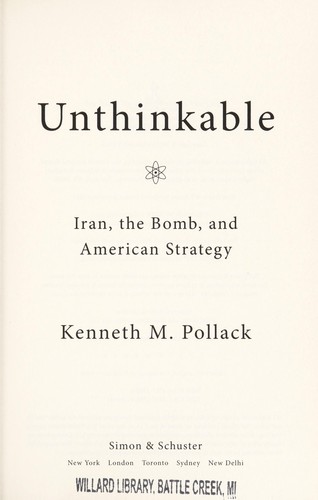
Unthinkable
Iran, the Bomb, and American Strategy
Core Thesis
Unthinkable is Kenneth M. Pollack's comprehensive strategic analysis of America's policy options toward Iran's nuclear program, drawing on his 25 years of Middle East expertise as a former CIA Persian Gulf analyst and two-time National Security Council staffer. A New York Times and Economist Best Book of 2013, the book walks through every major policy alternative — negotiation, sanctions, regime-change support, military strikes, and containment — in detailed, non-partisan analytical form. Its relevance to this site is contextual: the book explains, in far greater strategic depth than any single case file could, exactly why Iran's Arak, Natanz, and Bushehr nuclear facilities became the specific focus of the mutual American and Iranian intelligence anxieties this site's own Arak F-14 Radar Intercept case file documents.
About the Author
Kenneth M. Pollack was born in 1966 and earned a B.A. from Yale and a Ph.D. from MIT before beginning his career as a Persian Gulf military analyst at the CIA, where he was the principal author of the agency's classified postmortem on Iraqi strategy and military operations during the 1991 Gulf War — a formative early assignment that shaped his subsequent decades of Middle East military and strategic analysis.
Pollack served twice at the National Security Council during the Clinton administration, first as director for Near East and South Asian affairs and later as director for Persian Gulf affairs, giving him direct policymaking experience layered on top of his earlier intelligence-analysis career. He later became a senior fellow, and for a period director, of the Brookings Institution's Saban Center for Middle East Policy, one of Washington's most prominent Middle East policy research institutions.
Pollack's earlier book, The Persian Puzzle (2005), addressing the broader U.S.-Iran relationship, helped establish him as one of Washington's most closely read Iran policy analysts and sparked national discussion of American options toward Iran well before Unthinkable's narrower, nuclear-specific 2013 follow-up. He has since continued in senior policy roles, including as Vice President for Policy at the Middle East Institute.
Pollack has also written extensively on the broader Middle East beyond Iran specifically, including well-regarded books on Arab military effectiveness and the aftermath of the Arab Spring uprisings, giving him a comparative regional vantage point that informs Unthinkable's own analysis: his assessment of Iranian strategic behavior throughout the book is repeatedly benchmarked against his equally deep familiarity with how other regional states have historically responded to comparable security dilemmas, rather than treating Iran as an analytically isolated special case.
Historical Context & Origins
The book was published in 2013, at the height of international negotiations over Iran's nuclear program that would culminate two years later in the 2015 Joint Comprehensive Plan of Action (JCPOA), giving Pollack's detailed policy-options analysis direct, immediate relevance to an active, closely watched diplomatic process rather than a purely retrospective historical question.
Pollack wrote against the backdrop of nearly a decade of escalating international concern about Iran's nuclear program following the 2002 public disclosure of previously secret enrichment facilities at Natanz, concern that directly informed the broader climate of American intelligence interest in Iranian nuclear sites, including Arak, during the 2004 period this site's own case file addresses.
The book's publication also followed several years during which both covert action (including the Stuxnet cyberattack against Iranian centrifuges, publicly reported in 2010-2012) and direct military strike threats from both the United States and Israel had become serious, actively debated policy options rather than purely theoretical possibilities — the specific strategic environment Pollack's book methodically works through option by option.
This same period also saw a marked escalation in Israeli and American rhetoric about the acceptability of a nuclear-armed Iran, with Israeli officials in particular repeatedly signaling openness to unilateral military action if diplomatic and covert measures failed to sufficiently delay Iran's program. Pollack's book treats this specific, live possibility of an independent Israeli strike, and the complicated question of what obligations or consequences that would create for the United States, as one of its most consequential and carefully argued sections.
Core Arguments & Key Concepts
The book's central structure walks readers through five broad American policy options toward a nuclear-ambitious Iran in turn: intensified negotiation and sanctions, supporting Iranian opposition movements toward regime change, an Israeli military strike, an American military strike, and containment of an eventually nuclear-armed Iran — assessing each option's plausible costs, benefits, and risks with the same rigorous, dispassionate analytical method throughout.
Pollack's own conclusion, reached only after this exhaustive comparative analysis, favors containment as the least-bad realistic option if diplomacy ultimately fails to prevent Iran from acquiring nuclear weapons capability — a conclusion some reviewers characterized as reluctantly arrived at rather than a starting ideological position, given the considerable space the book devotes to fairly presenting the military-strike alternatives before setting them aside as too risky.
A recurring analytical theme is Pollack's insistence on separating Iran's nuclear ambitions from a broader, sometimes exaggerated Western tendency to treat Iranian foreign policy as uniquely irrational or apocalyptically motivated; he argues Iranian decision-making, while genuinely adversarial to American interests, follows recognizable state-security logic that any serious policy analysis must engage with on its own terms rather than dismiss as fanatical.
The book also documents in detail the specific technical and strategic significance of Iran's key nuclear sites — Natanz's uranium enrichment centrifuges, the Bushehr power reactor, and the Arak heavy-water production plant's plutonium-production potential — explaining precisely why each facility drew the specific level of Western intelligence and military planning attention it did, directly relevant background for understanding why an Iranian military unit might have been stationed on alert near Arak specifically during the period this site's own case file covers.
Pollack devotes particular attention to explaining, for a general readership, the underappreciated technical distinction between uranium-enrichment and plutonium-production pathways to a nuclear weapon — a distinction directly relevant to why Arak's heavy-water facility, oriented toward the plutonium pathway, drew a specifically different category of Western strategic concern than Natanz's uranium-enrichment centrifuges, since the two facility types would need to be addressed through partly different verification, sanctions, and (if it came to it) military-targeting approaches.
Key Cases & Evidence Discussed
This site's own Arak F-14 Radar Intercept (claimed November 2004) benefits directly from this book's detailed explanation of why the Arak heavy-water plant specifically, rather than Iran's many other military and industrial facilities, became a site of such sustained Western intelligence interest: its plutonium-production potential gave it strategic significance distinct from, and in some respects more concerning to Western planners than, the more widely publicized Natanz enrichment facility.
This site's own Kirtland AFB Sighting (Case File #116, 1980) offers a useful American-side point of comparison Pollack's book indirectly informs: both cases involve claimed unidentified aerial activity near a nuclear-security-sensitive facility, and Pollack's detailed account of how seriously and specifically nuclear sites are surveilled, defended, and monitored by the states that operate them helps contextualize why security personnel at such sites, in any country, might be primed to interpret ambiguous aerial activity through a heightened-threat lens.
Critical Reception & Controversies
The book was named a New York Times and Economist Best Book of 2013, reflecting broad critical acclaim across both general-audience and specialist foreign-policy publications. Foreign Affairs called Pollack's case "lucid and compelling," while other reviewers praised the book as "a thorough, informative and generally readable account of America's options with dealing with the Iranian nuclear program."
The Arms Control Association's own review, published under the header "Containment May Be the Best Strategy When It Comes to Iran," engaged substantively with Pollack's specific policy conclusion, treating the book as a serious, technically grounded contribution to arms-control policy debate rather than a purely journalistic account.
Academic reviewers in specialist journals, including a review published via Project MUSE, offered a more measured assessment, generally praising the book's comprehensiveness and analytical rigor while noting, as with any single-author policy-options survey, that Pollack's own institutional background at Brookings and prior CIA/NSC career inevitably shape which considerations receive the most extensive treatment.
No critical source located in researching this article disputes the book's core factual account of Iran's nuclear program's technical development or the historical record of American policy debate surrounding it; critical engagement instead centers, as with most serious policy-options books, on debating Pollack's own final recommended course of action.
The book's release also drew attention from readers and commentators specifically interested in its treatment of the military-strike options, given Pollack's own prior public association with a more assertive stance on Iraq in the lead-up to the 2003 invasion; several reviewers noted, generally approvingly, that Unthinkable's treatment of Iran strike options is considerably more cautious and skeptical of quick military solutions than some critics might have expected from that earlier record, treating the book's own analytical evolution as itself a data point in the broader Washington policy conversation about the lessons of the Iraq War.
Influence & Legacy
This exact edition is cited in this site's own Arak F-14 Radar Intercept case file's Further Reading section for offering "fuller context on why Arak, Natanz, and Bushehr became the specific focus of the intelligence and military anxieties this case's claim reflects."
The book's 2013 publication and subsequent influence on Iran-policy discourse coincided with, and by some accounts contributed background analytical framing to, the diplomatic process that produced the 2015 JCPOA nuclear agreement, though Pollack himself was not a direct negotiator in that process.
Pollack has continued to be cited extensively as an authoritative voice on Iran and broader Middle East strategic policy in the years since, including through his subsequent role at the Middle East Institute, extending this book's underlying analytical framework into ongoing coverage of Iran's nuclear program following the 2018 American withdrawal from the JCPOA and subsequent developments.
Pollack's own earlier record as a prominent advocate for the 2003 Iraq invasion, laid out in his 2002 book The Threatening Storm, gives Unthinkable's comparatively more cautious final recommendation an additional layer of interpretive weight for readers tracking the evolution of his own strategic thinking across the intervening decade, distinct from the book's freestanding value as an Iran-specific policy analysis.
The Book
As an Amazon Associate, OverClassified may earn from qualifying purchases made through this link, at no extra cost to you.
Why This Is Essential Reading
Unthinkable earns its place on this list as the single most comprehensive available strategic-policy account of exactly why Iran's nuclear facilities, Arak specifically included, became such an intensely watched flashpoint in American and Iranian mutual threat perception during the period this site's own Arak F-14 Radar Intercept case file covers. Read alongside David Crist's Twilight War and Babak Taghvaee's Desert Warriors, this book completes the strategic-context picture behind this site's own analysis of that case's central, still-unresolved claim.
Related Cases & Theories
Essential Viewing
Sources Cited
- Pollack, Kenneth M. Unthinkable: Iran, the Bomb, and American Strategy. Simon & Schuster, 2013 (ISBN-13 9781476733937). amazon.com
- "Unthinkable." Simon & Schuster (official publisher page, critical blurbs). simonandschuster.com
- "Kenneth M. Pollack." Wikipedia (full biography: CIA, NSC, Brookings career). en.wikipedia.org
- "Unthinkable: Iran, the Bomb, and American Strategy." Foreign Affairs (capsule review). foreignaffairs.com
- "Book Review: Containment May Be the Best Strategy When It Comes to Iran." Arms Control Association, December 2013. armscontrol.org
- "Unthinkable: Iran, the Bomb, and American Strategy by Kenneth M. Pollack (review)." Project MUSE. muse.jhu.edu
- "'Unthinkable: Iran, the Bomb and American Strategy'." WTTW Chicago News, October 30, 2013. news.wttw.com
- "A Discussion with Ken Pollack, Author of Unthinkable." Middle East Institute (podcast). mei.edu
- "Unthinkable: Iran, the Bomb, and American Strategy." Goodreads (reader ratings and reviews). goodreads.com
- "Unthinkable." Open Library (bibliographic record and cover art source). openlibrary.org
- This site's own case file: Arak F-14 Radar Intercept, for the full analysis this book's strategic context supports.
- This site's own key-figures entry: Kenneth M. Pollack, for his full biography and further case connections.
- This site's own essential reading entries: The Twilight War and Desert Warriors, for comparative context on the Arak case file.
Have corrections, additional research, or peer-reviewed sources? Help improve this entry.
Suggest an Edit