
Desert Warriors
Iranian Army Aviation at War
Core Thesis
Desert Warriors is Babak Taghvaee's military history of Iranian Army Aviation from its founding through the 1979 revolution and the Iran-Iraq War to the present, built on declassified records of the Iranian Joint Chiefs of Staff, Ground Force, and Army Aviation and covering 97 major wartime operations in granular, sourced detail. Unlike most entries on this site's Essential Reading list, this book does not discuss any UFO, UAP, or anomalous-phenomenon claim at all — its relevance here is entirely about assessing its author's own methodology and reliability. Taghvaee is the single named source, via a 2013 magazine article sourced to unnamed IRIAF contacts, behind this site's own Arak F-14 Radar Intercept case file, and this article evaluates what his separately published, verifiably declassified-record-based work reveals about the general credibility a reader should extend to his uncorroborated claims elsewhere.
About the Author
Babak Taghvaee, born in Iran in 1985, began publishing anonymous histories of the Iranian Air Force on Iranian websites in 2005 before moving into English-language defense journalism for outlets including AirForces Monthly and Combat Aircraft from 2008 onward. In 2011 he became one of two supervisors of the Iranian Air Force's own internal "Historical Identity of IRIAF" research project, a role suggesting genuine institutional access to Iranian air force personnel and archival material most Western journalists could never obtain.
Since then Taghvaee has built a substantial body of traditionally published military history work through respected specialist imprints including Helion and Osprey, alongside open-source-intelligence reporting for outlets including Radio Free Europe/Radio Liberty, Israel Hayom, the BBC, and, more recently, the Washington Institute for Near East Policy. This is a genuine, independently verifiable professional track record, not a fabricated byline — a point this site's own case file makes explicitly when assessing his general credibility as a source.
The specific claim connecting Taghvaee to this site's catalog is separate from this book: his October 2013 Combat Aircraft magazine article describing Iranian F-14 and F-4 crews chasing unidentified "luminous objects" near Iran's nuclear sites beginning in 2004, sourced entirely to unnamed Iranian air force contacts he said he interviewed over roughly two years. That single-authored, anonymously-sourced account has never been independently corroborated by a named Iranian pilot, a second journalist's own reporting, or any released Iranian document.
More recently, Taghvaee has expanded into contemporary open-source-intelligence reporting on Iran's military capabilities, including assessments cited by the Washington Institute for Near East Policy and commentary carried on wire services and social media during periods of active regional conflict. This ongoing, more immediately verifiable current-events work gives outside observers a continuously updated body of material against which to compare the accuracy of his real-time claims, distinct from either this book's historical scholarship or the older, unverifiable 2013 magazine claim.
Historical Context & Origins
Desert Warriors was published in 2019 by Helion & Company, a British specialist military-history press well regarded within the aviation-history genre for its detailed, heavily illustrated regional-conflict studies. The book arrived as part of Taghvaee's broader, decades-long project of documenting Iranian military aviation history in far greater depth than most Western defense journalism had previously attempted, drawing on his unusual direct access to IRIAF veterans and declassified institutional records.
The book's use of declassified Iranian Joint Chiefs of Staff and Army records represents a meaningfully different evidentiary standard than the 2013 magazine article underlying this site's Arak case file: those records are describable, in principle, as institutional documents with an origin point independent of Taghvaee's own reporting, whereas the 2013 article's central claim rests entirely on unnamed personal testimony collected by Taghvaee himself, with no equivalent documentary trail ever produced.
This site's own case file on the Arak F-14 Radar Intercept, centered on airspace near the Arak heavy-water plant in Markazi Province, Iran, cites this book specifically for this contrast, describing it as useful "for readers assessing Taghvaee's broader research methods and standing as an Iranian air force historian" — not for any content bearing on the UAP claim itself, since the book does not address that claim at all.
This distinction between record-grounded and testimony-only claims is itself a recurring analytical tool this site applies across many contested cases in its catalog, not a standard invented specifically for Taghvaee. A source's overall professional credibility is genuinely relevant background, but this site's own methodology treats it as one input among several, alongside the specific evidentiary character of each individual claim under review, rather than as a substitute for that claim-by-claim assessment.
Core Arguments & Key Concepts
The book's central historical argument is that Iranian Army Aviation, often overshadowed in Western military-history writing by the more heavily covered Iranian Air Force, played a decisive and underappreciated role across the Iran-Iraq War, with AH-1J Cobra attack helicopters destroying hundreds of Iraqi armored vehicles, Bell 214A helicopters conducting large-scale medical evacuation of wounded troops and civilians, and CH-47C Chinooks sustaining frontline logistics under direct anti-aircraft and surface-to-air missile threat.
Taghvaee structures the book around specific, individually documented operations — the text logs flying hours, sortie counts, munitions expended, and casualty figures for 97 distinct major operations — a level of granular, source-cited detail considerably more exacting than a general narrative history would require, and directly relevant to how this article assesses his working methodology when documentary sources are actually available to him.
The book is also distinguished, per specialist reviewers, by its extensive selection of previously unpublished photographs and color aircraft profiles, reflecting Taghvaee's continued direct access to Iranian military archives and veteran contacts well beyond what most foreign journalists or historians covering Iran's post-revolutionary military have been able to obtain.
Reading this book alongside the 2013 magazine article central to the Arak case file reveals a meaningful methodological contrast this article treats as directly relevant to assessing Taghvaee's reliability: where declassified institutional records were available, as in this book, Taghvaee's work is detailed, specific, and citeable to a documentary source; where no such record existed, as with the 2013 "luminous object" claim, his reporting necessarily rests on unnamed personal testimony alone, a structurally weaker evidentiary foundation regardless of the author's own general professional standing.
The book's coverage of the Iran-Iraq War also documents, in passing, the broader operational chaos and institutional secrecy characteristic of Iranian military record-keeping and public disclosure during and after that conflict — useful background for readers assessing why, even decades later, so much of Iran's own military history remains dependent on the kind of individual-researcher access Taghvaee has cultivated, rather than on the more routinely declassified and publicly archived records available for comparable Western military histories.
Key Cases & Evidence Discussed
This site's own Arak F-14 Radar Intercept (Case File #, November 2004 claimed) is the case file this book's inclusion on this list exists to support, though the book itself does not discuss the incident. The case file's own extended analysis of Taghvaee's professional credibility — noting his real, independently verifiable track record while emphasizing that professional standing in a journalist's broader body of work is not the same thing as independent verification of any one specific claim — draws directly on the same body of published work this book represents.
The case file also documents that even writers sympathetic to Taghvaee's aviation-journalism credentials, including David Cenciotti of The Aviationist and Michael Peck writing for Forbes, expressed explicit, published doubt about the specific 2004 "luminous object" claim's reliability, while treating his broader body of work, including books like this one, as generally credible — precisely the distinction this article draws in evaluating why this particular book belongs on this list despite containing no UAP content of its own.
Critical Reception & Controversies
Specialist military-history and modeling reviewers responded positively to the book's research depth. A Military Modelling review called it "not only fascinating to read, but also a great modellers reference for a subject we don't see much about," while Cybermodeler's review specifically credited Taghvaee's "exceptional access to official Iranian sources" and praised the text's support from an extensive selection of previously unseen photographs and color profiles.
Reviewers within the specialist Middle East military-aviation history niche have generally treated Taghvaee's book-length work, including this title, as a credible and valuable primary reference, distinct from the more skeptical reception his single 2013 magazine claim about the Arak "luminous object" incident has received from writers examining that specific story.
No critical source located in researching this article raises the same evidentiary concerns about this book's declassified-record-based claims that multiple writers have raised about the 2013 magazine article's anonymously-sourced claim — a distinction this article treats as itself a meaningful, if indirect, form of critical corroboration for Taghvaee's general reliability when working from genuine documentary sources.
This site's own case file notes a related point worth restating here: David Cenciotti, Michael Peck, and David Axe, the three named commentators who examined the 2013 "luminous object" claim most closely, each expressed genuine uncertainty rather than outright dismissal, and none characterized Taghvaee himself as generally unreliable. Their skepticism was aimed specifically at the claim's uncorroborated, anonymous sourcing and its physically implausible performance figures (Mach 10 flight combined with a full hover, a combination no known aircraft has ever demonstrated), not at Taghvaee's broader professional standing as a military historian — the same standing this book itself reflects.
Influence & Legacy
This exact 2019 Helion edition is cited in this site's own Arak F-14 Radar Intercept case file's Further Reading section specifically as a tool for readers assessing Taghvaee's broader research methods and standing as an Iranian air force historian, rather than as a source bearing directly on the case's own central claim.
Taghvaee has continued publishing extensively on Iranian military affairs in the years since, including contemporary open-source-intelligence reporting on Iran's aviation industry and military capabilities for outlets like the Washington Institute for Near East Policy, extending the same declassified-record-and-verified-source methodology this book demonstrates into ongoing current-events coverage.
Within this site's own broader methodology, this book serves as a useful case study in a principle applied across many entries in this catalog: a source's general professional credibility and a specific individual claim's evidentiary strength are related but genuinely separate questions, and a fair assessment of any contested case requires evaluating both independently rather than treating one as a simple proxy for the other.
The book's continued availability and positive reception within the specialist military-history community also means it functions as an ongoing, checkable reference point: any future reassessment of Taghvaee's broader reliability, whether by this site or by other researchers, can draw on this book's own citation trail and declassified-record sourcing as a documented baseline, distinct from the considerably thinner evidentiary record surrounding his single 2013 UAP-adjacent claim.
The Book
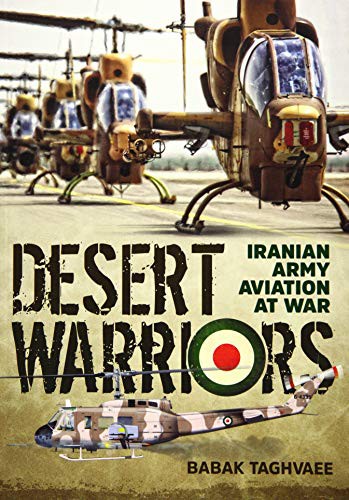
As an Amazon Associate, OverClassified may earn from qualifying purchases made through this link, at no extra cost to you.
Why This Is Essential Reading
Desert Warriors earns its place on this list for an unusual reason among this site's Essential Reading entries: not for any content about UAP or anomalous phenomena, since it contains none, but as a genuine, independently reviewable data point for assessing the reliability of the one journalist whose uncorroborated 2013 reporting is the entire evidentiary foundation of this site's own Arak F-14 Radar Intercept case file. Read as a companion to that case file's own extended source-credibility analysis, this book demonstrates that Taghvaee's work, when built on genuine declassified documentary records, is detailed, specific, and well-regarded — while leaving entirely open the separate, harder question of how much evidentiary weight a claim sourced only to his own unnamed personal contacts can bear on its own.
Related Cases & Theories
Sources Cited
- Taghvaee, Babak. Desert Warriors: Iranian Army Aviation at War. Helion & Company, 2019 (ISBN-13 9781910777565). amazon.com
- "Desert Warriors." Helion & Company (official publisher page). helion.co.uk
- "Desert Warriors: Iranian Army Aviation at War Book Review." Cybermodeler Online (page removed; archived copy). web.archive.org
- "Babak Taghvaee." The Washington Institute for Near East Policy (author profile). washingtoninstitute.org
- "Babak Taghvaee." Muck Rack (journalist profile). muckrack.com
- "Babak Taghvaee." Key.Aero (author profile and articles). key.aero
- "Desert Warriors." Open Library (bibliographic record and cover art source). openlibrary.org
- Cenciotti, David. "Iranian F-14s vs UFOs: urban legend or weird drones in action over Iranian nuclear plants?" The Aviationist, November 2013 (cited in this site's own case file's source-credibility analysis). theaviationist.com
- Peck, Michael. "Iran's F-14s vs. UFOs." Forbes, January 2014 (cited in this site's own case file's source-credibility analysis). forbes.com
- "Desert Warriors: Iranian Army Aviation at War." AbeBooks (bibliographic listing). abebooks.com
- "Babak Taghvaee." EverybodyWiki (biographical summary). en.everybodywiki.com
- This site's own case file: Arak F-14 Radar Intercept, for the full source-credibility analysis this article draws on.
- This site's own key-figures entry: Babak Taghvaee, for his full biography and further case connections.
- This site's own location entry: Arak Heavy Water Plant, the claimed incident's location.
Have corrections, additional research, or peer-reviewed sources? Help improve this entry.
Suggest an Edit