
UFOs of the First World War
Phantom Airships, Balloons, Aircraft and Other Mysterious Aerial Phenomena
Core Thesis
UFOs of the First World War: Phantom Airships, Balloons, Aircraft and Other Mysterious Aerial Phenomena is Nigel Watson's 2015 return to the phantom-airship material he had already surveyed fifteen years earlier in The Scareship Mystery, this time published by the mainstream British non-fiction house The History Press rather than a small specialist press, and widened specifically to the war years themselves rather than the pre-war panics that opened the phenomenon, drawing directly on newspaper archives, official military records, and personal correspondence gathered across the intervening decade and a half of his own continued research. Where the earlier book's own subtitle bounded its survey at 1909-1918 with a heavy emphasis on the 1909 and 1912-13 panics, this book concentrates on August 1914 through November 1918, collecting reports from combatant and neutral nations alike -- the British Isles, Germany, the United States, Canada, Norway, and Australia -- and knowingly ranging across a wide credibility spectrum, from mundane misidentified reconnaissance balloons and anti-aircraft flare rounds through to now-famous, heavily disputed wartime legends. This site's own research draws on it for two of the phenomenon's founding episodes it shares with the earlier book: the New Zealand Airship Wave, which this book's own broader Pacific and Southern Hemisphere coverage extends beyond Watson's earlier treatment, and the Sheerness Phantom Airship Incident, which this book folds into its opening chapters on the 1912-13 British scare as the direct prelude to the war proper.
About the Author
Nigel Watson is a British UFO historian and investigator who has researched sightings since the 1970s, holding a BA in Psychology from the Open University and a BA (Hons) in Film and Literature from the University of Warwick. By the time this book appeared in 2015, Watson had already spent over two decades cataloguing the same general territory: the 1988 Fund for UFO Research monograph The 1912-1913 British Phantom Airship Scare, co-authored with David Clarke and Granville Oldroyd, and the fuller 2000 survey The Scareship Mystery, documented on this site's own essential-reading library, both fed directly into this later, more commercially positioned volume.
This book represents a meaningful shift in Watson's own publishing trajectory. The Scareship Mystery appeared through Domra Publications, a small specialist press with a correspondingly narrow print run and, per this site's own research, zero surviving Goodreads ratings as of August 2026. This book instead appeared through The History Press, a mainstream British non-fiction publisher based in Cheltenham with a substantial catalog of popular military and social history -- a considerably larger commercial platform for the same underlying subject matter, and one that carries real, if modest, reader engagement data this site's research was able to verify directly: 11 Goodreads ratings averaging 3.64 out of 5 stars across 6 written reviews, checked August 2026.
Watson's authorial method across all three of these related works remains consistent: rather than arguing a single explanatory thesis, he compiles primary-source witness reports -- press accounts, official records, personal letters -- and lets the specific historical record speak for the case's own plausibility or implausibility. This site's own essential-reading library also documents his later, differently purposed 2013 book UFO Investigations Manual, a Haynes-branded practical field-methods guide this site's own Florence Stadium Sighting and Campeche Military FLIR Incident case files cite for evaluating physical-trace and instrumented sensor evidence -- making this book the third distinct register of Watson's work this site's library now documents: historical survey, WWI-specific catalog, and practical investigative reference.
Watson's own decades-spanning career also includes regular contributions to Fortean Times and The Skeptic magazine, publications occupying opposite ends of the credulity spectrum within British paranormal and skeptical publishing -- the former a general-interest chronicle of anomalous and unexplained phenomena, the latter a dedicated skeptical-inquiry outlet founded to apply rigorous scrutiny to exactly the kind of claim Fortean Times often simply reports. This site's own research treats Watson's willingness to write for both as a genuine, verifiable indicator of the same even-handed method his books display: rather than positioning himself as either a committed believer or a committed debunker, his published output across four decades consistently favors documenting the historical record as fully and accurately as it can be reconstructed, leaving the interpretive weight to fall wherever the surviving primary sources actually support it.
Historical Context & Origins
This book's 2015 publication fell squarely within the four-year window of the First World War centenary commemorations (2014-2018), a period that saw a substantial surge in centenary-themed military history publishing across the United Kingdom, The History Press's own catalog included. This site's own research treats that commercial context as directly relevant: a publisher with no prior track record in specialist ufology took on a WWI-specific aerial-anomaly title at almost exactly the moment British publishing as a whole was hungry for any well-researched angle on the war, a very different commissioning logic than the small specialist presses that had previously carried the bulk of Watson's earlier phantom-airship research.
The book's own chronological scope -- August 1914 through the November 1918 Armistice -- picks up almost exactly where this site's own Sheerness Phantom Airship Incident case file leaves off. That October 1912 sighting sat within the pre-war 1912-13 scare fueled by British fears of covert German Zeppelin reconnaissance; this book's own subject matter is what happened once that fear stopped being anticipatory and the war the scareship panics had been dreading actually began, with genuine German airships and aircraft now regularly operating over British and French skies alongside the continued stream of ambiguous, unverifiable reports.
This site's own New Zealand Airship Wave case file, occurring nearly five years before the war it precedes even began, sits chronologically before this book's own core war-years window, but the book's stated international scope -- extending explicitly into "the wider Pacific and Southern Hemisphere sightings of this era," per this site's own case-file citation of it -- gives it direct relevance to a wave whose own reports, per that case file's research, continued into Australia after New Zealand's reports ceased in September 1909, a genuinely trans-Pacific spread this book's broader multi-country structure is positioned to track in a way Watson's earlier, more Britain-and-New-Zealand-focused 2000 survey was not.
The war itself supplied a genuinely new perceptual environment this book's own case selection reflects throughout. Millions of ordinary combatants and home-front civilians were, for the first time in human history, regularly scanning the sky with real reason to expect an armed threat to appear there -- searchlights, anti-aircraft barrages, and blackout regulations became routine features of both front-line and home-front life across Britain, France, and Germany alike within the war's first two years. This site's own research treats that saturation of aerial vigilance, applied to genuinely novel and still-unfamiliar aircraft silhouettes, lighting conventions, and flare and searchlight technology, as the single most important background condition the book's own case material has to be read against: a population primed, night after night, to look up and interpret whatever it saw there as either friend, foe, or something else entirely.
Core Arguments & Key Concepts
The book's central organizing principle, per its own subtitle and per a War History Online feature summarizing several of its featured cases, is breadth over depth: rather than one deeply investigated national wave, it assembles a comparative international catalog spanning Britain, Germany, the United States, Canada, Norway, and Australia, treating wartime aerial misidentification as a universal human response to a genuinely new technological and psychological condition -- the first war in which death could plausibly arrive from directly overhead -- rather than a peculiarity of any single national press culture.
A second, more methodologically significant theme is the book's own honest range of source quality, a point an independent Goodreads reader review this site's research located makes explicit: the volume moves from soberly documented, verifiable military incidents through to frankly legendary, heavily disputed stories, and that same review notes candidly that only a small handful of the book's passages resemble what a modern reader would recognize as a flying-saucer-type "UFO" account in the post-1947 sense -- the great majority instead document misidentified balloons, flares, aircraft, and Zeppelin observation cars reported by frightened but honest wartime witnesses.
A third theme, consistent with Watson's own established analytical method from The Scareship Mystery, is that WWI-era witnesses interpreted ambiguous aerial phenomena through whatever conceptual framework their own culture actually possessed at the time, since the modern "flying saucer" category did not yet exist. Per War History Online's summary of the book's own "Angels of Mons" chapter, British soldiers retreating from the 1914 Battle of Mons who reported a mysterious protective figure overhead reached first for a specifically religious explanation -- St. George, St. Michael, or a band of angelic warriors -- rather than any notion of an unidentified craft, a pattern the book uses, per that same summary, to argue that many WWI "UFO" legends are better read as period-appropriate supernatural interpretation than as proto-ufological sightings misfiled by later enthusiasts.
A fourth theme is the book's willingness to supply mundane technical explanations alongside its more sensational material rather than only cataloging the anomalous. Its treatment of the so-called "Flaming Onions" -- glowing, tumbling projectiles WWI pilots reported chasing their aircraft, described by Cambridge historian and First of the Few author Denis Winter as moving "turning over end on end in a leisurely way" like living things -- includes the book's own most-cited mundane candidate explanation, per War History Online's summary: strings of flares fired from the German five-barreled anti-aircraft gun nicknamed the Lichtspucker, or "Light Spitter," a specific piece of period ordnance this site's own research could not independently verify beyond that same secondary summary but treats as a plausible, technically literate candidate consistent with the book's own even-handed method elsewhere.
A fifth theme is visible in the book's own deliberate mix of witness rank and circumstance, which its case selection appears to use to argue that the phenomenon crossed lines of military seniority and geography rather than clustering among any one class of unreliable observer. Per War History Online's summary of the book's own material, these named cases range from a serving pilot's own logged mid-flight observation -- Lieutenant R.S. Maxwell, who reported an artificial light at altitude he followed northeast for nearly twenty minutes before losing it in cloud -- to a home-front civilian's decades-delayed secondhand memory, and from a single-witness aerial dogfight report to a multi-witness ground sighting corroborated, however imperfectly, across several observers. This site's own research treats that structural range, honestly presented with its evidentiary weaknesses left visible rather than smoothed over, as the book's most defensible methodological choice: it lets readers see for themselves how much a WWI-era "UFO" report's credibility actually varies case by case, rather than asserting a uniform standard of evidence across all of them.
Key Cases & Evidence Discussed
The New Zealand Airship Wave (July-September 1909) falls just before this book's own core August 1914-November 1918 window, but this site's own case-file citation of the book specifically credits it with "the wider Pacific and Southern Hemisphere sightings of this era" -- a broader international framing than Watson's earlier, more tightly Britain-and-New-Zealand-scoped 2000 survey offered, situating the New Zealand wave's own trans-Tasman spread into Australia within a wider pattern of Southern Hemisphere aerial anomaly reporting the book treats as continuous with, rather than separate from, the war-years material that forms its main subject.
The Sheerness Phantom Airship Incident (October 14, 1912) involved multiple witnesses at the Sheerness Royal Navy Dockyard and nearby Queenborough, Isle of Sheppey, Kent, including a serving Royal Navy lieutenant among the witnesses. This site's own case-file citation of the book credits it with "detailed coverage of the Sheerness sighting and the wider 1912-13 British scare," positioning the incident as this book's own opening case study -- the moment the pre-war phantom-airship panic that would recur, in genuinely amplified form, once real German aircraft began appearing over British soil after August 1914, the direct subject the rest of the book goes on to document.
Beyond the two cases this site's own case files cite it for, the book documents a number of named war-years incidents not otherwise carried on this site, illustrative of its own war-years scope. "Lady Sopwith," per War History Online's summary, was first reported by Lieutenant Frederick Ardsley on an early morning patrol from Amiens to Villers-Bocage in northern France on January 9, 1918. The home-front "Aldeburgh sighting" concerns a 1968 letter to the Daily Mirror from a reader named A. E. Whiteland, then 84, recounting his mother's own account of watching, decades earlier from her Aldeburgh, Suffolk upstairs window, eight to twelve uniformed figures gripping the handrail of a round platform passing silently over the marshes -- a sighting the newspaper's own contemporary explanation attributed to a Zeppelin's observation gondola being lowered toward the ground, a reading aviation historian Charles Gibbs specifically disputed on the technical grounds that a period Zeppelin's observation car was far too small to carry more than a single occupant and would never have been lowered so close to the ground, and which UFO researcher Carl Grove's own subsequent investigation, per War History Online's account, was unable to resolve into any confirmed mundane explanation either way -- precisely the kind of genuinely unresolved case, neither confirmed nor confidently debunked, this site's own research treats as more honestly representative of the book's typical evidentiary standard than either of its two most famous, more thoroughly disputed legends.
Critical Reception & Controversies
Unlike The Scareship Mystery, which this site's research found carried zero Goodreads ratings, this book has a real, if modest, reader engagement record: 3.64 out of 5 stars averaged across 11 ratings and 6 written reviews, checked August 2026 -- concrete data this site discloses honestly rather than substituting the more common "no ratings found" pattern this session's other Watson-adjacent titles have carried.
One of those reader reviews this site's research located offers a genuinely mixed, specific assessment: praising the book as informationally solid while criticizing its readability, noting that many chapters consist substantially of strung-together witness statements rather than narrative synthesis, and describing the 224-page volume as "a pretty easy read but a bit tedious with report after report from various news sources that really doesn't provide much coherence or background." That same review specifically observes that only a small number of the book's paragraphs resemble what a modern reader would recognize as a flying-saucer-type "UFO" account -- an honest structural limitation this site's research treats as a genuine, disclosed shortcoming rather than a reason to discount the book's underlying research value.
This site's research also attempted to verify an Amazon rating for this title, but Amazon's bot-detection system repeatedly blocked automated requests to the listing during this session, the same persistent pattern encountered across every title checked this session. Per this site's own Amazon Rating Display Protocol, this gap is disclosed honestly here rather than fabricated or silently omitted -- readers are directed instead to the real, verified Goodreads figure above.
The book's own most widely circulated individual case -- a claimed 1917 encounter between the Red Baron, Manfred von Richthofen, and a saucer-shaped craft over Belgium, sourced to a single account by fellow German pilot Peter Waitzrick that did not surface until roughly eighty years after the claimed event, when Waitzrick was 105 years old, and was first published in the tabloid Weekly World News in August 1999 -- illustrates the book's own honest inclusion of material its critics, and by War History Online's own account historians generally, treat with real skepticism: the specific Fokker triplane model central to the story's dogfight did not enter operational service until months after the claimed spring 1917 encounter, a documented chronological inconsistency this site's research treats as substantially undermining the account's evidentiary weight, regardless of whether the book itself endorses or merely catalogs the story.
The book's treatment of the Gallipoli "vanishing regiment" legend -- three New Zealand soldiers' account of a British column marching into a solid gray cloud atop Hill 60 at Suvla Bay on August 20-21, 1915, from which, per the retelling, no man ever emerged -- carries a comparable evidentiary problem this site's research treats as worth disclosing directly: the popularized version's specific claim that the story was "authenticated by the Dardanelles Commission's final report" is not a claim this site's own research could independently verify against that Commission's actual published findings, and the real historical fate of the 1/5th Norfolk Regiment battalion most commonly associated with this legend -- heavy combat losses during the Gallipoli campaign, with the remains of a substantial number of its men recovered and identified only decades later -- is separately documented military history that does not require, and is not well served by, a paranormal-cloud explanation layered on top of it. This site's own research treats the Gallipoli story as a genuine, long-circulating piece of WWI folklore the book documents responsibly as folklore, not as a case this site's research can independently corroborate as an anomalous event in its own right.
Influence & Legacy
This book's placement with a mainstream commercial publisher, reaching a real if modest reader audience quantified by 11 Goodreads ratings against the complete absence of any comparable data for Watson's earlier, small-press Scareship Mystery, is itself a data point about how the phantom-airship subject moved between 2000 and 2015: from a specialist ufological niche served by dedicated small presses like Domra Publications and the Fund for UFO Research, into mainstream British military-history publishing willing to commission a full WWI-centenary-adjacent title on the same underlying material.
Within this site's own essential-reading library, this book joins The Scareship Mystery and UFO Investigations Manual as the third Nigel Watson title documented, together spanning his full working range: a small-press historical survey of the pre-war and wartime panics, a mainstream-press expansion of that same subject specifically into the war years, and a practical Haynes-branded field-methods guide for modern investigators -- a genuinely broad, decades-long body of work this site's library increasingly reflects as a coherent whole rather than three unrelated titles.
The book's own honest inclusion of frankly disputed legends alongside soberly documented military misidentification cases -- the Red Baron encounter, the Gallipoli "vanishing regiment" cloud story attributed to three New Zealand soldiers' account of British troops marching into a solid gray cloud at Suvla Bay's Hill 60 on August 20-21, 1915 -- has itself become part of how those specific stories continue to circulate in popular WWI paranormal folklore, with War History Online's own 2015-era feature treating the book explicitly as its sourcing authority for retelling both stories to a general military-history readership well beyond ufology's usual audience.
The book's multiple format editions -- hardcover, standard paperback, and a Kindle ebook release carrying its own separate ASIN -- reflect a level of ongoing commercial availability across formats that neither Domra Publications' 2000 print run of The Scareship Mystery nor the original 1988 FUFOR monograph ever achieved, a practical legacy in continued accessibility this site's research treats as directly attributable to The History Press's own mainstream distribution infrastructure rather than to any difference in the underlying research quality between Watson's various books on this shared subject.
The Book
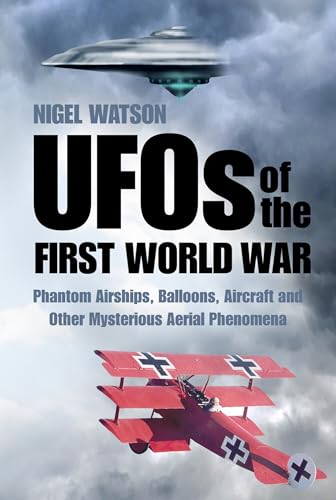
UFOs of the First World War
Phantom Airships, Balloons, Aircraft and Other Mysterious Aerial Phenomena
Find on Amazon →As an Amazon Associate, OverClassified may earn from qualifying purchases made through this link, at no extra cost to you.
Why This Is Essential Reading
UFOs of the First World War earns its place on this list as Nigel Watson's widest-reaching treatment of the phantom-airship phenomenon his own scholarship has documented since the 1988 FUFOR monograph, extending the pre-war-focused analysis of The Scareship Mystery into the war years themselves and, via a mainstream commercial publisher, into a considerably wider readership than his earlier specialist-press work reached. Its honest inclusion of material ranging from soberly documented misidentified Zeppelin observation cars through to frankly disputed tabloid-sourced legends like the Red Baron's alleged saucer dogfight gives this site's own New Zealand Airship Wave and Sheerness Phantom Airship Incident case files a genuinely international, war-years-extended context that Watson's earlier survey alone did not fully supply. Read as a wide, deliberately inclusive wartime catalog rather than a tightly argued single thesis, this book is essential because it documents, in one place, both the mundane technological confusion and the enduring folklore the First World War's own unprecedented aerial threat produced -- and because it does so without flattening the real difference in evidentiary weight between a serving pilot's own logged observation and an eighty-years-delayed tabloid legend, leaving that judgment, honestly, to the reader rather than trying to resolve it for them in advance.
Related Cases & Theories
Essential Viewing

Sources Cited
- Watson, Nigel. UFOs of the First World War: Phantom Airships, Balloons, Aircraft and Other Mysterious Aerial Phenomena. The History Press, 2015 (ISBN 978-0-7509-5914-8, cited here).
- "UFOs of the First World War." Goodreads (3.64 average rating, 11 ratings, 6 reviews, checked August 2026). goodreads.com
- "UFOs of the First World War: Phantom Airships, Balloons, Aircraft and Other Mysterious Aerial Phenomena." AbeBooks (ISBN 9780750959148, marketplace listing photograph used for this article's cover image). abebooks.com
- "UFOs of the First World War." The History Press (official publisher listing). thehistorypress.co.uk
- "The Red Baron, the Great War and UFOs." War History Online (feature summarizing several case chapters from the book, including the Red Baron and Gallipoli "vanishing regiment" accounts). warhistoryonline.com
- "Nigel Watson - UFOs of the First World War." Stan Mallow / Paranormal Yakker, YouTube (author interview, video verified via oEmbed). youtube.com
- This site's own resources library: Full Reading List, where this exact 2015 edition is cited across 2 separate case-file pages.
- This site's own key-figures entry: Nigel Watson, for his full biography and site-wide case connections.
- This site's own case file: New Zealand Airship Wave, cited for this book's Pacific and Southern Hemisphere coverage.
- This site's own case file: Sheerness Phantom Airship Incident, this book's opening case study.
- This site's own essential-reading entry: The Scareship Mystery, Nigel Watson's earlier 2000 survey of the same broader phenomenon.
- This site's own essential-reading entry: UFO Investigations Manual, Nigel Watson's later 2013 field-methods book.
- This site's own locations entry: Sheerness Royal Navy Dockyard, Kent, England.
- "The Phantom Airship Panic of 1913: Imagining Aerial Warfare in Britain before the Great War." Brett Holman, Journal of British Studies 55, no. 1 (January 2016), independent academic context for the war's immediate prewar backdrop. cambridge.org
Have corrections, additional research, or peer-reviewed sources? Help improve this entry.
Suggest an Edit