
UFO Retrievals
The Recovery of Alien Spacecraft — Thirty Crash Claims Examined by a Researcher Willing to Discard Most of Them
Core Thesis
UFO Retrievals works through roughly thirty claimed crash-and-recovery cases spanning more than a century — from documented claims going back to 1871 through to the 1990s — and reaches a conclusion the crashed-saucer literature was not expecting from Jenny Randles: that some are obvious hoaxes, that most of the rest resolve on objective assessment, and that only a small residue supports anything the field has claimed. Randles states her method in the introduction — to be objective and present the good, the bad and the occasionally downright ugly — and she means it. Published in 1995, at the commercial peak of the retrieval genre and two years before Roswell's fiftieth anniversary, it is the sceptical audit that the crash literature needed and had not received from anyone inside the field.
About the Author
Jenny Randles is Britain's most prolific working UFO investigator and the author of some sixty books on the subject. She served for years as Director of Investigations for the British UFO Research Association, which made her responsible for case handling rather than for advocacy, and that operational background shows in everything she writes.
Her position in the field is genuinely unusual and it is what makes this book matter. She is not a debunker — she has spent decades arguing that a residue of the phenomenon is unexplained and worth investigating — and she is not a believer in the sense the American crash literature uses the word. She is a case investigator whose default assumption is that most reports resolve, and who has been willing to say so about cases her own community treasured.
The record of that willingness is long. She joined David Clarke, Andy Roberts and Martin Shough in the 2000s re-investigation of the RAF Lakenheath–Bentwaters radar case, locating and interviewing the Venom aircrews whose testimony substantially complicated the classic account. She co-authored The UFOs That Never Were (2000) with Clarke and Roberts — a book whose entire purpose is dismantling cases the field had accepted. She was among the BUFORA investigators on the March 1993 Cosford incident and floated the rocket-body re-entry explanation that was later confirmed.
That track record is the reason a sceptical verdict from her carries weight that the same verdict from Philip Klass would not. Randles has no stake in the phenomenon being unreal, has published extensively on cases she considers genuinely unexplained, and has repeatedly taken the reputational cost of correcting her own side.
The counterweight, and it should be stated, is that sixty books is a lot of books. Randles writes for the popular market at a steady commercial rate, and the depth available in a 192-page Blandford survey covering thirty cases is necessarily limited. This is a well-judged book, not an exhaustive one, and readers wanting the full documentary treatment of any individual case will have to go elsewhere.
Historical Context & Origins
The mid-1990s were the crashed-saucer genre's commercial peak and its evidential low point. Roswell's fiftieth anniversary was approaching; the alien autopsy film had been broadcast in 1995 and was being defended by people who should have known better; the MJ-12 documents were a decade old and still dividing the field; and a steady supply of first-person retrieval claimants was appearing on television.
The retrieval claim had also become the field's centre of gravity in a way it had not been before. Through the 1950s and 1960s the subject was principally about sightings, radar returns and landing traces; by the 1990s the organising question for a large part of the American community was what the government had recovered and was hiding. That shift moved the evidential burden from observation, which can be tested, to secrecy, which cannot.
Britain's UFO culture was different and Randles is writing from inside it. BUFORA's tradition was investigative and case-focused, with a strong current of scepticism about American crash claims and a body of researchers — Clarke, Roberts, Shough, Randles herself — who were as interested in resolving cases as in accumulating them. A British survey of American crash claims comes with a different prior.
The historical range is the book's most interesting structural choice. Starting from documented claims of 1871 rather than from 1947 places Roswell inside a much longer tradition of reported aerial crashes — the Victorian airship reports, the Aurora, Texas claim of 1897, the foo fighter reports of the Second World War — and invites the reader to notice how the story's shape stays constant while its technology changes.
The 1897 airship material is particularly effective in this setting. Aurora is a nineteenth-century crashed-craft-and-buried-pilot story with a named location and a supposed grave, it was demonstrated to be a newspaper invention, and it is structurally identical to twentieth-century claims. Whatever Roswell is, it is not the first of its kind.
Aztec, New Mexico is the other essential precedent. The 1948 claim of a recovered disc with bodies, promoted by Frank Scully in a 1950 bestseller, was traced to confidence men and collapsed publicly — and then returned in the 1980s and 1990s as a revived case with new advocates. This site's Aztec file covers the sequence. It is the clearest available demonstration that a crash claim can be conclusively demolished and survive anyway.
Finally, the book appeared while MJ-12 was still an open dispute inside the field. Randles' treatment of the documents belongs to the period when their status was being fought over rather than to the later consensus that they are fabricated, and her handling of them is correspondingly careful.
Core Arguments & Key Concepts
Most retrieval claims do not survive examination, and someone from inside the field had to say so. The book's central finding and its reason for existing. Of roughly thirty cases, Randles concludes that some are outright hoaxes, that a majority resolve on objective assessment, and that a small number resist explanation. Coming from BUFORA's former Director of Investigations rather than from a professional sceptic, that arithmetic was harder to dismiss.
The evidence is dominated by misperception, mistaken identity and fabrication. Randles' own characterisation, and it is a claim about proportions rather than about possibility. She is not arguing that no unexplained event has ever occurred; she is arguing that the retrieval corpus as it stands is mostly noise, and that treating it as a body of evidence rather than as a body of claims is the field's basic error.
Crash claims are a genre with a history, and the genre predates the phenomenon. The structural argument produced by starting in 1871. Reported crashes of extraordinary aerial craft, complete with recovered occupants and official suppression, existed in the nineteenth century when there was nothing in the sky to crash. Whatever explains the persistence of the story has to be something other than the events it describes.
The strongest cases are not the famous ones. A recurring finding in Randles' work generally and visible here. Cases that acquire mass attention accumulate embellishment, hoaxers and self-appointed witnesses at a rate that eventually destroys them, while obscure cases with a small documentary trail can be assessed. Fame is a contaminant.
Official secrecy explains less than the field wants it to. Randles' British perspective is useful here. Governments classify aerospace material as a matter of routine, and the inference from 'this was secret' to 'this was extraterrestrial' requires a step nobody has supplied. Her position is not that no secrecy exists but that it has never been shown to be about what claimants say it is about.
A small residue remains and should not be conceded. The book is not a debunking exercise and Randles does not pretend the file is closed. Her willingness to say that a few cases still support the field's claims is what distinguishes the book from sceptical surveys, and it is also the point at which readers who want a clean verdict will be frustrated.
The main limitation is breadth over depth. Thirty cases in under two hundred pages means roughly six pages each, and several of these claims have documentary records running to hundreds of pages. Randles' judgements are sound and her case for them is necessarily compressed; a reader cannot check her reasoning from the book alone.
Key Cases & Evidence Discussed
The nineteenth-century claims from 1871 onward. The earliest documented reports of crashed extraordinary craft, establishing that the retrieval story is older than aviation and considerably older than the flying saucer.
Aurora, Texas, 1897. The airship-wave crash claim complete with a dead pilot and a marked grave in the town cemetery, examined in this site's case file and generally accepted to have been a newspaper fabrication — the template for everything that followed.
The Nebraska reports of 1897 and 1987. A ninety-year pairing that Randles uses to show the same claim structure recurring in the same place across an entire technological era.
The foo fighters of the Second World War. The aircrew reports of pacing luminous objects over Europe and the Pacific, covered on this site in its own file, and the wartime crash and recovery claims that attached themselves to them.
The Nazi rocket hypotheses. The persistent claims connecting German wartime aerospace development — V-weapons, experimental airframes — to recovered craft narratives, and the extent to which the retrieval literature has repeatedly mistaken advanced terrestrial hardware for something else.
Roswell, July 1947. The book's major chapter and the case against which everything else in the genre is measured. This site's Roswell file covers the incident, the Mogul attribution and the competing accounts.
Aztec, New Mexico, 1948. The recovered-disc claim promoted by Frank Scully, traced to confidence men, publicly demolished, and subsequently revived — the field's clearest demonstration that refutation does not kill a crash story. See this site's case file.
The 1965 Argentine crash photograph. A claimed photographic record of a downed object, assessed on its own evidence rather than on its reputation — representative of the international material that the American-centred literature usually omits.
The MJ-12 documents. The papers purporting to describe a high-level committee overseeing recovered material, assessed at a point when their status was still contested inside the field rather than settled against them.
Kecksburg, December 1965. The Pennsylvania fireball and recovery claim, examined in this site's case file — the American case that most closely resembles a genuine object-down event and the one where the documentary record is thinnest.
The Berwyn Mountains, January 1974. The Welsh case in Randles' own investigative territory, covered on this site in its own file, in which an earthquake, a meteor and a poaching party produced a crash-and-retrieval narrative that has never entirely gone away.
Critical Reception & Controversies
The book was published by Blandford as a general-interest hardcover and reviewed, where reviewed at all, in the specialist press. It has never been widely read outside the field and has never been reprinted in a major edition, which is the usual fate of a book that tells an enthusiastic audience its best material is not good.
Its reception within ufology was mixed in a revealing way. British researchers largely welcomed it; the American crash-retrieval community largely ignored it. In 1995 the retrieval genre was commercially enormous in the United States and a 192-page British survey concluding that most of it was hoax or misperception had no constituency there.
The substantive criticism from the field's side was that Randles was too quick. Six pages per case, on claims with documentary records running to hundreds of pages, does not permit the reader to follow the reasoning, and a researcher who disagrees with her verdict on any specific case cannot engage with it from the book. That criticism is fair and it is a real limitation.
The criticism from the sceptical side is the mirror image: that the residue Randles preserves is smaller than she says and that her willingness to leave a few cases open reflects a professional investigator's reluctance to close a file rather than an evidential judgement. This is also arguable, and it is the productive tension in all of her work.
What has aged best is the diagnosis. Randles' claim that the retrieval corpus is dominated by misperception, mistaken identity and fabrication has been repeatedly confirmed in the thirty years since — by the collapse of the alien autopsy film, by the settled verdict on MJ-12, by the exposure of successive first-person retrieval claimants, and by the failure of any recovered material to appear from any source.
What has aged least well is the framing of secrecy. Writing before the post-2017 disclosure of official programmes and reporting requirements, Randles treats government interest in recovered aerospace material as a straightforward matter. The subsequent record has complicated that — not by vindicating the crash claims, but by showing that official handling of unidentified objects was more extensive and more concealed than the 1990s consensus assumed.
The fair placement is as the best single sceptical survey of the crash-retrieval literature written by a working investigator. It is not the deepest treatment of any case in it, and it does not attempt to be. It is the book that establishes what the genre as a whole is worth, and its answer — not much, but not nothing — has held up better than either the enthusiasts' or the debunkers'.
Influence & Legacy
The book's principal legacy is as a precedent for internal criticism. Randles demonstrated that a researcher could survey her own field's most commercially valuable material, find most of it wanting, publish the finding under her own name, and continue working. The 2000 volume she co-authored with Clarke and Roberts, The UFOs That Never Were, follows directly from it, and the British tradition of case-demolition that produced the Lakenheath–Bentwaters and Cosford reassessments belongs to the same line.
It also fixed the long chronology. Placing Roswell in a sequence beginning in 1871 and running through Aurora and the foo fighters made it much harder to treat the crash claim as a distinctively post-war phenomenon requiring a post-war explanation, and that framing is now standard in serious treatments of the subject.
Its comparative method has been widely adopted without attribution. Assessing thirty cases against one another rather than each in isolation reveals which features recur across claims — the unnamed base, the sworn-to-secrecy witness, the deathbed disclosure, the material that was seen but not kept — and pattern-recognition of that kind is now the first tool a competent investigator reaches for.
The cautionary legacy is about what refutation achieves, and Aztec is the standing example. A case can be traced to identified confidence men, exposed in print, abandoned by its own promoters, and return thirty years later with new advocates and no new evidence. Randles documented that cycle in 1995 and it has run at least once more since. Demonstrating that a claim is false does not remove it from the literature, and any researcher who expects otherwise will be repeatedly disappointed.
The Book
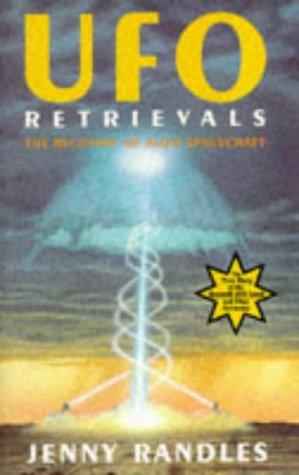
UFO Retrievals
The Recovery of Alien Spacecraft — Thirty Crash Claims Examined by a Researcher Willing to Discard Most of Them
Find on Amazon →As an Amazon Associate, OverClassified may earn from qualifying purchases made through this link, at no extra cost to you.
Why This Is Essential Reading
Read it, and read it early. UFO Retrievals is the most useful single book on the crash-and-recovery literature precisely because it was written by someone with standing inside the field who worked through thirty claims and concluded that most of them fail. Its range — from documented claims of 1871 through Aurora, the foo fighters, Roswell, Aztec, MJ-12 and the 1990s revivals — makes visible that the retrieval story is a genre with its own history, structure and recurring features, and that recognising the genre is more useful than adjudicating any single instance of it. Its limitation is depth: six pages a case will not let you check the reasoning, and every case here has a fuller treatment somewhere. Read it as the map, then go to this site's case files on Roswell, Aztec, Kecksburg and Berwyn for the terrain.
Related Cases & Theories
Sources Cited
- Randles, Jenny. UFO Retrievals: The Recovery of Alien Spacecraft. Blandford, London, 1995. 192 pp. hardcover / 248 pp. paperback. ISBN-10 0713724935 / ISBN-13 9780713724936. amazon.com
- Open Library edition record, UFO retrievals — Blandford, London, 1995; bibliographic verification and cover-art source. openlibrary.org
- Internet Archive holding, UFO retrievals: the recovery of alien spacecraft — the scanned Blandford 1995 edition, confirming publisher, place and date. archive.org
- Goodreads edition record — August 1 1995 publication, 248-page paperback extent, reader rating data, and the description of the book as tracing documented crash and retrieval claims back to 1871 and analysing thirty cases from around the globe, concluding that some are obvious hoaxes, that others can be explained away on objective assessment, and that a few support the field's claims. Reader reviews identify the Nebraska 1897 and 1987 reports, the foo fighters, the Roswell chapter, the 1965 Argentine crash photograph, MJ-12 and the Nazi rocket material, and quote Randles on the majority of the evidence being peppered with misperception, mistaken identity and a pinch of fabrication. goodreads.com
- Google Books record, UFO Retrievals — Blandford 1995, 192-page extent and subject classification. books.google.com
- AbeBooks catalogue record, ISBN 9780713724936 — edition and format verification. abebooks.com
- Wikipedia, "Jenny Randles" — her career, her role as BUFORA Director of Investigations, and the scale of her published output. en.wikipedia.org
- Wikipedia, "British UFO Research Association" — the organisation whose investigative tradition shaped Randles' method and this book's approach. en.wikipedia.org
- Wikipedia, "Roswell incident" — the case that anchors the retrieval genre and the book's major chapter. en.wikipedia.org
- Wikipedia, "Aztec, New Mexico UFO hoax" — the 1948 claim, its promotion by Frank Scully, its exposure and its subsequent revival. en.wikipedia.org
- Wikipedia, "Aurora, Texas, UFO incident" — the 1897 airship crash claim that establishes the genre's nineteenth-century origins. en.wikipedia.org
- Wikipedia, "Foo fighter" — the Second World War aircrew reports covered in the book's wartime chapters. en.wikipedia.org
- Wikipedia, "Majestic 12" — the documents whose status Randles assesses while it was still contested inside the field. en.wikipedia.org
Have corrections, additional research, or peer-reviewed sources? Help improve this entry.
Suggest an Edit