
UFO Exist!
A Broad History of the Phenomenon
Core Thesis
UFO Exist! is Paris Flammonde's 1976 broad historical survey of the UFO phenomenon, discussing the case this site's own Socorro Landing file documents in full — the April 24, 1964 encounter in which police officer Lonnie Zamora reported an egg-shaped craft on landing legs near Socorro, New Mexico, leaving trapezoidal ground depressions and burned creosote bush, a case Project Blue Book ultimately classified as "Unknown." A necessary correction upfront: this site's own citation had previously mistitled the book "UFOs Exist!" with an added S; every independently verified bibliographic and physical source, including a photograph of the actual bound spine, confirms the real title is singular: UFO Exist!
About the Author
Paris Flammonde was a longtime producer of Long John Nebel's late-night New York radio talk show, a program that regularly featured UFO researchers, contactees, and paranormal claimants, and he wrote across a range of paranormal and conspiracy subjects rather than specializing narrowly in ufology. His other books include The Age of Flying Saucers (1971) and The Kennedy Conspiracy (1969), among others.
This article could not confirm Flammonde's exact birth year despite research attempts; a 2015 tribute by James DiEugenio references his death as a recent "November passing" at the time of writing, suggesting late 2014 rather than the 2013 date found in some secondary sources. Given the conflicting and unconfirmed dating, this article does not state specific birth or death years rather than assert an unverified pair.
Historical Context & Origins
The book is a wide-ranging historical survey rather than a case-specific study, covering the UFO phenomenon's development from early sightings through the mid-1970s, including recurring figures like J. Allen Hynek and Donald Keyhoe and the institutional history of Project Blue Book. This article could not independently confirm the site's earlier description of the book as containing "a dedicated chapter" specifically on Socorro; the book's scanned copy on the Internet Archive is currently locked behind controlled digital lending with its search-inside index unavailable, and no table of contents could be located through any other source. This article states the book's likely Socorro coverage honestly as "discussed among its many cases" rather than asserting a specific chapter structure it could not verify.
This site's own case file documents the Socorro case's core physical evidence independently and in far more technical depth than a general survey like this one attempts: the four trapezoidal landing depressions, the burned creosote bush, and the disputed insignia Zamora alone reported seeing on the craft's side, sketched from memory rather than photographed or physically recovered. FBI Special Agent Arthur Byrnes Jr. arrived at the scene the morning after, on April 25, 1964, to conduct interviews and collect soil and vegetation samples for official laboratory analysis — a level of federal, in-person, next-day physical evidence collection that few UFO cases of any era can claim.
Core Arguments & Key Concepts
As a broad survey rather than a case-specific investigation, the book's likely contribution to Socorro is contextual: situating the case within the wider landscape of 1960s-era UFO reporting and Project Blue Book's institutional handling of it, alongside comparable contemporaneous cases, rather than presenting new witness interviews or physical evidence of its own.
This article did not find a specific interpretive thesis attributed to Flammonde regarding Socorro specifically, and does not attribute one to him beyond what the book's general survey framing supports.
Key Cases & Evidence Discussed
This site's own Socorro Landing case file documents the full record in far greater depth than this book review needs to repeat: Officer Zamora's complete account, the physical trace evidence, J. Allen Hynek's on-site investigation days after the encounter, and Project Blue Book chief Hector Quintanilla's own handling of the case's eventual "Unknown" classification. Readers wanting the complete, independently sourced record should consult that case file directly.
What is specific to this book is its 1976 vantage point, roughly a decade after Blue Book's 1969 closure, giving Flammonde's broader survey the benefit of hindsight on how the case fit into the government's overall UFO-investigation program as that program was winding down.
Critical Reception & Controversies
As of this article's research (August 2026), this book has a thin public review record: a single Goodreads rating average of roughly 3.3 out of 5 across a small number of ratings, too small a sample to characterize as any real consensus. No dedicated trade or journalistic review specific to this title was located.
This article found no skeptical rebuttal aimed specifically at this book's own arguments; its broad-survey structure appears to have drawn less individual critical attention than case-specific titles with more singular, testable claims.
Influence & Legacy
The book's legacy is as one of several mid-1970s general-audience surveys attempting to synthesize roughly three decades of American UFO reporting for a popular readership, alongside contemporaries covering similar ground. Its author's broadcasting background, through the Long John Nebel show, connects it to a specific era of New York-based paranormal media culture rather than to any particular field-investigation tradition.
Set alongside this site's own case file, which draws on Hynek's, Quintanilla's, and Blue Book's own documented handling of Socorro, this book is best read as a period-piece survey giving general context rather than as a primary source of new evidence about the case.
The Book
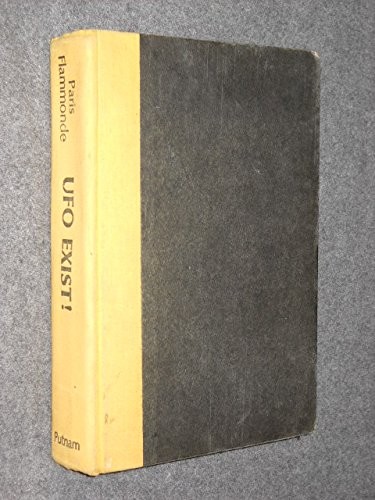
As an Amazon Associate, OverClassified may earn from qualifying purchases made through this link, at no extra cost to you.
Why This Is Essential Reading
UFO Exist! earns a modest place on this reading list as a broad, general-audience historical survey of the UFO phenomenon from a veteran of 1970s paranormal broadcasting, touching on Socorro as one case among many rather than as a dedicated study. Readers wanting the complete record of the case should consult this site's own Socorro Landing case file, which supplies the physical evidence, Hynek's and Quintanilla's documented roles, and the full evidentiary record this general survey does not attempt to replace.
Related Cases & Theories
Sources Cited
- Flammonde, Paris. UFO Exist!. G.P. Putnam's Sons, 1976 (ISBN-13 9780399115387). amazon.com
- "UFO exist!" Internet Archive (bibliographic record and cover scan confirming the singular title). archive.org
- "UFO Exist!" Open Library (edition record, ISBN, and page count). openlibrary.org
- DiEugenio, James. "Honor to Paris Flammonde." Kennedys and King, January 24, 2015 (tribute referencing his recent death). kennedysandking.com
- "Lonnie Zamora incident." Wikipedia (independent case overview, consistent with this site's own case file). en.wikipedia.org
- This site's own Lonnie Zamora key-figures entry (the case's primary witness).
- This site's own J. Allen Hynek key-figures entry (his on-site investigation of the case).
- This site's own Hector Quintanilla key-figures entry (Project Blue Book's handling of the case).
- Clark, Jerome. The UFO Encyclopedia, 4th Edition. Visible Ink Press, 2023 (reference-work entry on the case).
- Flammonde, Paris. The Age of Flying Saucers, Hawthorn Books, 1971 (an earlier Flammonde UFO survey, for context on his broader body of work).
- "Paris Flammonde." Goodreads (bibliographic listing of his broader body of work). goodreads.com
- This site's own Socorro Landing case file (full sourcing, physical evidence, and the Project Blue Book investigation documented there).
Have corrections, additional research, or peer-reviewed sources? Help improve this entry.
Suggest an Edit