
UFO Drawings from the National Archives
Core Thesis
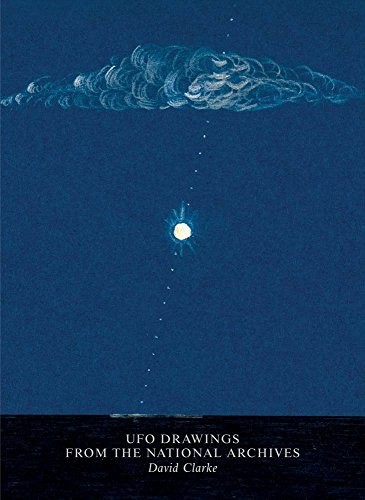
UFO Drawings from the National Archives is David Clarke's 2017 collection of six decades of letters, official reports, photographs, drawings, and paintings of UFO sightings drawn directly from Britain's Ministry of Defence files, published as the second volume in Four Corners Books' Irregulars series. On this site, it functions as primary-source material rather than secondary commentary: Clarke's detailed analysis of the Broad Haven School Sighting's children's drawings, reproduced and examined directly from the archive, established the specific finding — a three-day gap between sighting and drawing, not same-day independence — that this site's own case file relies on.
About the Author
David Clarke (born 1967) is an investigative journalist and academic, currently Associate Professor in the Department of Media Arts and Communication at Sheffield Hallam University. He earned a BA in Archaeology, Prehistory and Medieval History from the University of Sheffield in 1990 and a PhD in English Cultural Tradition and Folklore from the same institution in 1998, following certification as a journalist through the National Council for the Training of Journalists in 1992.
Before entering academia, Clarke spent nearly a decade as a news reporter and editor for regional publications including the Rotherham Advertiser, Sheffield Star, and Yorkshire Post, followed by five years in civil-service communications work. He joined Sheffield Hallam's journalism faculty in 2005, bringing a working journalist's documentary instincts to what became his defining academic and public specialism: the systematic study of official British government UFO records.
From 2008 to 2013, Clarke served as media consultant and curator for the Ministry of Defence's release of its UFO files to The National Archives — a project that transferred more than 210 public records spanning roughly 60,000 pages across ten separate tranches. His Freedom of Information Act requests during and after that period secured the release of significant additional material, including files on the Rendlesham Forest incident, the Flying Saucer Working Party briefing prepared for Winston Churchill, and the Condign Report, and in 2022 he discovered and published the sole surviving photograph from the Calvine UFO sighting.
This book, and Clarke's broader bibliography — including How UFOs Conquered the World (2015), covered separately in this site's own Essential Reading breakdown, The UFOs That Never Were (2000) and Out of the Shadows (2002), both co-authored with Andy Roberts, and Britain's X-traordinary Files (2014) — together represent one of the most extensive published bodies of primary-source-grounded UFO research produced by any single British writer.
Clarke's academic specialism in contemporary legend and folklore, formalized through his 1998 PhD, gives this specific book a distinctive interpretive lens largely absent from more purely investigative UFO literature: rather than treating each drawing purely as a data point to be verified or debunked, Clarke's folklore training equips him to read the drawings collectively as evidence of how ordinary people process and narrativize anomalous experience, a discipline-crossing approach reflected across his career, including his later co-founding of the Centre for Contemporary Legend at Sheffield Hallam University in 2018.
Historical Context & Origins
The book draws on Ministry of Defence UFO files whose formal collection Clarke traces back roughly sixty years, framed in the book's own publicity materials as originating from "a request from Winston Churchill" — a striking origin point for a records program that eventually generated tens of thousands of pages of public submissions, official assessments, and, central to this book specifically, amateur drawings and paintings submitted by ordinary witnesses attempting to depict what they had seen.
Published in 2017 as the second title in Four Corners Books' Irregulars series — a strand the publisher describes as spotlighting overlooked areas of British visual creativity and modern history — the book situates UFO witness drawings as a genuine, previously under-examined category of outsider and folk art, rather than treating them purely as investigative evidence to be assessed for accuracy alone.
The book's publication came near the end of the ten-tranche National Archives release process Clarke himself had helped curate since 2008, giving him direct, comprehensive familiarity with the full breadth of the archive's visual material by the time he began selecting and contextualizing the specific drawings this book reproduces — including cases like an alleged alien craft on the A1 motorway, flying saucers reported over Hampstead, and a spaceship landing claim at a primary school in Macclesfield, alongside the Broad Haven material most directly relevant to this site's own case files.
The release program's origin, tracing back to Winston Churchill's own wartime and postwar interest in aerial phenomena reports, gives the earliest material in this book's scope a genuinely deep historical span — meaning the drawings and letters this book reproduces are not confined to the UFO-culture-saturated decades following the 1947 Kenneth Arnold sighting and the coining of the term "flying saucer," but extend back to a period when British witnesses were describing anomalous aerial phenomena in a cultural vocabulary that predates the modern UFO genre almost entirely.
Core Arguments & Key Concepts
The book's organizing argument treats the drawings themselves as a distinct historical record worth serious attention on their own terms: watercolors, pencil sketches, blurry photographs, and technical-looking schematics submitted by members of the public across six decades, read collectively as what one review described as revealing "the uncanny experiences, rumors, hopes, fears and fantasies" of ordinary British people rather than as a simple catalog of evidence for or against extraterrestrial visitation.
Clarke's approach throughout is contextual and archival rather than adjudicative on a case-by-case basis: the book reads, in one reviewer's description, "less like a gallery guide than an idiosyncratic scrapbook" in which explanatory text is interspersed directly with the reproduced outsider art itself, letting each drawing's own period detail and submission context do much of the interpretive work.
Where the book does apply close investigative scrutiny, it is precise and consequential: Clarke's specific treatment of the Broad Haven School Sighting drawings, working directly from the school's own contemporary diary held in the archive, established that the celebrated near-identical children's sketches — long cited as powerful corroborating evidence that the children had independently witnessed the same object — were in fact produced three days after the sighting, following a weekend during which the children had every opportunity to compare notes and influence one another's recollections.
That specific finding exemplifies the book's broader method: rather than dismissing witness drawings as inherently unreliable or accepting them as straightforwardly corroborating, Clarke treats each drawing's own documented provenance — when it was made, under what conditions, and how it was collected — as the decisive variable in determining what evidentiary weight it can actually bear.
The book's inclusion of technical-looking schematics alongside more clearly amateur or childlike sketches also surfaces a recurring tension in how witness drawings get read: a more polished, confident, technically rendered drawing can appear more credible to a casual viewer while actually reflecting nothing more than the individual witness's own drafting skill or prior exposure to popular UFO iconography, whereas a cruder sketch by an untrained hand may in some cases preserve more genuinely idiosyncratic, first-hand detail. Clarke's curatorial juxtaposition of both types across the book invites readers to notice that distinction rather than defaulting to treating polish as a proxy for reliability.
Key Cases & Evidence Discussed
This site's own Broad Haven School Sighting (Case File #95, February 4, 1977), set at a small primary school near Broad Haven, Pembrokeshire, receives this book's most consequential treatment for this site's own purposes: Clarke's direct examination of the school's contemporary diary, reproduced and discussed in this book, established the three-day gap between the sighting and the drawing session that this site's case file cites as the specific finding complicating the drawings' long-assumed status as independent corroborating evidence.
This site's own Ripperston Farm & the Broad Haven Triangle Wave (Case File #245, beginning April 1, 1977) connects to this book through the same broader Pembrokeshire archive material Clarke draws on: MoD file documentation of the wider wave, including the Coombs family's Ripperston Farm reports, sits within the same National Archives collection this book selects its visual material from, giving readers of this book direct access to primary documentation behind both the school sighting and the broader wave surrounding it.
Critical Reception & Controversies
The book received attention from notably literary outlets not typically associated with UFO subject matter, including a feature in The Paris Review's blog and coverage by Vice, both engaging with the book primarily as a work of visual and social history rather than as UFO advocacy or debunking — a reception pattern reflecting the book's own framing as much a study of British outsider art and folk documentation as of unidentified aerial phenomena specifically.
One review specifically praised Clarke's "extraordinary" work of recontextualization, describing the book's scrapbook-like interweaving of explanatory text and reproduced art as its most distinctive achievement — a structural choice that let the book stand out from more conventional catalog-style treatments of official UFO archives.
Clarke's own standing as the National Archives' former UFO files consultant and curator gives the book a level of institutional authority few other UFO-subject titles can claim: this is a book selected and contextualized by the same person who spent five years preparing the underlying archive for public release, rather than a researcher working from the outside with secondhand access.
No source located during this article's research disputes the book's specific factual claims, including the Broad Haven drawing-timeline finding; such critical engagement as exists concerns interpretive emphasis on which drawings and cases most merit inclusion, a subjective curatorial question inherent to any anthology of this kind rather than a challenge to the book's underlying accuracy.
The book's relatively compact 128-page hardback format, priced at £14 on original release, positioned it as an accessible entry point into archival UFO research rather than a comprehensive scholarly monograph — a deliberate scope choice consistent with the Four Corners Irregulars series' broader mission of spotlighting overlooked visual-history subjects for a general readership rather than producing exhaustive academic treatments.
Influence & Legacy
This exact title is cited in this site's own Broad Haven School Sighting case file's Further Reading section, explicitly credited there as the source of the weekend-gap finding the case file's own Background section relies on — making this one of the relatively few Essential Reading titles this site treats as directly load-bearing for a specific case file's own central factual claim, rather than as general background context.
Clarke's 2018 public lecture at The National Archives itself, drawing on this book's research and delivered at the same Kew archive that houses the underlying files, extended the book's reach to a live audience engaging directly with the primary documents alongside Clarke's own curatorial framing.
As part of Clarke's broader six-title bibliography on British UFO history, this book occupies a distinctive niche within his own body of work: where titles like How UFOs Conquered the World and The UFOs That Never Were build sustained investigative narratives, this book instead lets the primary visual archive speak more directly, with Clarke's role closer to curator and contextualizer than to narrative historian — a complementary approach within a research career this site cites more extensively than that of almost any other single figure in British ufology.
The book's specific reliance on physical archival documents — a school's own diary, an official military file, a member of the public's original hand-drawn submission — also models a broader evidentiary standard this site applies throughout its own case files: that a claim's strength depends substantially on how directly it can be traced back to a contemporaneous primary record, rather than on how many times it has been repeated in later, more distant secondary retellings.
The Book
UFO Drawings from the National Archives
Find on Amazon →As an Amazon Associate, OverClassified may earn from qualifying purchases made through this link, at no extra cost to you.
Why This Is Essential Reading
UFO Drawings from the National Archives earns its place on this list as genuine primary-source scholarship rather than secondary commentary: Clarke's direct archival work here produced the specific finding — the three-day gap between the Broad Haven children's sighting and their now-famous drawings — that reshapes how this site's own Broad Haven School Sighting case file presents one of British ufology's most frequently cited pieces of supposed corroborating evidence.
Related Cases & Theories
Sources Cited
- Clarke, David. UFO Drawings from the National Archives. Four Corners Books (Four Corners Irregulars #2), 2017 (ISBN-13 9781909829091). amazon.com
- "UFO Drawings From The National Archives." Four Corners Books (official publisher description, format, publication date). fourcornersbooks.co.uk
- Clarke, David. "UFO drawings from The National Archives." Sheffield Hallam University Research Archive (SHURA), academic repository record confirming 2017 publication. shura.shu.ac.uk
- "UFO Drawings from the National Archives." The Paris Review (blog feature). theparisreview.org
- "Drawings of UFOs from the Government's Archives." Vice. vice.com
- "'UFO Drawings From The National Archives' by David Clarke, 2017." We Are the Mutants (review). wearethemutants.com
- "Dr David Clarke presents UFO files at The National Archives." Sheffield Hallam University SC2RI Impact Blog, March 8, 2018 (public lecture drawing on this book's research). blogs.shu.ac.uk
- Clarke, David. "Top 10 UFO documents at The National Archives." Dr David Clarke (personal site), March 15, 2018. drdavidclarke.co.uk
- "UFO Drawings from the National Archives." Open Library (bibliographic record, cover art source). openlibrary.org
- This site's own case file: Broad Haven School Sighting, for the full 1977 incident and this book's specific drawing-timeline finding.
- This site's own case file: Ripperston Farm & the Broad Haven Triangle Wave, for the full wider 1977 Pembrokeshire wave.
- This site's own key-figures entry: David Clarke, for his full biography and extensive further case connections.
Have corrections, additional research, or peer-reviewed sources? Help improve this entry.
Suggest an Edit