
UFO Crash Retrievals
The Complete Investigation — Status Reports I–VII, 1978–1994, Collected in One Volume
Core Thesis
UFO Crash Retrievals collects, in one 382-page volume, the seven Status Reports Leonard H. Stringfield issued privately between 1978 and his death in 1994 — the body of material on which the entire modern crashed-saucer literature rests. Stringfield spent those sixteen years collecting accounts from people who said they had seen recovered craft or non-human bodies: military personnel, medical staff, contractors, pilots. He was a serious and long-established researcher, he corroborated where he could, and he protected his sources absolutely. That last decision is the corpus's defining feature: almost every informant in these reports is anonymous, and the material therefore cannot be checked by anyone, including Stringfield's own successors.
About the Author
Leonard H. Stringfield (1920–1994) was a Cincinnati public relations executive and one of the most established figures in American civilian UFO research. He founded CRIFO — Civilian Research, Interplanetary Flying Objects — one of the largest civilian groups of the mid-1950s, and published its newsletter Orbit from 1953 to 1957 while maintaining an unusual semi-formal reporting relationship with Air Defense Command intelligence officers in Columbus, Ohio.
That standing matters for how the Status Reports were received. This was not an unknown enthusiast: Stringfield had a quarter-century of research history, served as an adviser to both NICAP and MUFON, and had done genuine documentary work — obtaining the original searchlight logs and surviving photographs behind the Norwood searchlight incident at Norwood, Ohio.
The crash-retrieval project began in 1978, when he presented the first collection of such accounts at a MUFON symposium, and it continued for sixteen years through seven successive reports. Each added new informants; each was privately printed and circulated within the research community rather than commercially published.
His method was to receive accounts, interview the informant, assess their plausibility and their apparent access, look for internal consistency, and publish the account while withholding the identity. He was scrupulous about the last part and it was a matter of principle: people came to him because he would not name them.
The consequence is the central fact about this corpus. Sixteen years of accumulated testimony from sources nobody but Stringfield could identify became, after his death in 1994, testimony nobody at all can identify. The informants cannot be re-interviewed, their service records cannot be checked, their claimed access cannot be verified, and their accounts cannot be corroborated or refuted. The material is permanently sealed by the promise that produced it.
Historical Context & Origins
Nothing like this existed before 1978. The crashed-saucer claim had a history — the Aztec story of 1948 promoted by Frank Scully and demolished in the 1950s — but that history was one of exposure, and serious researchers had spent two decades keeping their distance from it.
Stringfield's reports changed that, and the timing is important. They began in 1978, the year before the modern Roswell investigation started in earnest, and they established a research framework — anonymous military and medical informants describing recovered material — that the Roswell literature would then adopt wholesale.
The reports' recurring content is remarkably consistent and that consistency is the argument for them. Medical personnel describing autopsies of small humanoid bodies; military personnel describing recovery operations and secure transport; contractors describing materials with unusual properties; and, in nearly every case, an account of extraordinary security procedures and lifelong instructions not to speak.
Wright-Patterson Air Force Base recurs throughout as the claimed destination for recovered material, which places the reports inside the base's oldest rumour tradition — a tradition this library has examined elsewhere and which has never been substantiated by any released document.
The reports were privately printed and circulated within the field rather than sold in bookshops, and that distribution shaped their reception. They reached researchers rather than general readers, they were treated as working documents rather than as commercial products, and their claims entered the literature through citation rather than through public argument.
The literature they seeded is enormous. From the 1980s onward the crashed-saucer and recovered-technology claim became the organising proposition of a large part of American ufology, and a substantial proportion of its case material either originates in Stringfield's reports or follows their template.
The 2019 Lulu compilation is what makes the corpus accessible. For twenty-five years after Stringfield's death the Status Reports existed as scarce privately printed pamphlets in researchers' collections; putting all seven in one commercially available volume, alongside the full scans now on the Internet Archive, is a genuine service to anyone wanting to examine what the literature actually rests on.
Core Arguments & Key Concepts
A large body of first-hand testimony about recovered craft exists and has never been collected anywhere else. The corpus's foundational claim and its reason for existing. Whatever one concludes, Stringfield spent sixteen years assembling accounts that would otherwise not have been recorded at all, and this is the only place they are.
The accounts converge, and convergence across unconnected informants is evidence. Stringfield's central argument. Independent sources with no apparent connection describing similar recovery procedures, similar body morphology, similar security practices and similar materials would be difficult to explain by coincidence, and he pressed the point across all seven reports.
Source protection was necessary to obtain the material at all. The defence of his method, and it is not trivial. People claiming to have violated security obligations do not speak to researchers who will name them, and a policy of disclosure would have produced a much smaller corpus. The choice was between anonymous testimony and no testimony.
Convergence is also what a shared narrative produces, and the corpus cannot distinguish the two. The decisive counter-argument. Informants describing similar things may be describing the same events, or may be drawing on the same cultural material — a recovered-saucer narrative that had been circulating in American popular culture since 1950 and in Stringfield's own published reports since 1978. Later informants had read the earlier reports.
Anonymity converts testimony into something that cannot be assessed. The structural problem and it is fatal to the corpus's evidential use. An account from an unnamed informant whose claimed access cannot be verified, who cannot be re-interviewed, and whose service record cannot be checked is not weak evidence — it is a claim with no attached means of evaluation.
Stringfield's own credibility does not transfer to his sources. The most important distinction a reader must hold. Stringfield was, so far as anyone has established, an honest and careful man who reported accurately what he was told. That establishes that the informants said these things. It establishes nothing about whether the informants were telling the truth, and Stringfield had no means of finding out.
The corpus is unfalsifiable by construction and that is the deepest problem. There is no observation that could show any account in these reports to be false, because there is nothing to check it against. A body of material that cannot in principle be refuted is not a body of evidence, whatever its volume.
The reports are nonetheless the right place to start if you want to understand the claim. Worth saying, because everything above is negative. Anyone trying to establish what the recovered-craft proposition actually asserts, where its specific details came from, and why it took the shape it did rather than some other shape, has to work through this material. The corpus cannot answer whether anything was recovered. It answers, better than any secondary account, the question of what has been claimed and by what kind of source.
Key Cases & Evidence Discussed
Status Report I (1978). The original MUFON symposium presentation, Retrievals of the Third Kind, that opened the sequence and reintroduced the crashed-saucer claim to serious research after two decades of avoidance.
The medical informants. The accounts from people claiming to have participated in or witnessed autopsies of small humanoid bodies — the most-cited and most-repeated material in the whole corpus, and the direct ancestor of the imagery in every later treatment of the subject.
The recovery-operation accounts. Military personnel describing cordons, secure transport, containment procedures and the removal of material from crash sites.
The materials testimony. Contractors and technicians describing metals and components with properties they said were unlike anything conventional — claims for which no specimen has ever been produced.
The Wright-Patterson strand. The recurring identification of Wright-Patterson Air Force Base as the destination for recovered material, connecting the reports to that installation's oldest unsubstantiated rumour.
The security narrative. The near-universal account of extraordinary secrecy procedures and lifelong prohibitions on speaking — the element that explains, within the corpus's own logic, why none of it can be checked.
The Roswell overlap. The material in the later reports that bears on the 1947 New Mexico events, published as the modern Roswell investigation was building, and absorbed into it.
The Aztec precedent. Not Stringfield's subject but the case that shadows the whole enterprise: the 1948 Aztec claim, traced to confidence men, publicly demolished, and revived decades later — the demonstration that a crash story can be refuted and survive.
Critical Reception & Controversies
The Status Reports were privately circulated and never reviewed in any conventional venue. Their reception was within the research community, where Stringfield's long standing gave them immediate credibility, and where they were treated as working documents to be built on rather than as claims to be tested.
That reception is itself the most interesting thing about them. A corpus consisting entirely of anonymous testimony was absorbed into the field's evidence base with very little methodological objection, largely because of who had collected it. Credibility transferred from the collector to the collection in a way it should not have.
The sceptical assessment has never needed elaboration and has never been answered. No informant has been identified, no service record checked, no specimen produced, no document surfaced, and no independent corroboration of any account established in forty-eight years. Those are not gaps that further research might close; they are consequences of how the material was gathered.
The more subtle criticism concerns contamination across the sequence. Status Report I was published in 1978 and the later reports appeared over the following sixteen years, during which the crashed-saucer narrative became widely known and Stringfield's own earlier reports circulated among exactly the population his later informants came from. Convergence within a corpus whose subjects have read its earlier volumes is not independent convergence.
It should be said clearly that nobody has seriously alleged bad faith on Stringfield's part. The consistent judgement, including from critics, is that he reported honestly what he was told. The problem is not that he invented informants; it is that a researcher who cannot verify his sources and will not name them has produced a document that no one else can use as evidence.
The corpus's influence has been out of all proportion to its evidential standing, and that gap is the field's problem rather than Stringfield's. Material that could not be checked became foundational because it was extensive, consistent and collected by someone reputable, and the crashed-saucer literature has been building on it ever since.
The fair placement is as an indispensable primary document about the crash-retrieval claim's origins, and as no kind of evidence at all about crashes. Anyone tracing where the modern recovered-craft narrative came from must read it; anyone asking whether the narrative is true will find nothing here that bears on the question.
One comparison makes the problem concrete, and this library now contains both halves of it. Jenny Randles examined roughly thirty named crash claims and was able to say of each one whether it survived, because each had a location, a date, a claimant and a documentary trail that could be followed. Almost nothing in Stringfield’s seven reports can be handled that way, because the accounts have no attachment points. Two books on the same subject, published seventeen years apart, and only one of them can be argued with.
Influence & Legacy
The Status Reports created the modern crashed-saucer literature. Before 1978 the claim was disreputable and largely avoided by serious researchers; after Stringfield it had a corpus, a method, a source template and a respected name attached, and within a decade it had become the organising proposition of a large part of American ufology.
The anonymous-informant template is the specific inheritance and it has been extraordinarily durable. Every subsequent generation of crash-retrieval claimants — through the 1990s witness literature, the Disclosure Project's testimony volumes, and the current whistleblower material — follows the pattern Stringfield established: credentialled access asserted, identity withheld or unverifiable, corroboration structurally impossible.
The medical-autopsy material in particular has had a life of its own. The body descriptions recurring through these reports fixed an image that has been reproduced continuously since, in books, in documentaries, and in the 1995 alien autopsy hoax, which was constructed to match expectations these reports had substantially created.
The cautionary legacy is the clearest in this entire library and worth stating plainly. A careful, honest, long-established researcher spent sixteen years assembling a large and internally consistent body of testimony, and produced something that cannot be used as evidence by anyone, ever, because he protected his sources. Source protection is a real and defensible journalistic value; its cost is that the resulting material is unverifiable, and a field that builds its foundations on unverifiable material has built on nothing.
It is also worth noticing what the corpus did to the field’s sense of what evidence is. Before 1978 the serious American literature rested on sightings, radar returns, photographs and landing traces — all of them flawed, all of them at least in principle checkable. Stringfield’s reports introduced a class of material that was none of those things and was nevertheless treated as the strongest available support for the largest available claim, and the field’s centre of gravity moved accordingly. That shift, more than any individual account in the seven reports, is their real historical consequence.
The Book
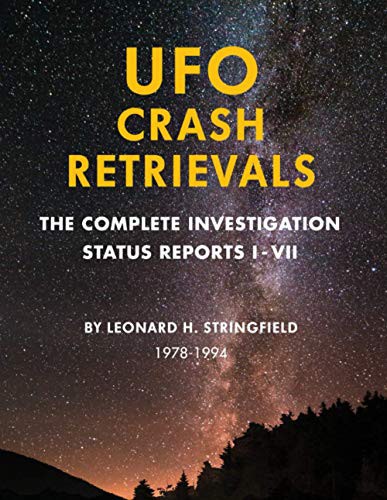
UFO Crash Retrievals
The Complete Investigation — Status Reports I–VII, 1978–1994, Collected in One Volume
Find on Amazon →As an Amazon Associate, OverClassified may earn from qualifying purchases made through this link, at no extra cost to you.
Why This Is Essential Reading
Read it to understand where the crashed-saucer literature came from, and expect to learn nothing from it about crashes. This compilation of Leonard Stringfield's seven Status Reports, 1978–1994, is the single most important primary document in the recovered-craft tradition: it is where the claim became respectable, where the anonymous-military-informant template was established, and where the medical-autopsy imagery that has dominated the subject for forty years was fixed. Stringfield was an established researcher of long standing and there is no serious suggestion he was dishonest. But he protected every source absolutely, he died in 1994, and the consequence is a large, consistent, internally impressive body of testimony that nobody can check, corroborate or refute — and whose later informants had read its earlier volumes. Read it alongside this site's Roswell and Aztec case files, and take the lesson the corpus teaches better than any argument could: testimony that cannot be attributed cannot be assessed, however much of it there is.
Related Cases & Theories
Sources Cited
- Stringfield, Leonard H. UFO Crash Retrievals: The Complete Investigation — Status Reports I–VII (1978–1994). Lulu Press, May 11, 2019. 382 pp. ISBN-10 0359685080 / ISBN-13 9780359685080. amazon.com
- Internet Archive, "UFO Crash Retrievals Status Reports 1–VII" by Leonard H. Stringfield — full scans of the original privately circulated reports. archive.org
- Open Library edition record, ISBN 0359685080 — bibliographic verification and cover-art source. openlibrary.org
- Google Books record, UFO Crash Retrievals: The Complete Investigation — the Lulu Press 2019 compilation, its 382-page extent, and the description confirming all seven Status Reports are included. books.google.com
- Goodreads edition record — edition data and reader reception for the compilation. goodreads.com
- Barnes & Noble catalogue record — edition and format verification. barnesandnoble.com
- Amazon record for UFO Crash Retrievals — Status Report I: Retrievals of the Third Kind — the 1978 original that opened the sequence. amazon.com
- Wikipedia, "Leonard H. Stringfield" — his 1920–1994 dates, his founding of CRIFO, the Orbit newsletter, his NICAP and MUFON advisory roles and the crash-retrieval Status Reports. en.wikipedia.org
- Wikipedia, "Mutual UFO Network" — the organisation at whose 1978 symposium the first Status Report was presented and to which Stringfield was an adviser. en.wikipedia.org
- Wikipedia, "NICAP" — the other principal American civilian organisation Stringfield advised. en.wikipedia.org
- Wikipedia, "Roswell incident" — the case whose modern investigation began the year after Status Report I and which absorbed the reports' framework. en.wikipedia.org
- Wikipedia, "Aztec, New Mexico UFO hoax" — the 1948 crash claim, its exposure and its revival, which shadows the whole crash-retrieval enterprise. en.wikipedia.org
- Wikipedia, "Anonymous source" — the journalistic practice at the centre of the corpus's method, its justifications and its costs. en.wikipedia.org
Have corrections, additional research, or peer-reviewed sources? Help improve this entry.
Suggest an Edit