
The Canadian UFO Report
The Best Cases Revealed
Core Thesis
The Canadian UFO Report: The Best Cases Revealed is a chronological, case-by-case survey of Canada's own UFO history, co-written by Chris A. Rutkowski, a Winnipeg-based science writer and educator who has catalogued Canadian sightings since the mid-1970s and who founded and still runs the country's only sustained civilian UFO-tracking effort, and Geoff Dittman, a Winnipeg-area accountant who joined that same effort as a volunteer data analyst in 1994. Published by Dundurn Press's Hounslow imprint in 2006, the book moves from Canada's earliest recorded aerial anomaly — a 1662 sighting of "fiery serpents" over Montreal — through more than three centuries of reports, drawing its core material directly from the authors' own archive: Ufology Research of Manitoba's (UFOROM's) annual Canadian UFO Survey, which by the book's 2006 publication had already compiled several thousand Canadian sighting reports since 1989, supplemented by declassified Department of National Defence, Transport Canada, and RCMP files and by Rutkowski's own two-decade informal arrangement receiving low-classification UFO reports directly from Canadian military bases. Unlike most single-case studies or American-centric survey books, its organizing claim is not a theory about what UFOs are but an assertion of coverage and provenance: that it presents the strongest, most thoroughly sourced Canadian cases — unexplained and explained alike, since a full closing chapter is devoted to the conventionally identified reports — drawn from a first-party national dataset no other Canadian UFO book of its era could claim.
About the Author
Chris A. Rutkowski is a Canadian science writer and educator holding university degrees in astronomy and education, who has taught space and astronomy courses and served as past president of the Winnipeg Centre of the Royal Astronomical Society of Canada. He began investigating Canadian UFO reports as a young researcher during the mid-1970s, cataloguing sightings connected to the 1975 Charlie Redstar wave centred on Carman, Manitoba, his home province — the same case this book's own chapter "Charlie Redstar and Friends" revisits directly. In 1989 he founded what became Ufology Research (originally Ufology Research of Manitoba, or UFOROM), based in Winnipeg, which has compiled, analyzed, and published the annual Canadian UFO Survey every year since, drawing on reports submitted by civilian investigators, government files, and the public; that Survey remains the single largest sustained dataset on Canadian UFO reporting and is the evidentiary backbone of this book. Rutkowski has since authored roughly ten books on UFOs and related subjects, is affiliated with the Center for UFO Studies, the Galileo Project, and the Scientific Coalition for UAP Studies, and maintained what Canadian defence officials themselves have called a "handshake agreement" — an informal, roughly two-decade arrangement, beginning around 1999, under which Transport Canada and several Canadian Forces bases (including CFB Comox) forwarded him low-classification civilian UFO reports, formalized in at least one internal military reference document instructing that "UFO sightings are to be referred to: Mr. Chris Rutkowski." As Rutkowski has described his own access, "I receive relatively low-classified reports with no security concerns," while acknowledging he does not receive every official report filed.
That same evidence-first, conclusion-agnostic posture runs through Rutkowski's approach to the material itself: he has said skeptics and debunkers have accused him of being too credulous, while confirmed believers have accused him of being a debunker, a position he treats as evidence he is doing the job honestly rather than steering toward either camp. He continued documenting Canadian government UFO material well beyond this 2006 book, later publishing Canada's UFOs: Declassified (2022), which this site covers separately in its own Essential Reading entry, working chapter by chapter through Library and Archives Canada's declassified 1947–1980 UFO files.
Geoff Dittman's path into UFO research began far from any research institution: as a child, he learned of an alleged UFO landing on the property neighbouring his family's cottage, an anecdote that stayed with him into adulthood. He holds a Commerce degree and a professional accounting designation and has spent his career in the insurance and finance industry, not in any UFO-adjacent field. In 1994 he discovered the Canadian UFO Survey and began volunteering with Ufology Research, contributing data entry, compilation, and statistical analysis to the annual Survey for the decade leading up to this book's publication — the specific, hands-on familiarity with the raw case data that The Canadian UFO Report represents his one major published byline drawing on. Dittman's involvement did not end with the book: more recent editions of the Canadian UFO Survey, including the 2025 report, continue to list him alongside Rutkowski as a compiler, meaning the working partnership this book documents from 2006 has now run for roughly three decades.
Historical Context & Origins
By 2006, Canadian ufology had a real but scattered documentary record, and The Canadian UFO Report arrived as an attempt to gather it into one place rather than break new theoretical ground. Individual Canadian cases had already received serious book-length treatment — Nova Scotia researchers Chris Styles and Don Ledger had published Dark Object: The World's Only Government-Documented UFO Crash on the 1967 Shag Harbour case in 2001, and engineer Palmiro Campagna had devoted a chapter of The UFO Files: The Canadian Connection Exposed (1997) to the declassified 1975 CFS Falconbridge radar incident — but no single volume had yet attempted a chronological, nationwide survey built from a first-party Canadian dataset rather than assembled secondhand from American-focused ufology literature, in which Canadian cases typically appeared, if at all, as brief regional footnotes.
The book also arrived on the back of a genuine institutional shift in how much of that record was publicly accessible. Canada's approach to its own government UFO files had grown comparatively open relative to the more piecemeal, request-driven American declassification process, and by the mid-2000s a substantial and growing body of Department of National Defence, Transport Canada, National Research Council, and RCMP material had already been logged, catalogued, and in some cases opened to researchers through Library and Archives Canada — the same institutional record this site's own Shag Harbour and Duhamel Alberta UFO Nests case files document in more detail. Rutkowski's own decade-old informal channel receiving low-classification reports directly from Transport Canada and several Canadian Forces bases put him and, by extension, Dittman in an unusually direct position to draw on that record rather than reconstruct it entirely through Access to Information requests, the slower and more adversarial route Styles and Ledger's Shag Harbour research had relied on.
Underlying all of this was the specific institutional history this site's own Project Magnet case file documents directly: Canada's first official government UFO investigation, approved by the Department of Transport in December 1950 under radio engineer Wilbert B. Smith, predated the United States' Project Blue Book in continuous operation and established, however informally, a Canadian government tradition of at least logging civilian UFO reports that persisted in various forms for decades afterward — the same loose institutional tradition Rutkowski's own later handshake arrangement with Transport Canada and the Canadian Forces effectively continued on a civilian-researcher basis once the government's own formal investigative apparatus had long since wound down.
The Canadian UFO Report is explicit about drawing on the Canadian UFO Survey's own accumulated case files as its primary evidentiary base — a survey that, by 2006, already represented seventeen years of continuous annual data collection — giving the book access to a scale and continuity of first-party Canadian material that neither the single-case studies preceding it, nor most general ufology surveys with only marginal Canadian coverage, could match.
Core Arguments & Key Concepts
The book's organizing method is chronological rather than thematic: it moves case by case from "The Historical Context" through "The Early Years," the post-war "Exciting Decades," "The Sixties" and "The Seventies," and on into the 1980s and beyond, before closing with dedicated chapters on "Government UFO Investigation," "The Canadian UFO Survey" itself, and, notably, a chapter titled "Misidentified Flying Objects" that walks through conventionally explained Canadian reports alongside the unexplained ones. That closing structural choice is itself an argument: rather than presenting only the cases that resist explanation, Rutkowski and Dittman explicitly include reports they judge to have mundane causes, positioning the book as a survey of Canadian UFO reporting as a phenomenon in its own right, not a brief for any single interpretation of what the unexplained residue represents.
A second recurring structural argument runs through the book's specific attention to physical-trace and multi-witness cases over single, uncorroborated sightings — the 1967 Falcon Lake burns, the 1967 Shag Harbour naval search, and the 1975 CFS Falconbridge radar-and-visual incident all involve some form of independent corroboration (physical injury and site evidence, a multi-agency search response, or a documented military instrument track and multiple witnesses) beyond a single person's word, and the book foregrounds that corroboration as its standard for what counts as a genuinely strong case, rather than sheer strangeness or witness sincerity alone.
In its chapters on government involvement — "Government UFO Investigation" and "But They Know Everything" — the book takes a measured, evidence-anchored position on official secrecy rather than a maximalist cover-up framing: it works from what the declassified Canadian record actually shows (informal report-logging arrangements, inconsistent internal classification, occasional public non-explanations) rather than asserting a coordinated concealment program for which the authors do not claim to have direct documentary proof. That restraint is consistent with Rutkowski's broader public stance, described in press coverage as favouring evidence over speculation and deliberately keeping the extraterrestrial question "offstage" while still maintaining that a genuine, unexplained residue of cases survives ordinary explanation.
The book's use of the Canadian UFO Survey as both a data source and a subject in its own right — devoting a full chapter to explaining the Survey's methodology and history rather than only citing figures from it in passing — is itself a distinctive structural argument: it asks readers to evaluate individual Canadian cases in the context of the broader statistical pattern of Canadian reporting the authors had, by 2006, already spent seventeen years compiling, rather than as isolated anecdotes.
Key Cases & Evidence Discussed
The book's single most physically documented case is the 1967 Falcon Lake incident, in which prospector Stefan Michalak reported a landed disc near Falcon Lake, Manitoba, and suffered a distinctive grid-pattern burn injury later commemorated on a Royal Canadian Mint coin — a case this site's own case file rates CREDIBLE on the strength of its physical-evidence trail, and one whose Manitoba setting places it squarely within the same regional UFO-reporting tradition Rutkowski's own career as a researcher began in.
The 1967 Shag Harbour incident — in which multiple witnesses, including RCMP constable Laurie Wickens, reported an object crashing into the water off Nova Scotia, triggering a genuine Royal Canadian Navy search — appears in the book as one of its central 1960s cases, five years before Chris Styles and Don Ledger's more exhaustively researched Dark Object (2001) and more than a decade before their follow-up Impact to Contact (2018), both of which this book's own account predates in publication but draws on the same broader public record those later, case-dedicated books would go on to examine in far greater depth.
Rutkowski's own regional history is most directly visible in the chapter "Charlie Redstar and Friends," covering the 1975 Charlie Redstar wave of sightings centred on Carman, Manitoba and documented in part through National Research Council case files — the same wave Rutkowski began cataloguing as a young researcher and later revisited directly in a dedicated 1993 book chapter of the same title, making this 2006 chapter a condensed return to material he had already spent decades with by the time this book was written.
The book also documents the November 1975 CFS Falconbridge radar-and-visual incident near Sudbury, Ontario — in which NORAD radar at the station tracked an unresolved target, seven Ontario Provincial Police officers reported visually sighting an object, and two interceptors were scrambled — a case later analyzed in far greater documentary depth in Palmiro Campagna's 1997 chapter on the same incident, drawn from a declassified 22nd NORAD Region Air Traffic Control log Campagna obtained under Canada's Access to Information framework.
Beyond these now-canonical cases, the book's chronological structure reaches back to Canada's earliest recorded aerial anomaly — a 1662 sighting of "fiery serpents" over Montreal — and forward through reported 1940s–50s "flying saucer" sightings at Goose Bay Air Force Base in Labrador and a 1973 wave of reports over Quebec, giving the book a chronological reach across more than three centuries of Canadian aerial-anomaly reporting that few other single volumes on the subject attempt.
Critical Reception & Controversies
The book's most substantive professional review came from Janet Arnett, former campus manager of adult education at Georgian College, in the Canadian Book Review Annual. Arnett's assessment was measured rather than dismissive: she noted the authors compiled more than 5,000 reports yet acknowledged that most witnesses in that dataset remain anonymous, preventing independent verification; that promised or claimed photographic evidence consistently fails to materialize across the case record the book surveys; and that claims resting on government classification are, by their nature, impossible for a reader to independently check. Arnett pointedly observed that the authors themselves "cannot prove aliens have landed in Canada," and concluded that readers already "inclined to give the little green men the benefit of a doubt" would find supporting material in the book — a formulation that reads as gentle skepticism about the book's persuasive reach rather than a rejection of its factual reporting.
Reader response on Goodreads, where the book holds a 3.67-out-of-5 average across eighteen ratings, raises a related but distinct concern: not evidentiary weakness so much as authorial tone. One reviewer, while calling the cases "interesting" and the assessment "seemingly a well documented" survey of Canadian sightings since the early 1900s, added that "the authors [are] dry at times. And they clearly have biases and seem highly defensive while writing certain chapters," suggesting the book would have read more persuasively "if they kept it more reporter like and kept personal opinions to a paragraph at the end of the case report perhaps" — a criticism of editorial restraint rather than of the underlying case research. A second reader called the survey "interesting but somewhat underwhelming," a milder version of the same complaint that the book's chronological breadth comes at some cost to depth on any single case.
A more structural critique applies not to this specific book but to the ongoing Canadian UFO Survey project whose seventeen years of accumulated data underpin it, and is worth including precisely because that Survey is the evidentiary foundation the book explicitly rests on. In an April 2024 methodology review published by the Experiencer Support Association, researcher Ryan Stacey argued that "the Canadian UFO Survey's documentation needs more detail about its data collection, classification, and analysis methodologies," and that the Survey's "apparent isolation from other significant UFO research organizations" — including the omission of MUFON Canada's and TESA's own case data from more recent editions — "suggests a missed opportunity for a more exhaustive and representative analysis," even as the Survey has, in the same period, drawn on "unvetted sources on social media, including Facebook, YouTube, and a podcast." Rutkowski has himself acknowledged operating in a genuine methodological middle ground, noting that skeptics and debunkers have criticized him for being too credulous while committed believers have accused him of being a debunker — a position he treats as evidence of even-handedness, but one that a formal outside methodology review suggests could still benefit from more transparent, standardized documentation of exactly how cases are verified, classified, and retained.
Taken together, the honest critical picture of The Canadian UFO Report is not that it fabricates or seriously misrepresents its underlying cases — no reviewer located for this entry disputes the book's core factual reporting on Falcon Lake, Shag Harbour, Charlie Redstar, or CFS Falconbridge — but that its evidentiary reach consistently outruns what it can independently verify: anonymous witnesses, undelivered photographs, unfalsifiable classification claims, an authorial tone reviewers found occasionally defensive, and a source dataset whose own collection methodology a later, dedicated review found insufficiently documented for outside researchers to replicate.
Influence & Legacy
The Canadian UFO Report became, per its publisher's own later marketing material, one of two Dundurn-published Rutkowski titles to reach national bestseller status in Canada, alongside his earlier Abductions and Aliens, giving Canadian ufology a mainstream, general-audience reference point it had previously lacked in book form. Its chronological, case-by-case survey model — anchored in the authors' own Canadian UFO Survey archive rather than in secondhand American sourcing — established a template Rutkowski would return to and expand sixteen years later in Canada's UFOs: Declassified (2022), covered separately in this site's own Essential Reading library, which applies the same evidence-anchored, case-by-case method specifically to Library and Archives Canada's declassified 1947–1980 government files.
The book's most direct and durable legacy, however, is not literary but institutional: the Canadian UFO Survey the book draws on and explains in its own dedicated chapter has continued publishing annually every year since, with Geoff Dittman remaining a listed co-compiler alongside Rutkowski as recently as the 2025 edition — meaning the working partnership this 2006 book documents has now run for roughly three decades and shows no sign of ending. That continuity gives The Canadian UFO Report an unusual status among UFO books: rather than a closed, one-time account of a static case record, it is best read as a snapshot of an evidentiary project that was already seventeen years old when the book appeared and has continued to grow for two decades since.
The book's specific case coverage also shaped how later, more specialized researchers approached the same material: Chris Styles and Don Ledger's far more exhaustive Impact to Contact: The Shag Harbour Incident (2018) and Palmiro Campagna's own declassified-document chapter on CFS Falconbridge both cover ground this book had already surveyed at a national, comparative scale, with Rutkowski and Dittman's book functioning as the broader chronological map those later, deeper single-case studies filled in.
Rutkowski's own informal standing with Canadian defence and transport officials, documented independently in Vice's investigative reporting on his "handshake agreement" arrangement, gives this book's underlying dataset a degree of first-party government access that later analysts examining Canadian UFO reporting have had to reckon with directly — whether treating it as a genuine research asset or, as the Experiencer Support Association's 2024 review implicitly suggests, as an arrangement whose informality is itself part of the transparency problem in Canadian civilian ufology.
The Book
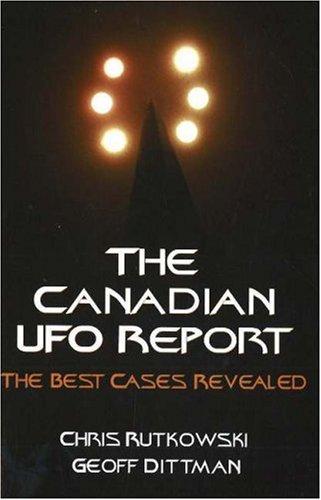
As an Amazon Associate, OverClassified may earn from qualifying purchases made through this link, at no extra cost to you.
Why This Is Essential Reading
The Canadian UFO Report earns its place on this list less as a work of theory or argument than as an act of institutional documentation: it is the first book-length attempt to gather Canada's own UFO record — from a 1662 account of "fiery serpents" over Montreal through Falcon Lake, Shag Harbour, Charlie Redstar, and CFS Falconbridge — into a single chronological survey built from a genuine, seventeen-year-deep first-party national dataset rather than reassembled secondhand from American sources. Chris Rutkowski's decades of fieldwork and his unusual informal standing with Transport Canada and the Canadian Forces, combined with Geoff Dittman's decade of hands-on data work inside the Canadian UFO Survey by the time of publication, gave the book access few single-case studies or general surveys of the era could match. Read against Janet Arnett's measured Canadian Book Review Annual notice, reader complaints about an occasionally defensive authorial tone, and the Experiencer Support Association's 2024 methodology critique of the Canadian UFO Survey the book draws on, it is essential less as a settled account of what happened in any single case than as the clearest available map of Canada's own UFO reporting record — a map two later, far more specialized books, Styles and Ledger's Impact to Contact and Rutkowski's own Canada's UFOs: Declassified, would go on to fill in with considerably more depth, but that this 2006 volume drew first, and largely alone.
Related Cases & Theories
Essential Viewing
Sources Cited
- "The Canadian UFO Report: The Best Cases Revealed." Open Library, edition record OL8547772M (bibliographic record: Dundurn Press, Toronto, May 2006, 334 pp., ISBN 1550026216 / 9781550026214, cover art source). openlibrary.org
- "The Canadian UFO Report: The Best Cases Revealed." Amazon.com product listing (publisher, format, ISBN confirmation). amazon.com
- "The Canadian UFO Report: The Best Cases Revealed." Google Books (table of contents, publisher description, named cases). books.google.com
- "Our Team." Canadian UFO Report / Ufology Research (canadianuforeport.ca) — official biographical pages for Chris Rutkowski and Geoff Dittman, their credentials, and their roles with the Canadian UFO Survey. canadianuforeport.ca
- Arnett, Janet. Review of The Canadian UFO Report: The Best Cases Revealed. Canadian Book Review Annual Online (professional review: anonymous-witness and unverifiable-classification critique). cbra.library.utoronto.ca
- "The Canadian UFO Report: The Best Cases Revealed" by Chris A. Rutkowski. Goodreads (reader ratings and reviews, 3.67/5 average across 18 ratings). goodreads.com
- Stacey, Ryan. "A Critical Examination of Chris Rutkowski's Canadian UFO Survey." The Experiencer Support Association, April 25, 2024 (methodology critique: data-source transparency, classification standards, collaborative isolation). experiencersupport.org
- "CFS Falconbridge." Wikipedia (November 1975 radar/visual incident account, citing The Canadian UFO Report, ISBN 1-55002-621-6, as a source). en.wikipedia.org
- "Canada's Point Man for Military UFO Reports Is This Civilian in Winnipeg." Vice (investigative reporting on Rutkowski's informal Transport Canada / Canadian Forces reporting arrangement, the CL 213 referral document, and his own quoted description of the access it provides). vice.com
- "The 2025 Canadian UFO Survey." Ufology Research (PDF report compiled by Chris Rutkowski, Geoff Dittman, and Leanne Sallenback, confirming Dittman's continued role nearly two decades after this book's publication). img1.wsimg.com
- This site's own key-figures entry: Chris Rutkowski, for his full biography and case connections.
- This site's own case file: The Falcon Lake Incident (Case File #017).
- This site's own case file: The Shag Harbour UFO Incident (Case File #032), including its account of Chris Styles and Don Ledger's later, more exhaustive research.
- This site's own case file: Charlie Redstar (Case File #183).
- This site's own case file: CFS Falconbridge Radar Incident (Case File #190), including its account of Palmiro Campagna's declassified-document research.
- This site's own case file: Project Magnet (Case File #277), for the institutional history of Canadian government UFO investigation this book's later chapters build on.
- This site's own essential reading entry: Canada's UFOs: Declassified (Essential Reading ER-085), Rutkowski's 2022 follow-up applying the same method to Canada's declassified government files.
Have corrections, additional research, or peer-reviewed sources? Help improve this entry.
Suggest an Edit