
Spying on the Bomb
American Nuclear Intelligence from Nazi Germany to Iran and North Korea
Core Thesis
Spying on the Bomb is Jeffrey T. Richelson's comprehensive history of American nuclear intelligence efforts, tracing the subject from the World War II race to assess Nazi Germany's own nuclear program through Cold War-era Soviet monitoring to twenty-first-century concerns about Iran and North Korea, built on declassified documents and direct interviews with the scientists and intelligence officers involved. Its relevance to this site is direct: the book's dedicated treatment of U.S. reconnaissance efforts against Iran's nuclear program supplies essential background for evaluating the "suspected CIA drone" explanation Iranian sources themselves favored for the unidentified "luminous objects" central to this site's own Arak F-14 Radar Intercept case file.
About the Author
Jeffrey Talbot Richelson (1949–2017) grew up in the Bronx, earned his B.A. from the City College of New York, and completed a Ph.D. in political science at the University of Rochester in 1975, going on to teach at the University of Texas at Austin and American University before becoming a senior fellow with the independent, nonprofit National Security Archive at George Washington University.
Richelson was known throughout his career for his relentless use of Freedom of Information Act requests to declassify primary-source material on American intelligence history, a methodology that directly shaped his books' distinctive evidentiary depth. He authored more than a dozen books on intelligence and espionage, including The U.S. Intelligence Community (now in its seventh edition) and works on the CIA's Directorate of Science and Technology and American satellite reconnaissance programs, alongside directing publication of several of the National Security Archive's own declassified-document collections.
Richelson died in 2017, and both the National Security Archive and the Federation of American Scientists published tributes crediting him with having done more than almost any other single scholar to make the declassified documentary record of American intelligence history accessible to the public, through both his own books and the underlying archival collections his FOIA work helped create.
The National Security Archive and Federation of American Scientists tributes published after his death both specifically emphasized his distinctively persistent research method: rather than relying primarily on interviews or secondary sources, Richelson built his books around sustained, often years-long Freedom of Information Act requests, using what different agencies were willing to release, and what they withheld, as its own kind of evidence about which parts of the historical record remained most sensitive.
Historical Context & Origins
The book was published in 2006 by W. W. Norton, a period of heightened international concern about nuclear proliferation following the 2003 revelation of Libya's secret nuclear program, ongoing concern about North Korea's 2006 first nuclear test, and growing Western attention to Iran's own enrichment activities at Natanz — giving Richelson's historical treatment of American nuclear intelligence direct contemporary relevance rather than purely retrospective interest.
Richelson's methodology of combining newly declassified documents with direct interviews of surviving participants places the book within a specific tradition of intelligence history that treats the historical record as continuously recoverable through persistent archival research, rather than permanently closed off by government secrecy — a research philosophy this site's own case-file methodology shares when assessing what genuinely can and cannot be independently verified about a contested claim.
The book's dedicated Iran chapter arrived at a moment when American intelligence assessment of Iran's nuclear program was itself a matter of significant public and political controversy, following the 2007 National Intelligence Estimate's own controversial conclusion (published shortly after this book) that Iran had halted weapons-related nuclear work in 2003 — a conclusion that itself later drew skepticism from various quarters, illustrating the same fundamental difficulty in achieving confident nuclear-intelligence assessment that Richelson's book documents across seven decades of American practice.
This same period saw American nuclear-intelligence assessment more broadly under sustained public scrutiny following the 2002-2003 Iraq weapons-of-mass-destruction intelligence failure, which had badly damaged public and congressional confidence in the intelligence community's ability to accurately assess foreign nuclear and unconventional-weapons programs. Richelson's book, arriving directly in the wake of that failure, gained particular relevance for readers seeking a longer historical view of how often, and in what specific ways, American nuclear intelligence had gotten things wrong even before the widely publicized Iraq case.
Core Arguments & Key Concepts
The book's central argument, developed across its full historical sweep from Nazi Germany to contemporary Iran and North Korea, is that American nuclear intelligence has been a consistently difficult, frequently uncertain enterprise even with the substantial resources the United States has devoted to it — Richelson documents repeated instances where American assessments of adversary nuclear programs were significantly wrong in both directions, sometimes overestimating and sometimes underestimating actual progress.
Richelson traces the specific evolution of American nuclear-intelligence collection methods across the decades his book covers, from early human-intelligence networks and captured-document exploitation during and after World War II, through Cold War-era satellite reconnaissance and signals intelligence, to the more recent combination of satellite imagery, intercepted communications, and on-the-ground inspection regimes used to monitor Iran and North Korea.
On Iran specifically, Richelson documents the range of reconnaissance methods the American intelligence community has employed to monitor Iranian nuclear facilities, including satellite imagery of specific sites, signals intelligence, and, where the historical record supports it, unmanned aerial reconnaissance — providing the general technical and historical vocabulary this site's own case file draws on when evaluating the plausibility of the "suspected CIA drone" explanation Iranian personnel themselves offered for the unidentified aerial activity central to the Arak claim.
The book is candid throughout about the limits of what even extensive declassified documentation can establish: Richelson repeatedly flags where the historical record remains genuinely incomplete or where specific operational details remain classified even decades later, a methodological honesty directly comparable to how this site's own case files handle claims that cannot be fully verified from available sources.
Key Cases & Evidence Discussed
This site's own Arak F-14 Radar Intercept (claimed November 2004), centered on airspace near the Arak heavy-water plant, benefits directly from this book's Iran chapter, which documents the actual, historically confirmed pattern of American nuclear-intelligence collection against Iranian facilities — supplying a documented baseline against which to judge how far the Arak claim's specific described capabilities (Mach 10 flight combined with a full hover) depart from any historically confirmed American reconnaissance platform or method.
This site's own case file separately notes that the one American reconnaissance drone whose overflight of Iran is independently, publicly, and multiply confirmed — the RQ-170 Sentinel, captured near Kashmar in December 2011 — has performance characteristics (subsonic, propeller-less, no hover capability) that directly contradict rather than support the Arak claim's described capabilities; Richelson's broader historical treatment of American nuclear-intelligence platforms provides useful additional context for why no confirmed American system, across the entire seven-decade history this book covers, has ever combined hypersonic speed with hovering flight.
Critical Reception & Controversies
The book received strong reviews across both general and specialist publications. The New York Times Book Review praised Richelson for writing "with admirable clarity," while Kirkus Reviews called the book "full of tense and suspenseful turns" despite its rigorously documentary, non-fiction subject matter. The Wall Street Journal described it as "engrossing," and the Bulletin of the Atomic Scientists called it "a magisterial history of the U.S. nuclear intelligence effort."
Academic reviewers, including a review in Political Science Quarterly by Robert Jervis, a leading scholar of intelligence and international relations, engaged substantively with the book's scholarly contribution, treating it as a significant, well-documented addition to the intelligence-history literature rather than a purely popular account.
Reviewers consistently credited Richelson's established track record on prior books — his earlier works on the CIA's Directorate of Science and Technology, American satellite reconnaissance, and the broader U.S. intelligence community — as evidence of his particular qualification to write this specific, technically demanding synthesis.
No critical source located in researching this article disputes the book's core historical claims about the recurring difficulty and frequent uncertainty of American nuclear-intelligence assessment across the decades it covers; the book's reputation rests specifically on this documented, evidence-based candor about intelligence limitations rather than on any triumphalist account of American technical capability.
Some reviewers noted the book's considerable length and density as a genuine, if unavoidable, challenge for general readers, given the sheer historical scope Richelson chose to cover in a single volume; specialist reviewers generally treated this comprehensiveness as a strength rather than a flaw, since it allows a single reader to trace continuities and contrasts across nuclear-intelligence efforts against different adversary programs that most other books treat only individually.
Influence & Legacy
This exact edition is cited in this site's own Arak F-14 Radar Intercept case file's Further Reading section specifically as "directly relevant background for evaluating the 'suspected CIA drone' explanation Iranian sources themselves favored."
The book remains a standard reference work in subsequent scholarship and journalism on nuclear intelligence history, frequently cited alongside Richelson's other books as foundational sources for understanding the declassified documentary record of American nuclear-intelligence practice.
Following Richelson's 2017 death, both the National Security Archive and the Federation of American Scientists specifically credited his body of work, including this book, with having permanently expanded the publicly accessible documentary record of American intelligence history — a legacy this site's own case-file research, which regularly draws on declassified government documents, directly benefits from.
The book's specific treatment of Iran nuclear intelligence has also aged into an unusually durable reference point, since Iran's own nuclear program, unlike North Korea's more episodic public developments, has remained a continuously active subject of Western intelligence and diplomatic attention across the two decades since the book's publication, keeping its underlying historical framework consistently relevant to ongoing coverage rather than superseded by later events.
The Book
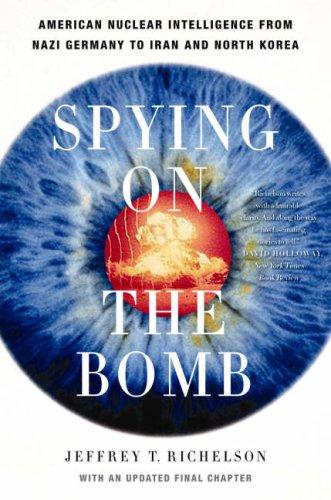
Spying on the Bomb
American Nuclear Intelligence from Nazi Germany to Iran and North Korea
Find on Amazon →As an Amazon Associate, OverClassified may earn from qualifying purchases made through this link, at no extra cost to you.
Why This Is Essential Reading
Spying on the Bomb earns its place on this list as the single most historically comprehensive, rigorously documented account available of what American nuclear intelligence against Iran has actually, confirmedly involved — essential context for judging how far the Arak claim's own described capabilities depart from anything this site's own Arak F-14 Radar Intercept case file can verify against the real historical record. Read alongside David Crist's Twilight War and Kenneth Pollack's Unthinkable, this book completes this site's own three-book context cluster for that case's central, still-unresolved claim.
Related Cases & Theories
Sources Cited
- Richelson, Jeffrey T. Spying on the Bomb: American Nuclear Intelligence from Nazi Germany to Iran and North Korea. W. W. Norton & Company, 2006 (ISBN-13 9780393329827). amazon.com
- "Jeffrey T. Richelson." Wikipedia (full biography: education, career, bibliography). en.wikipedia.org
- "In Memoriam: Jeffrey T. Richelson, 1949-2017." National Security Archive. nsarchive.gwu.edu
- "Remembering Jeff Richelson." Federation of American Scientists. fas.org
- "Dr. Jeffrey T. Richelson." National Security Archive (staff/fellow profile). nsarchive.gwu.edu
- "Spying on the Bomb." Kirkus Reviews. kirkusreviews.com
- "Spying on the Bomb: American Nuclear Intelligence from Nazi Germany to Iran and North Korea." Foreign Affairs (capsule review). foreignaffairs.com
- "Spying on the Bomb: American Nuclear Intelligence from Nazi Germany to Iran and North Korea." Atomic Archive (book review). atomicarchive.com
- Jervis, Robert. "Spying on the Bomb (review)." Political Science Quarterly, 2007. onlinelibrary.wiley.com
- "Spying on the Bomb." Goodreads (reader ratings and reviews). goodreads.com
- "Spying on the Bomb." Open Library (bibliographic record and cover art source). openlibrary.org
- This site's own case file: Arak F-14 Radar Intercept, for the full analysis this book's context supports.
- This site's own key-figures entry: Jeffrey T. Richelson, for his full biography and further case connections.
- This site's own essential reading entries: The Twilight War and Unthinkable, completing this site's Arak-case context cluster.
Have corrections, additional research, or peer-reviewed sources? Help improve this entry.
Suggest an Edit