
Revelations
Alien Contact and Human Deception
Core Thesis
Revelations: Alien Contact and Human Deception is the third and final volume of Jacques Vallée's Alien Contact Trilogy, following Dimensions (1988) and Confrontations (1990). Where the earlier two volumes catalog case evidence for Vallée's own interdimensional and close-encounter research, this book turns the same investigative rigor toward the opposite problem: hoaxes, military counterintelligence operations, and media manipulations that Vallée argues have actively misled UFO researchers and diverted attention from the phenomenon itself. This site's own research draws on the book for two very different modern cases — the 1989 Bob Lazar Area 51 disclosures and the December 2023 Langley AFB drone-swarm incident — treating Vallée's deception-focused framework as directly, and separately, relevant to both.
About the Author
Jacques Vallée (b. 1939) is a French-American astronomer, computer scientist, and one of the field's most intellectually rigorous researchers, and a protégé of J. Allen Hynek. He co-developed the "interdimensional hypothesis" — that UAP may originate from parallel realities rather than distant planets — analyzed isotopic ratios of anomalous materials at Stanford, served as a consultant to the Advanced Aerospace Threat Identification Program (AATIP), and was the inspiration for the character Lacombe in Steven Spielberg's Close Encounters of the Third Kind.
By 1991, Vallée had already published Passport to Magonia, The Invisible College, and the first two volumes of the Alien Contact Trilogy, giving him more than two decades of accumulated field investigation experience before turning his attention specifically to the phenomenon's deception and disinformation dimension in this book. That focus was not new territory for him: his earlier 1979 book Messengers of Deception had already examined how UFO belief could be manipulated by cults and manipulative individuals to control followers, meaning Revelations extends a concern with engineered belief-manipulation that runs through Vallée's career going back more than a decade before this specific book's 1991 publication. This site's own essential-reading library now documents eight of Vallée's books, reflecting his position as one of the most extensively covered single authors in this catalogue.
Vallée's own "control system" model — in which the UFO phenomenon itself may function to regulate human belief across history — is a related but distinct claim from the more narrowly human-engineered deception this specific book investigates: where the control-system model proposes the phenomenon's own deep structure shapes belief, Revelations documents specific, human-organized hoaxes and intelligence operations exploiting that same belief for conventional, earthly purposes — military counterintelligence, personal fraud, and institutional misdirection.
Historical Context & Origins
Ballantine Books published Revelations in September 1991, completing a trilogy that had begun three years earlier with Dimensions. The book's timing placed it squarely within the period immediately following the December 1988 broadcast that first brought Bob Lazar's Area 51 claims to national attention, giving Vallée the opportunity to investigate a still-fresh, still-unfolding case rather than a settled historical one.
The book arrived at a moment when the UFO research community was reckoning, more openly than in prior decades, with the reality that at least some sensational claims within the field had originated as deliberate intelligence-community disinformation rather than either genuine anomalous encounters or simple hoaxes — a distinction this site's own Government Deception Hypothesis theory page traces back to researcher Leon Davidson's 1957 The Flying Saucer Hoax, the first serious proposal that UAP reports themselves might function as CIA psychological warfare. Vallée's book, arriving 34 years later with far more documented case material, gave that older suspicion a far more developed evidentiary treatment.
This site's own research finds the book's central concern directly relevant to cases decades apart from its own 1991 publication date: its investigation of Cold War-era counterintelligence exploitation of UFO belief provides interpretive context this site's own Langley AFB case file applies to a December 2023 drone-swarm incident — evidence that Vallée's deception framework was built to outlast the specific cases that originally prompted it.
Core Arguments & Key Concepts
The book's central argument is that well-constructed hoaxes and deliberate media manipulations have measurably misled UFO researchers throughout the field's history, diverting serious investigative attention away from the phenomenon's own genuine, harder-to-explain core. Vallée treats this not as an argument against UAP research broadly — he maintains throughout that UFOs represent a genuine phenomenon worth investigating — but as a specific methodological warning that the field's own credibility has been repeatedly damaged by failing to distinguish real anomalies from engineered deceptions.
A second theme, directly applied in this site's own Bob Lazar case file, is that some of the most sensational individual claims within the field may represent deliberate military counterintelligence operations rather than either genuine disclosure or straightforward personal fraud. This site's own case file summarizes Vallée's specific application to Lazar directly: he "provides a critical, sociological perspective on Area 51 and the S-4 disclosures, warning of potential psychological warfare and military counterintelligence involvement" — a third interpretive category distinct from either "Lazar told the truth" or "Lazar lied for personal reasons."
A third theme is that Roswell and Area 51, the field's two most culturally dominant modern legends, deserve to be examined specifically as case studies in how a compelling narrative can be, in Vallée's own published framing, a "complex hoax" carefully engineered for a specific institutional benefit — a claim this site's own research treats as a genuinely testable historical proposition for particular sub-claims within each legend, rather than a blanket dismissal of every element of either case. This claim carries real institutional weight given Vallée's own standing: unlike a purely armchair skeptic, he had by 1991 already spent decades conducting direct field investigation of individual cases, giving his deception-focused chapters the same evidentiary grounding he applied to his own positive case findings elsewhere in the trilogy, rather than treating hoax investigation as a lesser or secondary activity.
A fourth theme, consistent with Vallée's own decades of direct field experience, is treating hoax investigation and genuine-phenomenon investigation as requiring the same rigorous evidentiary standard rather than different ones — the same skepticism a careful researcher applies to a claimed alien contact should apply equally to a claimed government cover story, since both are, in the end, claims requiring independent verification rather than acceptance on the strength of the claimant's own confidence or charisma.
Key Cases & Evidence Discussed
The Bob Lazar case (Case File #005, 1988–1989) at Area 51 / Groom Lake, Nevada, receives dedicated treatment in this book's Chapter 4, "The Dreamland Chronicles." Lazar claimed to have worked at a facility called S-4 near Papoose Lake, reverse-engineering an extraterrestrial disc he called the "Sport Model," with associates Gene Huff and journalist George Knapp among his earliest public witnesses. This site's own case file documents Lazar's account beginning in mid-1988, when he claims to have contacted physicist Edward Teller at Los Alamos requesting a recommendation before interviewing with defense contractor EG&G; by December 1988 he says he had begun work at S-4, reading briefing papers describing historical extraterrestrial interactions. Between March and April 1989, Lazar, his wife, Gene Huff, and pilot John Lear made repeated Wednesday-night trips into the Nevada desert to record anomalous lights over Groom Lake, until security patrol officers caught the group on their third trip, detaining and interrogating Lazar at Indian Springs Air Force Base and abruptly terminating his S-4 employment. His first public account aired May 15, 1989 on KLAS-TV, silhouetted and voice-disguised under the pseudonym "Dennis"; a second broadcast that November, this time under his real name, is what introduced Area 51 into global public consciousness. This site's own case file finds the case aligns most strongly with the Psycho-Social Hypothesis at 75 percent, while still assigning meaningful weight to genuine extraterrestrial reverse-engineering, precisely because Vallée's own deception-focused reading offers a third explanatory path beyond simple belief or disbelief: that Lazar's account, whatever its ultimate truth value, may itself have been shaped or exploited by a counterintelligence operation designed to protect genuinely classified conventional stealth-aircraft programs at the same physical location, using UFO mythology as effective cover precisely because it is so easy to dismiss outright.
The Langley AFB incident (Case File #100, December 2023, with an earlier 2012 precedent) at Langley Air Force Base, Hampton, Virginia, involved a swarm of equilateral-triangle-configured objects reported by witnesses including whistleblower Dylan Borland, on-duty USAF patrols, and General Gregory Guillot, documented through FAA logs and later Senate testimony. This site's own case file cites Vallée's book for its investigation of "deceptions, military intelligence hoaxes, and the psychological warfare aspects of the UFO phenomenon, providing critical context for drone wave reporting" — applying a framework developed to explain a specific 1989 disclosure to an evidentiary problem three decades later: distinguishing a genuine airspace-security incident from a possible deliberate or accidental disinformation dynamic layered on top of real drone activity.
Critical Reception & Controversies
On Goodreads, the book carries a strong 4.35-out-of-5 average from 361 ratings and 17 written reviews (checked August 2026) — a substantial sample and the highest rating of any Vallée title in this site's essential-reading library to date. One reviewer called it "essential reading on the subject," while another, describing it as the concluding volume of "the so-called 'Alien Contact' trilogy after Dimensions, and Confrontations," praised it as an "excellent book." A third reviewer, more focused on its skeptical case material specifically, wrote approvingly of the book's coverage of "crock, crap... psychical illness, fraud and gullibility all turning into alien brouhaha," adding they "totally loved some of the dialogues the author's quoting here" and calling it "lovely skepticism."
This site's research attempted to verify an Amazon rating for this title but Amazon's bot-detection system repeatedly blocked automated requests to the listing during this session, returning a CAPTCHA challenge across multiple attempts. Per this site's own Amazon Rating Display Protocol, this gap is disclosed honestly here rather than fabricated or silently omitted.
The book's most substantial independent validation on this site specifically is its citation record: two case files, separated by more than three decades (1989 to 2023) and covering structurally very different phenomena (a personal whistleblower disclosure versus a multi-witness airspace incursion), both draw on Vallée's deception framework directly, reflecting a genuinely durable interpretive tool rather than an analysis tied to one specific historical moment.
Influence & Legacy
The clearest evidence of this book's lasting relevance on this site specifically is its citation record spanning more than three decades of case history — from the 1989 Lazar disclosures through a December 2023 drone incursion — demonstrating that Vallée's deception-and-counterintelligence framework has remained interpretively useful well beyond the specific cases that originally prompted it.
As the concluding volume of a trilogy this site's own essential-reading library now documents in full (Dimensions, Confrontations, and this book), Revelations completes a body of work that moves from theoretical framework (the interdimensional hypothesis) through direct field casework to, finally, a sustained examination of how the field's own evidentiary record can be deliberately corrupted — a natural capstone to Vallée's own stated methodological priority of applying equal rigor to every category of claim.
This site's own Government Deception Hypothesis theory page cites this book alongside Leon Davidson's 1957 foundational work and the CIA's own 1997 Studies in Intelligence retrospective on its UFO-era involvement, positioning Vallée's contribution as a significant mid-point in a decades-long, still-ongoing documentary record of how intelligence agencies and the UFO research community have interacted, deliberately or otherwise.
The Book
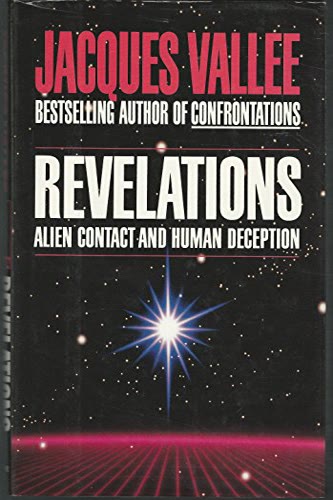
As an Amazon Associate, OverClassified may earn from qualifying purchases made through this link, at no extra cost to you.
Why This Is Essential Reading
Revelations: Alien Contact and Human Deception earns its place on this list as the concluding volume of Jacques Vallée's Alien Contact Trilogy and as a durable interpretive tool this site's own research applies across more than three decades of case history. Vallée's specific investigation of the Bob Lazar disclosures in Chapter 4, "The Dreamland Chronicles," offers this site's own case file a genuine third explanatory path beyond simple belief or disbelief — that a counterintelligence operation may have shaped or exploited Lazar's account to protect conventional classified programs — while the same book's broader deception framework proved directly applicable, three decades later, to the December 2023 Langley AFB drone-swarm incident. Its strong 4.35/5 Goodreads reception across a substantial 361-rating sample reflects a book readers continue to find genuinely essential rather than dated. Read as the completion of a trilogy that moves from theory through fieldwork to a sustained examination of deception itself, this book is essential because it applies the same rigorous evidentiary standard to hoaxes and intelligence operations that Vallée's earlier volumes applied to the phenomenon's own most genuine cases — a methodological consistency this site's own research treats as a model worth following.
Related Cases & Theories
Essential Viewing
Sources Cited
- Vallée, Jacques. Revelations: Alien Contact and Human Deception. Ballantine Books, 1991 (ISBN 0-345-37172-0, cited here).
- "Revelations: Alien Contact and Human Deception." Goodreads (rating 4.35/5, 361 ratings, 17 written reviews quoted, checked August 2026). goodreads.com
- "Revelations: Alien Contact and Human Deception." AbeBooks (ISBN 9780345371720, marketplace listing photograph used for this article's cover image). abebooks.com
- "Bob Lazar Opens Up About His Problems with the UFO Community — and Jacques Vallée's visit." Eyes On Cinema, YouTube (video verified via oEmbed). youtube.com
- This site's own resources library: Full Reading List, where this exact 1991 edition is cited across 2 separate case-file pages.
- This site's own key-figures entry: Jacques Vallée, for his full biography and site-wide case connections.
- This site's own case file: Bob Lazar, which cites this book's Chapter 4 investigation of the Area 51 disclosures directly.
- This site's own case file: Langley AFB, which applies this book's deception framework to a 2023 drone-swarm incident.
- This site's own theory page: Government Deception Hypothesis, which cites this book alongside Leon Davidson's 1957 foundational work.
- This site's own essential-reading entry: Dimensions, the first volume of Vallée's Alien Contact Trilogy.
- This site's own essential-reading entry: Confrontations, the second volume of Vallée's Alien Contact Trilogy.
- "Advanced Research." Jacques Vallée's official website (author's own publication history and research summary). jacquesvallee.net
- This site's own key-figures entry: Bob Lazar, the subject of this book's Chapter 4 investigation.
- "Bob Lazar." Wikipedia (used lightly, for basic biographical cross-checking only; not relied upon for case facts, which follow this site's own dedicated case file and primary sources above). en.wikipedia.org
- Central Intelligence Agency. "The CIA's Role in the Study of UFOs, 1947–90." Studies in Intelligence, 1997 (the agency's own retrospective on government involvement in UFO-era disinformation, directly relevant to this book's central subject). cia.gov
Have corrections, additional research, or peer-reviewed sources? Help improve this entry.
Suggest an Edit