
The Panama Canal Zone Radar Sighting
Over three consecutive nights in March 1958, radar operators at two independent installations in the Panama Canal Zone — Battery D of the 764th Anti-Aircraft Artillery Battalion on Flamenco Island, and a separate search-radar unit on Taboga Island — independently tracked unidentified targets performing maneuvers their own operators described as impossible for the aircraft of the day. Track Radar at Flamenco Island held a lock on two objects for over five hours, recording a climb from roughly 2,000 to 10,000 feet in five to ten seconds the instant a searchlight was trained on them. A Pan American Airlines pilot reported a visual sighting two nights later. The whole episode was compiled by Caribbean Air Command intelligence officer Capt. Vernon D. Adams into Air Intelligence Information Report No. IR-4-58 — a document whose own surviving text shows an investigation genuinely split between confirmed mundane contacts (a stray weather balloon, cloud-return clutter) and a residual, harder-to-explain track that was never specifically resolved.
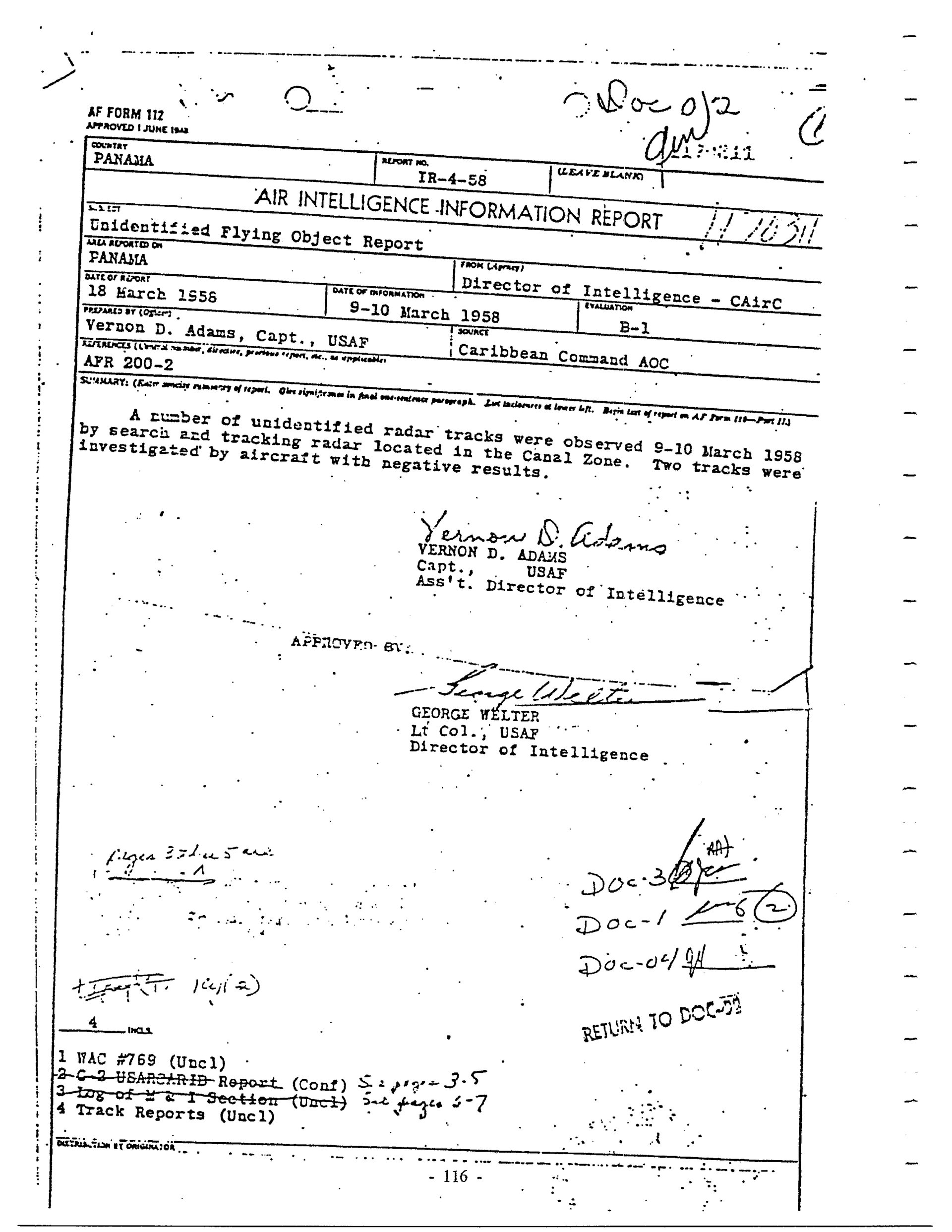
Pictured: page one of Air Intelligence Information Report No. IR-4-58 itself — prepared and signed by Capt. Vernon D. Adams, USAF, and approved by Lt. Col. George Welter — scanned directly from the declassified original held in the Internet Archive's National Security Internet Archive collection. This is a direct photograph of the case's actual founding document, not a reconstruction. No photograph of the radar returns, the searchlight illumination, or of any object is known to exist; radar-scope photography was not standard practice at Panama Canal Zone Army/Air Force radar sites in 1958.
Theoretical Alignment
This is a low-alignment case across every major interpretive framework, which is itself the most honest thing that can be said about it. A genuinely solid Track Radar lock, an instantaneous altitude change, and independent corroboration from a second radar site the following day are the strongest points in favor of treating the residual, unexplained portion of the record as evidence of a real, physically anomalous craft (ETH). But the same 48-hour window's own log contains a confirmed false contact (a stray weather balloon) and the reporting officer's own acknowledgment that some returns were "definite when associated with clouds" — undercutting any framework that requires the whole episode to be a single coherent phenomenon. Nothing in the record supports an interdimensional or psycho-social reading beyond the general observation that trained military radar operators, primed by a decade of Cold War vigilance, do occasionally mistake weather and equipment artifacts for hostile aircraft.
Background
By March 1958 the Panama Canal Zone had been one of the most heavily defended strips of territory in the Western Hemisphere for over four decades. The 553-square-mile Zone, administered by the United States under the 1903 Hay–Bunau-Varilla Treaty, hosted two separate senior commands: Caribbean Air Command (CAirC), headquartered at Albrook Air Force Base from 1946 to 1963, and United States Army Caribbean (USARCARIB), whose anti-aircraft artillery units guarded the Canal's Pacific and Atlantic approaches. Air defense of the Pacific entrance fell to the 764th Anti-Aircraft Artillery Battalion, garrisoned at Fort Clayton with gun and radar batteries sited on the Causeway Islands of Fort Amador — including Flamenco Island — and on outlying positions such as Taboga Island, twelve miles out in the Gulf of Panama.
The sighting arrived at a moment of acute Cold War anxiety. The Soviet Union had orbited Sputnik 1 barely five months earlier, in October 1957, and the United States had answered with its own first satellite, Explorer 1, on January 31, 1958 — just five weeks before the first Flamenco Island contact. Air defense units across the hemisphere were on heightened alert for exactly the kind of anomalous, high-performance radar return this case would produce, and Air Force doctrine already took the possibility seriously enough to have a standing reporting mechanism: Air Force Regulation 200-2, "Unidentified Flying Objects Reporting," first issued in 1953 and revised in August 1954 and again in February 1958, required any Air Force unit encountering such a target to file a report through Air Defense Command and the Air Technical Intelligence Center at Wright-Patterson using the standardized AF Form 112 — the exact form Capt. Adams used to compile this case. Six years earlier, the CIA's own December 1952 intelligence estimate on the "flying saucer" phenomenon had explicitly worried that Soviet intelligence could exploit America's radar-tracking apparatus, and that a genuinely hostile aircraft might exploit American radar operators' own uncertainty about what they were seeing.
The Zone was not tracking an unfamiliar kind of anomaly for the first time in 1958. On the night of November 25, 1952, radar attached to Canal Zone anti-aircraft guns had tracked two objects maneuvering between 1,000 and 28,000 feet for five and a half hours; three Air Force bombers and a Navy patrol plane were scrambled and failed to intercept them. That episode reached the Washington Post via columnist Drew Pearson under the headline "Sky Objects Mystify Canal Zone," and survives today in Project Blue Book's own Caribbean Command file — giving the 764th's officers a direct institutional memory of an almost identical event on the same stretch of radar coverage less than six years before Capt. Harold E. Stahlman was called from his quarters on the night of March 9, 1958.
Panama's own political relationship with the United States was also under real strain that year. The Panamanian government had rejected U.S. requests to station Nike surface-to-air missiles in the Republic in both 1956 and 1958, and nationalist student demonstrations against the American presence recurred in 1955, 1958, 1959, and again in 1964 — the same underlying friction that would eventually force renegotiation of the Hay–Bunau-Varilla Treaty and, decades later, the Torrijos–Carter Treaties that closed every base named in this case file. A March 1959 State Department intelligence estimate on threats to U.S. Caribbean facilities, describing conditions essentially unchanged from the prior year, characterized the sitting Panamanian government as "generally pro-US and a moderate" but "weak," under pressure from an opposition that had learned to focus public discontent on the American military presence.
Complete Timeline
| Date | Event |
|---|---|
| 19:58R, Mar 9 | An unknown aircraft is reported flying inbound on the "Tango" air route. No known traffic is in the area; Tocumen tower later advises one aircraft accounts for it. |
| 20:03R, Mar 9 | First contact. The 764th Anti-Aircraft Operations Center (AAOC) at Fort Clayton receives a radar report of an unidentified aircraft approaching the Pacific side of the Isthmus. The AAOC's Operations Duty Officer telephones Capt. Harold E. Stahlman, the unit's Operations Officer and Deputy Defense Commander for Anti-Aircraft Artillery, at his quarters. |
| ~20:08R, Mar 9 | Stahlman arrives at the AAOC to personally direct the response. |
| 20:43–20:45R, Mar 9 | Two additional radar blips appear alongside the first, which is identified as a Cubana Airlines aircraft landing at Tocumen Airport, Republic of Panama. The two unidentified blips indicate objects in the vicinity of Fort Kobbe. Separately, a blip near Albrook believed to be an orbiting weather balloon is logged and referred to Air Traffic Control. |
| 20:45R, Mar 9 | Confirmation received that a weather balloon had in fact been released at approximately 18:30R and should be descending southeast of Albrook — the balloon track is resolved as explained. |
| 21:40R, Mar 9 | The tower clears Pan American Flight P-501 for direction-finding instructions to route around the unidentified object as it crosses the canal over Albrook. |
| 22:45R, Mar 9 | The unidentified object is now 4,870 yards from Battery D's position on Flamenco Island, at roughly 3,500 feet. A harbor-entrance searchlight, assisted by an Air Force–Navy crash boat, is brought to bear to attempt visual identification. |
| ~23:00R, Mar 9 | The searchlight test. The instant the light touches the objects, Track Radar records them climbing from roughly 2,000 feet to 10,000 feet in five to ten seconds. Radar operators report the objects become markedly more evasive as soon as the light was employed. |
| 23:55R–24:00R, Mar 9 | The object is tracked moving away rapidly to the southwest at high altitude; radar records two separate returns, one near 10,000 feet, roughly 7,800 yards from the site. |
| 00:44R, Mar 10 | Braniff Flight 400 reports a negative visual sighting during a brief in-flight investigation, though radar places the aircraft within roughly 100 yards of the object at the time. |
| 00:55R, Mar 10 | Radar reports two distinct targets now roughly 100 yards apart; Braniff Flight 400 lands at 00:47R. |
| 02:08–02:10R, Mar 10 | Track Radar contact with the Flamenco Island objects is lost. This closes the primary observation window: 2003R, March 9 to 0208R, March 10 — over five hours of intermittent tracking on two objects roughly 100 yards apart, at Grid LJ 2853, holding a steady, slight circular pattern over the vicinity of Fort Kobbe at altitudes averaging 7,000 feet. |
| 10:12R, Mar 10 | Second, independent contact. Taboga Island's search radar picks up an unknown aircraft at Grid KL1646, speed 290 knots, matching no known traffic when checked against Tocumen, Albrook, and Howard air traffic control and the Civil Aeronautics Administration. The blip reaches roughly 900 knots, then stops completely for several minutes before moving again. |
| 10:30R, Mar 10 | Major Davis at Howard Field Operations is advised of the unidentified object and personally takes off to look. |
| 11:20R, Mar 10 | Air Force aircraft 5289, a T-33 jet trainer, is launched from Howard Field to investigate; the surviving log excerpt breaks off as the object is reported observed. |
| 14:12R, Mar 10 | Track Radar at Taboga Island is secured after the target, whose speed had been calculated at roughly 1,000 mph, moves away from the two approaching USAF jets. |
| ~04:00R, Mar 11 | The Pan American pilot report. The pilot of inbound Pan American Airlines aircraft C-509, a DC-6, reports an unidentified flying object roughly twelve miles north of the "Fox Trot" air route, appearing larger than his own aircraft and traveling southeasterly. Lt. Roy M. Strom, Operations Officer of the 764th AAA Battalion, relays the report. |
| Mar 11 (concurrent) | Radar independently plots an unidentified target three times over roughly eleven minutes, tracking a 45-mile displacement to the northeast before the contact could not be further resolved. |
| 18 March 1958 | Report IR-4-58 compiled. Capt. Vernon D. Adams, Caribbean Air Command's Assistant Director of Intelligence, consolidates the AAOC and USARCARIB narratives, the movement-and-identification log extracts, and the track reports into Air Intelligence Information Report No. IR-4-58, approved by Lt. Col. George Welter, Director of Intelligence. The Army's own supplement notes its office "continues to report information as developed," indicating the matter remained under active observation past the report's compilation date. |
First Contact: The Night of March 9–10
The case begins, in the surviving paperwork, with an ordinary duty-officer phone call. At 2003R on March 9, 1958, the 764th Anti-Aircraft Operations Center's Operations Duty Officer telephoned Capt. Harold E. Stahlman at his quarters to report that search radar had picked up an unidentified aircraft approaching the Pacific side of the Isthmus of Panama. Stahlman, who held the dual role of AAOC Operations Officer and Deputy Defense Commander for Anti-Aircraft Artillery, arrived at the operations center roughly five minutes later and personally took charge of what would become a multi-hour tracking effort.
The first blip that appeared on the radar screen resolved quickly and mundanely: at 2043R it was identified as a Cubana Airlines aircraft on approach to Tocumen Airport in the Republic of Panama, and it landed there without further incident. But at almost the same moment, two additional, unaccounted-for blips appeared on the scope, indicating two objects in the vicinity of Fort Kobbe. A civilian aircraft already airborne in the general area was asked to make a visual search; it turned up nothing. Search Radar picked up the objects and handed the track to Track Radar sited at Flamenco Island, Fort Clayton, and Ancon — and this unit succeeded in locking onto both objects.
Search and Track Radar Lock at Flamenco Island
What the Flamenco Island crew logged for the next several hours is the technical core of the case. Their official data, reproduced verbatim in Report IR-4-58, records two objects, approximately one hundred yards apart, observed continuously from 2003R on March 9 to 0208R on March 10 — more than five hours. The radar fixed their position at Grid Reference LJ 2853 on the Military Grid Reference System, at an average angle of elevation of roughly 36.5 degrees and an azimuth of 330 mils from the Flamenco Island battery. Their manner of flight was described as "steady, slight circular path over the vicinity of Fort Kobbe," at altitudes that "varied from two to ten thousand feet," averaging around seven thousand.
The report's own reasoning about what this meant is worth reading closely. Track Radar — as opposed to the broader-sweeping Search Radar that first detected the objects — can, per the operators' understanding at the time, only maintain a continuous lock on a solid, reflective target; it does not sustain a lock on diffuse returns such as precipitation or cloud clutter. Because the unit succeeded in holding a Track Radar lock on both objects for over five hours, the report concludes: "it was assumed that the objects were solid." The possibility that the contacts were weather balloons was explicitly checked and discarded — the Air Force was contacted directly and confirmed no balloons were aloft over that specific position at that time (a separate, confirmed balloon contact near Albrook that same evening is addressed below, and its resolution is exactly why this distinction mattered to the investigators).
The Searchlight Test
At 2245R, with the object roughly 4,870 yards from the Flamenco Island battery at an altitude of about 3,500 feet, Stahlman's team attempted a direct visual identification: a searchlight from the harbor-entrance control point was trained on the radar-locked objects, assisted by an Air Force–Navy crash boat standing by in the harbor. What happened next is the single most striking data point in the entire case file. Per the report's own language: "When the light touched the objects, they traveled from an altitude of two thousand feet to ten thousand feet in five to ten seconds." A vertical climb of roughly 8,000 feet within a ten-second window works out to an average rate of climb on the order of 48,000 feet per minute — more than ten times the sustained climb rate of the era's fastest interceptors, achieved (on the log's own account) with no audible propulsion signature and no advance warning on the scope.
Radar operators reported that the objects became noticeably more evasive from the moment the searchlight was employed. By midnight the log records the objects at roughly 10,000 feet, 7,800 yards from the site, with two distinct returns — one near 10,000 feet, the other lower. Two commercial airliners were drawn into the episode without incident: Braniff Flight 400, conducting a brief visual investigation at 0044R, reported a negative sighting even though radar placed the airliner within roughly 100 yards of the object at that moment, and landed safely at 0047R. Radar contact with the Flamenco Island objects was ultimately lost at 0210R on March 10, closing out the primary observation window.
A Confirmed False Positive: The Weather Balloon Over Albrook
Report IR-4-58 is unusual among 1950s radar cases for how candidly it documents its own false alarms in the same log as its unresolved contact. At 2045R on March 9 — almost exactly the moment the Flamenco Island track was developing — a separate blip near Albrook and Taboga was logged as "believed to be a weather balloon," noted as appearing to orbit, with no known aircraft in the area at all. Within the same hour, this was confirmed: a weather balloon had in fact been released at approximately 1830R and should, by the time of the report, have descended somewhere southeast of Albrook. Air Traffic Control was formally advised of the possibility that the balloon could interfere with air traffic, and the contact was closed as explained.
This detail matters far more than its brief mention in the log suggests. It demonstrates, from inside the same 48-hour window and the same reporting chain, that AAOC personnel were both willing and able to correctly identify and close out a mundane false contact when the evidence supported it — which is exactly why their inability to do the same for the Flamenco Island track, despite genuine effort, carries real evidentiary weight. Capt. Adams's own summary narrative acknowledges this mixed picture directly, noting that scope-operator interrogation found some "returns were definite when associated with clouds," while "generally the tracks were triangular with speed or movement very erratic," at times appearing to be "evading action." The report treats these as two different categories of contact within the same investigation, not one single unified anomaly — a distinction subsequent secondary retellings of this case have not always preserved.
March 10: The Taboga Island Pursuit
The following morning brought a second, geographically separate contact that Stahlman also reported. At 1012R on March 10, the search radar site on Taboga Island — a volcanic island roughly twelve miles offshore in the Gulf of Panama — picked up an unknown aircraft at Grid KL1646, an initial speed of 290 knots, and no known traffic in the area when checked against Tocumen, Albrook, and Howard Field air traffic control and the Civil Aeronautics Administration. The weather at Taboga was partly cloudy, in contrast to the clear, unlimited visibility logged at Flamenco Island the night before — a genuine difference in observing conditions the report preserves rather than smooths over.
The target's behavior was, if anything, more extreme than the Flamenco Island contact: from an erratic flight pattern it shifted into a "triangular shaped flight pattern," varying "from hovering to approximately one thousand miles per hour." Its altitude could not be determined "due to the radar system used" — an honest limitation the report notes rather than fabricates a figure for. Major Davis, at Howard Field Operations, personally took off to investigate at 1030R; a T-33 jet trainer, tail number 5289, launched from Howard Field at 1120R to make a direct interception attempt. The surviving log excerpt breaks off shortly after the T-33's launch, with a note that the object was observed, before the record picks back up with the radar's own account: the target moved away from the two approaching USAF jets, its speed calculated at roughly 1,000 miles per hour, before Track Radar use at the site was terminated at 1412R.
March 11: The Pan American Pilot Report
The case's only sustained visual account came two nights later, and reached the file secondhand. At approximately 0400R on March 11, 1958, the pilot of an inbound Pan American Airlines DC-6, tail designation C-509, reported an unidentified flying object roughly twelve miles north of the "Fox Trot" air route. According to the account relayed by Lt. Roy M. Strom, the 764th AAA Battalion's Operations Officer, the object "appeared larger than the aircraft and was traveling in a southeasterly direction." At the same time, radar independently plotted an unidentified contact three times over an eleven-minute window, tracking a 45-mile displacement to the northeast before further resolution became impossible.
The Pan American pilot himself is not named in the surviving document, and his account — a directional and relative-size impression, nothing more — was never independently corroborated by a second crew member, a ground witness, or a photograph. It is, by any honest reading, the thinnest single data point in the case file. Its significance lies less in what it proves on its own than in its timing: a professional airline pilot, with no evident connection to the military radar operators three sites away, reported an unusual aerial object on the same general bearing and within the same 48-hour window that two independent Army and Air Force radar installations were separately logging unexplained contacts.
Compiling Report IR-4-58
The paper trail that survives today is itself a small case study in how the Air Force's 1958-era UFO reporting apparatus actually functioned. Under Department of the Army Intelligence Collection Memorandum #200-528-1 (8 August 1957, subject: "Unconventional Aircraft"), Army units were required to notify the headquarters of the nearest Major Air Command of any sighting that came to Army personnel's attention — which is why USARCARIB's own G-2 (intelligence) staff drafted a narrative supplement, drawing on Stahlman's and Strom's firsthand accounts, and forwarded it to Caribbean Air Command rather than simply filing it internally. On the Air Force side, AFR 200-2, "Unidentified Flying Objects Reporting" (short title UFOB), separately obligated Air Force commanders to report the same class of sighting up their own chain, using the standardized AF Form 112.
Capt. Vernon D. Adams, CAirC's Assistant Director of Intelligence, was the officer who actually assembled the finished document: the AF Form 112 cover sheet with his own narrative summary, the USARCARIB supplement carrying Stahlman's and Strom's statements, and an attached extract from the AAOC's own movement-and-identification log — the minute-by-minute record this case file's timeline draws directly from. The completed report, dated 18 March 1958 and titled simply "PANAMA," carries the case designation IR-4-58 directly on its own cover sheet, and was formally approved by Lt. Col. George Welter, CAirC's Director of Intelligence, whose countersignature appears beneath Adams's own. The USARCARIB supplement closes by noting that its office "continues to report information as developed" — language indicating the situation was still considered active as of the report's compilation date, eight days after the Pan American sighting.
Key Witnesses
Capt. Harold E. Stahlman
The on-scene commander for the case's opening night. Called from his quarters at 2003R on March 9, 1958, Stahlman arrived at the AAOC roughly five minutes later and directed the entire multi-hour tracking effort, including the decision to attempt visual confirmation with a harbor-entrance searchlight — the moment that produced the case's most dramatic single data point, the objects' near-instantaneous climb from 2,000 to 10,000 feet. Stahlman filed a second report the following day covering the independent Taboga Island contact, making him the only figure in the case with firsthand authorship of both radar events.
Lt. Roy M. Strom
A newly commissioned Artillery lieutenant on his first Army assignment, Strom relayed the March 11 Pan American DC-6 pilot's report and correlated it with a simultaneous, independent 45-mile radar plot. He went on to a 31-year career entirely within U.S. Army Military Intelligence — battalion command in Vietnam, brigade command at the founding of Army Intelligence and Security Command (INSCOM), the Defense Intelligence Agency, and the U.S. Army Intelligence Center and School — retiring in 1985 as a Brigadier General and Deputy Chief of Staff for Intelligence, Forces Command. He was inducted into the U.S. Army Military Intelligence Corps Hall of Fame in 2009 and died in 2012. No other witness in this case file went on to a documented, decades-long career specifically inside the profession of intelligence analysis.
Capt. Vernon D. Adams
The Air Force intelligence officer who compiled Report IR-4-58 itself — not a firsthand observer of the radar contacts, but the author of the case's own analytical framing. Adams's cover narrative is notable for its restraint: rather than flattening the episode into a single unified anomaly, he explicitly distinguishes contacts his own scope-operator interviews attributed to cloud formations from the separate, "triangular," erratically moving tracks that were never resolved. That distinction is the foundation this case file's own honesty rests on.
Lt. Col. George Welter
Adams's superior officer, whose countersignature approving Report IR-4-58 moved the case up the Air Force's own UFOB reporting chain under AFR 200-2. Welter's role was administrative rather than observational, but his approval is what makes IR-4-58 an official Air Force intelligence product rather than an unfiled field note.
The Five Observables Assessment
The Five Observables framework, developed by former AATIP director Luis Elizondo, is used to classify UAP encounters based on performance characteristics that exceed known technology:
Assessment: The searchlight-triggered climb from 2,000 to 10,000 feet in five to ten seconds is the case's strongest candidate for Instant Acceleration, and by extension Anti-Gravity Lift as an implied mechanism — but both are marked Speculative rather than Present because the underlying figures come from a 1958-era radar operator's real-time estimate, not from instrumented telemetry or preserved scope photography. The Taboga Island target's calculated top speed of roughly 1,000 mph is fast for 1958, but it falls well short of the hypersonic threshold (Mach 5, roughly 3,800+ mph) required to mark that observable Present, so it is honestly scored Absent. Low Observability is explicitly Absent, not Present: the entire case is built on the objects being reliably detected, tracked, and locked by radar at two independent sites — the opposite of a low-observable signature. No trans-medium (air-to-water or water-to-air) transition is reported anywhere in the record.
Evidence Assessment
Supporting Anomalous Origin
- Track Radar at Flamenco Island held a continuous lock on two objects for over five hours — per the operators' own stated logic, only achievable on a solid, reflective target, not diffuse cloud clutter
- The weather-balloon explanation was actively checked and formally ruled out for the primary Flamenco Island track by direct confirmation that no balloons were aloft at that position
- The searchlight-triggered climb from 2,000 to 10,000 feet in five to ten seconds implies a vertical rate far beyond any 1958-era aircraft's sustained climb performance
- A second, independent radar site (Taboga Island) recorded a separate erratic, high-speed contact the very next morning, ruling out a single equipment malfunction as a complete explanation
- An uncorroborated but contemporaneous Pan American DC-6 pilot report, two nights later, described a visually observed object larger than his own aircraft on a plausible track
- The reporting chain included a career Army officer, Lt. Roy M. Strom, whose subsequent 31-year record inside Army Military Intelligence gives no indication of a witness prone to exaggeration or fabrication
Supporting Conventional Explanation
- The same 48-hour reporting window contains a confirmed false contact — a weather balloon released at 1830R, correctly resolved within the hour
- Capt. Adams's own cover narrative states plainly that some radar returns that period "were definite when associated with clouds"
- Every direct visual search came back negative: a civilian aircraft near Fort Kobbe, and Braniff Flight 400 despite radar placing it within roughly 100 yards of the object
- Panama's tropical convective weather is a well-documented source of anomalous radar propagation and false returns, and Taboga Island's own log notes partly cloudy conditions during its contact
- The sole visual account (the Pan American pilot) is secondhand, the pilot is unnamed in the surviving record, and no second crew member's account survives to corroborate it
- No photograph, film, radar-scope photo, or physical trace of any kind was preserved from either radar site
- The case was never listed among Project Blue Book's own catalogued "Unknowns," consistent with an eventual Air Force disposition toward a conventional (cloud/false-target) explanation
Why "Disputed"
This case earns a DISPUTED classification, not because two well-documented sides make equally strong opposing cases, but because the surviving primary document is itself internally split. It is not, in the way many UFO case files are, a single anomalous account later challenged by outside skeptics: Report IR-4-58's own author, Capt. Vernon D. Adams, documents both a cleanly resolved false alarm (the weather balloon) and a genuinely unresolved residual track in the same report, on the same night, without forcing either into the other's explanation.
What is not in dispute: two independent radar installations, Flamenco Island and Taboga Island, recorded multi-hour tracks on erratically maneuvering targets over three consecutive nights in March 1958; the Flamenco Island crew achieved and held a Track Radar lock they interpreted, using the equipment logic of the day, as evidence the targets were solid; a searchlight test coincided with a dramatic, radar-logged altitude change; and a commercial airline pilot independently reported an unusual object on a related bearing two nights later. What remains genuinely contested is how much weight the "solid lock" reasoning deserves against 1958 radar technology's well-documented susceptibility to anomalous propagation and cloud-return artifacts in tropical conditions — the same conditions the report's own author flags as present that week — and whether the Air Force's eventual disposition toward clouds and false targets, evident from the case's absence from Blue Book's catalogued Unknowns, fairly closes out the Flamenco Island searchlight event specifically, or simply closes the file administratively without addressing its most anomalous single data point.
Sensor & Instrumentation Detection Profile
This is, by the nature of its surviving record, almost entirely a radar case — and an unusually well-documented one for 1958, since the compiled report preserves specific grid coordinates, elevation angles, azimuths, and timestamps rather than the vaguer summaries typical of the era.
- Search Radar, Flamenco Island / Fort Clayton / Ancon (Battery D, 764th AAA Bn): Initial detection instrument for the March 9–10 contact; broad-sweep radar that first picked up the unidentified blips before handing the track to the site's Track Radar.
- Track Radar, Flamenco Island: Achieved and sustained a continuous lock on two objects for over five hours (2003R Mar 9 – 0208R Mar 10), recording position (Grid LJ 2853), elevation angle (~36.5°), azimuth (330 mils), and altitude (2,000–10,000 ft, averaging 7,000 ft). The operators' own stated technical assumption — that continuous Track Radar lock implies a solid, reflective target rather than diffuse atmospheric clutter — is the case's central technical claim, and reflects genuine 1950s radar-operations doctrine rather than a claim invented after the fact.
- Search Radar, Taboga Island: Independently detected and tracked the March 10 contact (Grid KL1646), logging a speed profile from hovering to roughly 1,000 mph and a shift from an erratic to a "triangular shaped" flight pattern; altitude could not be determined "due to the radar system used" — an operator-acknowledged instrument limitation, not a data point.
- Searchlight, harbor-entrance control point: The only non-radar detection instrument directly employed against the primary target; its illumination coincided with the case's most dramatic recorded event, the rapid altitude climb.
- Visual (aircrew): A civilian aircraft's visual search (negative), Braniff Flight 400's visual search (negative, despite radar-confirmed proximity), and the uncorroborated Pan American DC-6 pilot's direct visual sighting on March 11 (positive but unverified).
- Aerial intercept: A T-33 jet trainer (AF 5289) launched from Howard Field on March 10 to attempt a direct intercept of the Taboga Island contact; the surviving record does not preserve a definitive outcome beyond the target's evasive departure.
- No radar-scope photography, gun-camera film, or any other imaging instrument is referenced anywhere in the surviving document — a genuine gap in the record, not a suppressed one; scope photography was not standard equipment at every Canal Zone radar site in 1958.
Environmental & Geospatial Context
The two radar sites recorded meaningfully different atmospheric conditions on their respective contact nights, and the surviving report preserves that difference rather than smoothing it into a single description. At Flamenco Island on the night of March 9–10, prevailing weather was logged as clear with unlimited visibility — conditions that, taken at face value, argue against ordinary cloud-return radar clutter as the sole explanation for the sustained Track Radar lock, though tropical convective cells can develop and dissipate rapidly enough in the region to leave a "clear" hourly observation only a partial picture of conditions at any given moment. At Taboga Island the following morning, conditions were logged as partly cloudy — a real, contemporaneous difference that likely explains why that site's operators could not determine the object's altitude "due to the radar system used," where the Flamenco Island crew, under clearer skies, could.
The broader geospatial picture is one of dense, overlapping radar coverage: Flamenco Island, Fort Clayton, and Ancon shared Track Radar responsibility for the Pacific approach to the Canal, while Taboga Island's search radar covered the Gulf of Panama approach roughly twelve miles further out, and Howard Field's T-33 interceptors provided the sector's quick-reaction capability. This layered defense — a legacy of the Canal Zone's status as a strategic chokepoint since the Canal's 1914 opening — is precisely why an isolated equipment fault at a single station cannot, on its own, account for the full case: two geographically separate installations, operated by different crews, recorded broadly similar erratic-and-evasive target behavior within roughly fourteen hours of each other.
Observer Credibility & Occupational Profile
Every named observer in this case was a serving military officer or enlisted radar operator acting in an official duty capacity, not a civilian reporting an unprompted personal experience — a credibility profile closer to Lakenheath-Bentwaters or Gorman than to a typical civilian sighting report. Capt. Harold E. Stahlman held a dual command role (AAOC Operations Officer and Deputy Defense Commander for Anti-Aircraft Artillery) that placed the entire tracking decision chain, including the searchlight test, directly under an officer with real authority and real accountability for the response. Lt. Roy M. Strom's subsequent career is the strongest single credibility signal in the case: a 31-year record entirely inside U.S. Army Military Intelligence, culminating in a Brigadier General's stars, command of a Military Intelligence brigade at the founding of INSCOM, a tour at the Defense Intelligence Agency, and induction into the Army's own Military Intelligence Corps Hall of Fame — a career built on a documented professional reputation for sound, sober analytical judgment, not the profile of an officer prone to embellishing a routine duty report early in his career.
The case's weakest credibility link is also its only true civilian witness: the unnamed Pan American Airlines DC-6 pilot, whose account survives only secondhand, through Strom's relay, with no name, no independent corroboration from a co-pilot or flight engineer, and no follow-up interview on record. Capt. Vernon D. Adams, the report's compiling author, occupied a genuinely disinterested position — an intelligence officer whose job was to file an accurate account up the chain of command under AFR 200-2, not to advocate for any particular interpretation, which is consistent with his report's own unusually even-handed treatment of both the resolved and unresolved contacts.
Physical & Material Assays
None exist for this case, and none are claimed anywhere in the surviving record. No debris, fragment, or physical trace of any kind was recovered at any of the three sites involved. This is consistent with the case's nature as a pure radar-and-visual sighting with no reported landing, crash, or close-range encounter — there was never an opportunity for physical material to be collected. Readers should treat the absence of this evidence category as an honest gap in what a radar-only case of this type can ever produce, not as a suppressed or withheld line of investigation.
Historical Precedents & Archive Matches
The most direct historical precedent for this case sits in the same Canal Zone air-defense archive, six years earlier. On the night of November 25, 1952, radar attached to Panama Canal Zone anti-aircraft guns tracked two objects maneuvering between 1,000 and 28,000 feet in altitude at an estimated 275 mph, continuously, for five and a half hours — from 6:06 PM to 11:47 PM. Three Air Force bombers and a Navy patrol plane were scrambled and failed to catch the objects. The incident reached national attention through Washington Post columnist Drew Pearson's December 21, 1952 piece, "Sky Objects Mystify Canal Zone," and the underlying report survives in Project Blue Book's own Caribbean Command file. The parallels to the 1958 case are direct rather than thematic: the same command structure, the same class of anti-aircraft radar, a broadly similar multi-hour erratic track, and the same ultimate inability of scrambled aircraft to achieve a visual identification.
More broadly, the case belongs to a well-documented category of Cold War military radar-visual sightings that includes this site's own coverage of the Lakenheath–Bentwaters Incident (1956) and the Washington, D.C. UFO Flap (1952) — cases sharing the same basic evidentiary shape of trained radar operators, genuine equipment logs, scrambled interceptors, and an outcome that split between confirmed mundane contacts and a residual unresolved track. Project Blue Book's own comprehensive catalog of roughly 1,700–2,200 cases it classified as true "Unknowns" does not include this case under its IR-4-58 designation or under a Panama entry for March 1958, a data point consistent with the Air Force ultimately filing it toward an explained, rather than unidentified, disposition.
Material Analysis
Because no physical debris exists for this case, "material analysis" here means something narrower and more honest than it does for a crash-retrieval case: an assessment of the radar returns themselves as the only physical trace the event actually produced. Radar operators of the era relied on a specific, testable technical assumption — that a Track Radar system's continuous lock is achievable only against a solid, electromagnetically reflective target, and will not sustain against the diffuse, drifting returns produced by rain, cloud droplets, or temperature-inversion ducting. This assumption was real 1950s radar-operations doctrine, not an invention of later ufology, and it is the entire technical basis for the Flamenco Island crew's conclusion that their two objects were "solid."
Modern radar meteorology complicates that assumption without fully overturning it. Tropical convective cells, of the kind common over the Isthmus of Panama, can produce localized returns dense and coherent enough to briefly sustain an early-generation Track Radar lock, particularly under anomalous-propagation conditions caused by temperature and humidity gradients over warm coastal water — conditions the region experiences routinely. Whether the Flamenco Island lock genuinely exceeded what atmospheric clutter could produce, or fell within the range 1950s-era Track Radar could occasionally be fooled by, cannot be determined from the surviving paperwork alone; no contemporaneous meteorological radar data, only the operators' own log, survives to settle the question.
Supporting a Genuine Solid Target
- Continuous Track Radar lock sustained for over five hours, per the era's own stated operational logic for such a system
- The weather-balloon explanation was actively checked and ruled out for this specific track
- A second, independent site (Taboga Island) recorded a comparably erratic contact the next morning under different weather conditions
- The searchlight-triggered altitude change implies a real, physical response to illumination, not a static instrument artifact
Supporting an Atmospheric/Equipment Origin
- The same reporting window contains a confirmed cloud/balloon-related false contact just minutes from the primary track
- Capt. Adams's own report acknowledges some returns "were definite when associated with clouds"
- Panama's tropical convective weather is a well-documented source of anomalous radar propagation
- No independent visual confirmation of a solid object was ever achieved at Flamenco Island despite two dedicated search attempts
The Conventional Explanation Candidate (CEC)
Report IR-4-58's own text supports more than one candidate explanation operating simultaneously across its various contacts, rather than a single theory covering the entire episode. The three most defensible candidates, evaluated separately below, are anomalous radar propagation and cloud clutter, weather-balloon contamination of the broader sighting wave, and a genuine, still-unresolved residual contact.
Radar Anomalous Propagation & Cloud/Precipitation Clutter
Tropical maritime air masses over the Isthmus of Panama routinely produce the conditions — strong humidity and temperature gradients over warm coastal water, localized convective cells, and duct-forming temperature inversions — that 1950s-era search and Track Radar was known to occasionally misread as solid, moving targets. Capt. Adams's own report explicitly documents this phenomenon operating that same week, describing some returns as "definite when associated with clouds." This candidate most plausibly accounts for the Taboga Island contact's partly-cloudy conditions and its altitude-indeterminate readings, and offers a real, technically grounded (if not fully provable from the surviving record) explanation for at least part of the Flamenco Island track as well.
Weather Balloon Contamination of the Sighting Wave
A weather balloon released at approximately 1830R on March 9 is confirmed to have produced a separate, initially unidentified contact near Albrook that same evening — correctly resolved within about an hour. This candidate fully and specifically explains that one contact, and demonstrates that at least one genuine, mundane source of confusion was active in the immediate vicinity during the exact window the Flamenco Island track was developing. It does not, however, explain the Flamenco Island track itself, which the report treats as a distinct contact investigated and explicitly ruled out as balloon-related through direct confirmation with the Air Force.
Genuine Unconventional Aircraft (Unresolved Residual Track)
After subtracting the confirmed balloon contact and the acknowledged cloud-clutter returns, a residual track remains: the Flamenco Island objects that sustained a five-hour Track Radar lock, were assumed solid under the operators' own stated equipment logic, and produced a searchlight-triggered altitude change with no conventional aircraft of the era capable of matching it. This candidate is not "proven" by the surviving record — no photograph, physical trace, or unambiguous positive visual identification exists to support it — but it is also not eliminated by anything in the document itself. It remains the honest, residual "unknown" at the center of an otherwise substantially explained case.
The Assessment
Anomalous Propagation / Cloud Clutter
PlausibleA well-documented, technically real phenomenon in Panama's climate, explicitly acknowledged as present that week in the report's own text. Most plausible as a partial explanation, covering the Taboga Island contact and portions of the broader sighting wave, but not conclusively demonstrated to account for the sustained Flamenco Island Track Radar lock specifically.
Weather Balloon Contamination
Confirmed (Partial)Directly confirmed by the Air Force for the specific Albrook-area contact at 2045R on March 9. Fully explains that one incident. Does not extend to the separately investigated and ruled-out Flamenco Island track.
Genuine Unresolved Aerial Phenomenon
InconclusiveNot eliminated by anything in the surviving record, but also unsupported by any physical evidence or unambiguous positive visual identification. The honest residual category once the confirmed balloon contact and the acknowledged cloud-clutter returns are set aside.
Related Cases
Confirmed Documents & Official Records
The full declassified primary document this case file is built from: Capt. Vernon D. Adams's AF Form 112 cover report, the USARCARIB supplement carrying Stahlman's and Strom's statements, and the AAOC movement-and-identification log extract. Hosted by the Internet Archive's National Security Internet Archive / Government Documents collection, public domain.
UNCLASSIFIED (declassified)The standing regulation that required the AF Form 112 report this case file is based on, establishing the Air Force's UFOB reporting chain through Air Defense Command and the Air Technical Intelligence Center.
UNCLASSIFIEDContemporaneous intelligence assessment describing the political tensions surrounding the Panama Canal Zone and its Taboga Island and Rio Hato facilities in the period immediately following this case.
UNCLASSIFIED (declassified)Search Government Archives Directly
Further Reading — Recommended Literature
The Report on Unidentified Flying Objects
The first head of Project Blue Book's own account of how the Air Force's 1950s UFO-reporting apparatus — the same AF Form 112 / AFR 200-2 system that produced Report IR-4-58 — actually worked from the inside.
Watch the Skies! A Chronicle of the Flying Saucer Myth
A Smithsonian aerospace historian's unbiased chronicle of the UFO phenomenon's major cases and the Air Force's shifting investigative and public-relations posture toward them, decade by decade.
The UFO Encyclopedia
The field's standard reference work, documenting the broader wave of 1950s-60s military radar-visual cases this Panama sighting belongs to.
Project Blue Book Exposed
A twenty-year study of Project Blue Book's own declassified files, examining how the program's radar and intercept cases — including cases like this one that were closed as explained — were actually investigated and filed.
The UFO Evidence
NICAP's landmark 1964 compilation of radar and radar-visual case data from the same era as this sighting, including the Canal Zone's earlier documented 1952 precedent.
DISCLOSURE: Some links above are affiliate links. If you purchase through them, OverClassified receives a small commission at no additional cost to you. This helps support independent research.
Essential Viewing
No Videos Available
Sources
- Adams, Vernon D., Capt., USAF. "Air Intelligence Information Report No. IR-4-58 — Panama Canal Zone Radar Sighting," Caribbean Air Command, Office of the Director of Intelligence, 18 March 1958. archive.org
- AC of S, G-2, United States Army Caribbean (USARCARIB). "Supplement to AF Form 112, Report No. IR-4-58" (statements of Capt. Harold E. Stahlman and Lt. Roy M. Strom), March 1958. archive.org
- 764th Anti-Aircraft Operations Center, Movement & Identification Section. "Extracts From the Log," 9–10 March 1958 (attachment to Report IR-4-58). archive.org
- Unredacted.info. "Radar and Pilot Encounters with Unidentified Objects Over Panama Canal." unredacted.info
- Military Officer Magazine, Military Officers Association of America (MOAA). "Spotted," October 2019 issue. qgdigitalpublishing.com
- U.S. Air Force. Air Force Regulation 200-2, "Unidentified Flying Objects Reporting" (12 August 1954 revision). cufon.org
- Wikisource. "Air Force Regulation 200-2, Unidentified Flying Objects Reporting." en.wikisource.org
- National Investigations Committee on Aerial Phenomena (NICAP). "November 25, 1952 Panama Canal Zone UFO Sighting" (citing Project Blue Book, OSI FLYOBRPT, Caribbean Command). nicap.org
- Pearson, Drew. "Sky Objects Mystify Canal Zone." The Washington Post, December 21, 1952 (as cited by NICAP)
- Sparks, Brad. "Comprehensive Catalog of Project Blue Book UFO Unknowns." NICAP.org (cross-referenced; this case's IR-4-58 designation does not appear in the Unknowns catalog). nicap.org
- National Archives and Records Administration. "Project BLUE BOOK — Unidentified Flying Objects." archives.gov
- Office of the Historian, U.S. Department of State. Foreign Relations of the United States, 1958–1960, Volume V, Document 111, "SNIE 100-3-59: Threats to U.S. Military Facilities in the Caribbean and Brazil," 10 March 1959. history.state.gov
- U.S. Army Corps of Engineers / DTIC. "Guarding the Gates: The Story of Fort Clayton — Its Setting, Its Architecture." apps.dtic.mil
- The Army Historical Foundation. "Fort Grant and Fort Amador, Panama Canal Zone." armyhistory.org
- GlobalSecurity.org. "Fort Kobbe." globalsecurity.org
- U.S. Army Military Intelligence Corps Hall of Fame. "Brigadier General Roy M. Strom." ikn.army.mil
- Wikipedia. "Fort Clayton." en.wikipedia.org
- Wikipedia. "Fort Kobbe." en.wikipedia.org
- Wikipedia. "Panama Canal Zone." en.wikipedia.org
- Wikipedia. "United States Air Forces Southern Command" (Caribbean Air Command, 1946–1963). en.wikipedia.org
See something inaccurate? Have additional information or sources?
Suggest an Edit →Last Updated: August 2026