
The La Boca Cumayasa Sighting
Just before dawn on May 13, 1968, Dominican businessman Isidro Álamo, his wife, and a hired sailor were sport fishing off La Boca Cumayasa, a river-mouth fishing hamlet on the Caribbean coast of the Dominican Republic, when a round, yellow, moon-sized light descended to what they judged was only a few hundred feet above their boat. For nearly an hour it cycled through red, brilliant white, and dull gray, disabled the boat's engine, running lights, and radio, and — according to Álamo — appeared to sway in response when he pointed a flashlight at it before extending a retractable beam of its own. The case sat almost unknown outside a 1979 Spanish-language book for thirty-five years until Spanish researcher Vicente-Juan Ballester Olmos, curator of the FOTOCAT photographic-UFO catalog, ran the timestamp against declassified U.S. Air Force and NASA archives and found an almost exact match: a barium-vapor rocket release, code-named Project Dogwood, launched from Vega Baja, Puerto Rico, at a logged time just minutes from the moment the Álamo party's sighting began.
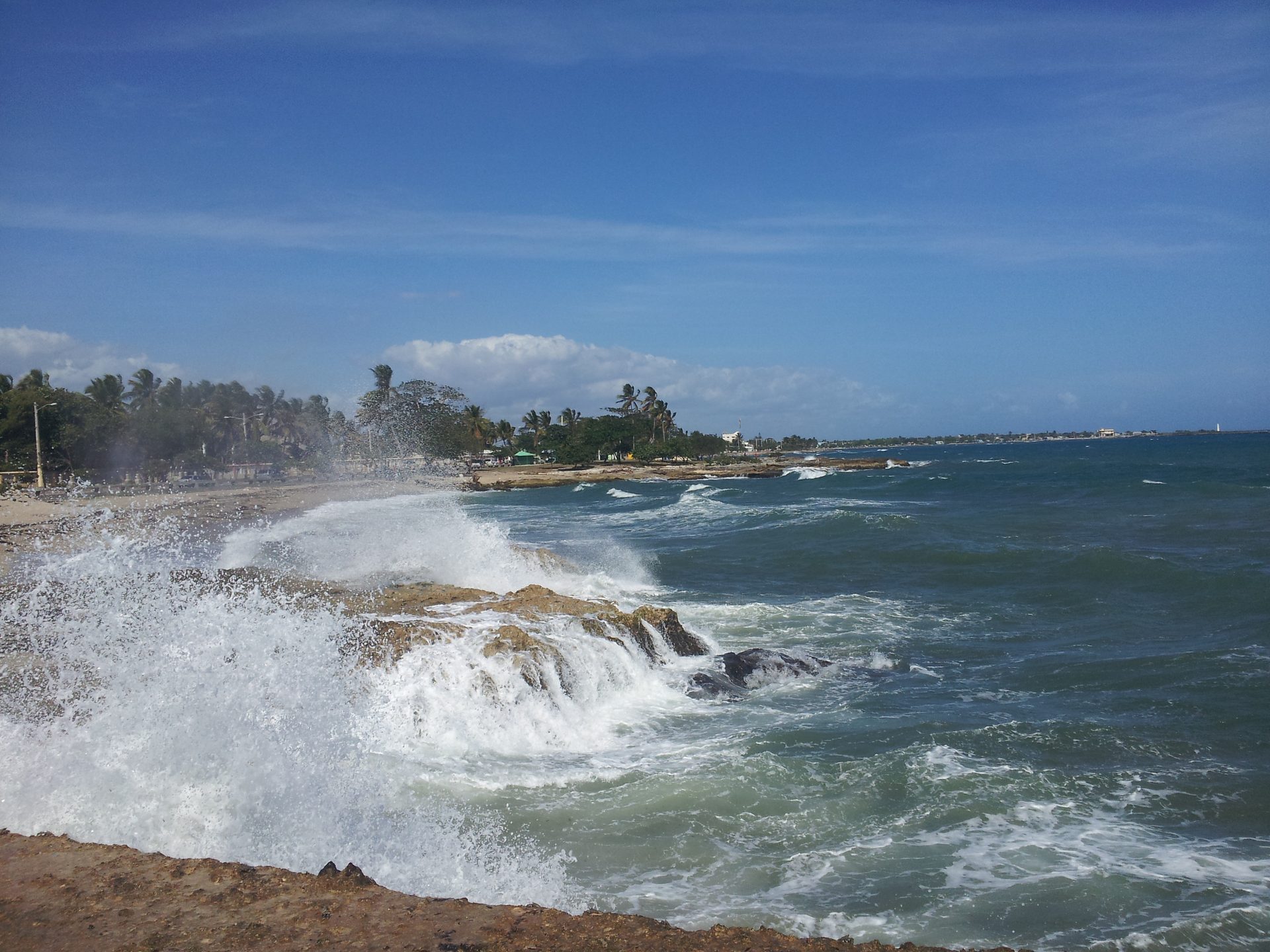
Pictured: the malecón (seafront promenade) of San Pedro de Macorís, the Caribbean coastal provincial capital nearest La Boca Cumayasa — not the actual sighting site itself, a remote river-mouth fishing hamlet roughly 30 km further east with no known public-domain or rights-clear photograph of its own. No photograph of the 1968 object exists; the only surviving illustration is a witness sketch reproduced in the case's original 1979 source book, which is not available under a license this site can reproduce.
Theoretical Alignment
Alignment with the Extraterrestrial and Interdimensional Hypotheses is minimal: the case's own defining features — a slow-forming, color-cycling, expanding light with no defined hull, no sustained directional flight, and no trace evidence — are a textbook description of a sunlit high-altitude gas release, not a controlled craft. The moderate Psycho-Social alignment reflects not a claim of fabrication but the documented pattern this case shows: three untrained, badly frightened observers turned a genuine, striking, unfamiliar aerial event into a specific narrative of directed response and mechanical failure under acute stress, a well-known amplification effect in the eyewitness literature this site tracks across many nocturnal-light cases.
Background
By 1968, the Caribbean basin had its own modest but active UFO-reporting culture, distinct from the better-documented waves in the continental United States and Western Europe. Puerto Rico in particular would go on to become one of Latin America's most UFO-saturated territories, generating thousands of reports through the 1970s and 1980s, many collected by the island's community of independent researchers. One of the earliest serious compilers of this regional material was Sebastián Robiou Lamarche, an engineer by training, born in La Vega, Dominican Republic, who relocated to Puerto Rico in 1963 to study at the University of Puerto Rico's Mayagüez campus and remained there the rest of his working life. Long before he became known primarily as a historian of Taíno and pre-Columbian Antillean culture, Robiou Lamarche spent the 1970s gathering firsthand UFO testimony from across the Spanish-speaking Caribbean, publishing the results in 1979 as Manifiesto OVNI de Puerto Rico, Santo Domingo y Cuba — a roughly 500-page volume with a prologue contributed by J. Allen Hynek, the former Project Blue Book scientific consultant who by then headed the Center for UFO Studies. It remains, more than four decades later, one of the most-cited regional sourcebooks for Caribbean UFO history.
The La Boca Cumayasa case appears on pages 184–186 of that book as one entry among dozens, without any special flag distinguishing it from the rest. It sat there, essentially unexamined by outside researchers, until 2014, when Spanish ufologist Vicente-Juan Ballester Olmos — by then one of Europe's most methodologically rigorous UFO investigators and the longtime curator of FOTOCAT, a running worldwide catalog of photographically or otherwise well-documented UFO reports that has grown to more than 13,000 entries since it began in 2000 — systematically worked through Robiou Lamarche's book while compiling FOTOCAT's Caribbean holdings. The Cumayasa case caught his attention not because of a photograph (none exists) but because of the specificity of the account: named principal witness, a precise time and duration, a specific estimated size and altitude, and an unusual directed-response detail involving a handheld flashlight. That specificity is exactly what let him resolve it.
The broader technical background that makes the resolution possible is the Cold War-era U.S. Air Force and Advanced Research Projects Agency (ARPA) program of upper-atmosphere barium-vapor release experiments, run through the 1960s and 1970s primarily by the Air Force Cambridge Research Laboratories (AFCRL) in cooperation with NASA and the Los Alamos Scientific Laboratory. These were not secret in the sense of being hidden from the scientific community — they were published, peer-reviewed geophysics research, part of a well-documented international effort (alongside comparable European programs run by the Max Planck Institute) to study the ionosphere and magnetosphere by releasing a chemical tracer cloud that becomes luminous when struck by sunlight at altitude, tracking how it deforms in the geomagnetic field. They were, however, essentially unknown to the general public, including to boaters fishing off a small Caribbean river mouth before dawn.
By the time Ballester Olmos took up the case, FOTOCAT itself had grown from a personal spreadsheet begun around 2000 into what its curator describes as an in-progress worldwide catalog of published UFO photo, film, and video events — a project that would go on to log more than 13,000 individually researched cases. Its stated purpose was never simply to accumulate raw sightings, but to build, case by case, the kind of subject-, geography-, and year-oriented reference work that lets a researcher recognize a pattern like this one: a specific, oddly precise witness account that reads, on close inspection, like the description of a real technical event rather than an invented one. That same discipline had already led Ballester Olmos, working independently and in collaboration with colleagues such as Ricardo Campo Pérez and Juan Antonio Fernández Peris, to similar archival resolutions of Spanish military UFO files.
Complete Timeline
| Date | Event |
|---|---|
| May 13, 1968, ~09:06–09:10 UT (~4:06–4:10 AM AST) | A rocket carrying a barium-vapor payload, part of the ARPA-sponsored SECEDE I research campaign and individually code-named Project Dogwood, is launched from the Vega Baja area of Puerto Rico's north coast and releases its chemical charge at an altitude of roughly 200 km, creating a sunlit cloud eventually spanning on the order of 100 km. |
| May 13, 1968, ~4:00 AM AST | Isidro Álamo, his wife, and a hired sailor, sport fishing from a boat off La Boca Cumayasa, notice a round, yellow object at roughly 30° elevation, comparable in apparent size to the full moon (itself visible that night). |
| Shortly after | The object appears to close the distance rapidly, turning red, then reportedly comes to a stop directly overhead at an altitude Álamo judged at roughly 300 m, before descending further to an estimated 150–200 m and changing color again, to bright white and then dull gray. |
| Same period | The witnesses report the boat's engine becoming intermittent, its signal lights malfunctioning, and its radio failing to transmit. Fear reportedly grips all three; the sailor has to be restrained from jumping overboard, and Mrs. Álamo ties her wedding ring to a fishing rod in case the boat is lost. |
| Same period | Álamo points a handheld flashlight at the object; according to his account it appears to "sway" in apparent response, then extends a beam of light from two square, lantern-like structures at its ends before retracting them. |
| ~5:05 AM AST (sunrise) | The object recedes vertically, trailing green light, and is lost from view with the arrival of dawn. Total observed duration: approximately one hour. |
| 1979 | Sebastián Robiou Lamarche publishes the Álamo family's account, drawn from his own interviews and correspondence, on pages 184–186 of Manifiesto OVNI de Puerto Rico, Santo Domingo y Cuba (Punto y Coma, San Juan), with a prologue by J. Allen Hynek. |
| September 25, 2014 | Vicente-Juan Ballester Olmos, reviewing Robiou Lamarche's book to catalog Caribbean cases for FOTOCAT, flags the Cumayasa account as unusually specific and cross-references its timestamp against archived AFCRL and NASA barium-release records, with research assistance from Manuel Borraz Aymerich and correspondence with Harvard astrophysicist Jonathan McDowell. |
| September 25, 2014 | Ballester Olmos publishes his identification — the Project Dogwood barium release, logged at 09:06–09:10 UT from Vega Baja, Puerto Rico — on the FOTOCAT blog, in both Spanish and English, resolving a discrepancy in McDowell's own public launch-tracking database along the way. |
| 2026 | This case file is published on OverClassified as part of the site's ongoing case-file queue, drawing on Ballester Olmos's published analysis together with independent verification of the underlying AFCRL and NASA documentation. |
The Encounter, In Full
The account that follows is drawn directly from Robiou Lamarche's 1979 book, as translated and quoted by Ballester Olmos in his 2014 FOTOCAT analysis. It is the only detailed narrative of the case that has ever been published; no independent interview of the Álamo family by any other researcher, before or since, appears to exist in the record.
The phenomenon began at about 4:00 a.m. on May 13, 1968, and disappeared with the light of dawn; sunrise at the observation site is given as 5:05 a.m., putting the total duration at close to an hour. The setting was a small sport-fishing boat off La Boca Cumayasa, near San Pedro de Macorís, on the southeastern Caribbean coast of the Dominican Republic. Aboard were businessman Isidro Álamo, his wife, and a hired sailor, all engaged in ordinary predawn sport fishing when, from the stern, they noticed a "round, yellow" object at roughly 30° elevation — about the apparent size of the full moon, itself clearly visible that night.
What happened next, according to Álamo, unfolded with startling speed. The object turned red as it seemed to close the distance quickly, and within a few seconds appeared to cover the roughly one-nautical-mile (1,832 m) gap separating it from the boat, coming to a stop directly overhead at an altitude Álamo estimated at about 300 m. It then shifted to a very bright white, then to a dull gray, and descended further, "like a falling paper," until it hovered an estimated 150–200 m above the boat.
Fear took hold of all three witnesses. Álamo tried to accelerate the boat's engine; it responded only intermittently. He tried the boat's signal lights; they, too, began to malfunction. He tried the radio; it produced nothing. It was in this moment — boat crippled, object seemingly right overhead — that Álamo took out a flashlight and pointed it at the object.
"...as if responding to the signal, [it] began swaying."
Álamo used the moment to estimate the object's diameter at roughly 75 feet (23 m). The object, per the account, then extended a beam of light from "a couple of square lanterns" positioned at its ends — "after a few seconds, these were retracted and returned back to the saucer, as if it was a tube of light." The panic aboard the small boat, by Robiou Lamarche's telling, became acute enough that the crew had to physically restrain the sailor from jumping into the water, while Mrs. Álamo tied her wedding ring to one of the fishing rods, in case the worst happened and the boat was lost or capsized. The object continued changing colors, trailing green light as it finally departed, moving vertically, until the arriving daylight at 5:05 a.m. swallowed it from view.
An Extraordinary Account, By Design
Ballester Olmos's own 2014 write-up does not undersell how compelling the raw account reads on its face, before any resolution is applied — and it is worth reproducing his framing directly, because the case file's ultimate verdict depends on taking the initial impression seriously rather than dismissing it out of hand:
"Let us admit it: this is an extraordinary case. Three observers, three reliable witnesses, a UFO that produces electromagnetic effects and responds to signals from the witnesses. Its shape, size and maneuvers are unrelated to any conventional aircraft. It was at a short distance from the observers, who were irradiated with a retractable light beam, undoubtedly an anomaly of physics."
That sentence is not a throwaway rhetorical device. It is the deliberate setup for what follows: Ballester Olmos goes on to note, with evident irony, that resolving the case required none of the traditional tools of field ufology — no trip to the Dominican Republic, no interview with the surviving witnesses on the spot. It required only a laptop, an internet connection, and access to three separate declassified or public technical archives: NASA's own technical report library, the Air Force Cambridge Research Laboratories' published annual research summary, and an independent space-launch historian's tracking database.
Thirty-Five Years of Obscurity
Part of what makes this case an unusually clean test of archival method is how little attention it received in the intervening decades. Robiou Lamarche's Manifiesto OVNI sold and circulated modestly within Puerto Rican and Caribbean ufology circles after 1979, but it was never translated into English in full, was not widely distributed in the continental United States, and its author's own career trajectory moved decisively away from UFO research shortly afterward. Robiou Lamarche went on to become a recognized authority on Taíno mythology and pre-Columbian Antillean culture, publishing several further books between 1992 and 2017 on indigenous Caribbean history, archaeology, and comparative iconography — a body of work that today defines his public reputation far more than his single UFO book does. With its author's own attention elsewhere, and with no photograph to drive continued interest the way an image typically does in UFO literature, the La Boca Cumayasa case had no obvious mechanism to resurface until a specialist happened to be reading the book cover to cover for an unrelated cataloging project 35 years later.
Key Witnesses
Isidro Álamo
The only named witness in the case, and the source of every specific detail in the record — the estimated altitude, diameter, duration, and the flashlight-response episode all rest on his recollection alone, as relayed to Sebastián Robiou Lamarche for the 1979 book. Nothing in the published record indicates Álamo had any prior interest in UFOs, any technical or scientific training relevant to estimating distance and altitude over open water at night, or any motive to fabricate the account; equally, nothing in the record allows independent verification of his specific numeric estimates, which is precisely the gap the barium-cloud identification exploits. No later interview, correction, or elaboration by Álamo himself is known to exist beyond what Robiou Lamarche originally published.
Mrs. Álamo
Present throughout the encounter but not identified by her own name in the published account. Her most specific individually attributed action — tying her wedding ring to a fishing rod in anticipation of the boat being lost — is one of the case's most vivid and human details, and reads as a genuine, spontaneous panic response rather than an embellishment invented for a later audience; it corroborates the general level of fear the group reported, though it adds no independently checkable factual content to the sighting itself.
The Sailor
The third witness aboard, employed by Álamo to help crew the boat. His only individually recorded action is having to be physically restrained from jumping into the water during the most frightening part of the encounter. As with Mrs. Álamo, his presence corroborates a three-person sighting rather than a single uncorroborated account, but no separate statement, interview, or description attributed specifically to him survives in the record independent of Álamo's own narrative.
The Five Observables Assessment
Assessment: Only "Instant Acceleration" registers as even speculative, and only because of Álamo's own claim that the object closed roughly one nautical mile "in a few seconds" — a claim with no instrumented timing behind it, made under acute stress by an observer with no reference points on open water before dawn. Every other observable is absent: the object never demonstrated anti-gravity lift signatures (it behaved throughout like a drifting, expanding, brightening and dimming cloud, not a maneuvering solid body), it was never described as hypersonic in sustained flight, it was continuously and easily visible for the better part of an hour (the opposite of low observability), and no transition between air, water, or space was reported. This is, in short, a profile with almost none of the performance characteristics the Five Observables framework was built to flag — and a strong positive match, instead, to the gradual illumination geometry of a sunlit, wind-sheared, high-altitude gas release.
Evidence Assessment
Supporting Anomalous Origin
- Three independent witnesses aboard the same boat, all describing the same general sequence of events
- A specific, non-generic claim of directed response: the object appeared to "sway" when signaled with a flashlight
- Reported electromagnetic interference — intermittent engine, malfunctioning signal lights, and a failed radio — coincident with the object's closest approach
- A specific, structurally detailed claim: retractable "square lantern" light-beam projectors at the object's ends
- No evident financial or publicity motive on Álamo's part; the account was volunteered to a researcher, not sold to a tabloid
Supporting Conventional Explanation
- A documented, dated, archivally logged barium-vapor rocket release from Vega Baja, Puerto Rico, timed to within minutes of the sighting's own reported start
- The object's slow color-cycle (yellow→red→white→gray→green) matches the known optical behavior of a sunlit barium/strontium vapor cloud far more closely than any conventional aircraft or natural astronomical body
- The witnesses' own wildly inaccurate distance and altitude estimates (a cloud actually ~200 km up and ~100 km across, judged by eye at night over water to be 150–300 m away) demonstrate exactly the kind of scale misjudgment this class of case is known for
- Barium/strontium releases of this kind produce visible light through solar excitation but are not documented to generate electromagnetic fields capable of disabling a boat engine, lights, or radio — a genuine, unresolved gap in the conventional explanation, addressed below
- No photograph, radar return, or any form of instrumented data corroborates any part of the account; it rests entirely on three witnesses' memory as later recorded by a single interviewer
- The case was not independently re-investigated on-site by Ballester Olmos or any other researcher; the identification is a desk-based archival correlation, however precise
Why "Debunked"
This case earns a DEBUNKED classification because the strength of the conventional match is unusually high for this site's case-file queue — higher, on the specific dimension of time correlation, than most of the barium-cloud and satellite-reentry identifications already published here. The Project Dogwood barium release was not approximately contemporaneous with the sighting; declassified AFCRL and NASA documentation places its release at 09:06–09:10 UT, which converts to roughly 4:06–4:10 a.m. local Dominican Republic time — inside the very first minutes of a sighting the witnesses themselves say began around 4:00 a.m. This is not a same-night, roughly-matching-hour correlation of the kind that leaves real room for coincidence; it is a same-minute correlation, verified against three independent archival sources (an AFCRL annual report, a NASA technical publication's appendix table, and an independent space-launch historian's database), that also required and survived a real cross-check — Jonathan McDowell's own public listing initially disagreed by roughly four hours until he traced the discrepancy to a "05:06L" (local) versus UT labeling error in his source material and corrected it.
What keeps this case from scoring even lower — and what earns it "Debunked" rather than a more dismissive framing — is that the barium-cloud identification, however strong, does not by itself explain every claimed detail. A sunlit vapor release does not straightforwardly account for reported engine, light, and radio malfunctions, and Ballester Olmos says so plainly in his own published analysis. The most defensible reading is not that Álamo's group invented these details from nothing, but that a small boat crewed by frightened, untrained observers, confronted for the better part of an hour by a genuinely spectacular and completely unfamiliar celestial event, experienced ordinary, unrelated mechanical hiccups (a common enough occurrence on an aging fishing boat) and folded them into a single, coherent, frightening narrative after the fact — the well-documented pattern of narrative embellishment this site's own editorial standard explicitly expects researchers to weigh, and which Ballester Olmos's closing line addresses directly: eyewitnesses "misinterpret, embellish, and color" real, unfamiliar events, sometimes inventing corroborating detail without any intent to deceive.
Sensor & Instrumentation Detection Profile
No radar, photographic, or other instrumented data of any kind was ever collected on this event; it rests entirely on unaided naked-eye observation by three civilians from a small boat. Ironically, the instrumentation that ultimately resolved the case was not contemporaneous with the sighting at all, but archival: a 1968 AFCRL annual research report, a 1980 NASA technical publication's historical appendix table logging past chemical-release missions, and a modern independently maintained space-launch tracking database, cross-referenced against each other decades after the fact. The actual 1968 release itself, by contrast, was genuinely instrumented at the time by its own operators — Los Alamos Scientific Laboratory aircraft carried photometric equipment specifically to track the barium cloud's evolution for the SECEDE research program's own scientific purposes, entirely independent of, and unaware of, any civilian boat that might happen to be watching from 285 km away.
Environmental & Geospatial Context
The sighting occurred over open Caribbean water off a rural, sparsely populated stretch of the Dominican Republic's southeastern coast, under a clear predawn sky with a near-full moon reported visible — conditions that would have made a bright, high-altitude, sunlit vapor cloud unusually easy to see against a still-dark sky, since sunlight reaches an object 200 km up well before it reaches sea level, the same "high-altitude twilight" geometry that makes such releases so visually striking specifically in the hour or two before local sunrise or after local sunset. The launch site at Vega Baja, on Puerto Rico's north coast, lies roughly 285 km (about 180 miles) west-northwest of the sighting location across the Mona Passage and the eastern Caribbean Sea; for an object at 200 km altitude, the geometric line-of-sight horizon distance exceeds 1,500 km, meaning the release would have remained visible, weather permitting, across a large swath of the northeastern Caribbean, not just from the immediate vicinity of the launch pad.
Observer Credibility & Occupational Profile
Isidro Álamo is described only as a "businessman" with no further occupational detail, no stated scientific, aviation, maritime, or military training relevant to estimating distance, altitude, or velocity over open water at night, and no documented prior interest in UFOs. His wife and the hired sailor carry no independent occupational credentials in the record either. All three were, moreover, a single social/employment unit aboard one small boat rather than geographically or socially independent observers, which somewhat reduces (without eliminating) the corroborative weight normally credited to a multi-witness sighting: a shared fright response can propagate within a small group faster than it would across strangers. The case's evidentiary value rests almost entirely on the specificity and internal consistency of Álamo's account as recorded by a single interviewer eleven years after the fact, rather than on any independent professional standing of the observers themselves.
This does not make Álamo an unreliable narrator in any pejorative sense — a businessman with no stake in UFO research volunteering a detailed, internally consistent account to a book author, without evident financial motive, is a broadly ordinary and plausible witness profile for a genuine, frightening nighttime experience. What it does mean, for purposes of scoring this case's overall evidentiary weight, is that none of the traditional markers this site weighs most heavily for elevating a witness's credibility — relevant professional training, an independent corroborating report from someone outside the immediate group, contemporaneous documentation rather than a decade-later retelling, or any form of instrumented backup — are present here. The account's real strength lies entirely in its specificity (a named witness, a precise time, a numeric altitude and diameter estimate) rather than in the observers' own qualifications, which is exactly the kind of case where matching the account against an independent archival record, as Ballester Olmos did, carries more evidentiary weight than the testimony does standing alone.
Physical & Material Assays
None. No debris, residue, landing trace, or any form of recoverable physical material was ever reported, searched for, or collected in connection with this sighting. The only surviving non-testimonial record is a witness illustration reproduced in Robiou Lamarche's 1979 book depicting the object's position relative to the boat — an artist's or witness's sketch, not a photograph or physical specimen. No soil, water, or metallurgical sampling was ever conducted, and none would have been meaningful in any case: nothing in the account describes physical contact between the object and any surface, vessel, or person aboard the boat.
Historical Precedents & Archive Matches
This case sits within a well-established pattern that Ballester Olmos himself has documented repeatedly across his decades of Spanish and international UFO research: a striking nocturnal light, initially read as an unidentified craft, that resolves under archival cross-checking into a specific, dated, government or military technical activity. His own published case list includes several close parallels also covered elsewhere on this site: the Deception Island Sightings of 1965, where Antarctic observers' UFO reports were traced to the Echo II passive-communications satellite and misidentified stars; the Gando Air Base / Canary Islands UFO cluster of 1974–1979, resolved as U.S. Navy Poseidon C-3 missile tests using declassified Eastern Test Range launch records; and the RAF Cosford / Shawbury Sighting of 1993, where he independently supplied a NORAD trajectory statement identifying a Cosmos 2238 rocket-body re-entry.
The closer structural parallel, however, is this site's own Jimmy Carter Sighting of January 1969 — a self-luminous, color-changing object watched for ten to twelve minutes by a future U.S. president and roughly a dozen fellow Lions Club members in Leary, Georgia, later matched to a logged Eglin Air Force Base barium-cloud rocket release whose elevation, timing, and color sequence corresponded with real specificity to Carter's own written account. Barium and strontium vapor releases were a genuinely active, recurring source of Cold War-era UFO reports on both sides of the Atlantic through the late 1960s and 1970s, precisely because they were visually spectacular, poorly understood by the general public, and — unlike most classified military hardware — frequently conducted from coastal or remote sites specifically chosen to minimize risk to populated areas, which also maximized the chance a release would be witnessed only by chance civilian observers with no context for what they were seeing.
A larger-scale, better-documented illustration of the same broader family of misidentification comes from outside this site's own case-file roster entirely. On the evening of June 14, 1980, a huge, reddish-orange, "horseshoe- or crescent-shaped" object was witnessed across a wide swath of central Russia, and roughly an hour later a strikingly similar object was independently photographed in the western sky over five South American countries. Soviet citizens reportedly panicked in the streets, fearing an attack. American space analyst James Oberg subsequently identified the cause: multiple launch contrails from a Soviet Molniya-class booster (carrying the Kosmos-1188 early-warning satellite), backlit by the reddish midnight sun over Russia, followed roughly an hour later by the booster's fourth stage completing its high-altitude orbital-insertion burn as it passed over South America, producing a sunlit exhaust cloud — not a barium payload in this case, but the same underlying phenomenon of sunlit rocket byproduct at extreme altitude generating a dramatic, slow-evolving, color-shifting light visible across enormous distances, resolved not through witness interviews but through orbital-mechanics and launch-schedule analysis. The parallel to La Boca Cumayasa is instructive precisely because the specific chemistry differs (rocket exhaust and contrails rather than a deliberate barium tracer release) while the resolving method — matching a precise sighting timestamp against an independently documented rocket event's own logged schedule — is identical.
Material Analysis
Because no physical trace evidence exists for this case, "Material Analysis" here concerns the physical plausibility of the phenomenon's own reported optical and mechanical behavior, rather than any recovered specimen.
The Optical Behavior
The reported color sequence — yellow, then red, then bright white, then dull gray, with a final green trail on departure — is a close match to the documented visual behavior of a barium/strontium vapor cloud excited by sunlight at high altitude. As neutral barium atoms ionize under solar ultraviolet radiation, a release typically shows an initial neutral-atom emission (often yellow-green to white), followed by a separating, color-differentiated ion cloud (frequently described in the SECEDE-era literature as taking on red, violet, or blue-white hues as it stretches and thins along magnetic field lines), with overall brightness fading as the cloud disperses and dilutes — consistent with an observer seeing an initially compact, bright, colorful object gradually fade to gray and vanish over the better part of an hour.
The Unresolved Electromagnetic Claims
The one genuine gap in the conventional identification is mechanical, not optical: reported interference with the boat's engine, lights, and radio. A barium-vapor cloud excited by sunlight radiates in the visible spectrum through resonance fluorescence; it is not documented in the SECEDE-era or any later literature as a source of radio-frequency interference, electrical fields, or any effect capable of reaching a boat 200 km below it and disabling onboard electrical or mechanical systems. Two explanations for this gap are available, and neither requires an anomalous physical mechanism: first, that a small, likely aging sport-fishing boat experienced its own unrelated, mundane mechanical and electrical hiccups during exactly the minutes its crew was most frightened, and folded the coincidence into a single narrative; second, that some or all of these details were embellished, consciously or not, in the retelling — a well-documented feature of high-stress eyewitness testimony that Ballester Olmos's own closing commentary explicitly flags as the case's likely secondary lesson, distinct from the primary optical identification.
Supporting Non-Terrestrial Origin
- No mundane mechanism has been documented that would cause a high-altitude barium release to disable a boat's engine, lights, and radio simultaneously
- The flashlight "response" detail, if taken at face value, has no equivalent in the standard barium-cloud literature
- Three witnesses, aboard the same vessel, gave a broadly consistent account of a frightening, sustained close encounter
Supporting Terrestrial Origin
- The optical sequence (color-cycling, gradual fade, extended duration) matches known barium/strontium release behavior far more closely than any proposed craft technology
- A real, archivally dated, minute-precise matching launch record exists for the exact night and hour
- The witnesses' scale estimates (300 m vs. an actual ~200 km altitude) are off by roughly three orders of magnitude, exactly the kind of misjudgment expected when estimating the size and distance of an unfamiliar light source over open water at night with no reference points
- No independent instrumented data of any kind corroborates the electromagnetic-interference claims specifically
- The "swaying" flashlight response is consistent with an observer, straining to track a slowly drifting, wind-sheared cloud, subconsciously attributing ordinary atmospheric drift to a reaction they themselves triggered moments earlier — a form of illusory correlation well documented in the eyewitness-perception literature
The Conventional Explanation Candidate: Project Dogwood
The leading — and, on the optical evidence, essentially conclusive — explanation for the La Boca Cumayasa sighting is a documented U.S. military/scientific barium-vapor rocket release, individually code-named Project Dogwood, launched as part of the ARPA-sponsored SECEDE I research campaign. This is the explanation Ballester Olmos himself proposed and defended in his 2014 FOTOCAT analysis, and it is the primary basis for this case file's classification.
What Project Dogwood Actually Was
SECEDE (an AFCRL-run acronym for a multi-year, multi-site barium-cloud research program) used sounding rockets to release chemical payloads — typically barium, sometimes mixed with strontium as a spectroscopic tracer — at ionospheric altitudes, generating a cloud of neutral atoms that photoionize under solar ultraviolet radiation. The resulting mix of neutral and ionized barium diffuses differently through the local geomagnetic field: neutral atoms drift largely with local winds, while ions are constrained to travel along magnetic field lines, and the visible divergence between the two populations lets researchers directly map electric fields and plasma behavior in the upper atmosphere — data with real Cold War strategic relevance for understanding how nuclear detonations and ballistic-missile reentries would behave in that same environment. The SECEDE campaign ran multiple release series across several years and sites; SECEDE II, for instance, released barium payloads over Florida using ground-based optical interferometers, while SECEDE III conducted releases in Alaska. Project Dogwood was one individually named release within the earlier SECEDE I series, launched from the Vega Baja area on Puerto Rico's north coast, with photometric tracking data reportedly gathered by aircraft from the Los Alamos Scientific Laboratory.
Two independent U.S. government-originated documents place Project Dogwood's release at essentially the same moment the Álamo party's sighting began. The Air Force Cambridge Research Laboratories' own annual summary, AFCRL Space Science Research During 1968, records a rocket launch from Vega Baja at 09:08 UT on May 13, 1968. A later NASA technical publication, Environmental Analysis of the Chemical Release Module (NASA TP-1750, 1980), includes a historical appendix table (Table B-3) logging the actual barium release at 09:10:44 UT the same date. Both times convert to roughly 4:08–4:11 a.m. Dominican Republic local time (AST, UTC−4) — inside the first several minutes of a sighting the witnesses themselves place as beginning around 4:00 a.m.
A third, independent line of evidence closes the loop. Harvard astrophysicist Jonathan McDowell, whose long-running suborbital and orbital launch-tracking database is one of the most widely used independent references in the space-history field, initially listed the Vega Baja launch at 05:06 UT — a roughly four-hour discrepancy from the AFCRL/NASA figures. When Ballester Olmos raised the inconsistency directly with McDowell, the astrophysicist traced it to his own source material, an AFCRL memo (AFGL-TR-78-012, Special Reports No. 213), and found the launch time had been recorded there as "05:06L" — meaning 5:06 a.m. local Puerto Rico time (AST), not UT. Converted correctly, 05:06 AST is 09:06 UT — matching the AFCRL and NASA figures to within four minutes. McDowell corrected his own listing accordingly. This is not a case where a single ambiguous document was taken at face value; it is a case where an apparent contradiction between three independent archives was actively investigated and resolved into agreement.
The Wider SECEDE Program
Project Dogwood was not an isolated experiment but one release within a sustained, multi-year research effort. SECEDE I, of which Dogwood was part, ran its releases from Vega Baja in the late 1960s specifically because Puerto Rico's low geomagnetic latitude and its proximity to the Arecibo Observatory's ionospheric radar made it a favored site for studying how injected plasma clouds interact with Earth's magnetic field near the boundary of the equatorial ionosphere. Follow-on campaigns moved to different geomagnetic regimes to broaden the data set: SECEDE II conducted barium releases over Florida in the early 1970s, tracked by ground-based optical interferometers measuring the Doppler-shifted spectral lines of sunlight scattered from the expanding neutral and ionized barium populations, while SECEDE III shifted operations to Poker Flat Research Range in Alaska, deliberately chosen for its high-latitude auroral-zone geomagnetic conditions, a very different regime from the low-latitude tropical setting of the original Dogwood release. Photometric and radar data from these campaigns were shared across the era's ionospheric-physics community and referenced for years afterward in geophysics literature studying artificial plasma injection — the same class of published, mainstream science, not classified weapons work, that eventually let Ballester Olmos identify this sighting from open sources alone.
The chemistry itself explains why barium specifically was chosen over other elements. Barium has a relatively low ionization potential, meaning a large fraction of the neutral vapor cloud photoionizes quickly under solar ultraviolet exposure once released above the atmosphere's absorbing layers; the freshly created ions are then trapped by and forced to move along local magnetic field lines, while the remaining un-ionized neutral atoms continue drifting largely with the ambient neutral wind. Watching the visible separation between these two populations — the neutral cloud spreading in one pattern, the ionized component stretching and curving along field lines in another — gave researchers a direct, visual way to map electric fields and plasma motion in the ionosphere that was otherwise extremely difficult to observe. From the ground, before any of that physics was understood by an observer, the net effect was simply an initially bright, compact, colorful light that would brighten, shift hue, and slowly stretch, thin, and fade over the better part of an hour — exactly the descriptive arc Isidro Álamo gave Robiou Lamarche in 1979, eleven years before either man had any reason to know what a barium release even was.
Why The Optical Match Is Strong
Beyond the timing, the visual description itself fits the barium-release profile closely. A release at ~200 km altitude, excited by sunlight the ground observers themselves could not yet see (since sunlight reaches that altitude well before it reaches sea level, in the hour before local sunrise), would appear as a bright, colorful, initially compact light that brightens, changes hue as neutral and ionized barium populations separate and diffuse, and gradually fades and disperses over tens of minutes — matching, point for point, the reported yellow-to-red-to-white-to-gray sequence and the roughly hour-long duration. Ballester Olmos's own figure for the resulting cloud's extent, on the order of 100 km, dwarfs the witnesses' own estimate of a 23-meter object — exactly the kind of scale misjudgment expected when an unfamiliar light source with no size reference is viewed over open, featureless water at night.
Astronomical or Satellite Re-Entry Misidentification
Before the Dogwood correlation was established, the two next most obvious conventional candidates for a slow, color-changing predawn light would be an astronomical body (Venus is the classic culprit for a bright, low, color-shifting predawn or dusk light, as in this site's own Jimmy Carter Sighting) or a decaying satellite or rocket-body re-entry burning up in the atmosphere. Neither fits this case as well as the barium release. Venus in mid-May 1968 would not plausibly account for the reported close, hovering approach to within a few hundred meters, the roughly hour-long active color-cycling and departure, or the alleged flashlight-triggered "swaying" response — a fixed, essentially stationary point of light does not sway or dart. A meteoric or re-entry fireball, meanwhile, would typically last seconds to at most a couple of minutes, not the better part of an hour that all three witnesses describe. Neither candidate offers anything close to the minute-precise, independently cross-checked timing match that the Dogwood identification provides.
Ball Lightning or a Natural Atmospheric-Electrical Phenomenon
A third candidate worth naming, precisely because of the reported electromagnetic interference, is some form of natural atmospheric-electrical phenomenon, such as ball lightning or St. Elmo's fire, phenomena occasionally invoked to explain glowing, moving lights near vessels with reported instrument disruption. This candidate fails on several fronts specific to this case: ball lightning events are characteristically brief (seconds to at most a couple of minutes), are strongly associated with active thunderstorm conditions (none were reported; the sky was described as clear), and have never been documented to sustain a coherent, color-cycling, roughly hour-long display at an apparent altitude of hundreds of meters. It does not explain the object's reported directed response to a flashlight signal, its structured "square lantern" light-beam detail, or its rough coincidence with a real, dated, off-site rocket launch. It is included here because the interference claims genuinely need an explanation, not because the evidence supports it as a serious alternative to Project Dogwood.
The Assessment
Project Dogwood Barium-Vapor Release
Highly Plausible (optical component)An archivally dated, minute-precise, three-source-corroborated match for the sighting's location, timing, duration, and full color sequence. This is the strongest explanation this case file has assessed, and the one FOTOCAT's own curator regards as effectively conclusive for what the witnesses actually saw. It does not, on its own, fully account for the reported engine/radio/light interference, which is best explained as coincidental mechanical trouble compounded by witness stress and embellishment rather than as a property of the barium cloud itself.
Astronomical or Satellite/Rocket-Body Re-Entry
ImplausibleNeither a planetary misidentification nor a re-entry fireball accounts for the reported hour-long duration, close hovering approach, or directed-response detail, and neither offers any comparable timing correlation to a real, dated event.
Ball Lightning / Natural Atmospheric-Electrical Phenomenon
ImplausibleRaised specifically to address the electromagnetic-interference claims, but incompatible with the clear-sky conditions, the sustained hour-long duration, and the structured visual details reported, and offers no comparable evidentiary basis.
Related Cases
Confirmed Documents & Official Records
The Air Force Cambridge Research Laboratories' own annual summary, logging the Table A1 rocket-launch test from Vega Baja, Puerto Rico at 09:08 UT on May 13, 1968 — the launch identified as the source of this sighting.
UNCLASSIFIED (DTIC public release)By J.P. Heppner and M. Dubin, NASA Goddard Space Flight Center. Appendix B, Table B-3 records the Project Dogwood barium release at 09:10:44 UT on May 13, 1968 — the specific archival source that pinpoints the release to the minute.
UNCLASSIFIEDA Defense Technical Information Center-held research report documenting the optical and interferometric characteristics of SECEDE-era barium releases, the technical basis for the color-cycling behavior this case file's Material Analysis section describes.
UNCLASSIFIED (DTIC public release)Search Government Archives Directly
Further Reading — Recommended Literature
The UFO Encyclopedia, 4th Edition
The standard general reference for cross-checking individual case histories, classification terms, and the broader landscape of misidentified aerial phenomena this case belongs to.
UFOs Explained
A foundational skeptical case-by-case survey demonstrating how archival and technical cross-checking — the same method Ballester Olmos applied here — resolves individual sighting reports.
The Heavens and the Earth: A Political History of the Space Age
Pulitzer Prize-winning history of the Cold War space race, providing the institutional and geopolitical background for ARPA- and Air Force-sponsored upper-atmosphere research programs like SECEDE.
UFOs In Central and South American AirSpace
A regional survey of Latin American and Caribbean UFO reports spanning 1947–1979, the same wave and geography that produced the La Boca Cumayasa sighting.
UFOs Over the Americas
Published the very year of this sighting by APRO's founders, this contemporary survey captures how Western Hemisphere UFO reports of this exact era were being collected and framed before archival resolution became possible.
DISCLOSURE: Some links above are affiliate links. If you purchase through them, OverClassified receives a small commission at no additional cost to you. This helps support independent research.
Essential Viewing
No Videos Available
A reasonable search turned up no video specifically and primarily covering the La Boca Cumayasa sighting. This is an obscure case outside the small set of UFO incidents with dedicated documentary or archival video coverage; per this site's editorial standard, no off-topic, recycled, or generically Caribbean-UFO-themed video has been substituted in its place.
Sources
- Robiou Lamarche, Sebastián. Manifiesto OVNI de Puerto Rico, Santo Domingo y Cuba, Editorial Punto y Coma, San Juan, Puerto Rico, 1979, pp. 184–186. Prologue by J. Allen Hynek. openlibrary.org
- Ballester Olmos, Vicente-Juan. "An Outstanding UFO Sighting in the Caribbean," UFO FOTOCAT Blog, September 25, 2014 (English). fotocat.blogspot.com
- Ballester Olmos, Vicente-Juan. "Una impresionante observación ovni en el Caribe," UFO FOTOCAT Blog, September 25, 2014 (Spanish original). fotocat.blogspot.com
- Air Force Cambridge Research Laboratories. AFCRL Space Science Research During 1968, Table A1, Appendix A (Vega Baja rocket launch, 09:08 UT, May 13, 1968). apps.dtic.mil
- Heppner, J.P. & Dubin, M. Environmental Analysis of the Chemical Release Module, NASA Technical Publication 1750, November 1980, Appendix B, Table B-3 (Project Dogwood barium release, 09:10:44 UT, May 13, 1968). ntrs.nasa.gov
- Defense Technical Information Center. "Interferometric and Photometric Studies of Barium Releases," AD0736776, 1974. apps.dtic.mil
- "The SECEDE III Barium Release Missions," Los Alamos Scientific Laboratory report, OSTI document 4105798 (background on the ARPA-sponsored SECEDE I/II/III barium-release campaign series, of which Project Dogwood was a SECEDE I event). osti.gov
- McDowell, Jonathan. Personal correspondence with Vicente-Juan Ballester Olmos, 2014, cited in the FOTOCAT blog analysis, resolving a UT/local-time discrepancy in McDowell's own suborbital launch listing against AFCRL memo AFGL-TR-78-012, Special Reports No. 213.
- McDowell, Jonathan. Jonathan's Space Report / General Catalog of Space Objects, planet4589.org (general reference; the specific 2014-era listing page cited in the original FOTOCAT analysis is no longer live as of this case file's research). planet4589.org
- "Sebastián Robiou Lamarche, entre el aquí y el allá y el Caribe," 80grados.net (biographical profile: engineering background, 1963 relocation from La Vega, Dominican Republic to Puerto Rico, doctoral work at the Center for Advanced Studies of Puerto Rico and the Caribbean, and career as a Taíno/Antillean-culture historian). 80grados.net
- Lüst, R. "Barium Cloud Experiments in the Upper Atmosphere," in The Century of Space Science, Springer, 2001 (general technical background on the optical and diffusion behavior of ionospheric barium releases).
- "Ramón Santana (municipio)," Wikipedia (geography of the Boca de Cumayasa river mouth and its host municipality; used for basic orientation, cross-checked against primary sources for all specific claims). es.wikipedia.org
- "Vega Baja, Puerto Rico," Wikipedia (geographic coordinates and general background on the barium-release launch area). en.wikipedia.org
- Sandee.com. "Playa Cumayasa, La Cana, La Romana, Dominican Republic" (coastal coordinates near the sighting site). sandee.com
- This site's own case file, Jimmy Carter Sighting (1969), for a directly comparable barium-cloud rocket-release identification and its methodology.
- This site's own case file, Gando Air Base / Canary Islands UFO, for Ballester Olmos's Poseidon-missile-test identification methodology.
- This site's own case file, Deception Island Sightings (1965), for Ballester Olmos's Echo II satellite identification methodology.
- This site's own case file, RAF Cosford / Shawbury Sighting (1993), for Ballester Olmos's Cosmos 2238 re-entry identification methodology.
- "An Overview of FOTOCAT Project," Vicente-Juan Ballester Olmos, archive.org (background on the FOTOCAT catalog's scope, methodology, and history). archive.org
- Profile: Vicente-Juan Ballester Olmos, brief CV, old.hessdalen.org (background on Ballester Olmos's research career). old.hessdalen.org
- "San Pedro de Macorís," Wikipedia (light background reference on the nearest provincial capital to the sighting site). en.wikipedia.org
- Sheaffer, Robert. Bad UFOs blog, 2016–2020 (comparative methodology reference for the Jimmy Carter barium-cloud identification, cited for cross-case comparison).
- Oberg, James. "Giant UFO Over Two Continents," FATE Magazine, January 1983 (the June 14, 1980 Soviet/South American rocket-retrofire sighting, cited as a comparable large-scale precedent for sunlit high-altitude rocket byproduct misidentified as a UFO). debunker.com
See something inaccurate? Have additional information or sources?
Suggest an Edit →Last Updated: August 2026