
The "Chandelier" UAP
In 2013, an infrared sensor aboard an unidentified U.S. military platform recorded one minute and forty-six seconds of footage over the Persian Gulf, showing a symmetrical, eight-pointed, star-shaped area of thermal contrast drifting and maneuvering against the sky before leaving the frame. U.S. Central Command submitted the clip to the Pentagon's All-domain Anomaly Resolution Office (AARO) with no oral or written description attached — no witness account exists anywhere in the case's own official record. The footage first reached the public in January 2024 via filmmaker Jeremy Corbell and journalist George Knapp, who nicknamed it "the Chandelier," and was formally declassified by the Department of War on May 8, 2026 as file DOW-UAP-PR038, one of the first records released under the Trump administration's PURSUE initiative. Skeptical analyst Mick West argues the shape is a diffraction artifact — camera glare bent into eight points by the sensor's own internal optics — rather than the true form of any physical object. AARO itself has drawn no conclusion; the file remains catalogued as unresolved.
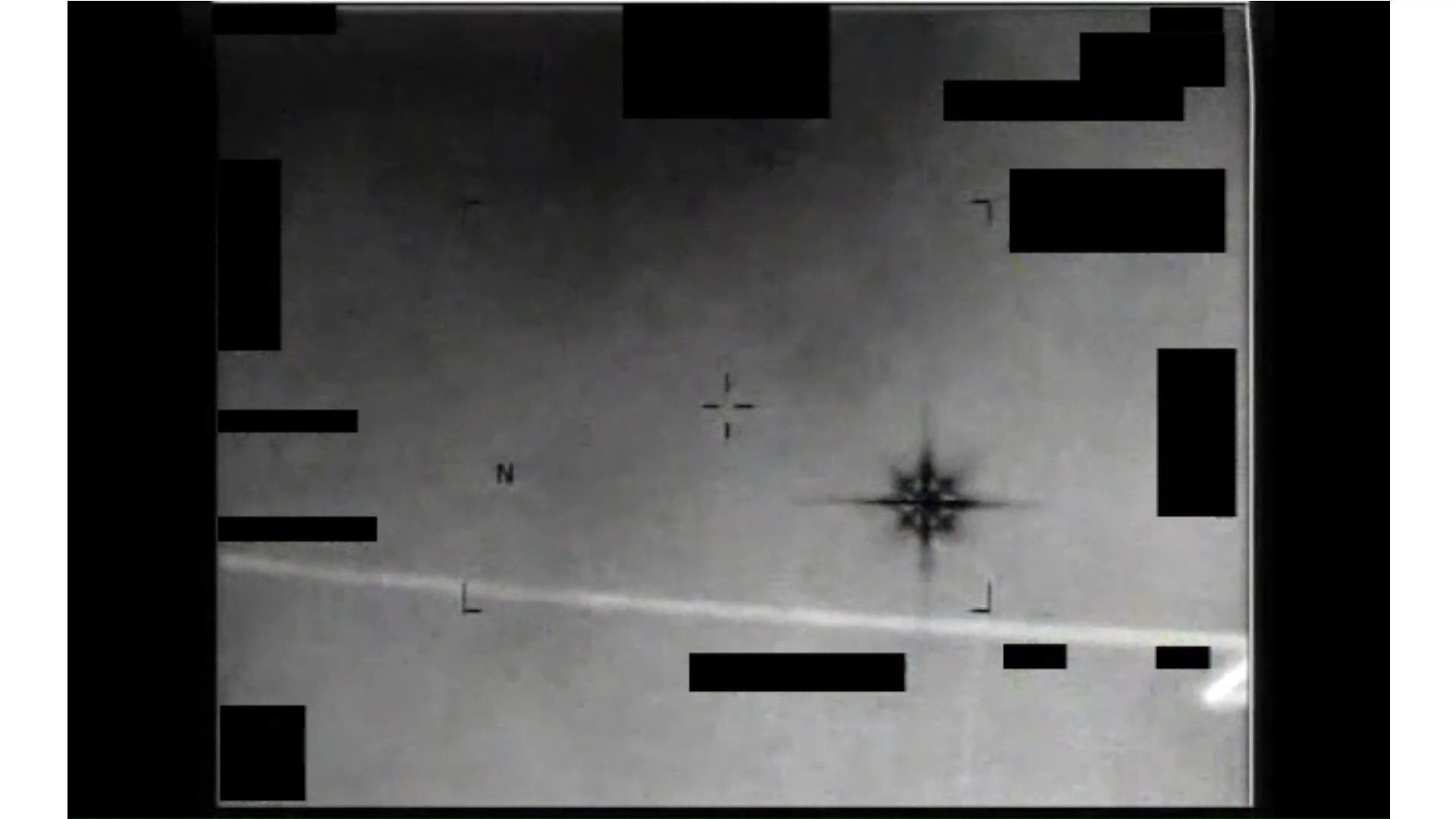
Pictured: an actual frame captured directly from DOW-UAP-PR038, the real declassified infrared video released by the Department of War on May 8, 2026 — not a reconstruction or artist's rendering. The eight-pointed thermal signature is visible at center-right; the black bars are the government's own redactions over sensor telemetry text, and the diagonal white line is the horizon.
Theoretical Alignment
The Chandelier case aligns only weakly with the Extraterrestrial Hypothesis: nothing in the footage or the surrounding record describes propulsion, structure, or behavior beyond an ambiguous area of thermal contrast moving across a sensor's field of view. It aligns more meaningfully, if still modestly, with a Psycho-Social framing — not in the sense of a hallucination or hoax, but in the sense that the case's entire public life has been driven by interpretation of an ambiguous image rather than by any new physical or testimonial evidence. A raw sensor clip with no accompanying description was transformed into "the Chandelier" by a documentary filmmaker's chosen nickname, kept alive online through pattern-recognition and speculation, and only much later folded into a government release that itself explicitly declines to interpret it. The Interdimensional Hypothesis has essentially no purchase here; nothing about the object's reported behavior suggests trans-dimensional travel as opposed to ordinary atmospheric motion of a small, distant heat source — real or artifactual.
Background
By 2013, the Persian Gulf had been one of the most densely monitored bodies of water on Earth for more than two decades. U.S. Central Command (CENTCOM), headquartered at MacDill Air Force Base, Florida, and responsible for the entire Middle East area of operations, maintained a continuous rotation of manned aircraft, unmanned aerial systems, and naval assets over the Gulf's shipping lanes, oil infrastructure, and contested waters bordering Iran, Iraq, Kuwait, Saudi Arabia, Bahrain, Qatar, and the United Arab Emirates. Electro-optical/infrared (EO/IR) targeting pods — systems originally built to designate targets for laser-guided munitions and to provide full-motion video for intelligence, surveillance, and reconnaissance (ISR) missions — were standard equipment on the fixed-wing aircraft and remotely piloted vehicles that patrolled this airspace around the clock, generating enormous volumes of infrared video that was reviewed by aircrews and intelligence analysts and then, in the overwhelming majority of cases, simply archived and forgotten.
The Chandelier footage is one small piece of that much larger archive. It predates the modern era of Pentagon UAP transparency by several years: the first widely publicized declassified U.S. military UAP videos — the "Tic Tac" footage from the USS Nimitz encounter and the Gimbal and GoFast clips recorded from the USS Theodore Roosevelt strike group — were not released by the Department of Defense until December 2017 and March 2018 respectively, and were not the subject of an organized, agency-wide declassification effort until the creation of AARO in 2022. The Chandelier clip sat unpublicized for roughly a decade before an unnamed source is reported to have shared it, first as a still image and later corroborated in full-motion form, with independent UFO researchers. Unlike Gimbal and GoFast, which were captured by a strike group aircrew during an active, multi-day sequence of intercepts and were accompanied by extensive contemporaneous pilot commentary and radar cross-checks, the Chandelier video appears to be an isolated capture: a single clip, apparently generated automatically or opportunistically by a sensor operator, filed into CENTCOM's records with no narrative report attached at all.
That total absence of a human account is the single most unusual feature of this case relative to virtually every other Pentagon-released FLIR video on this site. Gimbal, GoFast, and the Nimitz encounter all include pilot voice recordings, post-flight debriefs, or both. The Chandelier file includes none of these. What survives is the raw sensor data itself, plus more than a decade of after-the-fact interpretation by people who were never present when it was recorded.
Complete Timeline
| Date | Event |
|---|---|
| 2013 (exact date undisclosed) | An infrared sensor aboard an unidentified U.S. military platform records 1 minute 46 seconds of footage over the Persian Gulf, capturing an area of thermal contrast resembling an eight-pointed star. The reporting servicemember files it with U.S. Central Command without any oral or written description of what was observed. |
| 2013 – c. 2023 | The footage remains in CENTCOM/AARO archives, unpublicized. No public record establishes exactly when or through whom a copy first reached civilian researchers. |
| January 10–11, 2024 | Documentary filmmaker Jeremy Corbell, working with investigative journalist George Knapp, publishes a still frame from the video, dubbing the object the "Chandelier UAP" and stating it was filmed over the Persian Gulf at coordinates near 29.16°N, 49.45°E. Corbell says U.S. intelligence sources described a heat signature "unlike anything I've ever seen" with no visible flight-control surfaces, but declines to release the full video, citing national-security concerns. |
| January 10, 2024 | Skeptical analyst Mick West publicly responds on social media within hours, writing that the "Chandelier" appears to be a diffraction artifact — "a glare from a very bright/hot source, like a missile rocket/engine" — and opens a technical discussion thread on his forum, Metabunk.org. |
| January 11–15, 2024 | Metabunk contributors "flarkey" and "john.phil" identify the sensor as an MTS-B multi-spectral targeting turret from on-screen telemetry text and build a working optical simulation reproducing the eight-pointed pattern from the turret's own spider-vane and iris geometry. |
| February 19, 2026 | President Trump directs the Department of War (formerly the Department of Defense), with support from the Office of the Director of National Intelligence, to find, review, declassify, and publicly release unresolved UAP-related government records under a new program: the Presidential Unsealing and Reporting System for UAP Encounters (PURSUE). |
| May 8, 2026 | The Department of War publishes the first PURSUE release — roughly 162 files — at war.gov/ufo. Among them is DOW-UAP-PR038, officially titled "Unresolved UAP Report, Middle East, 2013," containing the full, previously unreleased 1:46 video with an official written description but with on-screen telemetry text redacted. |
| May 2026 onward | The Chandelier file circulates widely in UAP and mainstream media coverage of the PURSUE release. Researchers including Christopher Mellon and Ryan Graves publicly note that the PURSUE release, including this file, lacks the metadata, sensor parameters, and chain-of-custody documentation needed for independent parties to verify or resolve the case. |
What the Declassified File Actually Says
The Department of War's own released description of DOW-UAP-PR038 is short, clinical, and deliberately non-interpretive — and it is worth quoting in full, because it is the only first-party government account of this case that exists:
"The United States Central Command submitted a report of an unidentified anomalous phenomenon to the All-domain Anomaly Resolution Office (AARO) consisting of one minute and 46 seconds of video footage from an infrared sensor aboard a U.S. military platform in 2013. The reporter did not provide any oral or written description of the observation.
Video Description: This video depicts an area of contrast resembling an eight-pointed star with arms of alternating length.
00:10: The sensor field-of-view narrows to zoom in on the area of contrast.
00:11–00:29: The area of contrast moves within the sensor field-of-view, followed by a visible trail.
00:30: The area of contrast leaves the sensor field-of-view at the bottom right of the screen.
00:35–01:44: Following an apparent cut, the area of contrast generally remains within the sensor field-of-view before exiting the frame from the top left quarter of the screen."
Two phrases in that official text matter enormously to how the case should be read. First, "area of contrast" — not "object," not "craft," not even "target." The Department of War's own release deliberately avoids asserting that the eight-pointed shape corresponds to a discrete physical thing at all; it describes only what is visible on the sensor display. Second, the file's own closing caveat states plainly: "This video description is provided for informational purposes only. Readers should not interpret any part of this description as reflecting an analytical judgment, investigative conclusion, or factual determination regarding the described event's validity, nature, or significance." AARO is not endorsing the idea that a structured object was present; it is publishing raw data and explicitly declining to characterize it.
The file's metadata records a "date taken" of January 1, 2013 — almost certainly a database placeholder rather than a genuine recorded date, since PURSUE's public database defaults incomplete dates to the first of the year, the same convention this site follows elsewhere for imprecise dates. The true date within 2013 has not been disclosed. The file is catalogued under category "B-ROLL," release batch "Release 01" (May 8, 2026), and lists its incident location only as "Middle East" — a far broader designation than "Persian Gulf," which comes not from the government file but from Corbell's original 2024 release.
The Original 2024 Leak: Corbell, Knapp, and the "Chandelier" Nickname
Before the Department of War ever acknowledged the file existed, the footage reached the public through the same informal channel that has surfaced most modern leaked Pentagon UAP material: documentary filmmaker Jeremy Corbell, frequently working alongside veteran Las Vegas investigative journalist George Knapp. On January 10–11, 2024, Corbell published a single still frame from the video — not the full motion clip — describing it as showing a UAP with "a heat signature unlike anything I've ever seen before" and relaying, without naming his sources, that people in the intelligence community had told him the object "appeared to have no flight control surfaces, such as a cockpit." He gave the object its enduring nickname, "the Chandelier," for its resemblance to the branching arms of an inverted light fixture, and stated it had been filmed over the Persian Gulf at coordinates he cited as 29°09′41.4″N, 49°26′56.7″E. Corbell said he was withholding the full video itself, citing national-security sensitivities.
This release pattern is now a familiar one on this site: Corbell has previously published leaked stills and clips including the USS Omaha spherical-object footage and the "Mosul Orb" image, in each case relying on undisclosed sources and declining to fully substantiate his claims about the material's context at the time of release. His key-figures profile on this site already notes that critics observe he "does not disclose his sources and that his on-camera framing consistently favors extraterrestrial interpretations" — a pattern that repeats here. The 2024 "no flight control surfaces" and "unlike anything I've ever seen" characterizations were never independently corroborated by any named military or government source, and remain, more than two years later, exactly what they were the day they were published: secondhand claims relayed by a filmmaker about a video he did not release in full.
What Corbell's 2024 release did accomplish, whatever its evidentiary limits, was to put a genuine, verifiably real government sensor clip into public circulation more than two years before the Department of War itself acknowledged the file. When PURSUE's official release finally arrived in May 2026, independent researchers were able to confirm that the government's DOW-UAP-PR038 file was, in fact, the same video Corbell had partially described — a rare case of an unofficial UFO leak being subsequently validated, in substance if not in every claimed detail, by the government's own later disclosure.
The Sensor: Identifying the MTS-B and Its Optics
Neither Corbell's original release nor the Department of War's own 2026 file identifies the specific aircraft or drone that carried the camera. That gap was partially filled by independent analysis. Metabunk forum contributor "flarkey," working from on-screen telemetry text visible in the earlier, less-redacted version of the footage that had circulated online, identified the equipment as an MTS-B (Multi-Spectral Targeting System-B) — a Raytheon-built electro-optical/infrared targeting and reconnaissance turret most commonly associated with the U.S. Air Force's MQ-9 Reaper unmanned aircraft, though some Metabunk contributors argued specific optical characteristics in the footage were more consistent with the smaller MTS-A turret fitted to the older MQ-1B Predator. The Department of War's own released file does not name the carrying platform, and independent analysts have not reached a firm consensus on which specific airframe recorded the Chandelier — only that its optics are consistent with the MTS family of targeting pods used broadly across CENTCOM's manned and unmanned ISR fleet in the Gulf region during this period.
Why the specific turret model matters is optical, not merely bureaucratic. Every camera lens with an internal aperture produces diffraction — the bending of light around the edges of any structure placed in its optical path. A camera with a perfectly circular, unobstructed aperture produces a simple circular blur (a bokeh disc) around any sufficiently bright or hot point source. A camera whose aperture is instead shaped by internal support struts (frequently called "spider vanes," used to hold a secondary mirror or sensor element in place inside a compact catadioptric lens assembly) or by a non-circular iris blade will instead produce a spiky, star-shaped diffraction pattern — the same physical phenomenon amateur and professional astrophotographers see around bright stars imaged through telescopes with vaned secondary-mirror supports, and the same effect visible around streetlights photographed through many smartphone camera lenses with polygonal iris blades. The number, length, and symmetry of the resulting spikes is a direct, predictable function of the specific optical hardware inside the lens — not of the true shape of whatever produced the original point of light or heat.
The Diffraction-Artifact Hypothesis: Mick West's Technical Case
Mick West, the retired video-game programmer turned independent skeptical investigator who founded Metabunk.org and has previously published detailed technical analyses of the Gimbal and GoFast, USS Omaha, Iraq "Sphere", and Campeche FLIR cases, was among the first people to publicly respond to Corbell's 2024 release. Within hours, West posted: "The 'Chandelier' UFO appears to be a diffraction artifact. Basically, a glare from a very bright/hot source, like a missile rocket/engine. It's not actually that shape, as anyone familiar with optics would tell Jeremy."
West and other Metabunk contributors then built a detailed technical case over the following days:
- Optical source of the spikes: West's central claim is that the MTS-B turret's own internal optics — specifically the crenulated spider vanes holding its secondary mirror in place, combined with a square iris aperture set at roughly 45 degrees to those vanes — are together capable of producing an eight-pointed diffraction pattern with alternating arm lengths, matching the government's own official description of the shape almost exactly. In this model, four longer spikes come from the spider-vane diffraction and four shorter, interleaved spikes come from the square iris — a structural explanation for the very detail ("arms of alternating length") that the Department of War's release highlights as distinctive.
- Independent optical simulation: Metabunk contributor "john.phil" used Maskulator, a piece of amateur astrophotography software designed to model diffraction spikes from a telescope's mirror-support geometry, to construct a combined mask reproducing both the spider-vane and square-iris diffraction sources. The resulting simulated pattern was, in the thread's own assessment, "showing remarkable similarity to the Chandelier" — a falsifiable, reproducible optical model rather than a bare assertion.
- Precedent in other released military footage: West compiled multiple other examples of similar star-shaped diffraction spikes appearing around bright or hot points in other publicly released MQ-1/MQ-9-family targeting-pod video, arguing the effect is a known, recurring artifact of this exact class of sensor rather than something unique to this one clip.
- The "crispness" problem and a laser hypothesis: West separately noted that the sharpness and symmetry of the Chandelier's spikes seemed unusually crisp compared to ordinary heat-source diffraction, raising the possibility that the true point source was not simply a hot object but a coherent light source — such as a laser target designator's reflection — interacting with the same optical geometry. Contributor "FatPhil" discussed the coherence properties of laser light and how they might interact differently with the turret's aperture than an incoherent thermal glow, without the thread reaching a final resolution on this specific refinement.
Under this model, the true object recorded by the sensor was never an eight-pointed structure at all: it was a small, distant, and essentially featureless point of intense heat or light — a missile plume, a flare, an aircraft engine exhaust, or some other bright thermal source — whose actual shape was overwhelmed and replaced on-screen by the camera's own internal optical signature. On this reading, the "movement," the "visible trail," and the object's disappearance and reappearance in the government's own frame-by-frame description are all still real events, but they describe the movement of an ordinary bright point, not a structured, eight-armed craft.
What the Skeptical Case Does Not Resolve
West's diffraction model is optically well-grounded and, unusually for a UAP skeptical argument, backed by an actual reproducible simulation rather than assertion alone — but it stops short of being a complete case resolution, for reasons the Metabunk thread itself acknowledges. Identifying the mechanism that could produce the observed shape is not the same as identifying what the underlying point source actually was. No specific missile launch, flare deployment, aircraft, or other dated, logged event has been publicly matched to this footage; the "real object is probably a heat source" conclusion remains a plausible category of explanation rather than a specific, verified identification, in the same way that AARO's own broader UAP caseload frequently resolves cases to a general category (balloon, drone, bird) without always being able to name the specific balloon or drone involved.
Separately, and unlike the Gimbal and GoFast cases — where the same public telemetry that let West build his glare and parallax models was also independently checked against the tracking display's own recorded range and bearing data by AARO itself, producing a matching, quantitative 2025 resolution — no comparable independent, government-conducted verification of the diffraction hypothesis for the Chandelier has been published. AARO's own release explicitly declines to offer any analytical judgment on the file at all. West's explanation is, at the time of writing, the most technically detailed public account of what the Chandelier might be, but it remains an independent researcher's hypothesis, not a confirmed government finding.
The competing account — relayed secondhand by Corbell, from anonymous "people in the intelligence community" — describes an object with "no wings," "seemingly no place for anyone to sit," a "bizarre shape," "strange propulsion," and a sudden disappearance. None of these specific claims appear anywhere in the Department of War's own released description, which describes only an "area of contrast" leaving the frame at a screen edge — ordinary, expected sensor behavior for anything that moves outside a camera's field of view, not a claim of instantaneous vanishing. If these more dramatic characterizations are accurate, they would have to be drawn from portions of the video, or from a briefing, that have never been publicly released; as reported, they are unverifiable hearsay layered atop a document that itself declines to make any such claims.
Locating the Sighting: "Persian Gulf" vs. "Middle East"
A small but genuine discrepancy runs through this case's public record: Corbell's 2024 release specified a location over the Persian Gulf, at coordinates independent researchers subsequently extracted from the leaked footage's own embedded telemetry as approximately 29°09′41″N, 49°26′57″E — a position in open Gulf waters roughly equidistant from the Kuwaiti, Iranian, and Saudi coastlines, well within CENTCOM's area of responsibility. The Department of War's own 2026 official file, by contrast, redacts all on-screen telemetry text in the version it released and logs the incident location only under the broader category "Middle East," never specifying "Persian Gulf" at all. The two accounts are not necessarily in conflict — "Persian Gulf" is a subset of "Middle East" — but the coordinate precision cited by Corbell and Metabunk researchers cannot be independently verified against the government's own redacted release, since the specific data point that would confirm or refute it has been withheld. This site follows Corbell's original, more specific "Persian Gulf" designation, consistent with how the case has been described in virtually all subsequent reporting, while noting explicitly that the government's own formal file does not confirm that precision.
The same PURSUE release batch that included the Chandelier also contained at least two other CENTCOM files logged to the Persian Gulf specifically — DOW-UAP-PR091 ("21 Aug [Callsign] Observes UAP in Persian Gulf," dated 2020) and DOW-UAP-PR098 ("UFOs in Formation Over Persian Gulf?") — underscoring that this stretch of water has generated a recurring, if scattered, stream of CENTCOM sensor reports over more than a decade, of which the Chandelier is simply the most widely publicized.
The PURSUE Declassification and What It Does — and Does Not — Establish
The Chandelier's formal government release cannot be understood in isolation from the program that produced it. On February 19, 2026, President Trump directed the Department of War (the renamed Department of Defense), with support from the Office of the Director of National Intelligence, to conduct a government-wide effort to find, review, declassify, and publicly release unresolved UAP-related records — a program formally named the Presidential Unsealing and Reporting System for UAP Encounters, or PURSUE. The Department of War's own published directive is explicit that the materials being released are, by definition, cases the government "is unable to make a definitive determination on the nature of," and that this status can result simply "from a lack of sufficient data" rather than from any genuinely anomalous quality of the case itself. Then-Secretary of War Pete Hegseth stated the program was intended to give "unprecedented transparency" after files "hidden behind classifications... have long fueled justified speculation."
PURSUE has released material in five tranches between May 8 and August 7, 2026 — roughly 375–380 records in total, drawn from at least eight federal agencies including the Department of War, FBI, NASA, and others, posted to the dedicated war.gov/ufo portal rather than AARO's pre-existing public website. The Chandelier's DOW-UAP-PR038 file was part of the very first tranche, released May 8, 2026, alongside roughly 160 other files.
Researchers who welcomed the disclosure in principle were nonetheless sharply critical of its execution in ways directly relevant to this case. Christopher Mellon, a former deputy assistant secretary of defense for intelligence who has been closely involved in Pentagon UAP transparency efforts since helping bring the Nimitz and Gimbal footage to The New York Times in 2017, said of the release that it "puts something important on the record" but cautioned that "data alone is not disclosure... releasing raw files without context may confuse more than clarify." Former Navy pilot Ryan Graves, who has separately testified to Congress about UAP encounters, argued the released material needed "clear provenance, sensor context, metadata, chain of custody" rather than "ambiguous imagery" to be useful. Journalist Alejandro Rojas noted that "case summaries without coordinates, sensor parameters... make independent analysis very difficult," and retired Rear Admiral Tim Gallaudet observed that with "no metadata included... [it is] impossible to conclude objects were anomalous." Every one of these criticisms describes the Chandelier file precisely: a real, authentic government sensor clip, officially acknowledged to exist, released with its most diagnostically useful telemetry redacted and with zero underlying witness account to interpret it by.
A caveat on treating "Unresolved" as evidence: this file's own "Unresolved" catalog status is real, but a government body's failure or unwillingness to name a mundane explanation is not, on its own, positive evidence of anomaly, any more than a government body's stated explanation elsewhere is automatically the final word (see this site's own treatment of AARO's balloon-cluster finding in the Al Taqaddum "Jellyfish" case for the mirror-image caution). Government and military bodies investigating UAP reports have a documented history of incomplete, delayed, or later-revised positions in both directions — toward premature explanation and toward prolonged non-resolution — shaped by institutional incentives, resourcing decisions about which cases get deep technical review, and classification constraints that keep outside researchers from auditing an investigation's actual completeness. PURSUE's own release directive states plainly that "Unresolved" can follow simply from "a lack of sufficient data" rather than from anything genuinely anomalous about the case. This file therefore treats the Chandelier's official "Unresolved" status as one data point among several — alongside the file's real technical distinctiveness and West's own unfinished skeptical case — not as government confirmation that something anomalous was recorded.
Key Witnesses & Investigators
No named eyewitness exists in this case — the reporting servicemember who filed the original footage with CENTCOM is, per the government's own release, unidentified and provided no description at all. The individuals below are the people whose research, reporting, or analysis actually shaped what the public knows about this case.
Jeremy Corbell
Independent filmmaker who, working with George Knapp, released a still frame from the video on January 10–11, 2024, gave the object its "Chandelier" nickname, and relayed secondhand claims from unnamed intelligence sources describing a heat signature "unlike anything I've ever seen before" with no visible flight-control surfaces. He did not release the full video and did not disclose his sources. His account preceded the government's own 2026 declassification by more than two years and was subsequently confirmed, in substance, to describe the same real file — though his more dramatic secondhand characterizations of the object's shape and behavior have never been independently corroborated and do not appear in the Department of War's own official video description.
George Knapp
Veteran journalist who broke the Bob Lazar story in 1989 and has decades of mainstream UAP reporting credibility. Co-presented the Chandelier release with Corbell in January 2024. Knapp's involvement lent the initial leak more mainstream journalistic weight than a Corbell release alone typically carries, though the underlying sourcing for the intelligence-community characterizations remained the same undisclosed origins.
Mick West
Published the first detailed public rebuttal within hours of Corbell's 2024 release, arguing the object's apparent shape is a diffraction artifact produced by the recording camera's own internal optics rather than the true form of any physical object. Directed and participated in a multi-contributor Metabunk forum thread that identified the likely sensor model (MTS-B) from on-screen telemetry and built a working optical simulation reproducing the eight-pointed pattern. West has published comparable technical analyses of several other Pentagon-released FLIR cases on this site, including Gimbal & GoFast and the Campeche Military FLIR Incident.
The Five Observables Assessment
The Five Observables framework, developed by former AATIP director Luis Elizondo, is used to classify UAP encounters based on performance characteristics that exceed known technology:
Assessment: The Chandelier case offers essentially no basis for assessing four of the five observables. No speed, acceleration, or altitude figures exist anywhere in the public record, because no telemetry was released; the object's motion is described only qualitatively ("moves within the sensor field-of-view, followed by a visible trail"), which is consistent with almost any speed from a slow-moving flare to a fast-moving aircraft depending on the (unreleased) sensor's zoom level and the (unknown) range to target. "Low Observability" is marked speculative only in the loose sense that the object was detected exclusively on infrared and never described as being seen visually, radar-tracked, or picked up on any other sensor — but this is equally consistent with the diffraction-artifact explanation (an ordinary heat source too small or distant to register on other instruments) as with a genuinely low-observable craft. This case simply does not contain the kind of multi-sensor, quantified data that made the Five Observables framework meaningfully applicable to cases like Nimitz or Gimbal.
Evidence Assessment
Supporting an Anomalous Reading
- The footage is a real, authenticated U.S. government sensor recording, formally acknowledged and declassified by the Department of War in 2026 — not a hoax, a CGI rendering, or a misattributed clip from an unrelated event.
- The object's motion, including a visible trail and directional travel across the frame, was significant enough that a sensor operator zoomed the camera in to track it (per the government's own 00:10 timestamp note), indicating something on-screen was judged worth following in real time.
- AARO's own release explicitly declines to resolve the case to any known object, aircraft, or natural phenomenon, and it remains formally catalogued as "Unresolved" rather than "Explained" more than a decade after it was recorded.
- The eight-pointed shape with alternating arm lengths is distinctive and symmetrical enough that it has resisted casual dismissal by skeptics and proponents alike; even Mick West's rebuttal required a multi-day technical thread and a custom optical simulation to construct a full explanation, rather than a one-line dismissal.
Supporting a Conventional Explanation
- No witness — military or civilian — has ever gone on record describing what was seen. The government's own file states plainly that "the reporter did not provide any oral or written description of the observation."
- A reproducible optical simulation (spider-vane and square-iris diffraction, modeled independently by a Metabunk contributor using astrophotography software) generates a pattern closely matching the government's own official description, including the specific detail of "arms of alternating length."
- The Department of War's own release describes only an "area of contrast," deliberately avoiding any claim that the shape corresponds to a discrete, structured physical object.
- The most dramatic claims about the object (no wings, no cockpit, "strange propulsion," instant disappearance) trace back entirely to anonymous, secondhand sourcing relayed by a filmmaker with a documented pattern of undisclosed sourcing on prior cases, and do not appear anywhere in the official government description.
- No radar, no second sensor, and no independent visual sighting corroborates the infrared clip — a single, uncorroborated sensor stream is a comparatively weak evidentiary basis relative to the multi-sensor documentation available for cases like Nimitz or Gimbal.
Why "Disputed"
The Chandelier UAP is classified DISPUTED with a comparatively low credibility score because, unlike most other cases on this site carrying that stamp, it lacks even the baseline element every other Disputed or Credible case has in common: a human being willing to describe, on the record, what they saw. Roswell has hundreds of interviewed witnesses; Gimbal and GoFast have named aircrew and recorded cockpit audio; even weaker cases like Thomas Mantell have a chain of ground observers and radio transmissions. The Chandelier has none of this. What exists is a single, isolated, eleven-year-old sensor clip, filed by an anonymous operator who characterized nothing, interpreted by a filmmaker who would not release the full video and would not name his sources, and finally acknowledged by a government agency whose own release explicitly refuses to offer any analytical judgment at all.
Against that backdrop, the diffraction-artifact hypothesis is unusually strong as skeptical explanations go: it identifies a specific, named piece of hardware (the MTS-B turret), a specific, well-understood physical mechanism (spider-vane and iris diffraction), and produces a reproducible optical simulation that visually matches the government's own official description of the shape, down to the specific detail of alternating arm lengths. It does not, however, rise to the level of a fully confirmed resolution, because no independent party — least of all AARO itself — has published a matched, dated real-world event (a specific missile test, flare drop, or aircraft transit) that the diffraction pattern was actually diffracting. What survives, honestly assessed, is a real and still-unresolved government file, a technically serious but unconfirmed conventional explanation, and an enormous gap between the modest, hedged language of the official record and the much more dramatic secondhand claims that made the case famous in the first place.
Sensor & Instrumentation Detection Profile
The entirety of this case's evidentiary record is a single infrared sensor stream, almost certainly from a Raytheon MTS-B (or possibly the smaller MTS-A) multi-spectral targeting turret carried aboard an unidentified U.S. military fixed-wing aircraft or remotely piloted vehicle operating in CENTCOM's Persian Gulf area of responsibility. No radar track, no visual-band corroboration, no acoustic data, and no second independent sensor of any kind has been publicly associated with this event. The released file's own on-screen telemetry — which in an unredacted state would likely have included range, bearing, target coordinates, and platform altitude, the same class of data that allowed independent verification of the Gimbal and GoFast cases — has been redacted in the 2026 government release, leaving only the raw video image and the government's brief prose description as available evidence.
Environmental & Geospatial Context
No meteorological, lunar, or atmospheric data was released alongside this file, and because the exact date within 2013 is undisclosed, none can be independently reconstructed with confidence. The location is described by the government only as "Middle East," with the more specific "Persian Gulf" designation and approximate coordinates (roughly 29.16°N, 49.45°E) sourced only from the original 2024 leak and subsequent independent OSINT analysis, not from the official file itself. The Persian Gulf's marine environment — warm surface water, high humidity, and frequent haze — is a genuinely challenging one for infrared sensors, which can be affected by thermal contrast between sea, sky, and any airborne targets in ways that vary significantly with time of day and atmospheric moisture; none of these conditions can be verified for this specific recording given the total absence of released metadata.
Observer Credibility & Occupational Profile
The reporting servicemember is entirely anonymous and, per the government's own file, offered no description of the observation at all — there is no testimony to assess for credibility because none exists. Of the identifiable public figures who shaped the case's interpretation, Jeremy Corbell is a documentary filmmaker with a long track record of publishing leaked military UAP material but a documented pattern of withholding sourcing and favoring extraterrestrial framing; George Knapp is a veteran, mainstream-credentialed investigative journalist whose decades of UAP reporting (including breaking the Bob Lazar story) give his involvement real institutional weight; and Mick West is a technically trained independent analyst (a former video-game graphics programmer) whose optical/diffraction analyses of other Pentagon FLIR cases, including Gimbal, have previously been closely echoed by later official AARO findings on related cases. None of the three was present when the footage was recorded; all three are, in different ways, secondhand interpreters of a document none of them originally created.
Physical & Material Assays
No physical evidence of any kind exists for this case. No debris, no recovered hardware, and no material sample has ever been claimed, submitted, or tested. The only artifact is the video file itself.
Historical Precedents & Archive Matches
Star-shaped or spiked light artifacts in optical and infrared imagery are a well-documented, long-recognized phenomenon entirely independent of UFO reporting; amateur and professional astrophotographers have catalogued and modeled diffraction spikes around bright stars for as long as reflector telescopes with vaned secondary-mirror mounts have existed, and the same effect is a routine nuisance in ordinary smartphone photography of streetlights and headlights at night. Within the specific corpus of declassified Pentagon UAP material, the Chandelier is not an isolated case of a "surprising" sensor artifact prompting genuine, sustained expert disagreement: the same PURSUE release batch that included the Chandelier also included the "Jellyfish" UAP, a separate CENTCOM-area infrared clip recorded on a different sensor (an MX-20 turret) showing a different, tendril-like thermal pattern that has likewise drawn competing anomalous-object and sensor-artifact readings. Within this site's own published case-file archive, Mick West's glare/artifact analyses of the Gimbal rotation and the Campeche "eleven objects" (later matched to oil-platform gas flares) both illustrate the same underlying pattern: infrared sensor video of real, physically ordinary sources routinely produces visual effects that can look far stranger, and far more structured, than the true underlying object actually is.
Material Analysis
There is no physical debris, trace evidence, or recovered material of any kind associated with this case, and none has ever been claimed. What exists instead is a single digital video file — and, unusually even by the standards of other sensor-only UAP cases on this site, that file's own chain of custody and technical metadata are almost entirely opaque. The Gimbal and GoFast recordings, by contrast, are original-format Navy ATFLIR data complete with on-screen range, bearing, and closure-rate telemetry that has allowed multiple independent parties — West, a NASA-affiliated independent study team, and AARO itself — to conduct genuine, falsifiable forensic reconstruction of those objects' actual flight paths. The Chandelier file offers no equivalent opportunity: its own telemetry has been redacted in the version the government chose to release, its exact recording date is undisclosed, its carrying aircraft is unidentified, and the copy that first reached the public in 2024 arrived as a single still image from an undisclosed source rather than the full motion file. The "material" being analyzed in this case, in other words, is thinner and less independently verifiable than in almost any other Pentagon FLIR case this site has published — a genuine limitation on how confidently any reading of the footage, anomalous or conventional, can be held.
Supporting a Genuine Anomalous Event
- The file is authenticated, original U.S. government sensor material, not a re-encoded or secondhand copy of uncertain provenance — its authenticity as a real CENTCOM recording is not in dispute.
- AARO's own 2026 release catalogues the case as formally "Unresolved," not as explained, more than a decade after it was recorded and years after independent skeptical analysis was published.
Supporting a Conventional Origin
- The single most evidentially useful piece of data — the sensor's own on-screen telemetry, which resolved the Gimbal and GoFast cases — has been redacted in this case's release, actively preventing the kind of independent quantitative reconstruction that helped settle those other cases.
- No second sensor, no radar, and no witness account exists to cross-check the infrared image against, leaving a single uncorroborated data stream as the entire evidentiary basis for any reading of the case.
The Conventional Explanation Candidate
Because the government's own release offers no analytical conclusion, the case for a conventional origin rests entirely on independent researcher analysis — principally Mick West's Metabunk thread. That analysis actually comprises several distinct, related but separable hypotheses, evaluated individually below.
Camera Diffraction Artifact (Spider-Vane / Iris Diffraction)
The primary hypothesis: the eight-pointed shape is produced by light or heat from an ordinary, unstructured point source diffracting around the MTS-B turret's own internal optical hardware — its secondary-mirror support vanes and square iris aperture — rather than reflecting the true shape of whatever produced the original signal. This is supported by a working, independently constructed optical simulation that reproduces the observed pattern, including its distinctive alternating arm lengths, and by documented precedent for similar spike patterns in other MTS-family sensor footage.
Underlying Point Source: Flare, Missile Plume, or Aircraft Engine Glare
If the diffraction hypothesis is correct, some real point source of intense heat or light still had to be present for the optics to diffract in the first place. Candidates discussed by researchers include a signal or illumination flare, a missile motor plume, or the exhaust/afterburner of a conventional aircraft — any of which would present as an intensely bright, largely featureless thermal point at range, exactly the kind of source diffraction theory requires. No specific, dated launch or flight record has been published matching this footage to any one of these candidates.
Laser Reflection or Coherent-Light Source
A refinement of the above: the unusual crispness and symmetry of the spikes, compared to typical incoherent thermal-glow diffraction, led some Metabunk contributors to suggest the true source might be coherent light — such as a laser target designator's reflection off a surface, aircraft, or particulate in the air — rather than simple heat. This remains a discussed refinement rather than a settled point within the skeptical analysis itself.
Genuine Unconventional Aircraft
The alternative to all of the above: that the eight-pointed shape is a real, physical structure belonging to an unidentified craft. This reading depends heavily on secondhand claims (no wings, no cockpit, "strange propulsion," instant disappearance) that are not corroborated anywhere in the government's own official description and have never been attributed to a named source. No physical, radar, or multi-sensor evidence supports this reading independent of the disputed visual shape itself.
Camera Diffraction Artifact
PlausibleThe strongest candidate. A reproducible optical simulation matches the government's own official shape description in detail, and the underlying physics (spider-vane and iris diffraction) is well-established and routinely observed in comparable sensor and camera systems.
Flare / Missile Plume / Engine Glare
InconclusiveA physically reasonable category of underlying point source consistent with the diffraction model, but no specific, dated event has been publicly matched to this footage to confirm which (if any) of these candidates is correct.
Laser Reflection
InconclusiveA plausible refinement discussed by the same analysts who proposed the diffraction model, but not independently confirmed or ruled out; the thread itself treats this as an open technical question rather than a settled conclusion.
Genuine Unconventional Aircraft
ImplausibleRests entirely on unverifiable, anonymously sourced secondhand claims that do not appear anywhere in the government's own official video description, and offers no physical or multi-sensor corroboration independent of the disputed shape itself.
Related Cases
Confirmed Documents & Official Records
The official declassified file, database entry, and official video description — released as part of PURSUE Release 01. Search the PURSUE database directly for "DOW-UAP-PR038" or "PR038" to view the file record and video.
UNCLASSIFIED (declassified 2026)The official Department of War announcement accompanying the first PURSUE release, including Secretary Hegseth's public statement on the program's goals.
UNCLASSIFIEDThe Department of Defense's official public video distribution hub hosting of the same declassified file, mirrored from the war.gov/UFO release.
UNCLASSIFIEDSearch Government Archives Directly
Further Reading — Recommended Literature
Escaping the Rabbit Hole: How to Debunk Conspiracy Theories Using Facts, Logic, and Respect
West's own book on debunking methodology — the revised edition adds material specifically on UFO claims. Essential for understanding the reasoning process behind his diffraction-artifact analysis of the Chandelier and similar Pentagon FLIR cases.
UFOs: Generals, Pilots, and Government Officials Go on the Record
A New York Times bestseller built on interviews with high-level military and government witnesses, useful context for how radically the Chandelier's total absence of witness testimony differs from the cases that built modern UAP credibility.
Imminent: Inside the Pentagon's Hunt for UFOs
Memoir by the former head of the Pentagon's AATIP program and originator of the Five Observables framework used throughout this site's case assessments, including this one.
UFO: The Inside Story of the US Government's Search for Alien Life Here—and Out There
A comprehensive history of official U.S. government UAP investigation, situating programs like AARO and initiatives like PURSUE within a much longer institutional history of Pentagon secrecy and partial disclosure.
Skinwalkers at the Pentagon: An Insiders' Account of the Secret Government UFO Program
Co-written by George Knapp, who co-revealed the Chandelier footage with Jeremy Corbell in 2024 — an inside account of the classified AAWSAP program and the broader institutional culture that produced files like this one.
DISCLOSURE: Some links above are affiliate links. If you purchase through them, OverClassified receives a small commission at no additional cost to you. This helps support independent research.
Essential Viewing
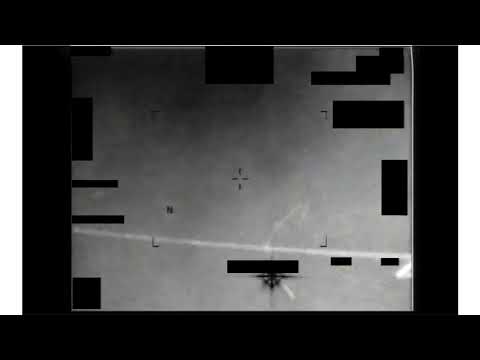
DOW-UAP-PR038: The Full Declassified Video
The complete, unedited 1m46s government-released infrared video, re-uploaded in full following the May 2026 PURSUE declassification.
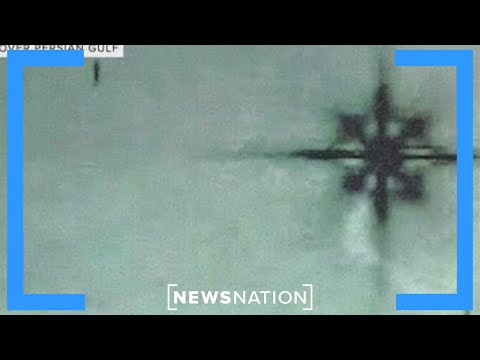
NewsNation: "Chandelier" UAP Photo Shows Strange Object in Persian Gulf
NewsNation's Vargas Reports segment covering Jeremy Corbell's original 2024 release and the surrounding debate over the object's true nature.
Sources
- Department of War. DOW-UAP-PR038, "Unresolved UAP Report, Middle East, 2013," official video description. PURSUE Release 01, May 8, 2026. war.gov/UFO
- Department of War. "Department of War Releases Unidentified Anomalous Phenomena Files in Historic Transparency Push," May 8, 2026. war.gov
- DVIDS. "DOW-UAP-PR38, Unresolved UAP Report, Middle East, 2013." dvidshub.net
- West, Mick. "PR38: The 'Chandelier' UFO." Metabunk.org forum thread, opened January 10, 2024. metabunk.org
- West, Mick (@MickWest). "The 'Chandelier' UFO appears to be a diffraction artifact..." X/Twitter, January 10, 2024. x.com
- Corbell, Jeremy & Knapp, George. "Chandelier" UAP release, "Weaponized" platform / TMZ "UFO Revolution" documentary series, January 10–11, 2024. weaponizedpodcast.com
- NewsNation. "'Chandelier' UAP photo shows strange object in Persian Gulf." newsnationnow.com
- NewsNation (Vargas Reports). "'Chandelier' UAP photo shows strange object in Persian Gulf." Video segment. youtube.com
- WLT Report. "The White House Just Posted a 2013 Military Video of an Unidentified Eight-Pointed Star Over the Middle East," May 10, 2026. wltreport.com
- WLT Report. "Watch: Military Captures Startling Image of 'Chandelier' UFO," January 12, 2024. wltreport.com
- Yahoo News. "Wild UFO Video Captures Strange 'Eight Pointed Star' Making Odd Movements." yahoo.com
- DefenseScoop. "'Data alone is not disclosure': UAP research community reacts to Trump's first PURSUE file drop," May 14, 2026. defensescoop.com
- WCCB Charlotte. "Pentagon begins releasing new files on UFOs and says the public can draw its own conclusions," May 8, 2026. wccbcharlotte.com
- MeriTalk. "Pentagon Releases Fifth Tranche of Declassified UAP Files." meritalk.com
- Ground News. "Pentagon Drops 41 Declassified UAP Files in Fifth Batch." ground.news
- Mellon, Christopher. Public statement on the PURSUE release, quoted via DefenseScoop, May 2026.
- Graves, Ryan. Public statement on the PURSUE release's metadata and provenance shortcomings, quoted via DefenseScoop, May 2026.
- Rojas, Alejandro. Public statement on PURSUE case-summary limitations, quoted via DefenseScoop, May 2026.
- Gallaudet, Tim (RADM, ret.). Public statement on the absence of metadata in the PURSUE release, quoted via DefenseScoop, May 2026.
- Metabunk.org forum contributors "flarkey," "john.phil," "FatPhil," and "koolkake." Technical discussion, sensor identification, and diffraction modeling within the PR38 thread, January 2024.
- OverClassified. "USS Roosevelt / Gimbal & GoFast" case file (cross-referenced Mick West analysis methodology). overclassified.org
- OverClassified. "Campeche Military FLIR Incident" case file (cross-referenced FLIR-artifact precedent). overclassified.org
- OverClassified. "USS Nimitz / Tic Tac Encounter" case file (cross-referenced Pentagon FLIR disclosure history). overclassified.org
See something inaccurate? Have additional information or sources?
Suggest an Edit →Last Updated: August 2026