
Alexander's Griffin-Basket Ascent
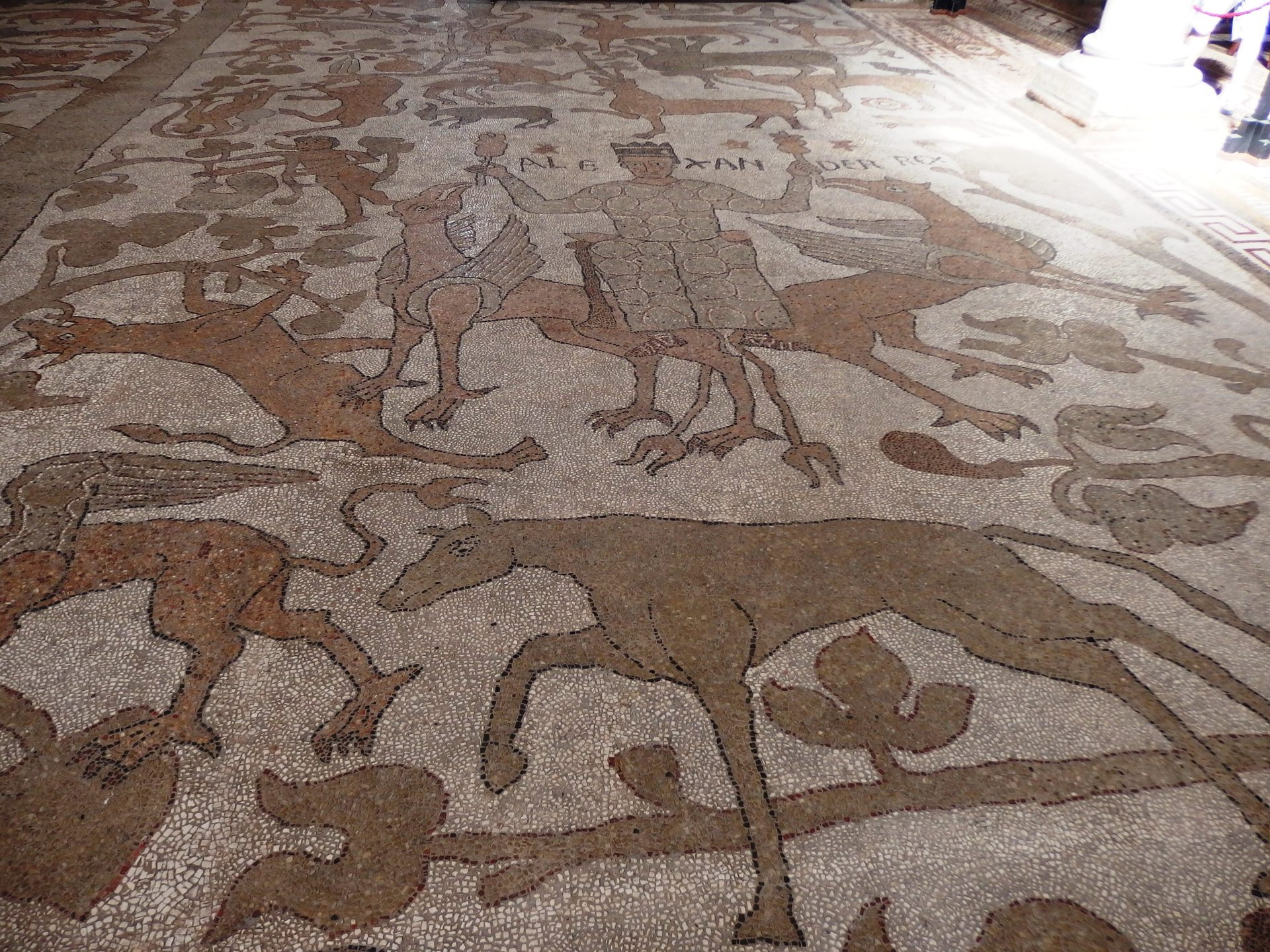
In one of the most widely reproduced legends of the entire Middle Ages, Alexander the Great captures two hungry griffins, harnesses them to a basket or cage, and dangles meat on spears just out of their reach — luring the starving beasts to fly him higher and higher into the sky, toward the sun, until a heavenly voice or angel rebukes his ambition and sends him back down to earth. The scene is carved in full, and clearly labeled "ALEXANDER REX," into the 12th-century mosaic floor of Otranto Cathedral in southern Italy, and into an 11th-century Byzantine relief on the north facade of St. Mark's Basilica in Venice — two of hundreds of surviving manuscripts, mosaics, church carvings, and tapestries across five centuries that illustrate it. The story is entirely real as a piece of literature and art history; the flight it describes never happened. It belongs to the Alexander Romance, the vast, self-consciously fictional storytelling tradition that grew up around Alexander's name beginning in the Hellenistic period and expanded for more than a millennium afterward — a tradition that also gave Alexander a submarine descent in a glass barrel, a journey to the land of talking trees, and an audience with Amazons, none of which appear in any of the surviving historians who actually accompanied or interviewed people who knew him. This file documents the griffin-flight legend's genuine textual history, its real and striking artistic afterlife, its equally genuine circulation in modern ancient-astronaut and "historical UFO sightings" literature as a candidate folk-memory of ancient flight — and the reason every classical historian who actually wrote about Alexander's life, from his own contemporaries onward, records nothing of the kind.
Theoretical Alignment
This file sits closer to this archive's cleanly resolved literary-legend files — Alexander's own "Flying Shields" myth and, in a different register, the Vedic Vimanas — than to its genuinely contested historiographical debates like the Aztec Eight Omens. Unlike the flying-shields claim, which has no ancient or medieval source of any kind and was invented wholesale by a 20th-century paranormal writer, the griffin-basket ascent is a completely real, richly attested piece of medieval literature and art with a traceable textual history stretching back to late antiquity. What it is not, on the assessment of every specialist in Alexander Romance studies this file cites below, is a record of anything that happened: it is presented within its own source texts as a marvel and a moral lesson about the limits of ambition, structurally identical to comparable "flying king" legends attached to other rulers who never claimed to have flown either. This file documents that legend in full — its real origins, its real depictions, its real circulation in modern ancient-astronaut media — while being explicit throughout about the difference between "this legend is real and worth taking seriously as literature" and "this legend describes a real event."
Sensor & Instrumentation Detection Profile
As with every entry in this site's Ancient Records series, there is no modern sensor record to evaluate; the entire evidentiary record is textual and art-historical. The relevant "instrumentation" here is manuscript philology: tracing which recensions of the sprawling, multiply-rewritten Alexander Romance contain the griffin episode, in what form, and how early. The Greek text attributed to "Pseudo-Callisthenes" (an anonymous author whose work was long wrongly credited to Alexander's real court historian Callisthenes of Olynthus) survives in several distinct recensions that scholars label with Greek letters: the oldest reconstructable Greek version, recension α (alpha), is generally dated to around the 3rd century CE, itself likely compiling earlier Hellenistic material; an Armenian translation follows in the 5th century and a Syriac translation in the 7th. Classicist Ioannis M. Konstantakos, in the most detailed recent philological study of this specific episode, traces the griffin-flight narrative itself to the Byzantine recensions λ (lambda) and γ (gamma) and to the manuscript known as codex L, while noting it is already independently alluded to by a named 4th-century rabbinic authority, Rabbi Jonah of Tiberias — strong internal evidence that some version of the story was circulating in the Eastern Mediterranean well before its fullest surviving literary elaborations. A later recension, ε (epsilon), is linked by manuscript scholars to source material datable to around 640 CE, showing the story continuing to be reworked and re-embellished for centuries after its first attestation. During the Byzantine millennium the Romance underwent, by standard reckoning, seven successive major rewritings (recensions β, λ, ε, and γ, plus a verse "Poem of the Marcianus" manuscript, recension ζ, and the vernacular "Rimada"), several with their own sub-recensions, as scribes and poets continuously expanded, trimmed, and re-embellished the base narrative — the ordinary, well-documented process of medieval textual transmission, not evidence of a suppressed original eyewitness account.
This file's own review of the available secondary philological literature (Konstantakos 2020; Richard Stoneman's introduction to his 1991 Penguin translation; the essays collected in Z. David Zuwiyya's 2011 Companion to Alexander Literature in the Middle Ages) confirms a consistent scholarly reconstruction: Alexander captures two griffins (in some tellings, large birds of prey or vultures generally), starves them for several days, harnesses them to a basket, throne, or cage, and holds meat aloft on spears or a yoke just beyond their reach. The starving birds beat their wings trying to reach the bait and carry Alexander steadily upward — in some versions high enough that the earth below appears as a small disc ringed by the ocean, coiled like a serpent — until a voice from heaven, or a winged, man-faced creature in some retellings, halts his ascent and orders him back to earth, chastising him for seeking knowledge of the heavens before he has mastered the concerns of the earth below him. No version of the story specifies a real date, army, or geographic location for the episode; it exists purely as a self-contained marvel-tale within the larger Romance narrative.
Environmental & Geospatial Context
The griffin-ascent legend's real "environment" is geographic and cultural rather than a single physical site: it is one of the most widely dispersed literary motifs to survive from the ancient and medieval Mediterranean and Near Eastern world. Z. David Zuwiyya's 2011 Brill volume alone gathers fourteen scholarly chapters tracing Alexander-legend material across Greek and Latin recensions, then onward into Syriac, Persian, Coptic, Arabic, Ethiopic, and Hebrew versions, and further still into Armenian, Byzantine Greek, and the major medieval European vernaculars (French, German, Spanish, Italian, English) — a genuinely cross-cultural transmission history matched by very few other pieces of ancient literature. Within that transmission, the griffin-flight episode became, according to art historians who have surveyed its iconography, "by far the most famous of all the marvellous adventures told in the Alexander Romance" as a subject for medieval visual art specifically, appearing across illuminated manuscripts, cathedral floor and wall mosaics, church relief carvings, ivory caskets, embroidered textiles, and decorative tiles from roughly the 11th through the 16th centuries.
Two real, physically surviving, and independently verifiable examples anchor this file's own research. The earlier is a Byzantine relief on the north facade of St. Mark's Basilica in Venice, dated by art historians to the 11th century and believed to have been carved in Constantinople before being incorporated into the basilica's exterior decoration — showing Alexander seated in a chariot-like vessel between two griffins. The later and far better documented is the enormous floor mosaic of Otranto Cathedral (Cattedrale di Santa Maria Annunziata) on Italy's Adriatic coast, completed 1163–65 under Archbishop Gionata (Jonathas) and signed by the priest Pantaleone, its creator. The Otranto mosaic is one of the largest and best-preserved medieval figural floor mosaics anywhere in Europe, organized around a great Tree of Life motif that branches out to connect several hundred individual figures and scenes drawn from the Bible, classical mythology, medieval bestiary tradition, and Arthurian legend; within this vast composition, a discrete panel labeled in Latin "ALEXANDER REX" ("King Alexander") shows Alexander seated between his two winged griffins exactly as the Romance describes, and is among the mosaic's most frequently reproduced and photographed individual panels. Beyond these two surveyable examples, this file's research corroborates (without being able to independently verify site-by-site) that the motif recurs across numerous further illuminated Alexander Romance manuscripts in major European collections and additional church sculpture, consistent with art historians' characterization of it as one of medieval Europe's single most frequently illustrated secular narrative subjects.
Observer Credibility & Occupational Profile
There is no eyewitness to evaluate in this file, because no version of this legend, ancient or medieval, ever presents itself as eyewitness testimony. The Greek text's traditional attribution to "Callisthenes" is itself a documented ancient mistake: the real Callisthenes of Olynthus was Alexander's actual court historian, a nephew of Aristotle who accompanied the campaign and wrote a now partially-lost contemporary history called the Deeds of Alexander — but he fell out with Alexander over the introduction of Persian court ceremonial and was executed in 327 BCE, six years before Alexander's own death, on suspicion of involvement in the "Pages' Conspiracy." The anonymous author of the actual Romance, writing at the earliest in the Hellenistic or early Roman period and drawing on Callisthenes' real reputation as "the historian who was there," borrowed his name to lend the resulting fiction unearned documentary authority — a genuine ancient case of what modern scholars would recognize as a pseudepigraphic (falsely attributed) text, hence the standard modern designation "Pseudo-Callisthenes."
Set against this anonymous, self-consciously fictionalizing source stand the four historians whose surviving works are the actual primary sources for Alexander's real campaigns: Arrian of Nicomedia (2nd century CE Roman senator and consul, whose Anabasis of Alexander explicitly draws on the now-lost eyewitness memoirs of Alexander's own general Ptolemy, later Ptolemy I of Egypt, and the engineer Aristobulus), Plutarch (c. 100 CE biographer, whose Life of Alexander draws on a wide range of earlier anecdotal material, discussed at length in this archive's companion file on Plutarch's Battle of Lucullus), Diodorus Siculus (1st century BCE universal historian, generally thought to depend heavily on the contemporary court historian Cleitarchus), and Quintus Curtius Rufus (probably 1st century CE, drawing on a range of now-lost Hellenistic sources). None of the four — the same four historians whose detailed, mutually corroborating accounts of the real Siege of Tyre are documented in full in this archive's companion file on Alexander's "Flying Shields" myth — records anything resembling a griffin flight, a basket ascent, or any comparable aerial episode anywhere in Alexander's real career. This is not a marginal or ambiguous absence: these are the same historians who were, on other occasions, entirely willing to record dreams, omens, oracular pronouncements, and other supernatural-adjacent material when their sources actually supplied it (Plutarch's account of Alexander's dream about a satyr before the fall of Tyre, discussed in the companion file, is a direct example). Their collective silence on a basket flight to the edge of heaven is a real, specific, and — for a figure this thoroughly documented — historically decisive absence.
Historical Precedents & Archive Matches
This file sits alongside a specific cluster of related entries already published in this archive. Most directly, it is a deliberately separate case from Alexander's "Flying Shields" myth already documented on this site: that file traces an entirely different, entirely modern (1959–1966) fabrication about triangular "shields" attacking Alexander's army at the Siege of Tyre, a claim with no ancient or medieval source whatsoever. The griffin-basket ascent, by contrast, is a genuine medieval legend with a real, centuries-deep manuscript and artistic record — the two are routinely and carelessly conflated in casual online "ancient UFO" listicles, and this file exists in part to keep that distinction clear. This file's own subject also belongs to a much older, cross-cultural pattern of "flying king" legends that this archive's Vedic Vimanas file and Ezekiel's Wheel file both touch from different angles — stories of rulers or prophets elevated bodily into the sky, evaluated on this site's consistent standard of taking the primary text seriously as a real historical document while distinguishing that from any claim about a real physical event.
The most directly relevant scholarly precedent is Konstantakos's 2020 study itself, which situates Alexander's flight within a specific, older "kingly flight" story-pattern also attached to two other named rulers: the Persian epic king Kai Kāvūs, whose own flying throne appears in Ferdowsi's 11th-century Persian epic the Shahnameh (a throne lifted by four starving eagles baited with meat on poles, which collapses when the birds tire, dropping the king back to earth in a considerably harsher ending than Alexander's own safe descent), and the Mesopotamian king Nimrod, traditionally associated in later Jewish and Islamic legend with the Tower of Babel and, in some tellings, his own attempt to reach or challenge heaven. Konstantakos traces this pattern's ultimate roots to still older Mesopotamian and Near Eastern "heroic flight" narratives, of which the oldest known example in the region is the Sumerian myth of Etana, primeval king of Kish, who is carried skyward on an eagle's back to petition the goddess Ishtar for a plant that will let him father an heir — a real, independently attested cuneiform tradition many centuries older than Alexander himself. This comparative pattern is itself strong internal evidence for how the griffin-ascent legend actually functions: not as a garbled memory of one specific historical event, but as a recurring literary type-scene, freely reattached across cultures and centuries to whichever powerful ruler a given storytelling tradition wanted to caution against overreaching pride.
Historical Background
The Historical Alexander and the Literary Alexander
Alexander III of Macedon (356–323 BCE) is among the most thoroughly documented figures of classical antiquity in one specific sense and among the most heavily mythologized in another. His real military campaigns — the conquest of the Persian Empire, the sieges of Tyre and Gaza, the invasion of Egypt and founding of Alexandria, the pursuit of Darius III into Central Asia, and the eastern campaigns into Bactria, Sogdiana, and India — are recorded in unusual depth by the four surviving historians named above, all writing generations to centuries after Alexander's death but drawing, to varying and much-debated degrees, on genuinely contemporary material, including the lost eyewitness memoirs of his own general Ptolemy. Almost immediately after his death in Babylon in 323 BCE, however, a second and entirely different Alexander began to take shape in popular storytelling — not the historical conqueror of the Perseus Digital Library's critical texts, but a folkloric hero-king whose adventures multiplied freely across the diverse cultures of the Hellenistic and later medieval world, gaining fantastical episodes with no basis in the documented campaign at all: a quest for the Water of Life, an audience with talking oracular trees, a descent to the ocean floor inside a glass barrel or diving bell to observe sea creatures, an army of Amazons, and — the subject of this file — a flight to the edge of heaven on the backs of griffins.
Pseudo-Callisthenes and the Birth of the Alexander Romance
The text scholars call the Alexander Romance (sometimes cited by its traditional but incorrect attribution, "Pseudo-Callisthenes") is now generally regarded as antiquity's most successful and most widely translated work of prose fiction. Its earliest reconstructable Greek form, recension α, is conventionally dated to around the 3rd century CE, though the underlying material — much of it likely compiled from earlier, independently circulating Alexander-legend fragments, letters, and local traditions from Hellenistic Egypt — is generally thought by scholars including Konstantakos to have been assembled sometime between the late Hellenistic period and the early Roman Imperial age, several centuries after Alexander's actual life. Unlike the real historians', the Romance's anonymous author (or successive authors and redactors) never claims strict factual accuracy; ancient and medieval readers appear to have understood and enjoyed it as a heroic adventure narrative built around a real historical name, in the same broad genre as the Greek prose romances collected in modern editions like B. P. Reardon's Collected Ancient Greek Novels. The work's own internal narrative interests — travel to fantastical lands, encounters with monstrous or hybrid creatures, tests of a hero's wisdom and restraint — place it squarely within the broader ancient novel tradition rather than within historiography as ancient or modern readers would define that term.
The Byzantine Recensions and the Griffin Episode's Elaboration
The Romance did not remain static after its earliest Greek form. Byzantine scribes and redactors reworked it repeatedly across roughly a thousand years of continuous manuscript transmission, producing the sequence of major recensions — β, λ, ε, γ, and several further sub-traditions — that modern classicists use to track the text's evolution. Konstantakos's philological analysis places the griffin-ascent episode's fullest surviving narrative elaboration specifically in recensions λ and γ and in the important manuscript witness known as codex L, while noting that the core idea — Alexander borne aloft by trained or baited birds — is independently and much more briefly alluded to far earlier, in the 4th-century-CE reference attributed to Rabbi Jonah of Tiberias. The later ε recension, linked by manuscript scholars to source material datable to around 640 CE, shows the story continuing to accrue detail well into the early medieval period, including the elaborated "gate of paradise" framing found in some later versions. This layered, centuries-long process of reworking is entirely typical of how popular legendary material was transmitted in the pre-print era, and stands in sharp, documented contrast to the tightly cross-checked, source-cited manuscript tradition of the real historians (Arrian, Plutarch, Diodorus, Curtius), whose accounts of Alexander's actual campaigns show nothing comparable.
The Legend's Journey: Byzantium, the Latin West, and Rabbinic Literature
From its Byzantine Greek elaboration, the griffin-flight story spread along two broadly separate but occasionally intersecting paths. Westward, Julius Valerius's Latin translation/adaptation of the Greek Romance (probably early 4th century CE) and the later, highly influential medieval Latin Historia de Preliis ("History of the Battles," attributed to the 10th-century Archpriest Leo of Naples) carried Alexander's fantastical adventures, griffin flight included, into the literary mainstream of the Latin Christian West, feeding directly into the vernacular French, German, English, Italian, and Spanish Alexander romances that flourished from roughly the 12th through 15th centuries and, in turn, into the visual artistic tradition surveyed above. Independently, and by scholarly reckoning considerably earlier in its first attestation, a version of the same core ascent narrative entered rabbinic literature: the Jewish Encyclopedia's entry on Alexander the Great identifies a specific "Alexander's Ascent into the Air" tradition attributed to the Jerusalem Talmud (tractate Avodah Zarah 3:1, 42c) and to Numbers Rabbah 13, explicitly describing it as "a reminiscence of a narrative in Pseudo-Callisthenes" — scholarly language for an independent, parallel line of transmission drawing on the same underlying Greek storytelling tradition rather than a coincidental invention. This rabbinic ascent tradition is textually distinct from a separate, better-known Talmudic Alexander legend, "Alexander at the Gate of Paradise" (Babylonian Talmud, tractate Tamid 32b), in which Alexander journeys on foot to the entrance of Paradise and is given a symbolic gift (a human eyeball that, weighed against gold, proves that only more dust can outweigh human greed) — a genuinely different episode built around a comparable moral of restrained ambition, which this file is careful not to conflate with the griffin-flight narrative proper.
Complete Timeline
| Date | Event |
|---|---|
| 356 BCE | Alexander III of Macedon born in Pella. |
| 334–323 BCE | Alexander's real, extensively documented military campaigns against the Persian Empire and into Central Asia and India — the historical record against which this legend is evaluated. |
| 327 BCE | Callisthenes of Olynthus, Alexander's real court historian, is executed after the "Pages' Conspiracy"; his name is later, wrongly, attached to the fictional Romance as "Pseudo-Callisthenes." |
| 323 BCE | Alexander dies in Babylon. Arrian, Plutarch, Diodorus, and Curtius later compose the surviving historical accounts of his campaigns — none records a griffin flight or any comparable aerial episode. |
| Late Hellenistic–early Imperial period | Underlying legendary material that will feed the Alexander Romance begins circulating, per Konstantakos's (2020) philological reconstruction. |
| c. 3rd century CE | Earliest reconstructable Greek recension (α) of the Alexander Romance compiled. |
| Early 4th century CE (probable) | Julius Valerius's Latin adaptation of the Greek Romance begins the text's transmission into the Latin West. |
| 4th century CE | Rabbi Jonah of Tiberias alludes to Alexander's aerial ascent, per Konstantakos — the earliest identified textual trace of the griffin/bird-flight motif attached to Alexander specifically. |
| 5th century CE | Armenian translation of the Alexander Romance produced (the basis of Albert Mugrdich Wolohojian's standard 1969 English translation). |
| 7th century CE | Syriac translation of the Alexander Romance produced. |
| 11th century CE | Byzantine relief depicting Alexander's griffin-borne flight carved (probably in Constantinople), later incorporated into the north facade of St. Mark's Basilica, Venice. |
| c. 640 CE (source material) | Manuscript scholars link the later ε recension's material to this period, showing continued elaboration of the story into the early medieval era. |
| 10th century CE | Archpriest Leo of Naples's Latin Historia de Preliis, based on the Greek Romance, becomes a major conduit for the legend's spread across the medieval Latin West. |
| 1163–1165 CE | The Otranto Cathedral mosaic floor completed under Archbishop Gionata (Jonathas), signed by its creator, the priest Pantaleone — including the "ALEXANDER REX" griffin-flight panel this file's hero image documents. |
| c. 1010 CE | Ferdowsi completes the Shahnameh, including the structurally parallel "Flying Throne of Kai Kāvūs" episode later identified by scholars as part of the same "kingly flight" story-pattern. |
| 12th–15th centuries CE | Vernacular Alexander romances (French, German, English, Italian, Spanish) proliferate across medieval Europe, and the griffin-flight scene becomes, per art-historical surveys, one of the most frequently illustrated secular subjects in medieval manuscript and church art. |
| c. 1420 | "The True History of the Good King Alexander" manuscript tradition, among the many later medieval vernacular retellings that continued to illustrate the griffin flight. |
| 1969 | Albert Mugrdich Wolohojian publishes the standard modern English translation of the Armenian Alexander Romance (Columbia University Press). |
| 1991 | Richard Stoneman publishes The Greek Alexander Romance (Penguin Classics), the standard modern English translation and the most widely used entry point to the text for English-language readers. |
| 2010 | Jacques Vallée and Chris Aubeck publish Wonders in the Sky, a major modern sourcebook for the "historical UFO sightings" genre within which this legend recurs in popular ancient-astronaut discussion. |
| 2011 | Z. David Zuwiyya publishes A Companion to Alexander Literature in the Middle Ages (Brill), the standard modern scholarly survey of the Romance's full cross-cultural transmission. |
| 2020 | Ioannis M. Konstantakos publishes "The Flying King," the most detailed recent philological study of this specific episode's origins and comparative "kingly flight" story-pattern, in Classica: Revista Brasileira de Estudos Clássicos. |
| 2010s–2020s | History Channel's Ancient Aliens franchise and adjacent ancient-astronaut web and video content repeatedly invoke Alexander's ancient "flight" legends (both this episode and the separately documented "flying shields" myth) as possible evidence of ancient aerial technology, prompting direct skeptical rebuttals including the "It's Probably Not Aliens" podcast episode addressed specifically to Alexander claims. |
The Primary Source Document
The Legend, As the Alexander Romance Tradition Actually Tells It
This file's own synthesis of the standard modern scholarly summaries — cross-checked against Stoneman's 1991 translation notes, Konstantakos's 2020 philological study, and the Jewish Encyclopedia's summary of the parallel rabbinic version — renders the episode's core narrative content as follows, drawn from across the Byzantine λ/γ recensions and later medieval retellings that elaborate it in the fullest detail: Alexander, having conquered vast stretches of the known world, is seized by a desire to see the earth from above and to look upon the heavens themselves. He orders his men to capture two large griffins (in earlier or parallel versions, simply large birds of prey or vultures) and has them starved for several days. He then constructs a basket, cage, or throne-like seat, harnesses the starving griffins to it by a yoke, and takes his seat, holding out on the ends of two long spears or a pole pieces of raw meat, positioned just above and beyond the birds' reach. Desperate to reach the bait, the griffins beat their wings and strain upward, carrying Alexander and his makeshift craft higher and higher into the sky — in the more elaborate retellings, high enough that the inhabited world below shrinks to the size of a small disc or threshing-floor, ringed by the ocean coiled like a great serpent or dragon. As Alexander approaches the outer reaches of the sky, a divine voice, or in some versions a winged, human-faced creature encountered at "the gate of paradise," halts him: he is rebuked for seeking to know the things of heaven before he has understood the things of earth, or for a presumption unbecoming even to the world's greatest conqueror, and is ordered to turn back. Alexander lowers the bait, the exhausted griffins descend, and he returns safely to his army and his court — chastened, in the story's own clear moral terms, rather than triumphant.
A Consistent Moral Structure, Not a Flight Log
Every scholarly treatment this file consulted is consistent on one central point: the episode's narrative function within the Romance is unambiguous and is stated as such within the text's own frame, not read into it by modern skeptics. It is what later literary scholars would call an exemplum superbiae — a moral illustration of pride and its proper limits — deployed against a figure whose real historical reputation for boundless ambition (memorialized independently in Plutarch's account of Alexander weeping that he had "not yet" conquered all the worlds Anaxarchus described) made him an obvious and durable vehicle for exactly this kind of cautionary story. This reading is reinforced directly by the episode's place within the wider Romance, which pairs the griffin-borne ascent to the sky with a companion episode — Alexander's descent to the ocean floor inside a glass barrel or diving bell — forming a matched pair of "highest heaven / deepest sea" hubris-adventures that appear together in numerous manuscript illustration programs and that art historians and literary scholars read as a single deliberate thematic unit about the limits of human (even superhuman) ambition in both directions.
Confirmed Institutional & Academic Holdings
The peer-reviewed philological study this file relies on most directly for the episode's manuscript recension history, earliest attestation, and comparative "kingly flight" story-pattern.
PEER-REVIEWED ACADEMIC RECORDIndependently licensed photographic documentation of the real 1163–65 Otranto Cathedral mosaic panel, including this file's own hero image.
OPEN-LICENSE PHOTOGRAPHIC ARCHIVEThe standard scholarly English translation of the 5th-century Armenian recension, freely accessible in full, documenting the wider Romance tradition this episode belongs to.
ACADEMIC TRANSLATION, OPEN ACCESSSearch Institutional & Academic Archives Directly
Evidence Assessment
Supporting the Legend's Genuine Antiquity and Cultural Significance
- A real, textually traceable attestation exists from at least the 4th century CE (Rabbi Jonah of Tiberias, per Konstantakos 2020), well within late antiquity and centuries before its fullest medieval literary elaboration
- Two independent, physically surviving period artworks — the 11th-century St. Mark's Basilica relief and the 1163–65 Otranto Cathedral mosaic — independently confirm the legend's real circulation and cultural importance in the medieval Mediterranean world
- The legend appears independently in both the Greek/Latin Christian Romance tradition and in rabbinic Jewish literature (Jerusalem Talmud, Numbers Rabbah), evidence of genuinely wide and multi-cultural transmission rather than a single narrow literary channel
- Peer-reviewed classical philology (Konstantakos 2020) treats the episode as a serious, worthwhile object of comparative literary-historical study
Undermining Any Claim That This Describes a Real Flight Event
- None of the four surviving primary historians of Alexander's real campaigns — Arrian, Plutarch, Diodorus, Curtius — mentions this episode, despite otherwise detailed, willing-to-be-strange accounts of Alexander's actual life
- The episode's own attribution to "Callisthenes" is a documented ancient misattribution; the real Callisthenes died in 327 BCE and left no such account, and the actual anonymous author wrote centuries later within a self-consciously fictional genre
- The episode is structurally identical to comparable "flying king" legends independently attached to the unrelated rulers Kai Kāvū and Nimrod, and to the far older Sumerian Etana myth — a recurring literary type-scene, not a one-off eyewitness report
- Every scholarly source this file consulted reads the episode's function as a deliberate hubris/ambition morality fable, explicit within the text's own narrative frame, not a claim to historical fact
Comparative Analysis
A Different Kind of "Ancient UFO" File
This file occupies a specific, clearly defined position within this archive relative to its two closest neighbors. Against Alexander's "Flying Shields" myth, already published on this site, this file's subject is real medieval literature with a genuine, centuries-deep manuscript and art-historical record, where the flying-shields claim has no ancient or medieval source of any kind and is a fully traceable 20th-century fabrication — the two should never be treated as the same claim or cited interchangeably, a conflation this file's research found repeatedly in casual online "ancient astronaut" content. Against the Aztec Eight Omens, this file's subject involves a genuinely easier evidentiary question: where the Eight Omens rest on a real, contested historiographical debate among credentialed Mesoamericanist historians about whether a genuine indigenous account was later reworked, the griffin-ascent legend's own author never claimed to be recording history at all, and no credentialed classicist or Alexander Romance specialist argues otherwise.
The "Kingly Flight" Pattern
Konstantakos's comparative analysis is the single most useful tool for understanding why this legend takes the exact shape it does. Kai Kāvū's flying throne in the Shahnameh uses the identical starve-and-bait mechanism (four eagles, meat on poles) and ends far more punitively, with the throne collapsing and the king crashing back to earth — explicitly framed within Ferdowsi's poem as divine punishment for a specific act of prideful overreach urged on Kai Kāvū by a tempting div (demon). Nimrod's association with the Tower of Babel carries the same "reaching toward heaven ends in humbling" structure in an even older biblical and post-biblical frame. That the same narrative skeleton recurs, independently, attached to at least three unrelated historical or legendary rulers across Greek, Persian, and Hebrew/Mesopotamian storytelling traditions is close to decisive evidence that the pattern is a portable literary device for dramatizing hubris, not a distorted transmission of one specific historical flight.
Material Analysis: The Manuscripts and the Monuments
Because this file's evidentiary record is textual and art-historical rather than physical in the sense of a recoverable artifact, its "material analysis" concerns the manuscript and monument record directly. The Otranto Cathedral mosaic is the single strongest piece of physical evidence for the legend's real medieval cultural weight: a permanent, monumental, dated (1163–65), signed (by the priest Pantaleone, under Archbishop Gionata) work of public religious art, still in situ and open to visitors today, that devotes one of its several hundred individual Tree of Life panels specifically to this legend and labels its subject unambiguously "ALEXANDER REX." A church commissioning and installing a permanent floor mosaic of this scene, alongside biblical and classical subjects, is strong direct evidence of how thoroughly the legend had entered mainstream medieval visual and moral culture by the mid-12th century — entirely independent of, and centuries after, its own earliest literary attestation.
The St. Mark's Basilica relief adds an important, earlier data point: an 11th-century Byzantine carving, made in or near Constantinople and later incorporated into one of medieval Christendom's most prominent churches, shows the same core iconography — Alexander seated between two griffins — predating the Otranto mosaic by roughly a century and confirming the motif's currency in the Greek East before its fullest elaboration in the West. Taken together with the textual manuscript record (the Armenian, Syriac, Greek Byzantine, and Latin recensions surveyed above), the material record establishes a legend that was genuinely, continuously, and visibly part of medieval religious and courtly culture across a remarkably wide geographic and linguistic range — a real and interesting historical fact in its own right, and one this file treats as worth documenting seriously, entirely apart from the separate question of whether it describes anything that actually happened in Alexander's own lifetime.
Consistent With a Genuine, Real Medieval Literary and Artistic Tradition
- The Otranto mosaic and St. Mark's Basilica relief are both real, dated, physically surviving, and independently verifiable artworks, not later fabrications or misattributions
- The legend's manuscript transmission across Greek, Armenian, Syriac, Latin, and vernacular European recensions, plus its independent appearance in rabbinic literature, is thoroughly documented by peer-reviewed classical and Jewish studies scholarship
- The legend's cultural prominence (among the most frequently illustrated secular subjects in medieval art, per art-historical surveys) is itself a genuine, well-attested historical phenomenon worth taking seriously
Undermining Any Claim of a Real Underlying Flight Event
- No manuscript tradition, however elaborated, ever claims contemporaneous eyewitness status; every version is explicitly a later literary composition, centuries removed from Alexander's actual life
- The legend's own attributed author ("Callisthenes") is a documented ancient case of false attribution, undermining any claim to eyewitness authority at the source
- No trace of the episode appears in Alexander's own real, independently attested administrative and campaign record as reconstructed by modern historians from inscriptions, coinage, and the real historians' accounts
The Paleocontact / Ancient-UFO Interpretation
The claim this file exists to evaluate is specific: that Alexander's griffin-basket ascent represents a genuine, garbled folk-memory of an actual ancient flight technology or aerial encounter, cited as such within real ancient-astronaut and ufological literature rather than merely resembling one in retrospect. That citation history is real. The legend recurs across decades of ancient-astronaut web content and video discussion grouping it with other pre-modern "flight" narratives — the Vedic Vimanas already documented on this site, Ezekiel's Wheel, Kai Kāvū's flying throne, and Etana's eagle-flight — as part of a broader claimed pattern of ancient peoples encountering or dimly remembering advanced aerial technology. Per this site's standing editorial policy, History Channel's Ancient Aliens franchise, which has repeatedly discussed Alexander's various "flight" and aerial-phenomenon legends across its run, is treated here strictly as a documented cultural-impact fact where directly relevant, never as a citable source of evidence for any claim in this file. The genuinely notable counter-signal is that this specific citation pattern has itself provoked direct skeptical pushback from within ufology-adjacent media: the podcast It's Probably Not Aliens, featuring researcher Dael Kingsmill, devoted a full episode specifically titled around Ancient Aliens's repeated fabrications and misreadings of Alexander material, and multiple independent skeptical writers (Michael S. Heiser, the classics blog Tales of Times Forgotten, Openminds.tv) have published detailed rebuttals distinguishing the real, documented literary legend from inflated or invented "ancient UFO" claims built on top of it.
What this citation history does not establish, and does not claim to establish on its most careful presentations, is that any credentialed classicist, Alexander Romance specialist, or Byzantinist endorses a paleocontact or extraterrestrial reading of the griffin-flight episode. No scholar cited anywhere in this file's Sources section makes that argument; the citation runs entirely through a separate, parallel literature — ancient-astronaut writers and popular "historical flight" cataloguers — that treats the Romance's own genuine, real, well-documented existence as raw material for a chronology-of-anomalies project distinct from, and not in dialogue with, the classical philological scholarship this file's Historical Background and Material Analysis sections document in full.
The Mainstream Scholarly Interpretation
A Literary Legend, Not a Garbled Memory
The consistent scholarly reading — built on Konstantakos's (2020) comparative philology, Zuwiyya's (2011) survey of the Romance's cross-cultural transmission, and Stoneman's (1991) introduction to the standard English translation — treats the griffin-basket ascent as a deliberate literary composition serving a specific, well-understood narrative function within the wider Alexander Romance: dramatizing the limits of even the greatest conqueror's ambition, using a folkloric "kingly flight" story-pattern that long predates Alexander himself and that medieval audiences would have recognized as belonging to the same genre as his glass-barrel ocean descent, his encounters with talking oracular trees, and his journey to the edge of the world. No specialist reading treats the episode as a distorted transmission of a genuine historical event requiring an unusual or anomalous explanation; the explanation for why the story exists and takes the shape it does is fully and satisfyingly accounted for by ordinary, well-documented literary and folkloric processes.
Why the Real Historians' Silence Matters
The case for treating this as pure legend does not rest only on the episode's presence in a fictionalizing genre; it is reinforced by the same kind of direct comparative check this archive's companion file on Alexander's "Flying Shields" myth applies to a different claim. Arrian, Plutarch, Diodorus, and Curtius collectively represent one of the richest surviving bodies of connected historiography for any single ancient military campaign, and all four were willing, on other occasions, to record dreams, omens, and supernatural-adjacent episodes when their sources supplied them. Their total, unanimous silence on a public, spectacular, multi-day event — Alexander flying to the edge of heaven before an army that would presumably have witnessed it — is not an incidental gap in an otherwise thin record; it is a specific absence in an unusually rich and detailed one, exactly the pattern classical historians treat as strong evidence that a later-attested episode was never part of the real historical tradition at all.
Five Observables Assessment
The Five Observables framework, developed decades later by former AATIP director Luis Elizondo to classify modern UAP performance characteristics that exceed known technology, is included here for structural consistency with the rest of OverClassified's case files, but does not meaningfully apply to a medieval literary legend that explicitly attributes its subject's ascent to living, straining, meat-baited griffins rather than to any craft or unexplained propulsion system.
Assessment: As with this site's other pre-modern, text-based Ancient Records entries, the Five Observables framework is the wrong instrument here. Its inclusion should not be read as suggesting genuine exotic-performance or non-human-technology evidence exists for this case.
Conventional Explanation Candidates
Three candidates are assessed below.
Deliberate Literary Hubris-Morality Fable (Mainstream Scholarly Consensus)
Highly PlausibleDirectly supported by Konstantakos's (2020) comparative "kingly flight" analysis, Zuwiyya's (2011) survey of the Romance's transmission, and the episode's own explicit narrative framing (a heavenly rebuke of Alexander's ambition) within every surviving version. This is the position essentially all specialist Alexander Romance scholarship holds.
A Borrowed, Recurring Folkloric "Flying King" Type-Scene
Highly PlausibleStrongly supported by the episode's structural identity to the independently attested Kai Kāvū (Shahnameh) and Nimrod legends, and its likely ultimate roots in the far older Sumerian Etana myth — a portable narrative device reused across unrelated cultures and rulers, not a one-off transmitted memory of a single event.
Genuine Ancient Flight Technology or Encounter, Garbled Into Legend
UnprovenNo credentialed classicist, Byzantinist, or Alexander Romance specialist who has studied the primary sources endorses this reading; it exists entirely within a separate ancient-astronaut and "historical UFO sightings" literature not in dialogue with the philological evidence this file documents. Directly contradicted by the complete silence of every surviving primary historian of Alexander's actual, extensively documented life.
Why "Debunked"
This file receives a DEBUNKED classification — but, as this file has tried to make explicit throughout, the classification applies specifically to the claim that this legend describes a real historical flight event, not to the legend's own genuine existence as a piece of medieval literature and art, which this file treats as entirely real and worth serious documentation. This is the same distinction this archive's companion file on Alexander's "Flying Shields" myth draws, but the underlying evidentiary shape is different: that file found no ancient or medieval source of any kind for its claim, a pure modern invention with a fully traceable 20th-century paper trail. This file's subject, by contrast, is undeniably a real, richly attested, centuries-old literary and artistic tradition — the Otranto Cathedral mosaic and the St. Mark's Basilica relief are genuine period artworks depicting a genuine medieval story, and this file's own hero image documents that fact directly. What is equally clear, and equally well-documented by peer-reviewed philology, is that the story was never presented, by any author in its own long transmission history, as an eyewitness account or historical record: it entered circulation centuries after Alexander's death, under a false authorial attribution, within a genre whose own ancient and medieval readers understood it as heroic romance rather than history, following a folkloric pattern independently reused for at least two other, unrelated rulers, and it is unanimously absent from the accounts of the four historians whose surviving work constitutes the actual documented record of Alexander's real life.
On the narrower question this file was specifically tasked with evaluating — whether this legend is genuinely invoked in UFO/UAP and ancient-astronaut research as a possible historical flight account — this file finds a real, traceable, and honestly reportable citation history within that literature, including direct television treatment on History Channel's Ancient Aliens franchise and enough sustained popular circulation to have provoked its own dedicated skeptical rebuttals. That satisfies this site's threshold for genuine topical relevance to a UFO/UAP research archive. But, exactly as with the Eight Omens file's own governing distinction, "this account is genuinely, repeatedly invoked in ancient-astronaut literature" is not the same claim as "credentialed specialists who study the primary sources think something anomalous was actually observed" — and on this file's specific subject, unlike the Eight Omens' genuinely contested historiography, that second claim is not merely unsettled but directly and unanimously rejected by every relevant body of specialist scholarship this file consulted.
Related Entries
Further Reading — Recommended Literature
The Greek Alexander Romance
The standard modern English translation of the primary source this entire file is built on, including the griffin-flight episode itself.
Legends of Alexander the Great
A focused companion volume gathering and annotating the Romance's most famous marvel-episodes, including the ascent to heaven and the ocean descent.
A Companion to Alexander Literature in the Middle Ages
The standard modern scholarly survey of the Romance's full Greek, Latin, Syriac, Persian, Arabic, Ethiopic, Hebrew, and European transmission, central to this file's Historical Background section.
Alexander the Great
A major modern biography of the real, historical Alexander, useful as a direct contrast to the fictionalized Romance tradition this file documents.
Wonders in the Sky: Unexplained Aerial Objects from Antiquity to Modern Times
The standard modern reference catalog for the "historical UFO sightings" genre this file's Paleocontact/Ancient-UFO Interpretation section documents and evaluates.
DISCLOSURE: Some links above are affiliate links. If you purchase through them, OverClassified receives a small commission at no additional cost to you. This helps support independent research.
Essential Viewing

Sources
- Konstantakos, Ioannis M. "The Flying King: The Novelistic Alexander (Pseudo-Callisthenes 2.41) and the Traditions of the Ancient Orient." Classica: Revista Brasileira de Estudos Clássicos 33 (2020): 105–138. revista.classica.org.br
- Stoneman, Richard, trans. The Greek Alexander Romance. London: Penguin Classics, 1991.
- Stoneman, Richard. Legends of Alexander the Great. London: I.B. Tauris, rev. ed. 2012.
- Zuwiyya, Z. David, ed. A Companion to Alexander Literature in the Middle Ages. Leiden: Brill, 2011.
- Wolohojian, Albert Mugrdich, trans. The Romance of Alexander the Great by Pseudo-Callisthenes (Armenian version). New York: Columbia University Press, 1969. archive.org
- Fox, Robin Lane. Alexander the Great. London: Allen Lane, 1973 (Penguin ed.).
- Vallée, Jacques, and Chris Aubeck. Wonders in the Sky: Unexplained Aerial Objects from Antiquity to Modern Times. New York: Tarcher/Penguin, 2010.
- "Alexander the Great." Jewish Encyclopedia. jewishencyclopedia.com
- Wikimedia Commons. "Category: Otranto cathedral mosaic – Flight of Alexander." commons.wikimedia.org
- Wikimedia Commons. "Category: Flight of Alexander the Great." commons.wikimedia.org
- Wikimedia Commons. "File: Otranto, cathedral, mosaic 13.jpg." Photo: Palickap, CC BY-SA 4.0. commons.wikimedia.org
- Mosaico di Otranto (official site). "The Otranto Mosaic: A Jewel of Medieval Europe." mosaicodiotranto.com
- Perseus Digital Library. Arrian, Anabasis of Alexander. perseus.tufts.edu
- Perseus Digital Library, Greco-Roman Collection (Plutarch, Diodorus Siculus, Quintus Curtius Rufus). perseus.tufts.edu
- Attalus.org. "Alexander Romance ('Pseudo-Callisthenes')." attalus.org
- Public Domain Review. "Alexander in the Bathysphere." publicdomainreview.org
- British Library Medieval Manuscripts Blog. "Underwater Adventures." blogs.bl.uk
- The Metropolitan Museum of Art. "Kai Kavus Ascends to the Sky," Folio from a Shahnama of Shah Tahmasp. metmuseum.org
- Heiser, Michael S. "Alexander the Great and UFOs." drmsh.com
- "No, Alexander the Great Didn't See Flying Saucers." Tales of Times Forgotten. talesoftimesforgotten.com
- "Deconstructing the Alexander the Great UFO Story." Openminds.tv. openminds.tv
- Kingsmill, Dael, guest. "Ancient Aliens Really Need To Stop Making Things Up About Alexander (the Great)." It's Probably Not Aliens podcast. art19.com
- Pageau, Jonathan. "The Ascent of Alexander The Great." YouTube, youtube.com; transcript at thesymbolicworld.com
- "Alexander Romance." Wikipedia. en.wikipedia.org
- "Otranto Cathedral." Wikipedia. en.wikipedia.org
- "St Mark's Basilica." Wikipedia. en.wikipedia.org
- "Kay Kāvus." Wikipedia. en.wikipedia.org
See something inaccurate? Have additional information or sources?
Suggest an Edit →Last Updated: August 2026