
UFO Scotland
The Secret History of Scotland's UFO Phenomenon
Core Thesis
UFO Scotland: The Secret History of Scotland's UFO Phenomenon is Scottish paranormal researcher and author Ron Halliday's 1998 attempt to do something no one had yet done in book form: assemble a single, comprehensive survey of more than fifty years of UFO reports from across Scotland, from the Highlands to Orkney, built substantially on eyewitness testimony Halliday collected directly and much of which, per the book's own framing, had never been published before. Rather than centering on one famous case, the book moves across the country's best-known incidents — the 1979 Livingston forester's encounter, the Lossiemouth "alien" report, the A70 abduction claim, and the first years of the Bonnybridge/Falkirk Triangle wave — treating Scotland itself, rather than any single sighting, as the proper unit of investigation. This site's own research draws on the book for exactly that regional-survey value: both of the Scottish case files that cite it use Halliday not as the source of a single anecdote, but as one of the two most consistently engaged, decades-long chroniclers of Scotland's UFO record, the other being his frequent collaborator Malcolm Robinson.
About the Author
Ron Halliday built his reputation as, in his own conference biography's phrasing, Scotland's foremost investigator and writer on the paranormal, a career that ran in parallel with, rather than separate from, ordinary journalism: for several years he wrote the "X-Files" column for the Glasgow Evening Times, and he has appeared on national broadcast programming including BBC's Newsnight. He heads Scottish Earth Mysteries Research, a research group through which much of his fieldwork has been conducted, and has written across the full breadth of Scottish strange phenomena rather than UFOs alone, with later titles including Scotland's X-Files, Paranormal Scotland, Alien Spirits, Haunted Glasgow, The A-Z of the Scottish Paranormal, McX: Scottish X-Files, and Famous Scots and the Supernatural.
1998 was an unusually productive year for Halliday specifically on the UFO subject: this site's own Bonnybridge case file documents that he published two distinct book-length treatments that same year — this book and the more narrowly focused Beyond the Falkirk Triangle — making him, alongside Robinson, one of the two writers most closely associated with Scottish ufology's written record from the wave's earliest years onward. That partnership continued for close to three decades: in 2025, Halliday and Robinson co-published The Bonnybridge UFO Enigma (A Modern Day Mystery), a joint retrospective covering more than thirty years of the case they had each separately chronicled since the early 1990s.
Some secondhand bookseller listings for this title carry inconsistent ISBN records — a handful of marketplace catalogues attach this book's title to the ISBN properly belonging to Beyond the Falkirk Triangle (1873631839), evidently a data-entry conflation rather than a real bibliographic fact. This site's own case-file research independently confirms the two are genuinely separate books, published the same year by the same Edinburgh press but with different scope: this book a nationwide survey, Beyond the Falkirk Triangle a dedicated treatment of one specific regional wave. The edition cited here carries its own distinct ISBN, 978-1-84502-928-9, per Google Books' own cataloguing.
Historical Context & Origins
B&W Publishing (the imprint that became Black & White Publishing) released UFO Scotland in 1998, a decade in which Scotland's UFO reporting had a genuinely active, still-unfolding regional story to draw on: the Bonnybridge/Falkirk Triangle wave, which this site's own case file dates to James Walker's originating January 1992 sighting, was by 1998 already six years into Billy Buchanan's ongoing public log of resident reports, and had drawn international tabloid attention three years earlier via the U.S. National Enquirer's June 1995 front-page "Town in Panic Over 2,000 UFO Sightings" headline. Halliday's book arrived, in other words, not as a retrospective on a settled historical matter but as a first attempt to place a live, still-developing regional wave into the context of Scotland's much longer UFO history stretching back decades earlier.
That longer history included, most prominently, the 1979 Livingston case — forester Robert Taylor's encounter at Dechmont Law, which this site's own case file documents as one of the only UFO reports in the world ever to become the subject of an active police criminal investigation, on the strength of torn clothing and physical injuries a doctor and forensic examiners independently documented. By 1998, the case was already approaching two decades old and had generated its own dedicated technical literature, including BUFORA's 1982 monograph Encounter at Livingston and a chapter-length skeptical rebuttal in Steuart Campbell's 1994 book The UFO Mystery Solved, giving Halliday an unusually well-documented case to synthesize rather than one he had to establish from scratch.
This site's own research finds the book's publication timing gave it a specific, useful vantage point: close enough to Livingston's original 1979 investigation to draw on witnesses and investigators still available and willing to speak, yet also positioned to document the Bonnybridge wave's crucial early years directly, rather than reconstructing them later from secondary press accounts the way subsequent decades of tabloid coverage increasingly had to.
Core Arguments & Key Concepts
The book's organizing premise is that Scotland's UFO phenomenon deserves treatment as a coherent regional subject in its own right, rather than as a scattering of isolated incidents folded into broader British or international UFO literature. Halliday builds this case less through a single unifying theory of what UFOs are and more through breadth and testimony: the book's stated method, per its own framing, rests on "remarkable eyewitness accounts, many of which have never been published before," gathered directly by Halliday rather than compiled secondhand from press clippings.
A second, more specific argument runs through the book's treatment of the Livingston case directly: this site's own case file documents that Halliday, alongside Malcolm Robinson, has argued that no fully satisfying explanation has yet reconciled Steuart Campbell's psychogenic-seizure-and-Venus-mirage theory with the physical marks Detective Constable Ian Wark independently documented in the clearing — roughly thirty to forty holes and two ladder-like rows of ground impressions, found using only Robert Taylor's own directions, hours before any detailed medical or astronomical counter-theory existed to shape what an investigator might expect to see. This is a genuinely narrow, falsifiable-sounding claim rather than a broad assertion of alien visitation: Halliday's position, as this site's own research represents it, is specifically that the ground evidence remains unexplained by the leading skeptical account, not that the case proves extraterrestrial contact.
A third theme, most visible in the book's early coverage of the still-unfolding Bonnybridge wave, is Halliday's consistent methodological caution about statistical and testimonial claims that circulate faster than they can be verified. This site's own case file notes that Halliday's fellow chronicler Robinson was similarly careful in the same period to stress that "UFO" strictly means an unidentified object, "not... alien ships" — a definitional discipline Halliday's own decades of published work on the wave, from this 1998 volume through the 2025 joint retrospective, has generally maintained, treating unexplained sightings as unexplained rather than pre-resolved in favor of any single interpretation.
Taken together, the book functions less as an argument for a specific explanation of Scottish UFO reports and more as a case for taking regional, sustained, testimony-based fieldwork seriously as its own category of evidence — a methodological stance that shaped Halliday's subsequent three-decade career chronicling the same cases as they continued to develop long after this book's original 1998 publication.
Key Cases & Evidence Discussed
The Livingston UFO Encounter (November 9, 1979, approximately 10:00 AM) at Dechmont Law, Deans Forest, Livingston, West Lothian, receives extended treatment as one of the book's anchor cases. Forester Robert Taylor, working for the Livingston Development Corporation, encountered a large, dark, rough-textured spherical object with a raised rim and small mast-like projections hovering above a forest clearing; two smaller spiked spheres detached from beneath it and, by Taylor's account, seized his trouser legs and began dragging him toward the larger craft before an overpowering smell caused him to lose consciousness. He was found roughly an hour later, disoriented, unable to speak clearly, with torn trousers and documented grazing on his chin and thigh. Because his injuries and damaged clothing were substantial enough to prompt Lothian and Borders Police to open a formal assault investigation, Scene-of-Crime Officer Detective Constable Ian Wark personally examined the clearing and documented thirty to forty small holes and two ladder-like rows of ground impressions that no known forestry equipment, aircraft, or contemporaneous construction activity could account for. This site's own case file records that Halliday, together with Robinson, has specifically argued that Steuart Campbell's later Venus-mirage-and-temporal-lobe-seizure theory — however medically detailed — never adequately explains those independently documented physical ground marks, a position this book helped establish in the broader literature well before Campbell's own fullest published rebuttal-target, The UFO Mystery Solved, appeared in 1994.
The Bonnybridge UFO Wave (originating January 1992, ongoing) centered on Bonnybridge and the surrounding "Falkirk Triangle" region of central Scotland, received early book-length documentation from Halliday at a formative moment in the case's history. This site's own case file identifies Halliday, alongside Robinson, as one of the wave's two most persistent chroniclers from its earliest years, publishing this book and the companion volume Beyond the Falkirk Triangle in the same year the case was only six years into councillor Billy Buchanan's ongoing log of resident sighting reports and three years past the international attention generated by the National Enquirer's 1995 front-page headline. Writing this close to the wave's origin gave Halliday's early coverage a documentary value later retellings, compressed and dramatized across decades of subsequent tabloid and television treatment, generally lack — a distinction this site's own case file draws explicitly in cautioning that most later television coverage of Bonnybridge repackages the same underlying testimony Buchanan, Robinson, and Halliday had already compiled through direct, on-the-ground work, rather than contributing new evidence of its own.
Critical Reception & Controversies
On Goodreads, the book carries a modest 3.58-out-of-5 average from 12 ratings and 2 written reviews (checked August 2026) — a small sample, consistent with a 1998 regional small-press title rather than a book that reached a wide international audience, but one that happens to be genuinely, sharply divided rather than uniformly positive. One reviewer, Dan Zarfati, wrote that the book "reviews classic cases, but also unknown cases, some high strangeness also there," calling it overall "a very good read." A second reviewer, Richard Hardy, took the opposite view entirely, dismissing it as "complete and utter tosh, appallingly constructed and written," and characterizing it as illustrating "everything wrong with the self published genre" — a specific factual point worth correcting for accuracy's sake: the book was not, in fact, self-published, but issued by B&W Publishing, an established Edinburgh trade press, even though the reviewer's broader stylistic and structural criticism stands as his own genuine assessment independent of that one inaccurate detail.
This site's research attempted to verify an Amazon rating for this title but Amazon's bot-detection system repeatedly blocked automated requests to the listing during this session, returning a CAPTCHA challenge across multiple attempts. Per this site's own Amazon Rating Display Protocol, this gap is disclosed honestly here rather than fabricated or silently omitted.
The book's clearest independent validation on this site specifically is, as with several of Halliday's other titles, its citation record rather than any professional book-review coverage: no major UFO-literature review outlet coverage of this specific title was located during this research, consistent with its status as a regional small-press release rather than a title from a major international publisher. What this site's own case files do document is that both cases the book covers in depth — Livingston and Bonnybridge — independently confirm Halliday's standing as one of the two most consistently engaged Scottish UFO chroniclers across more than thirty years, from this 1998 book through his 2025 joint retrospective with Robinson.
Influence & Legacy
The clearest evidence of this book's lasting relevance on this site specifically is that it was, by its own back-cover framing, the first comprehensive study of Scotland's UFO phenomenon in book form — a claim this site's own research finds no earlier competing survey to contradict — giving it a foundational role in Scottish ufology's written record that subsequent decades of coverage, including Halliday's own later books, have built on rather than superseded.
Halliday's continued engagement with the same two cases this book covers, across more than a quarter-century, gives this specific title an unusually direct line to more recent developments: the Livingston case received renewed attention through Robinson's 2019 book and documentary, and the Bonnybridge wave Halliday covered here in its early years is the same case he and Robinson jointly revisited in their 2025 retrospective — meaning this 1998 volume functions, in retrospect, as the opening chapter of a research relationship that continued for close to three decades rather than a standalone period piece.
This site's own essential-reading library and case-file citation record treat the book as most valuable specifically as an early, close-to-the-source regional survey — a category of UFO literature this site's research finds is comparatively rare, since most book-length UFO treatments either focus on a single famous case or attempt sweeping international coverage, leaving country- or region-specific surveys like this one an important but under-represented category in the wider literature.
The Book
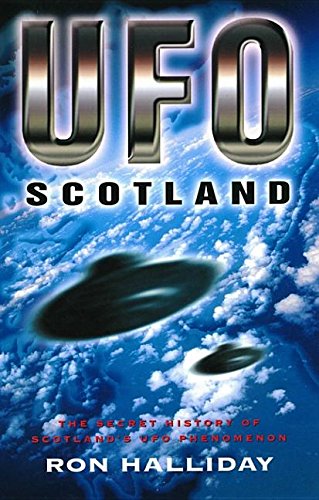
As an Amazon Associate, OverClassified may earn from qualifying purchases made through this link, at no extra cost to you.
Why This Is Essential Reading
UFO Scotland: The Secret History of Scotland's UFO Phenomenon earns its place on this list as the first book-length attempt to treat Scotland's UFO history as a coherent regional subject, and as a close-to-the-source early record of two cases this site's own research continues to engage with directly. Ron Halliday's specific argument regarding the Livingston case — that the physical ground marks Detective Constable Ian Wark documented remain unexplained by Steuart Campbell's later mirage-and-seizure theory — is a genuinely narrow, evidence-focused claim this site's own case file treats as a live, unresolved point rather than settled either way. Its early coverage of the still-unfolding Bonnybridge wave, written just six years into the case's public life, offers documentary value that decades of subsequent, more compressed tabloid retelling generally cannot match. Its thin but genuinely split Goodreads reception — a 3.58/5 average built from one enthusiastic and one sharply critical review — reflects a regional small-press title that reached a modest audience rather than a landmark bestseller, and this site discloses that split honestly rather than smoothing it into an artificially positive summary. Read alongside Halliday's own subsequent three decades of work on the same two cases, this book is essential less as a single finished argument than as the documented starting point of one of Scottish ufology's longest-running research relationships.
Related Cases & Theories
Essential Viewing
![Scotland's UFOs, Cryptids & Strange Encounters [Eerie's Vault Episode #134]](/images/thumbs/yaLHr6szcdY.jpg)
Sources Cited
- Halliday, Ron. UFO Scotland: The Secret History of Scotland's UFO Phenomenon. B&W Publishing, 1998 (ISBN 978-1-84502-928-9, cited here).
- "UFO Scotland: The Secret History of Scotland's UFO Phenomenon." Goodreads (rating 3.58/5, 12 ratings, 2 written reviews quoted, checked August 2026). goodreads.com
- "UFO Scotland: The Secret History of Scotland's UFO Phenomenon." Google Books (publisher, ISBN, and page-count metadata). books.google.com
- "UFO Scotland." AbeBooks (ISBN 9781845029289, marketplace listing photograph used for this article's cover image). abebooks.com
- "Scotland's UFOs, Cryptids & Strange Encounters [Eerie's Vault Episode #134]." Eerie's Vault, YouTube (video verified via oEmbed). youtube.com
- This site's own resources library: Full Reading List, where this exact 1998 edition is cited across 2 separate case-file pages.
- This site's own key-figures entry: Ron Halliday, for his full biography and site-wide case connections.
- This site's own key-figures entry: Malcolm Robinson, Halliday's frequent research collaborator on Scottish cases.
- This site's own case file: Livingston UFO Encounter (1979), which cites Halliday's argument regarding the case's unexplained ground marks.
- This site's own case file: Bonnybridge UFO Wave, which documents Halliday's early and continuing role chronicling the case.
- "Ron Halliday." Supernatural Secrets Symposium speaker biography (author career summary, publications list, media appearances). supernaturalsecretssymposium.com
- "Ron Halliday." Black & White Publishing author collection page. blackandwhitepublishing.com
- Campbell, Steuart. The UFO Mystery Solved, Explicit Books, 1994, ISBN 0-9521512-0-0 (the skeptical counter-theory this book's Livingston coverage is read against). amazon.com
Have corrections, additional research, or peer-reviewed sources? Help improve this entry.
Suggest an Edit