
UFO Chronicles of the Soviet Union
A Cosmic Samizdat
Core Thesis
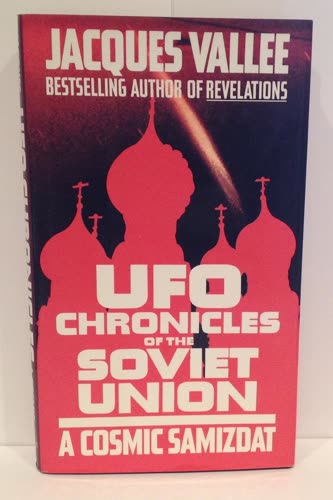
UFO Chronicles of the Soviet Union: A Cosmic Samizdat documents Jacques Vallée's January 1990 journey into the USSR, undertaken at the invitation of the Soviet press agency Novosti in the immediate wake of the 1989 Voronezh sightings and the first real opening of glasnost. Traveling with French journalist Martine Castello, Vallée interviewed dozens of Soviet scientists, government and military officials, media figures, and one cosmonaut, uncovering a UFO research culture that had survived Soviet-era censorship not by disappearing but by going underground into informal networks — the "cosmic samizdat" of the title, borrowing the term for the clandestine self-published literature that had long circulated banned material throughout the USSR. Kirkus Reviews' own period assessment captures the book's real achievement precisely: "an intriguing example of glasnost in action and an important ufological document opening up rich new veins of exploration for researchers and buffs alike."
About the Author
Jacques Vallée, born in France in 1939, had already established himself by 1990 as one of the field's most intellectually rigorous researchers — a protégé of J. Allen Hynek, co-developer of the interdimensional hypothesis, and the inspiration for the character Lacombe in Close Encounters of the Third Kind — when he undertook the trip this book documents. His dual background as both a trained astronomer and a computer scientist (he helped build the ARPANET precursor to the modern internet) gave him a genuinely unusual set of credentials for engaging with Soviet scientists on their own technical terms, rather than as an outside enthusiast.
The trip itself was a direct product of glasnost's specific timing: Novosti, the official Soviet press agency, invited Vallée to visit following the widely publicized September 1989 Voronezh sightings, at a moment when Soviet authorities were, for the first time, willing to let a prominent Western researcher meet directly with the country's own UFO investigators rather than filtering their work through official denial. Vallée traveled with French journalist Martine Castello, and their combined access reached scientists, military and government officials, media figures, and, notably, one cosmonaut willing to discuss unexplained phenomena on the record.
This book stands somewhat apart from the rest of Vallée's better-known bibliography — Passport to Magonia, Dimensions, and Trinity among them — as a work of direct field journalism and travel narrative rather than theoretical synthesis. Reviewer Jon Adler's own assessment captures this distinction: the book benefits from Vallée's personal observations of "hotel décor, his struggles with navigating the subway," and similar first-person texture that keeps the material from reading as a dry case catalog, even as it documents genuinely substantive research contacts and case material.
Historical Context & Origins
Ballantine Books published UFO Chronicles of the Soviet Union in March 1992, roughly two years after Vallée's actual January 1990 trip and just months after the Soviet Union's own December 1991 dissolution — meaning the book arrived describing a country that had, by the time readers held it, already ceased to exist in the form Vallée visited. This timing gives the book a genuine historical-document quality distinct from most UFO literature: it captures a specific, narrow window when Soviet ufology was newly visible to Western researchers but the state that had suppressed it for decades was still, barely, intact.
The book's title deliberately invokes samizdat, the clandestine self-published literature Soviet citizens had used for decades to circulate material the state censored — Vallée's own reporting found that Soviet UFO research had survived under exactly this kind of informal, unofficial circulation, with researchers and enthusiasts sharing findings outside state-sanctioned scientific channels precisely because official Soviet science had no institutional space for the subject. Glasnost's partial opening let this underground network surface to a Western visitor for the first time.
The book's specific case coverage — the 1908 Tunguska explosion, the 1989 Voronezh sightings, and roughly 40 other close-encounter reports, per Kirkus's period review — situates it as a direct primary-source complement to Paul Stonehill's The Soviet UFO Files, published the same year: where Stonehill's book synthesizes the broader Soviet case record through his own Russian-language research network, Vallée's book documents a single, specific research trip and the direct personal contacts it produced, including named researchers like Vladimir Azhazha, already documented elsewhere in this site's own case-file research.
Core Arguments & Key Concepts
The book's central observational finding is that Soviet censorship, rather than eliminating UFO research, paradoxically pushed it into an unofficial network that flourished with a genuinely scientific rigor distinct from popular Western ufology: Vallée found Soviet scientists and officials engaging with the subject through indigenous methods, including "biolocation" (a Soviet dowsing-adjacent technique some investigators used to assess anomalous sites), reflecting a research culture that had developed largely independent of Western ufological conventions.
A second theme is Vallée's own consistent methodological argument, carried over from his wider body of work: reviewer Steven H highlights Vallée's observation that "unexplained reports often contain more data, with greater precision and reliability than the identified cases" — a counterintuitive claim that the genuinely unresolved cases, rather than being weaker evidentially, are often the best-documented precisely because witnesses and investigators scrutinize them more closely when a case resists easy explanation.
A third theme is the book's substantive engagement with Soviet scientific reception of Vallée's own extradimensional theory of UFO origins: per period reporting on the trip, Vallée found considerable Soviet interest in the idea that UFOs might originate from parallel or higher dimensions rather than other planets — a theoretical convergence between Vallée's own published work and independent Soviet scientific speculation that the trip itself helped surface.
A fourth, more startling theme concerns the book's documentation of specific, previously unreported claims: Kirkus's period review notes the book reports, "apparently for the first time in the West," that cosmonaut Yuri Gagarin was intoxicated during the March 1968 training flight that killed him — a claim attributed to the book's own Soviet sources rather than independently verified by this site's own research, and included here as an example of the kind of previously unpublished material Vallée's direct access to Soviet officials was able to surface, not as an established fact.
Key Cases & Evidence Discussed
Five of this site's own case files cite this exact 1992 edition directly, each connecting to Vallée's own January 1990 field research inside the USSR. The Dalnegorsk Height 611 Crash (Case File #101, 1986) is cited by this site's own case file as written "by the same researcher who personally examined Dalnegorsk material in 1990," drawing "on Vallée's direct interviews with Soviet scientists, officials, and a cosmonaut to document the strange, semi-tolerated world of Soviet-era UFO research that produced the Dalnegorsk investigation."
The Kapustin Yar UAP Sighting (Case File #107, 1989), at the Kapustin Yar military test range, draws on "Vallee's direct 1990 field research inside the USSR at the invitation of the Novosti press agency, providing essential context for the parallel civilian Soviet ufology network and the Voronezh case discussed throughout this file."
The Petrozavodsk Phenomenon (Case File #084, 1977), at Petrozavodsk, is described by this site's own case file as covered through "Vallée's own 1990 glasnost-era trip to the USSR, meeting Soviet scientists, military officials, and researchers connected to Setka-AN and cases like Petrozavodsk, Dalnegorsk, and Voronezh — the essential English-language primary account of the era's Soviet ufology," directly naming Setka-AN, the Soviet military-scientific UFO research program this site's own Stonehill essential-reading entry also documents.
The Tehran UFO Incident (Case File #018, 1976), over Tehran, connects to this book differently than the Soviet-specific cases: this site's own case file documents that Vallée "included a detailed analysis in his UFO Chronicles of the Soviet Union and noted that the electromagnetic effects on the F-4s' systems matched a consistent pattern he had documented across dozens of high-credibility cases globally" — using the book's own comparative case material to situate a non-Soviet incident within a wider documented pattern.
The Voronezh Landing (Case File #046, 1989) — the case whose September 1989 press coverage directly prompted Novosti's invitation to Vallée — receives this book's most substantive individual case treatment: this site's own case file cites Vallée's "later field research" for establishing that an earlier, less-publicized September 21 sighting by three seventh-grade students (identified in Vallée's own account as A. Lukin, Y. Levchenko, and S. Borisenko) preceded the widely reported September 27 event, a detail this site's own research treats as directly relevant to assessing rumor contagion in the case's later, more famous sighting.
Critical Reception & Controversies
UFO Chronicles of the Soviet Union drew reviews from two major American trade publications within weeks of each other in early 1992 — a genuinely rare distinction among the specialist and small-press UFO titles this site's essential-reading library otherwise covers. Kirkus Reviews (January 15, 1992) called it "an intriguing example of glasnost in action and an important ufological document opening up rich new veins of exploration for researchers and buffs alike," praising its blend of travel narrative and scientific reporting.
Publishers Weekly (February 3, 1992) took a more skeptical position, concluding bluntly that "only believers in UFOs will find this report convincing" — while still describing the book's actual content in detail, including its documentation of Soviet sightings featuring "round or saucer-shaped" craft and "anthropomorphic" beings consistent with American accounts. This site presents both period reviews honestly rather than favoring the more flattering one: the book's real reception was genuinely split between recognizing its documentary value and doubting its evidentiary weight.
On Goodreads, the book carries a more modest 3.72-out-of-5 average from 47 ratings and 6 written reviews — the most critically mixed reception of any book in this site's Vallée-adjacent essential-reading coverage. Reviewer Kirsten Bedford wished "there was more analysis," while still finding "the (quite frankly, very strange) sightings and all of the Soviet ufology researchers' interpretations of them... interesting enough." Statistician Robert A. Yaffee, Ph.D., by contrast, called it "a superb treatment of sightings behind the Iron Curtain, especially during Glasnost and Perestroika."
On Amazon, the book carries a 4.3-out-of-5 average from a small sample of 15 ratings (checked August 2026) — a smaller but more positive sample than Goodreads', consistent with the book's genuinely mixed critical standing across different reader communities.
The clearest and most independently verifiable measure of the book's lasting reference value on this site specifically is its own citation record: five separate case files, spanning Soviet Russia to Iran, cite this exact 1992 edition directly — a citation pattern this site's own research treats as durable evidence of the book's continued usefulness as the essential English-language primary account of glasnost-era Soviet ufology.
Influence & Legacy
The most directly measurable evidence of this book's ongoing influence is on this site itself: this exact 1992 edition is cited across five separate case-file pages — Dalnegorsk Height 611 Crash, Kapustin Yar UAP Sighting, Petrozavodsk Phenomenon, Tehran UFO Incident, and Voronezh Landing — making it, alongside Paul Stonehill's The Soviet UFO Files, one of this site's two primary reference sources for Soviet-era UFO history specifically, distinguished from Stonehill's book by its direct, first-person field-research character.
The book's specific documentary contribution — naming individual Soviet researchers, cases, and institutional programs like Setka-AN to a Western audience for the first time in accessible English-language form — gave later researchers, including Stonehill and Philip Mantle's own subsequent work, a foundational reference point for the same underlying Soviet ufology network Vallée had personally accessed during his 1990 visit.
Within Vallée's own wider bibliography, this book occupies a distinct niche as his most sustained work of direct field journalism, standing apart from the more theoretical Passport to Magonia and Dimensions and the later Trinity — a body of work this site's own Jacques Vallée key-figures entry already documents in depth for his interdimensional-hypothesis theoretical contributions specifically.
Within this site's own research specifically, this book functions as the primary documentary source connecting several otherwise geographically and thematically distinct case files — from the Tehran F-4 encounter to Voronezh's schoolyard sighting — through the single, specific research trip that first documented them together for Western readers.
The Book
As an Amazon Associate, OverClassified may earn from qualifying purchases made through this link, at no extra cost to you.
Why This Is Essential Reading
UFO Chronicles of the Soviet Union earns its place on this list as the essential English-language primary account of glasnost-era Soviet ufology: a genuinely rare work of direct field journalism by Jacques Vallée, documenting a specific, narrow historical window — a Western researcher granted direct access to Soviet scientists, officials, and a cosmonaut, in the same year the Soviet Union itself dissolved. Its real, lasting value on this site's own evidence is not a uniformly positive critical reception, which was genuinely split between Kirkus's praise for its documentary importance and Publishers Weekly's skepticism that "only believers... will find this report convincing," but a citation record spanning five case files across Soviet Russia and Iran, and a specific, irreplaceable documentary contribution: named Soviet researchers, institutional programs, and case details that reached Western readers here for the first time. Read alongside Paul Stonehill's The Soviet UFO Files for the broader synthesized case record, this book is essential precisely because it is not synthesis but testimony — Vallée's own eyewitness account of a UFO research culture that had survived Soviet censorship in exactly the clandestine, samizdat form its title names.
Related Cases & Theories
Essential Viewing
Sources Cited
- Vallée, Jacques. UFO Chronicles of the Soviet Union: A Cosmic Samizdat. Ballantine Books, 1992 (ISBN 0-345-37396-0, cited here).
- "UFO Chronicles of the Soviet Union: A Cosmic Samizdat." Amazon.com (ISBN 0345373960, publisher, publication date, page count, and current rating, checked August 2026). amazon.com
- "UFO Chronicles of the Soviet Union." Kirkus Reviews, January 15, 1992 (period trade review, verdict quoted). kirkusreviews.com
- "UFO Chronicles of the Soviet Union: A Cosmic Samizdat." Publishers Weekly, February 3, 1992 (period trade review, verdict quoted). publishersweekly.com
- "UFO Chronicles of the Soviet Union: A Cosmic Samizdat." Goodreads (rating 3.72/5, 47 ratings, 6 written reviews quoted). goodreads.com
- "Jacques Vallée." Wikipedia (biography: astronomer, computer scientist, career background). en.wikipedia.org
- "UFO Chronicles of the Soviet Union: A Cosmic Samizdat." Google Books (catalog record, edition details). books.google.com
- This site's own resources library: Full Reading List, where this exact 1992 edition (ISBN 0345373960) is cited across 5 separate case-file pages.
- This site's own key-figures entry: Jacques Vallée, for his full biography and site-wide case connections.
- This site's own case file: Voronezh Landing, which documents this book's detailed field-research account of the case.
- This site's own case file: Dalnegorsk Height 611 Crash, which cites Vallée's personal 1990 examination of case material.
- This site's own case file: Petrozavodsk Phenomenon, which names the Setka-AN program this book documents.
- This site's own case file: Tehran UFO Incident, which cites this book's comparative electromagnetic-effects analysis.
- This site's own essential-reading entry: The Soviet UFO Files by Paul Stonehill, the synthesized-case-record companion to this book's direct field testimony.
Have corrections, additional research, or peer-reviewed sources? Help improve this entry.
Suggest an Edit