
The Warminster Mystery
Astounding UFO Sightings
Core Thesis
The Warminster Mystery: Astounding UFO Sightings is Arthur Shuttlewood's first and best-known book, and the founding text of what this site's own Warminster Thing case file documents as one of Britain's most sustained UFO sighting waves. Written by the Warminster Journal features writer who became the phenomenon's central chronicler almost by accident, and published by Neville Spearman in 1967, the book compiles roughly two and a half years of material — from Marjorie Bye's Christmas 1964 sound report through Gordon Faulkner's September 1965 photograph and the crowds it drew to Cradle Hill — into a single, book-length case for the reality and strangeness of “the Thing.” It advances no single, tightly argued thesis so much as an accumulating one: chapter after chapter of named local witnesses, rendered in the direct, address-and-occupation style of provincial newspaper reporting, building toward the implicit conclusion that so much testimony, from so many ordinary people, cannot simply be dismissed. That reportorial technique is simultaneously the book's chief strength and its central, well-documented weakness, examined in full in this entry's Critical Reception section below: Shuttlewood's training as a local journalist made him an unusually thorough collector of witness accounts, but, as Magonia editor John Rimmer's own close reading of the book concludes, it also meant “no critical voice is allowed” — every account, however mundane or however strange, is transcribed with the same uncomplaining, uncritical fidelity, so that by its final chapters the book has moved from named witnesses describing lights and sounds to considerably more esoteric material, including Shuttlewood's own account of mystery telephone calls and, in Rimmer's phrase, “visitors from Aenstria.” Read today, and against this site's own case file on the underlying flap, the book functions less as a reliable evidentiary record than as exactly what Rimmer calls it: “an accurate record of uncritical anecdotes and rumour” — a genuine, dateable primary document of what a British town believed and told itself was happening, rather than a demonstrated account of what actually occurred overhead.
About the Author
Arthur Shuttlewood was born in 1920 in Chelmsford, Essex, and relocated to Warminster, Wiltshire in 1940. He served during the Second World War with the Grenadier Guards and the Air Ministry Constabulary — a military background he would later invoke directly and combatively when defending his own credibility against critics, discussed in this entry's Critical Reception section. After the war he settled into local journalism, eventually becoming a features writer for the Warminster Journal, the small-town weekly whose pages would carry the first published reports of what residents came to call “the Thing.”
Shuttlewood's own account of his involvement, as documented in this site's Warminster Thing case file, begins with Marjorie Bye's report reaching him in early January 1965, days after her Christmas Day encounter with an unearthly crackling sound near Bell Hill. By his own repeated telling, he began the investigation a skeptic and grew convinced only after accumulating a large volume of independent witness statements and, later in 1965, after reporting a sighting of his own from his own window. That conversion narrative — a working local reporter persuaded against his own professional instincts — became the framing device for The Warminster Mystery and for Shuttlewood's entire subsequent public identity: he went on to forward Gordon Faulkner's September 1965 photograph to the Daily Mirror, and to organize the regular public sky-watch gatherings at Cradle Hill that, per Steve Dewey and John Ries's later reassessment discussed below, made him the flap's de facto ringmaster.
The Warminster Mystery was the first of seven books Shuttlewood wrote on the phenomenon between 1967 and 1981. The next two, Warnings from Flying Friends (Portway Press, 1968) and UFOs: Key to the New Age (Regency Press, 1971), were marketed by their own publisher's blurb as completing what became known as the “Warminster trilogy” — at the time understood, per that same 1971 blurb, as Shuttlewood's planned final word on the subject, before four further books, including The Flying Saucerers and More UFOs Over Warminster, followed through 1981. Shuttlewood was, by all documented accounts, an unusually combative defender of his own work: his surviving 1971 reply to a critical article in the Merseyside UFO Bulletin, quoted at length in this entry's Critical Reception section, shows him invoking his own wartime service directly against his skeptical critics rather than engaging their specific factual objections. He died in Warminster in 1996, aged 76, having spent more than three decades as the town's best-known and most persistent chronicler of its own strangeness.
Historical Context & Origins
The events The Warminster Mystery chronicles are documented in full, and cross-checked against the wider surviving record, in this site's own Warminster Thing case file; this entry follows that case file's established chronology and evidentiary findings rather than restating or revising them. In brief: Marjorie Bye's pre-dawn Christmas 1964 report of an unearthly crackling and whining sound near Bell Hill opened the wave; Shuttlewood began actively soliciting further reports through the Warminster Journal from January 1965; sound reports multiplied through the spring; daylight sightings of a silent, light-covered object began in June 1965; a public town-hall meeting was convened on August 27, 1965 after residents demanded an official explanation; and Gordon Faulkner's photograph, taken September 9, 1965 and published in the Daily Mirror the following day after Shuttlewood forwarded it, transformed a local news story into a national sensation and drew thousands of sky-watchers to Cradle Hill through the remainder of the decade.
National television attention followed the Mirror's coverage: BBC West broadcast a half-hour documentary, Pie in the Sky, presented by Kenneth Hudson, on April 1, 1966, further cementing Warminster's growing reputation before Shuttlewood's own book reached print the following year. By the time The Warminster Mystery was published in 1967, the sky-watch culture at Cradle Hill the book itself helped popularize was already well established, meaning the book arrived less as an announcement of a new phenomenon than as the first attempt at a full, book-length retrospective on roughly two and a half years of accumulated material — a status Rimmer's 2014 review captures in calling it the ur-text of the entire subsequent Warminster literature.
The book's original publisher, Neville Spearman, founded in 1955 by Neville Armstrong, specialized across its several-hundred-title catalogue in exactly this kind of eclectic paranormal, occult, and unconventional nonfiction for the British market. In a detail worth noting for what it says about the range of UK ufology publishing at the time, Neville Spearman released Shuttlewood's anecdotal, uncritical Warminster Mystery in the very same year, 1967, that it published French astronomer and computer scientist Jacques Vallée's far more methodologically rigorous Challenge to Science: The UFO Enigma in its UK edition — a genuine, verifiable illustration of the enormous range the British UFO-book market of the era could accommodate under a single publisher's imprint.
Core Arguments & Key Concepts
Structurally, The Warminster Mystery proceeds largely as an extended sequence of individual witness vignettes, rendered in what John Rimmer's 2014 Magonia review identifies as the “finest tradition of the local reporter” — named residents introduced with their addresses, occupations, and family details before their accounts are recorded. Rimmer, opening the book at random for his review, quotes exactly this pattern directly from the text: “Ted and Gwen Davies live in a thatched cottage at Crockerton. They run separate shops in Warminster, she one for teenage fashions and he a fish saloon”; “Mrs Mildred Head, aged 63, is the wife of an ex-policeman and was once a seamstress at Warminster Hospital.” The technique, Rimmer argues, does real work: it sets “their remarkable stories firmly in a down-to-earth reality,” borrowing the ordinary, checkable specificity of provincial news reporting to lend weight to claims that would otherwise read as considerably stranger.
That same technique, applied without any critical filter, is also where the book's central argumentative weakness lies, per Rimmer's analysis. When Shuttlewood interviews “Major William Hill, of Silver Lane, Trowbridge, a hardened veteran of wartime campaigns,” he records without question Hill's account of “the down-beating pressure of aerial vibrations… a rolling motion beneath him as the whole bodywork swayed” — accepting it, in Rimmer's words, “in its entirety,” on the strength of the witness's respectable civilian occupation as “sales manager of a big motor garage.” The book applies exactly the same uncritical acceptance to every account it contains, mundane or extraordinary alike, a pattern Rimmer compares to a local paper's fete report: “you don't challenge the judges… when they say that Mrs Grundy's apple chutney is the best in town.”
The consequence, documented directly in Rimmer's review, is that the book's later chapters drift markedly further from the grounded, address-and-occupation reporting of its opening sections. Contributions from ufologists and self-described psychics who had by then clustered around the Cradle Hill sky-watches — Rimmer names John Cleary-Baker and Gordon Creighton specifically — are “relayed uncritically,” and the book moves into “worlds of mystery telephone messages… disappearing phantom pedestrians and Shuttlewood's own mystery visitors from Aenstria,” all “presented as a seamless part of one phenomenon.” This matters directly for how this book should be read against Shuttlewood's later, more overtly esoteric sequels: rather than being purely a later development in his career, the shift toward stranger, contactee-adjacent material is already visible, in embryonic form, within this first book's own closing chapters — even though its opening reportage remains, by comparison, genuinely measured and journalistic.
The publisher's own original marketing copy for the book, preserved in bookseller and bibliographic listings, promised readers “eyewitness accounts of strange ‘things’ seen by day and night; of bewildering mushrooms of smoke, crescents of fire, weird and disturbing sounds and even accounts of conversations with those from outer space,” and claimed the book's illustrations included “several fully authenticated photographs of UFOs taken in front of witnesses.” That second claim is a specific, checkable one this site is well positioned to evaluate: this site's own Warminster Thing case file, examining the same photographic record independently, finds that not a single Warminster-area photograph — including Faulkner's, the most consequential of them all — has ever been independently, scientifically authenticated. The publisher's 1967 dust-jacket promise of “fully authenticated” images was, on the evidence this site's own research has assembled, simply untrue.
Key Cases & Evidence Discussed
This site's own Warminster Thing case file (Case File #232) covers the identical underlying 1965–76 flap this book chronicles, and readers should treat that case file as the authoritative, independently researched account of the events themselves; this entry discusses only how The Warminster Mystery itself presents and frames that same material as its author lived through it in real time.
The book's earliest and best-documented material covers Marjorie Bye's originating Christmas 1964 sound report and the wave of similar acoustic accounts that followed through the spring of 1965, material Shuttlewood gathered directly in his capacity as the Warminster Journal's features writer. It moves on to the June 1965 shift toward daylight visual sightings of a silent, light-covered object, the August 27, 1965 Warminster Town Hall meeting convened specifically to demand an official explanation for the disturbances, and — as the book's own narrative and evidentiary centerpiece — Gordon Faulkner's September 9, 1965 photograph, which Shuttlewood himself forwarded to the Daily Mirror and which, per John Rimmer's review of the later reassessment In Alien Heat, was reproduced on the book's own original dust jacket.
The book's final third moves into the organized sky-watch culture Shuttlewood himself was, by 1966–67, actively building and leading at Cradle Hill — the same institution this site's case file identifies as the flap's single most sociologically significant and best-documented legacy, independent of whatever one concludes about the underlying phenomenon's cause. It is also here, as discussed in Core Arguments above, that the book's material shifts furthest from verifiable local reporting into unverified secondhand claims from the ufologists and self-described psychics who had begun gathering around the phenomenon by the time of writing.
Critical Reception & Controversies
The most substantial close reading of The Warminster Mystery as a text in its own right comes from John Rimmer, longtime editor of the British Fortean/ufological journal Magonia (successor to the Merseyside UFO Bulletin, or MUFOB), in a 2014 “First Read” review published on the Magonia Review site. Rimmer, who first read the book shortly after its original publication, ultimately judges it “an accurate record of uncritical anecdotes and rumour” — valuable, in his assessment, “not so much” for “what was happening in that small town” as for “what people thought was happening.” He credits the book with a genuine historical significance as “an almost unique casebook describing the birth of a UFO flap as a social phenomenon,” while noting that Shuttlewood's later books “wander off into rarefied realms of fantasy where no report, no claim, no barmy idea is too extreme not to be included” — a trajectory, discussed above, already partly visible within this first book's own final chapters. Rimmer attributes to fellow researcher Peter Rogerson the memorable verdict that the book constitutes part of the “gutter-roots of ufology.”
Jerome Clark, the American ufologist and author of the standard reference work the UFO Encyclopedia, dismissed Shuttlewood's Warminster output in a single line quoted in Steve Dewey and John Ries's 2006 reassessment In Alien Heat: The Warminster Mystery Revisited and reproduced in Rimmer's own review of that book: “the somewhat gullible books of local journalist Arthur Shuttlewood.” Dewey and Ries, themselves raised in Warminster and, per Rimmer's review, personal witnesses to the sky-watch atmosphere Shuttlewood cultivated, went considerably further in their own analysis: they describe Shuttlewood emerging as the phenomenon's “maven,” whose “quiet yet authoritative voice” during the nighttime Cradle Hill gatherings, in Rimmer's paraphrase of their finding, “created an hypnotic effect which enhanced one's susceptibility to the strange and unaccustomed lights and sounds of the locale.” Their broader verdict, also quoted in Rimmer's review, is that Warminster “was what anybody wanted it to be” — a case study in collective interpretation as much as in aerial phenomena, and, by 2006, in their own words, a case “if not forgotten, at least an embarrassment to modern-day ufologists.”
Shuttlewood's contemporaries were not uniformly gentle, and Shuttlewood himself was not a passive recipient of their criticism. In the Merseyside UFO Bulletin, Vol. 4, No. 6 (Winter 1971), researcher Alan Sharp had written of Warminster specifically that “gullibility, wishful thinking, belief in the supernatural and sheer ignorance are prime factors in the generation and acceptance of UFO reports,” adding that this was visible “nowhere better than at Warminster where contactee, author and journalist Arthur Shuttlewood has directed affairs for several years and has worked up a fine air of mystery and an enormous collection of spurious sightings.” Shuttlewood's own surviving reply, published in the same Bulletin, did not engage Sharp's specific factual claims so much as invoke his own wartime record against them directly: “It does need enormous courage, equal to that I knew on the battlefield in the last war, to do this, knowing one will automatically be branded a liar, crank, hypocrite or worse.” That exchange, preserved in the primary MUFOB record, is itself useful evidence of how Shuttlewood met sustained skeptical challenge throughout his career: with an appeal to personal courage and direct experience rather than a point-by-point response to the evidentiary objections being raised.
The sky-watch culture Shuttlewood's book helped launch also produced its own, more concrete evidentiary embarrassment a few years after publication, though after this book's own 1967 print date. Researcher David Simpson, working with Ken Raine as the Scientific and Intelligence Section, UFO Physical Research (SIUFOP), conducted deliberate experimental UFO hoaxes at Warminster between 1968 and 1970, culminating in a fabricated 1970 photograph that ran on the front page of Flying Saucer Review and, per Rimmer's account, led French physicist Pierre Guérin into “wild pseudoscientific speculation” before the hoax was exposed — provoking, in Rimmer's description, editor Charles Bowen's own indignant “Pathetic Cheats” editorial in FSR itself. Simpson published the results as “An Account of Experimental UFO Hoaxing” (Magonia 75, 2001, expanding an earlier 1976 article), explicitly framing the experiment as a test of “how do they influence the collection and compilation of UFO data? Are investigators unbiased, thorough and scientific?” While this specific hoax postdates The Warminster Mystery's own publication and is not itself a claim made in the book, Rimmer's own analysis treats it as a direct, documented consequence of the uncritical sky-watch culture the book had, by then, already helped establish and popularize.
Read together, this documented critical record — a respected Fortean editor's own close textual reading, a standard reference work's one-line dismissal, a contemporary researcher's direct 1971 attack answered by Shuttlewood's own combative, evidence-free rebuttal, and a later, deliberate hoax exposing the credulity of the exact sky-watch culture the book had popularized — converges on a consistent picture. It is also fully consistent with this site's own independent finding, in the Warminster Thing case file, that the underlying phenomenon combines a genuinely large, socially significant volume of testimony with an almost complete absence of independently authenticated physical or photographic evidence.
Influence & Legacy
The Warminster Mystery established the template — a sympathetic local chronicler actively soliciting and publishing reports, national tabloid amplification of a single disputed image, and an organized public sky-watch culture — that this site's own case file identifies as recurring in later British sighting waves, most notably the 1992–present Bonnybridge UFO Wave, separated from Warminster by roughly three decades and several hundred miles yet arriving at a remarkably similar structural shape. That pattern is also a close real-world match for the general Psycho-Social Hypothesis this site tracks in its own Psycho-Social Hypothesis theory file: a single vivid originating account, a sympathetic media figure, and a self-sustaining communal viewing ritual, treated by that framework as a classic driver of socially amplified misperception independent of whatever triggered the original reports.
Within Warminster's own subsequent literature, Shuttlewood's book directly seeded what its own publisher marketed as a “trilogy” and, beyond that, an entire further shelf of increasingly esoteric successor titles — through Shuttlewood's own later books and, after his active involvement declined, through Ken Rogers's Warminster UFO Newsletter and Peter and Janet Paget's Star House and Fountain Journal, which, per John Rimmer's review of In Alien Heat, went on to integrate Warminster fully into the wider New Age movement. In this sense the book's most direct legacy was not any specific evidentiary claim but the ongoing institution of Warminster itself as a self-perpetuating site of pilgrimage — a status this site's own case file documents as persisting into the present, most recently at a 60th Anniversary Conference held at Warminster's Athenaeum on August 24, 2025.
Rimmer's 2014 review also situates the book usefully within the broader Anglo-American tradition of journalist-chroniclers embedding themselves in a local high-strangeness wave: he compares Shuttlewood directly to John Keel, whose reporting on the Mothman sightings in Ohio's small river towns a few years later used similar techniques, though Rimmer judges Keel's work “perhaps a more entertaining read,” crediting Keel with a broader understanding of the social and mythical frameworks such phenomena draw on than Shuttlewood, in Rimmer's assessment, ever developed.
The Book
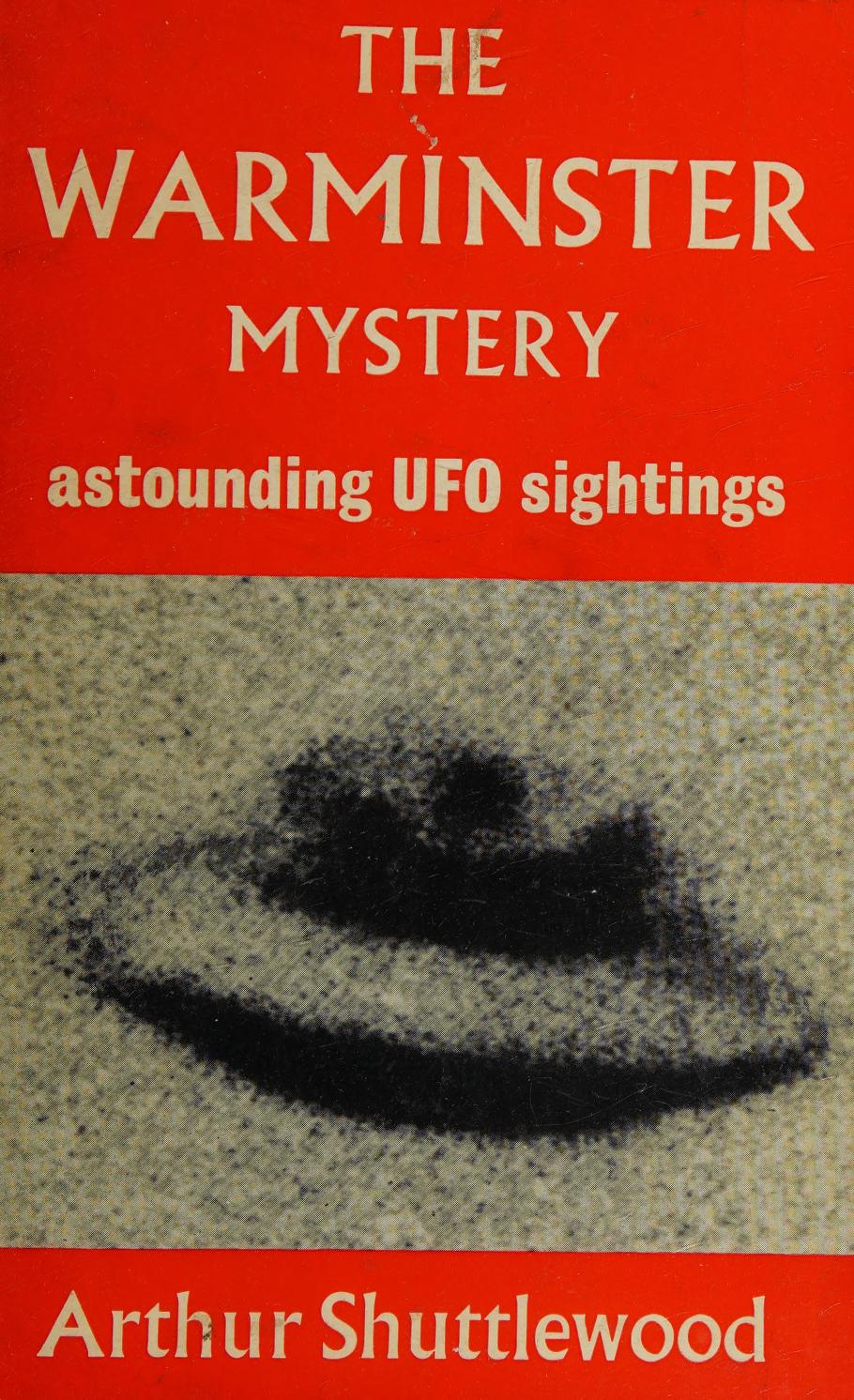
As an Amazon Associate, OverClassified may earn from qualifying purchases made through this link, at no extra cost to you.
Why This Is Essential Reading
The Warminster Mystery earns its place on this list not as a reliable evidentiary account of anomalous aerial activity, but as the single most important primary document of how a specific, real, and thoroughly documented British UFO flap actually felt and read to the people living through it in real time. Arthur Shuttlewood's training as a local newspaper reporter gave the book a genuine, checkable specificity — named witnesses, real addresses, real occupations — that lends its early chapters real historical value as social record, exactly as John Rimmer's own close reading concludes. That same untrained, uncritical reportorial instinct is also precisely why, by its final chapters, the book has already drifted from grounded local testimony into unverified rumor and the earliest hints of Shuttlewood's later, more overtly esoteric contactee material, and why this site's own independent case-file research finds no photograph or account from the underlying flap that meets the standard of independent authentication the book's own publisher explicitly, and falsely, claimed for it. Read against this site's own Warminster Thing case file, and against the documented skeptical record — Rimmer's and Peter Rogerson's assessments, Jerome Clark's dismissal, Alan Sharp's 1971 critique and Shuttlewood's own unyielding reply, Steve Dewey and John Ries's “maven” analysis, and the SIUFOP hoax that later exposed the sky-watch culture the book helped build — The Warminster Mystery is essential less as evidence for “the Thing” than as the founding, and in Peter Rogerson's own phrase distinctly “gutter-roots,” case study in how one committed local chronicler can turn a real, socially significant wave of testimony into a national phenomenon that outran, from its very first edition onward, what the underlying evidence could actually support.
Related Cases & Theories
Essential Viewing

Sources Cited
- "Arthur Shuttlewood." Wikipedia (biography, military service, Warminster Journal career, conversion narrative, book list, death). en.wikipedia.org
- "Neville Armstrong." Wikipedia (Neville Spearman publishing house history, founding date, catalogue subject range). en.wikipedia.org
- "THE WARMINSTER MYSTERY: ASTOUNDING UFO SIGHTINGS." Internet Archive, identifier warminstermyster0000shut (bibliographic record: Neville Spearman, 1967, 222 pp., scanned first-edition copy). archive.org
- "THE WARMINSTER MYSTERY. by Arthur Shuttlewood." Goodreads (edition and bibliographic record). goodreads.com
- "Shuttlewood's Books." UFO Warminster (dedicated Shuttlewood bibliography: publishers, editions, page counts, and original publisher blurb text for The Warminster Mystery and its six sequels). ufo-warminster.co.uk
- "THE WARMINSTER MYSTERY." Amazon.com listing, Tandem Books paperback ed., ISBN 0426127307 / 9780426127307 (edition cited above). amazon.com
- Rimmer, John. "First Read: The Warminster Mystery." Magonia Review, 2014 (close reading of the book's text, direct quotations, Peter Rogerson's ‘gutter-roots of ufology’ verdict, comparison to John Keel). pelicanist.blogspot.com
- Rimmer, John. "The Warminster Mystery" [review of Steve Dewey and John Ries, In Alien Heat: The Warminster Mystery Revisited]. Magonia, reposted at mrobsr.blogspot.com, 2009 (Jerome Clark's UFO Encyclopedia dismissal, Dewey and Ries's ‘maven’ and ‘hypnotic effect’ findings, SIUFOP hoax and Pierre Guérin/Charles Bowen ‘Pathetic Cheats’ episode). mrobsr.blogspot.com
- "Warminster." Magonia Review / Merseyside UFO Bulletin archive index (aggregated excerpts from MUFOB and Magonia coverage of Warminster, 1969–2015). pelicanist.blogspot.com
- Simpson, David, and Ken Raine. "An Account of Experimental UFO Hoaxing." Magonia 75, July 2001 (SIUFOP's 1968–1970 experimental hoaxes at Warminster). magoniamagazine.blogspot.com
- Shuttlewood, Arthur. Reply letter to Alan Sharp. Merseyside UFO Bulletin, Vol. 4, No. 6, Winter 1971 (primary-source exchange: Sharp's critique of Warminster and Shuttlewood's own direct reply). mufobmagazine.blogspot.com
- This site's own case file: The Warminster Thing (Case File #232), for the full, independently researched chronology and evidentiary assessment of the underlying flap this book chronicles.
- This site's own key-figures entry: Arthur Shuttlewood, for his full biography and case connections.
- This site's own theory file: The Psycho-Social Hypothesis (Theory File PSH-001), for the broader framework this entry applies to the sky-watch culture the book documents.
Have corrections, additional research, or peer-reviewed sources? Help improve this entry.
Suggest an Edit