
The Simulated Multiverse
An MIT Computer Scientist Explores Parallel Universes, the Simulation Hypothesis, Quantum Computing, and the Mandela Effect
Core Thesis
The Simulated Multiverse is Rizwan Virk's 2021 follow-up to his 2019 book, which this site already covers in its own Essential Reading article on The Simulation Hypothesis. This article's own research confirmed, via the book's own chapter index, that it extends into genuinely distinct territory: sustained treatment of the Mandela Effect (false collective memories, such as people misremembering "The Berenstain Bears") as possible evidence of branching simulated timelines, direct engagement with quantum mechanics' many-worlds interpretation, and quantum computing as a proposed computational mechanism for rendering multiple parallel timelines at once -- none of which appear in the 2019 book. As with that earlier book, this article's research found no evidence this book discusses UFOs or UAPs directly; Virk's application of the simulation framework to UAP phenomena remains, per this site's companion article, a later development pursued through media appearances rather than either book's own text.
About the Author
This site's own Rizwan Virk key-figures entry and companion Essential Reading article on The Simulation Hypothesis already document his MIT computer-science background, video-game industry career, and Galileo Project advisory role. This article notes only that this 2021 follow-up remains published solely through his own Bayview Books imprint, with this article's research finding no evidence of the kind of major-publisher reissue the 2019 book received from Tarcher/Penguin Random House in 2025.
Historical Context & Origins
This article's research directly located the book's own chapter index (via a licensed-text hosting site exposing individual chapter titles), confirming sustained, multi-chapter treatment of the Mandela Effect -- including chapters titled "The Mandela Effect: Real or Mass Delusion?," "Intentional False Memories," "Should the Mandela Effect Be Dismissed Outright?," and "NPCs, PCs, and the Mandela Effect" -- a topic essentially absent from the 2019 book. The index also shows chapters engaging Max Tegmark's multiverse classification scheme and what appears to be physicist Stephen Wolfram's computational "multiway systems" framework, situating the book within contemporary theoretical-physics discourse beyond the 2019 book's more general quantum-mechanics framing.
This article's research found the book's own marketing copy frames its physics argument as attempting to unify the many-worlds and Copenhagen interpretations of quantum mechanics within "an information based framework" -- a more specific and technical engagement with quantum foundations than the broader treatment in Virk's first book, though this article was not able to verify that framing against directly quoted chapter text.
Core Arguments & Key Concepts
The book's central mechanism proposes that quantum computing offers a plausible computational basis for a simulation to render or explore multiple parallel timelines simultaneously -- extending the "RPG version" of the simulation argument from Virk's first book (real consciousnesses plugged into a simulated environment) into a specifically multiverse-branching context.
Applied to the Mandela Effect specifically, the book's argument treats collectively misremembered details as potential evidence of branch-switching within a simulated multiverse, rather than the more conventional explanation of ordinary, well-documented collective false-memory formation -- a framing this article reports as Virk's own stated argument rather than an independently adjudicated conclusion.
Key Cases & Evidence Discussed
This site's own Simulation Hypothesis theory page, which already describes this book as "extending the framework to parallel universes, quantum computing, and the Mandela Effect," is directly corroborated by this article's own chapter-index research. Readers wanting the framework's specific UAP application should consult that theory page and this site's companion article on The Simulation Hypothesis directly, since this article's research found no UAP-specific content in this particular book.
Critical Reception & Controversies
This article directly retrieved a professional trade review from Publishers Weekly's BookLife, which called the book "an eccentric head trip" that weaves in Nick Bostrom, Black Mirror, Philip K. Dick, Devs, and Star Trek, concluding "skeptics will remain unconvinced, but the open-minded will enjoy contemplating the out-there possibilities." The review graded the book's production quality highly (design/typography A, illustrations A-, editing A-) and recommended it alongside Tom Siegfried's The Number of the Heavens and Carlo Rovelli's Reality Is Not What It Seems.
As of this article's research (August 2026), the book holds a 3.80-out-of-5 rating on Goodreads from 263 ratings and 35 written reviews -- a smaller readership than the first book, consistent with a niche sequel. A recurring reader complaint this article found worth reporting honestly: several reviewers described the book as containing "excessive references to the author's previous book," reading at times like a promotional extension of The Simulation Hypothesis rather than a fully independent work, even though its topical content, as this article's own chapter-index research confirms, is genuinely new.
Influence & Legacy
The book's legacy, per this article's research, is that of a well-produced but niche sequel -- praised by trade reviewers for its ambition and readability, engaged with by a modest but real readership, but without the broader institutional pickup (major-publisher reissue, sustained media citation) its predecessor eventually received.
Set alongside this site's own Simulation Hypothesis companion article and theory page, this book functions as the second installment in Virk's broader simulation-argument project, extending its scope into multiverse physics and collective-memory phenomena rather than into the UAP-specific application that remains, in both books, a matter for Virk's later, separate work.
The Book
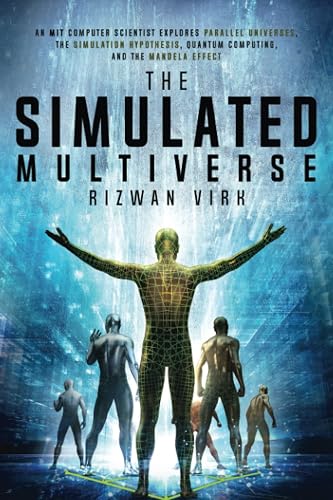
The Simulated Multiverse
An MIT Computer Scientist Explores Parallel Universes, the Simulation Hypothesis, Quantum Computing, and the Mandela Effect
Find on Amazon →As an Amazon Associate, OverClassified may earn from qualifying purchases made through this link, at no extra cost to you.
Why This Is Essential Reading
The Simulated Multiverse earns its place on this reading list as a genuine, verified extension of Rizwan Virk's simulation-argument project into the Mandela Effect, many-worlds physics, and quantum computing -- confirmed by this article's own direct examination of the book's chapter index rather than assumed from its title alone. Read alongside this site's own companion article on The Simulation Hypothesis, this book covers genuinely new ground even as several reader reviews found it leans rhetorically on its predecessor. Like that earlier book, it does not itself discuss UAPs -- readers seeking that specific application should consult this site's own Simulation Hypothesis theory page directly.
Related Cases & Theories
Sources Cited
- Virk, Rizwan. The Simulated Multiverse: An MIT Computer Scientist Explores Parallel Universes, the Simulation Hypothesis, Quantum Computing, and the Mandela Effect. Bayview Books, 2021 (ISBN 978-1-954872-00-4, cited here).
- Publishers Weekly / BookLife, professional review of The Simulated Multiverse -- directly retrieved for this article. publishersweekly.com
- French, M.K. Review of The Simulated Multiverse. Girl Who Reads -- directly retrieved for this article.
- Goodreads listing for The Simulated Multiverse (rating 3.80/5, 263 ratings, 35 reviews, checked August 2026). goodreads.com
- Amazon product listing for The Simulated Multiverse (ISBN 9781954872004), cover image and title-page wording directly verified for this article. amazon.com
- This site's own Rizwan Virk key-figures entry.
- This site's own Essential Reading article on The Simulation Hypothesis (Virk's 2019 first book).
- This site's own Simulation Hypothesis theory page, full sourcing on the framework's UAP-specific application.
- This site's own Massachusetts Institute of Technology (MIT) location entry (Virk's alma mater, cited here for institutional context).
- Tegmark, Max. Our Mathematical Universe. Knopf, 2014 (source for the multiverse-classification framework this book's chapter index engages).
- Virk, Rizwan. "The Avatar Hypothesis for UFOs/UAP." Substack essay, 2026 (referenced here for continuity with this site's companion article on Virk's later, separate UAP-specific work).
- This site's own resources library: Full Reading List.
Have corrections, additional research, or peer-reviewed sources? Help improve this entry.
Suggest an Edit