
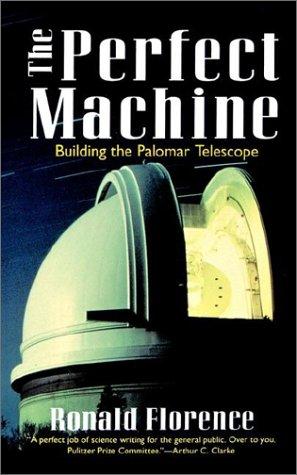
The Perfect Machine
Building the Palomar Telescope
Core Thesis
The Perfect Machine is Ronald Florence's 1994 history of the twenty-year campaign, beginning in 1928 and interrupted by the Depression and World War II, to design and build the 200-inch Hale Telescope at Palomar Observatory, dedicated in 1948. Its relevance to this site is direct and unusually consequential: the same telescope this book chronicles conducted the 1949–1958 First Palomar Observatory Sky Survey (POSS-I), whose photographic plates constitute the entire evidentiary base of astrophysicist Beatriz Villarroel's VASCO project, documented in this site's own Beatriz Villarroel & the VASCO Project case file.
About the Author
Ronald Florence was educated at Berkeley and Harvard and had authored five previous books before publishing The Perfect Machine in 1994. He lives with his family on the Connecticut shore, where, per his own author biography, they raise Cotswold sheep — a detail his publisher's own materials include, reflecting the personal, literary voice Florence brought to what could otherwise have been a purely technical institutional history.
Florence's background combines general historical and literary writing rather than a formal astronomy or physics credential, a combination reviewers have consistently credited as central to the book's success: he approaches the Palomar telescope's twenty-year construction as a genuinely human story of ambition, institutional politics, engineering failure and recovery, and personal sacrifice, rather than a narrowly technical account accessible only to specialists.
The book's success led directly to a further career milestone: it was adapted into Journey to Palomar: America's First Journey Into Space, a 90-minute PBS documentary more than five years in production, broadcast nationally and centered on George Ellery Hale, the telescope's founding visionary, extending Florence's own research and narrative framing to a considerably wider television audience than the book's readership alone would have reached.
Florence's broader body of work across his six published books spans both history and fiction, giving him a demonstrated versatility as a narrative writer beyond this single subject. This general narrative skill, applied to a technically demanding scientific and engineering subject, is precisely what reviewers have consistently credited as distinguishing The Perfect Machine from more narrowly specialist institutional histories of comparable scientific instruments, which often struggle to find a comparably wide general readership.
Historical Context & Origins
The book was published in 1994, marking the telescope's own approach toward its fiftieth anniversary of first light, at a moment when the 200-inch Hale Telescope, though no longer the world's largest (a title it held from 1948 until 1975, and effectively the dominant large optical instrument for even longer), remained a landmark achievement in the history of American science and engineering worth a full retrospective treatment.
Florence's research draws on the full, well-documented institutional history of the project: George Ellery Hale's own initial 1928 proposal and Rockefeller Foundation funding, the technical challenges of casting and grinding a 200-inch mirror blank at a scale never previously attempted, the project's near-total suspension during World War II when its personnel and resources were redirected to military optics work, and the mirror's own famous seventeen-foot disc, hand-polished over years to a tolerance of two-millionths of an inch.
The book's own subtitle addition in some editions — "A Poignant Chronicle of Big Science Born in Depression-Era America" — reflects Florence's explicit framing of the Palomar project as an early, foundational instance of what later became known as "Big Science": large-scale, expensively funded, institutionally complex scientific projects requiring sustained coordination across universities, private philanthropy, and industrial engineering partners, a model that would later define Cold War-era and modern astronomical, physics, and space-science projects alike.
This "Big Science" framing is directly relevant to understanding VASCO's own later research context: the Palomar telescope and its sky-survey program represent exactly the kind of large, institutionally sustained scientific infrastructure investment that can, decades after its original purpose has been fulfilled, continue generating scientifically valuable data for entirely new research questions its original builders never anticipated — a pattern common to major astronomical archives generally, and one this book's detailed account of the survey's original design and purpose helps readers appreciate as something other than a coincidence.
Core Arguments & Key Concepts
The book's central narrative argument is that the Palomar telescope's successful completion, despite two decades of technical setbacks, funding crises, and a multi-year wartime suspension, represents a genuinely dramatic story of institutional persistence — one Florence explicitly frames as poignant given that George Ellery Hale himself, the project's founding visionary, died in 1938, a full decade before the telescope he conceived was finally dedicated in 1948, along with two other principal figures who also did not live to see its completion.
Florence gives substantial attention to the specific engineering challenges of the mirror itself: earlier attempted mirror blanks, cast from fused quartz, proved too difficult to finish reliably, leading the project to switch to Pyrex glass, a material choice with its own significant technical risks given the unprecedented scale involved — the seventeen-foot blank's casting, cooling, and years-long grinding and polishing process is documented in the kind of granular technical and human detail that made the book's reputation as the definitive account of the project. The mirror blank's initial casting at Corning Glass Works required a cooling period of many months to avoid catastrophic internal stress fractures in glass of this unprecedented scale, a slow, unglamorous, and genuinely risky waiting period Florence renders with real narrative tension despite its inherently static nature — precisely the kind of technically accurate but also genuinely dramatic storytelling reviewers have consistently singled out as the book's defining achievement.
The book also documents the considerable institutional politics surrounding the project: competition and collaboration between Caltech, the Carnegie Institution's Mount Wilson Observatory, and Rockefeller Foundation funders, along with the practical logistics of transporting an unprecedented 200-inch, many-ton glass disc across the country from the Corning Glass Works in New York to California by a specially adapted rail car, an operation that itself became a significant public spectacle covered by contemporary press along its route.
Central to the book's account is the sky survey program the completed telescope, along with its smaller companion Samuel Oschin (48-inch Schmidt) Telescope, was built to support: systematic photographic mapping of the observable sky, a scientific mission requiring years of dedicated observing time and producing the very archive of photographic plates — the First Palomar Observatory Sky Survey, conducted 1949 through 1958 — that decades later became the foundational data source for entirely unanticipated later research, including Villarroel's own VASCO project.
Florence also documents the specific photographic technology and glass-plate emulsion processes used throughout the survey era, technical detail directly relevant to evaluating claims made decades later about the plates' own reliability: understanding exactly how a 1950s photographic plate was exposed, developed, and could potentially produce a spurious transient-looking artifact (through emulsion flaws, plate-handling damage, or processing chemistry variation) requires exactly the kind of granular technical grounding this book supplies, rather than a purely modern, digital-imaging intuition about how photography works.
Key Cases & Evidence Discussed
This site's own Beatriz Villarroel & the VASCO Project case file is the case file this book's institutional and technical history most directly supports. VASCO's entire research methodology depends on comparing modern digital sky surveys against the specific archive of photographic plates the Palomar telescope and its Samuel Oschin companion instrument produced during the 1949–1958 survey Florence's book documents in detail — understanding how those plates were made, what equipment produced them, and what technical limitations and artifacts that 1950s-era photographic process was subject to is directly relevant background for evaluating both VASCO's own "vanishing sources" findings and the plate-artifact rebuttal offered by astronomers skeptical of Villarroel's conclusions.
This site's own Washington D.C. UFO Flap (July 19, 1952) connects to this book through VASCO's own most striking specific finding: a co-authored 2024 paper documenting a "bright triple transient" recorded on Palomar plates dated July 19, 1952 — the same calendar date as the first night of the Washington radar-visual flap — with a follow-up study flagging a second candidate anomaly on July 27, 1952, coinciding with the flap's second weekend. Villarroel herself, per this site's own case file, describes these as statistical coincidences worth investigating rather than established evidence connecting the two phenomena, a caution this book's own detailed account of the survey's actual observing schedule and equipment helps a reader properly contextualize. Readers who understand how methodical and institutionally coordinated the Palomar survey's own observing schedule was, as this book documents in detail, are better equipped to judge whether a specific plate's exposure date genuinely represents a notable coincidence worth investigating or falls within the ordinary, explainable cadence of a systematic, years-long observing program that was always going to produce plates on a great many arbitrary calendar dates.
Critical Reception & Controversies
The book received outstanding reviews and has been described consistently, including by specialist astronomy reviewers, as the sole complete and detailed account of the Palomar telescope's full history. One review specifically praised Florence for overlooking "nothing about the relevant issues of Astronomy, optics, engineering, business, politics and personalities," while still avoiding any sense of overkill that might discourage a general reader from continuing to the next chapter.
The book is sold directly through the Palomar Observatory's own gift shop and bookstore, a notable form of institutional endorsement: the observatory whose own history the book documents continues, more than three decades after publication, to recommend it as the authoritative account for visitors and researchers alike.
Reviews consistently credit the book's literary quality — its attention to the human drama of Hale's own personal health struggles, the project's near-collapse during wartime, and the emotional weight of key figures dying before the telescope's completion — as distinguishing it from more narrowly technical institutional histories of comparable scientific projects.
No critical source located in researching this article disputes the book's core historical or technical account of the telescope's design and construction; its reputation as the definitive Palomar history has remained essentially unchallenged since publication.
Astronomy-focused review outlets have specifically praised the book's technical accuracy regarding the mirror-grinding and optical-testing processes, a detail that matters for this article's own assessment since it indicates Florence's research held up to scrutiny from readers with genuine domain expertise in optics and telescope engineering, not merely general historical or science-journalism readers less equipped to catch technical errors.
Influence & Legacy
This exact edition is cited in this site's own Beatriz Villarroel & the VASCO Project case file's Further Reading section as "a definitive history of the Samuel Oschin/Hale telescope complex whose 1949–1958 sky survey produced the very photographic plates at the center of VASCO's entire evidentiary base."
The book's adaptation into the PBS documentary Journey to Palomar extended its reach and reputation considerably beyond its own readership, introducing Florence's research and narrative framing of the Palomar story to a national television audience and further cementing the book's standing as the default popular reference on the telescope's history.
More than three decades after publication, the book remains directly relevant to entirely unanticipated later scientific developments: the survey program it documents in careful technical and institutional detail became, decades after its own 1958 completion, the foundational archive for VASCO's own search for "vanishing and appearing" astronomical sources — a research application neither Florence nor the original Palomar survey astronomers could have specifically anticipated when the plates were first exposed.
The Palomar Observatory's own continued operational status — the Hale Telescope remains a working scientific instrument today, alongside newer instruments on the same mountain — means the institution this book documents is not a purely historical subject but an active research site whose archived legacy data, including the very sky-survey plates central to this article's own connection to VASCO, continues to generate scientifically productive new research questions well into the twenty-first century.
The Book
As an Amazon Associate, OverClassified may earn from qualifying purchases made through this link, at no extra cost to you.
Why This Is Essential Reading
The Perfect Machine earns its place on this list as the definitive, essential technical and institutional history behind the specific photographic archive Villarroel's VASCO project depends on entirely. Read alongside this site's own Beatriz Villarroel & the VASCO Project case file, this book supplies exactly the kind of grounded understanding of how, when, and with what equipment the underlying Palomar sky-survey plates were actually produced that any fair evaluation of VASCO's contested "vanishing stars" findings requires.
Related Cases & Theories
Essential Viewing
Sources Cited
- Florence, Ronald. The Perfect Machine: Building the Palomar Telescope. HarperCollins, 1994 (ISBN-13 9780060926700). amazon.com
- "The Perfect Machine." ronaldflorence.com (author's own book page). ronaldflorence.com
- "The Perfect Machine: Building the Palomar Telescope." Palomar Observatory Gift and Book Store (official observatory endorsement/sale). store.palomar.caltech.edu
- "The Thumbnail Book Reviews: The Perfect Machine." UC Berkeley Space Sciences Laboratory. research.ssl.berkeley.edu
- "The Perfect Machine: Building the Palomar Telescope." Goodreads (reader ratings and reviews). goodreads.com
- "The perfect machine: building the Palomar telescope." Internet Archive (full digitized text). archive.org
- "Journey to Palomar." Journey to Palomar official documentary site. journeytopalomar.org
- "Journey to Palomar, America's First Journey Into Space." IMDb. imdb.com
- "The Perfect Machine." Open Library (bibliographic record and cover art source). openlibrary.org
- This site's own case file: Beatriz Villarroel & the VASCO Project, for the full analysis of the Palomar sky-survey plates this book's history supports.
- This site's own case file: Washington D.C. UFO Flap, for the case connected via VASCO's own July 1952 transient findings.
- This site's own key-figures entry: Ronald Florence, for his full biography and further case connections.
- This site's own key-figures entry: Beatriz Villarroel, for the VASCO project's full research history.
Have corrections, additional research, or peer-reviewed sources? Help improve this entry.
Suggest an Edit