
The Making of the Atomic Bomb
The Definitive History of the Manhattan Project
Core Thesis
The Making of the Atomic Bomb is Richard Rhodes's 1986 history of the Manhattan Project, winner of the 1987 National Book Award, the 1988 Pulitzer Prize for General Nonfiction, and the 1988 National Book Critics Circle Award — widely regarded as the definitive single-volume account of the atomic bomb's development, from the early-twentieth-century physics discoveries that made it theoretically possible through the bomb's actual 1945 use. Its relevance to this site is direct: the book's detailed account of the Allied powers' global scramble to secure sufficient uranium ore explains precisely why the Shinkolobwe mine's exceptional purity made it strategically indispensable, supplying essential nuclear-history context for this site's own Belgian Congo uranium-mine saucer case file.
About the Author
Richard Rhodes was born July 4, 1937, in Kansas City, Kansas. Following his mother's suicide in 1938, Rhodes and his older brother were raised by their father, a railroad boilermaker with only a third-grade education — a difficult early childhood, including time in a state boys' home, that Rhodes later wrote about directly in his own memoir. He attended Yale University on a full scholarship, graduating with honors in 1959.
Rhodes built his career as a historian, journalist, and author of both fiction and nonfiction, eventually writing more than twenty books, with sustained focus on nuclear history and broader questions of science, technology, and violence. The Making of the Atomic Bomb remains his single most celebrated work, though he continued the story in later books, including Dark Sun: The Making of the Hydrogen Bomb (1995), extending his nuclear-history project into the postwar arms race.
Rhodes has received grants and fellowships from the Ford Foundation, the Guggenheim Foundation, the MacArthur Foundation, and the Alfred P. Sloan Foundation, among others, and has lectured widely in the United States and internationally on nuclear history and policy. He has also served in various advisory and honorary capacities connected to nuclear history preservation, including recognition from the National Security Archive and the Atomic Heritage Foundation/National Museum of Nuclear Science and History.
Rhodes's own difficult early childhood, including a period spent in a state-run boys' home following years of documented mistreatment by a stepmother, gave him a personal familiarity with institutional record-keeping, bureaucratic process, and the gap between official accounts and lived experience that some commentators have suggested informed his later skill at reconstructing complex institutional histories from fragmentary documentary records — a formative background he later addressed directly in his own memoir, distinct from his nuclear-history writing but illuminating of the same close attentiveness to primary-source detail that made this book's own research so exhaustive.
Historical Context & Origins
Rhodes began research for the book in the late 1970s, drawing on then-recently opened archival material, declassified documents, and, crucially, direct interviews with surviving participants in the Manhattan Project — scientists, military officers, and administrators, many of whom were still alive when Rhodes began his research but whose numbers were rapidly dwindling by the time the book was published in 1986, giving his research an urgency and irreplaceable documentary value similar to Andrew Chaikin's contemporaneous astronaut-interview project for A Man on the Moon.
The book's 1986 publication arrived during the late Cold War, a period of renewed public anxiety about nuclear weapons following the early-1980s escalation in U.S.-Soviet tensions, giving Rhodes's historical account of the bomb's original creation a pointed, immediate resonance for contemporary readers concerned about the ongoing nuclear arms race his later book Dark Sun would go on to document in its own right.
The book's scope deliberately begins well before the Manhattan Project itself, tracing the scientific lineage of nuclear physics discoveries — from the 1930s identification of nuclear fission through the international scientific community's rapid recognition of its potential military applications — situating the Manhattan Project not as an isolated American engineering achievement but as the culmination of a genuinely international scientific process, with contributions from physicists across multiple countries, some of whom later worked on opposing sides of the war.
This long historical run-up also situates the book within a specific genre convention Rhodes himself helped popularize within popular science and technology history: rather than beginning at the most dramatic or climactic moment (the Trinity test, or the bombs' actual wartime use), the book insists on the slower, cumulative buildup of scientific understanding that made the later dramatic events possible, a structural choice that gives later chapters their full weight precisely because readers have already absorbed just how much prior theoretical groundwork had to be laid first.
Core Arguments & Key Concepts
The book's central narrative argument is that the atomic bomb's development represented an unprecedented convergence of pure theoretical physics, massive industrial-scale engineering, and urgent wartime political pressure — a combination Rhodes documents as historically unique in its speed and scale, compressing what might otherwise have been decades of gradual scientific and technical development into a few frantic wartime years.
Rhodes gives substantial, humanizing attention to the individual scientists and administrators central to the project — J. Robert Oppenheimer, Enrico Fermi, Leo Szilard, General Leslie Groves, and dozens of others — treating their personal motivations, moral anxieties, and interpersonal conflicts as inseparable from the technical history, a narrative approach reviewers consistently credit as distinguishing the book from more narrowly technical or purely institutional accounts of the same events.
A significant and directly relevant thread of the book's account concerns the global competition for sufficient fissile raw material: with uranium deposits scattered unevenly around the world and of wildly varying ore purity, Rhodes documents in detail why the Manhattan Project's planners considered securing reliable, high-grade uranium supply an urgent strategic priority equal in importance to the project's own scientific and engineering challenges — a priority that made the Belgian Congo's Shinkolobwe deposit, at 65-75% uranium oxide by weight compared to ore as dilute as 0.02% elsewhere, an almost uniquely valuable strategic asset.
Rhodes also documents the closely related fear, shared by Allied planners throughout the war, that Nazi Germany's own nuclear research program might succeed first — a fear later historical assessment would show was considerably overstated relative to Germany's actual technical progress, but one that nonetheless drove much of the Manhattan Project's own urgency and shaped the specific intelligence and security measures, including the OSS's Congo mission this site's own case file and its companion essential-reading title Spies in the Congo document, protecting the Allied uranium supply chain from potential German interference.
The book also documents the specific postwar transition this urgency produced: even after Germany's defeat removed the original strategic rationale for wartime secrecy, the rapidly emerging Cold War rivalry with the Soviet Union meant the uranium-security apparatus built during the war, including continued close American and Belgian attention to Shinkolobwe specifically, was never actually dismantled but instead redirected toward a new adversary — the same continuity of institutional attention this site's own case file traces directly into the early 1950s period its central UFO report occurred within.
Key Cases & Evidence Discussed
This site's own Flying Saucers Over the Belgian Congo Uranium Mines (Case File #173, March 29, 1952) is the case file this book's global uranium-supply history most directly supports. The case file's own Background section draws on this book's account of the worldwide uranium scramble to explain precisely why Shinkolobwe's exceptional ore purity, compared explicitly against the far more dilute contemporary American and Canadian deposits Rhodes also documents, made the mine strategically indispensable enough to justify the sustained decades of American, Belgian, and Soviet intelligence attention that ultimately swept up a 1952 newspaper report about "fiery discs" into CIA files.
This book pairs directly with this site's own recently published essential-reading entry on Susan Williams's Spies in the Congo: where Williams's book focuses narrowly and deeply on the specific OSS intelligence mission protecting Shinkolobwe's export route, Rhodes's considerably broader account situates that single mission within the full global context of the Manhattan Project's entire uranium-supply strategy, giving readers both the close-up operational detail and the wide strategic frame needed to fully understand why the Congo mattered as much as it did.
Critical Reception & Controversies
The book received the rare distinction of sweeping all three of America's most prestigious general nonfiction awards in consecutive years: the 1987 National Book Award, the 1988 Pulitzer Prize for General Nonfiction, and the 1988 National Book Critics Circle Award — a level of critical recognition matched by very few nonfiction books in any subject area.
The New York Times praised Rhodes's "uncanny ability to communicate the essence of theoretical physics in an engaging, comprehensible manner," while other reviewers described the book as a work of "great drama and sweep" and "a superb accomplishment," crediting Rhodes's exhaustive research and narrative skill in rendering an enormous, complex historical subject into genuinely readable prose.
Some reviewers did note a genuine structural challenge: the book's "gallery of names and events" was, even to sympathetic critics, occasionally "dizzying," and its scientific discussions, while generally praised as accessible, remain demanding for readers without any prior physics background — a fair characterization of any book attempting this level of comprehensive technical and historical detail within a single volume, and one this article notes alongside the otherwise overwhelming praise. This same structural challenge is one this article notes as directly comparable to the critical reception of Susan Williams's Spies in the Congo, this book's own companion title on this site's Essential Reading list, where at least one reviewer raised an almost identical concern about tracking a large multinational cast — a shared feature that appears less a flaw specific to either author and more an inherent characteristic of comprehensive, multi-country intelligence and scientific histories generally.
The book's reputation has remained essentially unchallenged in the decades since publication, continuing to be cited as the standard entry point for readers seeking a comprehensive, historically rigorous account of the atomic bomb's development, including in recent years amid renewed public interest in the subject following major film and television treatments of related Manhattan Project figures.
This renewed contemporary interest, including the substantial public and critical attention generated by Christopher Nolan's 2023 film focused specifically on Oppenheimer, has introduced Rhodes's book to new generations of readers seeking a fuller, more comprehensive treatment than a single film's necessarily narrower focus on one figure could provide — a dynamic several booksellers and reviewers specifically noted in renewed sales and recommendation coverage following the film's release.
Influence & Legacy
This exact edition is cited in this site's own Belgian Congo uranium-mine saucer case file's Further Reading section as "the Pulitzer Prize-winning history of the Manhattan Project, including the global scramble for uranium ore that made Shinkolobwe's exceptionally high-grade Congolese deposit strategically indispensable."
The book remains, nearly four decades after publication, the most frequently cited single-volume history of the Manhattan Project in subsequent scholarship, journalism, and popular treatments of the subject, a status its multiple major-award sweep and sustained critical reputation have kept essentially unchallenged.
Rhodes's continuation of the story in Dark Sun: The Making of the Hydrogen Bomb and his subsequent decades of nuclear-history writing and public lecturing have extended this book's foundational research and reputation into an even broader body of work, cementing his standing as the preeminent popular historian of the nuclear age specifically.
The Book
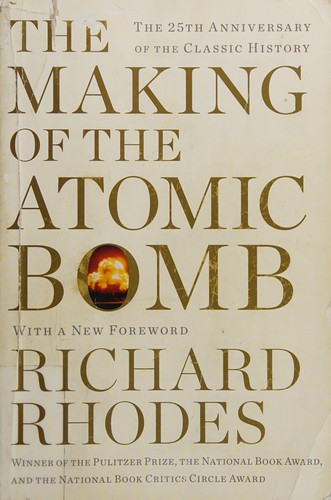
As an Amazon Associate, OverClassified may earn from qualifying purchases made through this link, at no extra cost to you.
Why This Is Essential Reading
The Making of the Atomic Bomb earns its place on this list as the single most comprehensive, critically vindicated account available of exactly why global uranium supply, and the Belgian Congo's Shinkolobwe deposit specifically, became such an urgent strategic priority during and after World War II. Read alongside Susan Williams's Spies in the Congo, this book completes the strategic-context picture behind this site's own Belgian Congo uranium-mine saucer case file, moving from the specific OSS mission on the ground to the full global stakes that mission was protecting.
Related Cases & Theories
Essential Viewing
Sources Cited
- Rhodes, Richard. The Making of the Atomic Bomb. Simon & Schuster, 1986 (25th Anniversary Edition, ISBN-13 9781451677614). amazon.com
- "Richard Rhodes." Wikipedia (full biography: early life, education, career, bibliography). en.wikipedia.org
- "The Making of the Atomic Bomb." Wikipedia (publication history, awards, content). en.wikipedia.org
- "Richard Rhodes." Atomic Heritage Foundation / Nuclear Museum (biography). ahf.nuclearmuseum.org
- "Richard Rhodes, Pulitzer Prize-winning author of The Making of the Atomic Bomb." National Security Archive, 2015. nsarchive.gwu.edu
- "Richard Rhodes." Bulletin of the Atomic Scientists (contributor biography). thebulletin.org
- "The Making of the Atomic Bomb." Kirkus Reviews. kirkusreviews.com
- "The Making of the Atomic Bomb." Simon & Schuster (official publisher page, critical blurbs). simonandschuster.com
- "The Making of the Atomic Bomb." Goodreads (reader ratings and reviews). goodreads.com
- "The Making of the Atomic Bomb." Open Library (bibliographic record and cover art source). openlibrary.org
- "Richard Rhodes — The making of the atomic bomb." Dwarkesh Podcast (YouTube). youtube.com
- This site's own case file: Flying Saucers Over the Belgian Congo Uranium Mines, for the full analysis this book's nuclear-history context supports.
- This site's own key-figures entry: Richard Rhodes, for his full biography and further case connections.
- This site's own essential reading entry: Spies in the Congo, the companion title on the Shinkolobwe OSS mission specifically.
Have corrections, additional research, or peer-reviewed sources? Help improve this entry.
Suggest an Edit