
Spies in the Congo
America's Atomic Mission in World War II
Core Thesis
Spies in the Congo is historian Susan Williams's 2016 account of the Office of Strategic Services' World War II mission to secure the Shinkolobwe mine in Belgian Congo, whose uranium ore — at 65–75% uranium oxide by weight, purer than any other known deposit on Earth — supplied roughly two-thirds of the fissile material in the first American atomic weapons. Its relevance to this site is direct and substantial: this book documents the real, extensively verified American, Belgian, and Soviet intelligence apparatus that surrounded Shinkolobwe for decades, the exact documented Cold War backdrop this site's own Belgian Congo uranium-mine saucer case file cites when explaining why two reported "fiery discs" over the district in 1952 landed in a CIA intelligence file at all.
About the Author
Susan Williams is a historian and Senior Fellow at the School of Advanced Study, University of London, whose research specializes in the history of sub-Saharan Africa, decolonization, the Cold War, and European colonialism's twentieth-century global power shifts. Her broader bibliography includes Colour Bar, Who Killed Hammarskjöld?, and the related later book White Malice: The CIA and the Covert Colonization of Africa, giving her a sustained, multi-book scholarly focus on exactly the intersection of African history and Western intelligence operations this book examines.
Williams received the Windham Campbell Prize in 2023, one of the literary world's most substantial nonfiction prizes, recognizing her broader body of historical writing — an honor reflecting her standing well beyond this single title's own reception.
For Spies in the Congo, Williams drew on newly released, formerly top-secret archival material from the United States, United Kingdom, and Belgium, alongside personal testimonies and audiovisual material including 8mm home-movie footage shot by the OSS's own lead agent in the field — primary-source access that gave the book's account of the Shinkolobwe intelligence mission a documentary depth not available to earlier, more general histories of the Manhattan Project's uranium supply chain.
Williams's broader academic training in African history, rather than nuclear physics or military-intelligence studies specifically, shaped the book's own distinctive analytical emphasis: where a more narrowly technical Manhattan Project history might treat the Congo primarily as a raw-materials footnote, Williams gives the mine, its Belgian colonial administration, and the African laborers who worked it their own full historical weight as active participants in the story rather than a passive backdrop to an entirely American and European drama.
Historical Context & Origins
The book was published in 2016, drawing on archival material that had only become accessible to researchers in the preceding years as American, British, and Belgian intelligence records from the World War II era continued their gradual, multi-decade declassification process — meaning much of the book's specific operational detail was genuinely unavailable to earlier historians of the Manhattan Project's uranium supply.
The book's subject sits within a broader story this site's own case file traces across more than a decade: Union Minière du Haut-Katanga's managing director Edgar Sengier shipped roughly 1,000 tons of Shinkolobwe ore to the United States for safekeeping in 1939 on nothing more than an informed hunch that uranium might soon matter; when Manhattan Project officials contacted him in 1942, he sold them his entire stockpile, and the mine was refurbished and reopened to supply roughly 30,000 additional tons through 1944 — the specific operational period this book's OSS mission narrative covers most closely.
Williams's research also situates the wartime OSS mission within its immediate, considerably darker strategic context: the genuine fear, however it is now assessed in hindsight, that Nazi Germany might successfully divert or smuggle Congolese uranium toward its own nuclear research program, a threat serious enough to justify posting American intelligence officers to a remote central African mining district specifically to monitor and secure the ore's entire export route from mine to Atlantic port.
The book's 2016 publication also arrived amid renewed general public interest in the hidden or under-told stories of World War II intelligence work, a publishing environment that had already proven receptive to comparable archival-recovery projects uncovering previously obscure but strategically significant wartime operations — a broader trend this book's own strong critical reception and sales performance benefited from, even as its specific African setting distinguished it from the more common European-theater espionage narratives dominating that wider publishing category.
Core Arguments & Key Concepts
The book's central argument is that the Shinkolobwe uranium supply chain represented a genuinely decisive, if historically underappreciated, strategic vulnerability the Allied atomic program depended on entirely — without secure, exclusive access to this single central African mine's exceptionally pure ore, the Manhattan Project's own timeline and technical feasibility would have looked considerably different, making the OSS's largely unglamorous logistics-and-security mission arguably as consequential to the war's outcome as more celebrated wartime intelligence operations.
Williams traces the specific, documented export route the OSS mission was built to protect: ore moved by rail from Shinkolobwe to Elisabethville, onward to Kolwezi, then by rail again to the Angolan port of Lobito for shipment to the United States — a route this site's own case file draws on directly, and one whose specific vulnerabilities to sabotage, diversion, or foreign intelligence penetration structured the entire OSS security operation the book documents.
The book also documents in granular detail the OSS's own operational methods in the field: intelligence officers embedded in the mining district, covert surveillance of potential threats, and the broader institutional apparatus that would later evolve, in the postwar period, into the CIA's own continued interest in the mine — including the "controlled source" intelligence asset a later historical account describes the CIA establishing specifically within the mining district to provide early warning of any threat.
Some critical readers have noted the book's large cast of characters — American, Belgian, and British intelligence officers, mining officials, and colonial administrators — as occasionally challenging to track across a narrative spanning multiple countries and intelligence services, a genuine structural complexity inherent to any book attempting to document a multinational intelligence operation this dispersed, rather than a flaw unique to Williams's own research or writing.
Williams also documents the specific individual at the center of the OSS's on-the-ground presence in the mining district, whose 8mm home-movie footage the book draws on directly — a rare category of primary-source material for a wartime intelligence operation of this kind, since routine covert fieldwork rarely produced its own contemporaneous visual documentation, making this specific footage an unusually direct window into the mission's day-to-day reality rather than a retrospective reconstruction built entirely from written reports and later interviews.
Key Cases & Evidence Discussed
This site's own Flying Saucers Over the Belgian Congo Uranium Mines (Case File #173, March 29, 1952) is the case file this book's history most directly supports. The case file's own Background section draws extensively on this book to explain why a single Austrian correspondent's dispatch about "fiery discs" over the Shinkolobwe district ended up as a report-numbered document in CIA files at all: American, Belgian, and Soviet intelligence services were all, for entirely earthly strategic reasons the book documents in detail, already paying very close attention to the airspace above this specific mine in 1952, following the Soviet Union's first successful atomic test in August 1949 sharply escalated Washington's anxiety over securing its uranium supply.
This site's own UFO Sightings Over Morocco and French West Africa (Case File #180, July 3, 1952) situates the Belgian Congo report within the broader 1952 wave the case file documents — the single busiest year of Project Blue Book's entire existence, cresting that July with the multiply radar-tracked Washington, D.C. UFO Flap and extending into a substantial African and European wave including Tunisia, Spain, and West Germany. This book's own narrower, single-location focus on the Congo's specific intelligence apparatus provides useful contrast against that wider regional pattern, helping a reader judge whether the Congo report's institutional documentation reflects something genuinely case-specific or simply the broader wave's general geographic spread reaching a location with unusually attentive intelligence coverage already in place.
Critical Reception & Controversies
The book received strong reviews across multiple outlets. The Economist called it "gripping," and The Guardian described it as meticulously researched with "shades of Graham Greene, a hint of Conrad, even echoes of Indiana Jones" — praise specifically crediting the book's genuine narrative tension despite its rigorously documentary, archive-grounded research base.
Kirkus Reviews called it "a fine complement to other accounts of wartime efforts to keep atomic weapons from the Germans," and Publishers Weekly praised it for offering "new insight on intelligence activities in sub-Saharan Africa during WWII" — both outlets specifically crediting the book's genuinely novel archival contribution rather than treating it as a retelling of already well-documented Manhattan Project history.
At least one reviewer offered a genuine critical note, observing that the book's large cast of characters across multiple national intelligence services occasionally makes the narrative difficult to follow, with readers needing to track numerous figures whose relationships to the central story are not always immediately clear — a fair structural criticism this article notes rather than omits, consistent with its practice of presenting genuine critical reception alongside praise.
No critical source located in researching this article disputes the book's core historical claims about the Shinkolobwe mine's strategic significance or the OSS mission's documented existence and activities; critical engagement centers on narrative structure and readability rather than any factual dispute.
The book's later companion, White Malice, examining the CIA's broader covert activities across postwar Africa, has itself received substantial critical attention, and its strong reception has retrospectively reinforced Spies in the Congo's own standing as the earlier, foundational installment in what has become a recognized, sustained body of scholarship on Western intelligence operations in Africa specifically.
Influence & Legacy
This book is cited in this site's own Belgian Congo uranium-mine saucer case file as the source for its account of the OSS mission chronicling the effort to secure Shinkolobwe's export route, directly shaping the case file's own Background section explaining the real, documented strategic context surrounding the 1952 sighting report.
The book has become a standard reference for subsequent scholarship and journalism on the intersection of African colonial history, the Manhattan Project's supply chain, and wartime intelligence operations, frequently cited alongside Williams's own related later book White Malice as essential background for understanding the Cold War's specifically African dimension.
Williams's own continued scholarly output, including her 2023 Windham Campbell Prize recognition, has kept this book's underlying research in continued circulation and citation well beyond its original 2016 publication, reinforcing its standing as a foundational rather than superseded account of the Shinkolobwe mission.
The book has also contributed to a broader, ongoing reassessment within African historical scholarship of the continent's own active, consequential role in twentieth-century global events, pushing back against older historiographical traditions that treated Africa primarily as a passive resource periphery to events decided in Washington, London, or Berlin — a reframing directly relevant to how this site's own case file treats the Belgian Congo not merely as an incidental UFO-report location but as a site of genuine, documented global strategic significance in its own right.
The Book
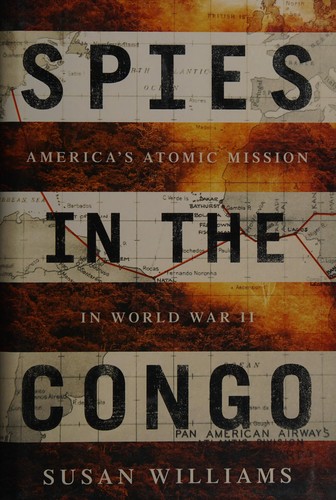
As an Amazon Associate, OverClassified may earn from qualifying purchases made through this link, at no extra cost to you.
Why This Is Essential Reading
Spies in the Congo earns its place on this list as the single most thoroughly documented account available of exactly why the airspace over the Shinkolobwe mine mattered enough, in 1952, for a report about "fiery discs" to travel all the way into CIA intelligence files. Read alongside this site's own Belgian Congo uranium-mine saucer case file, this book supplies the genuine, high-stakes strategic backdrop — not speculation, but archivally documented Cold War intelligence history — that separates this case from a purely speculative UFO report and grounds it in real, verifiable geopolitical stakes.
Related Cases & Theories
Sources Cited
- Williams, Susan. Spies in the Congo: America's Atomic Mission in World War II. PublicAffairs, 2016 (ISBN-13 9781610396547). amazon.com
- "Susan Williams (historian)." Wikipedia (full biography: career, books, awards). en.wikipedia.org
- "Dr Susan Williams." University of London, School of Advanced Study (academic profile). research.london.ac.uk
- "Susan Williams." Windham Campbell Prizes (2023 recipient profile). windhamcampbell.org
- "Spies in the Congo." Hurst Publishers (UK edition publisher page). hurstpublishers.com
- "Spies in the Congo." Hachette Book Group / PublicAffairs (official publisher page, critical blurbs). hachettebookgroup.com
- "Book review: Spies in the Congo by Susan Williams." The Scotsman. scotsman.com
- "Book Review: Spies in the Congo." HistoryNet. historynet.com
- Williams, Susan. "How a rich uranium mine thrust the Congo into the centre of the Cold War." The Conversation, September 1, 2016 (adapted from this book; also cited in this site's own case file). theconversation.com
- "Spies in the Congo: America's Atomic Mission in World War II." Goodreads (reader ratings and reviews). goodreads.com
- "Spies in the Congo." Open Library (bibliographic record and cover art source). openlibrary.org
- This site's own case file: Flying Saucers Over the Belgian Congo Uranium Mines, for the full analysis this book's intelligence-history context supports.
- This site's own case file: UFO Sightings Over Morocco and French West Africa, for the broader 1952 regional wave the Congo case sits within.
- This site's own key-figures entry: Susan Williams, for her full biography and further case connections.
- This site's own key-figures entry: Fritz Sitte, the original correspondent whose 1952 dispatch is the case file's sole primary source.
Have corrections, additional research, or peer-reviewed sources? Help improve this entry.
Suggest an Edit