
The Invention of News
How the World Came to Know About Itself
Core Thesis
The Invention of News is Andrew Pettegree's 2014 history of how commercial news publishing developed across ten European countries between 1400 and 1800, tracing the transition from private information networks controlled by medieval elites through sixteenth-century news pamphlets and traveling news singers to the newspapers of the eighteenth century. Its relevance to this site is institutional and contextual: the book documents, in careful historical detail, the exact commercial and political news economy — competitive printers, itinerant correspondents, sensationalized "wonder-sign" pamphlets sold for profit — that produced sheets like the 1566 Basel Celestial Phenomenon broadsheet, situating printer Samuel Apiarius and compiler Samuel Coccius within a much larger, well-documented pattern rather than treating their specific broadsheet as an isolated curiosity.
About the Author
Andrew Pettegree was born in 1957 and educated at Merton College, Oxford, before holding research fellowships at the University of Hamburg and Peterhouse, Cambridge. He moved to the University of St Andrews in 1986, where he is now professor of modern history and founding director of the St Andrews Reformation Studies Institute.
Pettegree is also founding director of the Universal Short Title Catalogue project, a comprehensive bibliographic database of every book published in Europe before 1601 — an enormous, decades-long scholarly infrastructure project that gave him direct, systematic access to the surviving print record underlying The Invention of News's own broad, ten-country comparative scope in a way few individual historians working from more limited archival access could match. This infrastructure-building dimension of his career is directly relevant to how this article evaluates the book's reliability: rather than drawing conclusions from a curated, hand-selected sample of famous or unusually well-preserved documents, Pettegree's comparative claims rest on a systematic, near-comprehensive survey of the surviving print record across the full period and geographic scope the book covers.
Beyond this book, Pettegree has published an extensive body of work on the Reformation and the history of print, including his award-winning 2010 study The Book in the Renaissance. He founded two influential monograph series, the St Andrews Studies in Reformation History and The Library of the Written Word, and currently serves as vice president of the Royal Historical Society, reflecting his broader standing within the professional historical community beyond his own individual publications.
Pettegree's later book The Bookshop of the World: Making and Trading Books in the Dutch Golden Age extended his interest in the commercial mechanics of the early print trade into the specific case of the Dutch Republic's own outsized role in European publishing, further developing the same core methodological approach — treating book and pamphlet production as a genuine commercial industry subject to ordinary market pressures — that structures The Invention of News's own treatment of the broader European news trade.
Historical Context & Origins
The book was published in 2014 by Yale University Press, arriving at a moment of renewed academic and public interest in the history of news media more broadly, driven partly by contemporary anxieties about digital media's own rapid transformation of how information spreads — a parallel Pettegree draws on explicitly, situating the sixteenth and seventeenth centuries' own periodic waves of new media technology (print pamphlets, then early newspapers) as an illuminating historical precedent for understanding periods of rapid informational change.
Pettegree's specific methodological approach — drawing on the systematic bibliographic infrastructure of the Universal Short Title Catalogue project he directs — allowed him to move beyond the kind of single-country or single-genre studies that had previously dominated the history of early news, instead tracing common patterns and genuine national differences across ten distinct European print cultures over four centuries.
The book's 2014 publication predates by roughly a decade the more recent surge of academic and popular interest in early modern "wonder-sign" (Wunderzeichen) broadsheets specifically as documented precursors to the modern UFO phenomenon — meaning Pettegree wrote about sheets like Basel's own 1566 broadsheet as one genre among many within the broader commercial news economy, without any particular ufological framing, giving his account a useful, independently arrived-at institutional context this site's own case file can draw on.
Pettegree also situates the specific German-speaking print centers relevant to both the Basel and Nuremberg cases — a densely competitive regional market featuring numerous rival printers often working in the same city or nearby cities — within his broader comparative framework covering France, England, the Low Countries, Italy, and other European print markets, allowing readers to judge whether the specific commercial dynamics that shaped Basel's own broadsheet were typical of the wider European pattern or reflected some more locally specific circumstance.
Core Arguments & Key Concepts
The book's central argument is that the transmission of news before the modern era was never simply a story of technological progress from oral rumor to printed newspaper, but a considerably more complex, non-linear process in which multiple parallel news channels — private correspondence networks among merchants and diplomats, public proclamation, traveling ballad-singers, and printed pamphlets — coexisted, competed, and influenced one another across the full four-century period the book covers.
Pettegree pays particular attention to the commercial dimension of early news publishing: printers and pamphlet-sellers were, from the earliest period the book covers, operating genuine businesses competing for paying customers, meaning the specific content that got published and sold was shaped as much by what readers would pay to read — sensational, dramatic, or reassuringly providential stories — as by any pure journalistic commitment to documented fact.
This commercial dynamic is directly relevant to how the book treats sensationalized "wonder-sign" pamphlets describing unusual celestial events, monstrous births, and other dramatic natural phenomena: Pettegree situates these not as fringe or marginal print products but as a genuinely significant, commercially successful category within the broader early news economy, one printers had every ordinary business incentive to produce and readers every ordinary appetite to purchase, regardless of the underlying events' actual accuracy.
The book also traces how competitive pressure between rival printers in the same city or region — exactly the kind of environment Basel's own print market operated within — created ordinary commercial incentives to be first with a dramatic story, incentives that did not necessarily reward the kind of careful, multiply-corroborated fact-checking a modern reader might assume period news publishing aspired to.
Pettegree devotes specific attention to the role illustration played in the commercial success of pamphlets describing unusual celestial or natural events: a striking woodcut illustration, often produced with considerably more artistic license than documentary precision, was itself a major selling point independent of the accompanying text's own accuracy — directly relevant context for evaluating the specific, dramatic imagery accompanying broadsheets like Basel's own illustrated depiction of colliding fiery spheres, which likely reflects the printer's own commercial and artistic priorities as much as any precise visual record of what witnesses actually reported seeing.
The book further documents the specific role played by traveling news singers and itinerant balladeers as a distinct, non-print channel operating alongside the pamphlet trade, often performing dramatized versions of the same sensational stories printers were simultaneously selling in written form. This dual-channel dynamic — a story circulating simultaneously through both oral performance and printed pamphlet, each reinforcing public awareness of and demand for the other — helps explain how a single regional event could achieve the kind of rapid, widespread public attention broadsheets like Basel's own account reflect, well before any modern mass-communication infrastructure existed.
Key Cases & Evidence Discussed
This site's own Basel Celestial Phenomenon (Case File #54, August 7, 1566), printed and sold in Basel, Switzerland, is the case file this book's institutional context most directly supports. The case file's own account of how Samuel Coccius compiled secondhand testimony into a written account, which Basel/Bern printer Samuel Apiarius then issued as an illustrated broadsheet, follows precisely the commercial production pattern this book documents across dozens of comparable sixteenth-century news pamphlets: a compiler assembling available testimony, a printer with a genuine commercial incentive to produce a dramatic, saleable product, and a reading public with an established appetite for sensational "wonder-sign" news.
This site's own Nuremberg Celestial Phenomenon (Case File #53, April 14, 1561), the closest documented parallel to Basel and one of the two most frequently reproduced primary sources in historical UFO literature, was produced within the same broader German-language print economy Pettegree's book documents, illustrating that Basel's broadsheet was not an isolated production but part of a recognizable, commercially successful genre spanning multiple print centers across the German-speaking lands of the period.
This site's broader catalog includes numerous other historical "celestial phenomenon" case files drawn from the same general 16th- and 17th-century European "wonder-sign" broadsheet tradition Pettegree's book documents at the institutional level. Readers evaluating any of these accounts benefit from the same basic commercial-context questions this book equips them to ask: who compiled the testimony, who printed and profited from the finished sheet, and what competitive or political pressures might have shaped which details were emphasized, exaggerated, or omitted before the account reached its final printed form.
The book's account of how surviving broadsheet collections were assembled and preserved — most notably the Wickiana collection at the Zentralbibliothek Zürich, compiled by the pastor and inveterate news-collector Johann Jakob Wick, which houses the surviving Basel broadsheet itself — also supplies useful archival context for this site's own case file, explaining why certain sensational broadsheets survive in the documentary record at all while countless other period pamphlets, printed in comparable numbers, were simply used, discarded, and lost.
Critical Reception & Controversies
The book won Harvard University's Goldsmith Book Prize in 2015, an award recognizing books that improve democratic governance through examination of media, politics, and public policy — a mark of the book's recognized significance beyond purely academic historical circles.
The New Yorker called the book "revelatory," and Kirkus Reviews described it as "learned and well-written," while BBC History Magazine praised it as "judicious and well written, with illustrations that give an immediate sense of how 'news' evolved from being the concern of the political elite to the privilege of entire nations."
Academic reviews, including a detailed assessment published in The Journal of Modern History, engaged substantively with the book's methodology and comparative scope, treating it as a significant scholarly contribution to the history of communication and print culture rather than merely an accessible popular synthesis. H-Net's own scholarly review, by historian Peter Marshall, specifically praised the book's success at making a genuinely comparative, multi-country historical argument accessible to non-specialist readers without sacrificing underlying documentary rigor — a combination Marshall noted as considerably harder to achieve across four centuries and ten national contexts than in a more narrowly scoped single-country study.
No critical source located in researching this article disputes the book's core historical account of early news publishing's commercial and institutional structure; critical engagement has focused on debating specific interpretive emphases and comparative national patterns rather than on any foundational factual dispute.
Some academic reviewers have noted the book's necessarily selective treatment of any single country's news history, given its deliberately broad ten-country, four-century comparative scope — a fair observation about any work attempting comparative synthesis at this scale, and one Pettegree himself has addressed in later, more narrowly focused books like The Bookshop of the World, which allow considerably deeper treatment of a single national case than the broader synthesis could accommodate.
Influence & Legacy
This exact edition is cited in this site's own Basel Celestial Phenomenon case file's Further Reading section as "a history of early print news culture across ten countries, situating printers like Samuel Apiarius and compilers like Samuel Coccius within the commercial and political news economy that produced sheets like Basel's."
The book has become a standard reference work in subsequent scholarship on early modern print and media history, frequently cited alongside Pettegree's own related work on the Reformation and the broader history of the book as foundational context for understanding how information actually circulated before the modern newspaper era.
Pettegree's continued direction of the Universal Short Title Catalogue project means the book's own underlying bibliographic infrastructure continues to grow and be refined well beyond the book's 2014 publication date, giving subsequent researchers, including this site's own case-file research into broadsheets like Basel's, an increasingly comprehensive documentary foundation to draw on.
The book's 2015 Goldsmith Prize recognition specifically credited its relevance to contemporary media-policy debates, a framing that has given the book a continued afterlife in discussions of digital-era media disruption well beyond its original historical subject matter — commentators drawing explicit parallels between the print revolution's own disruptive effects on how news traveled and the internet's comparable transformation of the modern news ecosystem, a parallel Pettegree himself explicitly invites in the book's own framing.
The Book
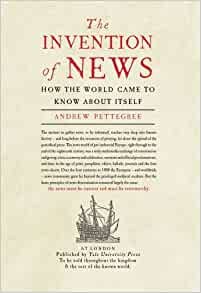
As an Amazon Associate, OverClassified may earn from qualifying purchases made through this link, at no extra cost to you.
Why This Is Essential Reading
The Invention of News earns its place on this list as the single most comprehensive available institutional context for understanding exactly why, and through what commercial and political mechanisms, a sheet like the 1566 Basel Celestial Phenomenon broadsheet came to exist and circulate in the first place. Read alongside Robert Greenler's Rainbows, Halos, and Glories, this book supplies the human and commercial half of the explanation this site's own case file offers — not just what physical phenomenon likely produced the reported sighting, but why the specific, dramatic, illustrated account of it that survives took the printed form it did.
Related Cases & Theories
Essential Viewing

Sources Cited
- Pettegree, Andrew. The Invention of News: How the World Came to Know About Itself. Yale University Press, 2014 (ISBN-13 9780300212761). amazon.com
- "The Invention of News." Yale University Press (official publisher page). yalebooks.yale.edu
- "Andrew Pettegree." Wikipedia (full biography: education, career, bibliography). en.wikipedia.org
- "Andrew Pettegree." University of St Andrews Research Portal (academic profile; page removed, archived copy). web.archive.org
- "Prof Andrew Pettegree." University of St Andrews School of History. st-andrews.ac.uk
- Marshall, Peter. "Review of Pettegree, 'The Invention of News: How the World Came to Know about Itself'." H-Net Reviews. networks.h-net.org
- "The Invention of News: How the World Came to Know about Itself." Goldsmith Awards, Harvard Kennedy School Shorenstein Center. goldsmithawards.org
- "The Invention of News." Kirkus Reviews. kirkusreviews.com
- Sterling, Christopher H. "Book Review: The Invention of News." Journalism & Mass Communication Quarterly, SAGE Journals, 2014. journals.sagepub.com
- "The Invention of News: How the World Came to Know About Itself." Goodreads (reader ratings and reviews). goodreads.com
- "The Invention of News." Open Library (bibliographic record and cover art source). openlibrary.org
- This site's own case file: Basel Celestial Phenomenon, for the full broadsheet analysis this book's institutional context supports.
- This site's own case file: Nuremberg Celestial Phenomenon, for the closely parallel 1561 broadsheet produced within the same print economy.
- This site's own key-figures entry: Andrew Pettegree, for his full biography and further case connections.
- This site's own essential reading entry: Rainbows, Halos, and Glories, the companion physical-explanation reference for the Basel and Nuremberg cases.
Have corrections, additional research, or peer-reviewed sources? Help improve this entry.
Suggest an Edit