
The Casimir Effect
Physical Manifestations of Zero-Point Energy
Core Thesis
The Casimir Effect: Physical Manifestations of Zero-Point Energy is physicist Kimball A. Milton's 2001 graduate-level monograph developing the Green's-function theory of Casimir forces -- the mathematical machinery underlying a genuine, experimentally confirmed quantum electrodynamics effect in which closely spaced conducting plates experience a measurable attractive force due to the restriction of vacuum electromagnetic field modes in the gap between them. This site's own research treats the book not as a source of speculative claims but as the rigorous physics foundation that later, far more speculative proposals -- including Robert Forward's 1984 "vacuum-fluctuation battery" and Bernard Haisch and Garret Moddel's patented atom-pumping approach -- both explicitly build on and, in most cases, fail to extend successfully. This site's own research draws on it for two theory pages: Vacuum Polarizability (PV Model) and the Zero-Point Energy Extraction Hypothesis, the latter of which cites it as developing the specific theoretical framework "both Forward's and Haisch/Moddel's extraction proposals build on."
About the Author
Kimball A. Milton is George Lynn Cross Research Professor of Physics, Emeritus, at the University of Oklahoma. He is a Fellow of the American Physical Society, a Fellow of the Institute of Physics (UK), a Foreign Member of the Royal Norwegian Society of Sciences and Letters, and held a Simons Fellowship from 2013 to 2014 -- a credentials profile this site's own research treats as placing him firmly within mainstream, peer-reviewed theoretical physics rather than the fringe-physics tradition many speculative-propulsion books in this site's library come from.
Milton's own research career has centered on nonperturbative methods in quantum field theory, including work on magnetic monopoles, PT-symmetric quantum field theories, and, most extensively, vacuum fluctuation phenomena -- the Casimir effect specifically -- studied across contexts ranging from cosmology through hadronic physics to condensed-matter systems. His own current research interests, per his university research page, include the divergences encountered in Casimir-force calculations, thermal corrections in real materials, the gravitational implications of quantum vacuum energy, repulsive Casimir forces, and Casimir friction and propulsion of particles moving through nontrivial backgrounds.
This site's own research treats Milton's specific technical contribution -- developing exact Green's-function techniques for extracting Casimir interactions between distinct bodies -- as directly relevant to evaluating the far more speculative extraction and propulsion proposals covered elsewhere in this site's theory library, since any claim about extracting usable energy or thrust from vacuum fluctuations must ultimately be checked against the same rigorous mathematical framework Milton's own book lays out.
Milton has also served as a working, peer-reviewed contributor to the broader quantum field theory literature well beyond this single monograph, publishing extensively on related topics in journals subject to the same standard peer-review process that governs mainstream physics publishing generally -- a sustained publication record this site's own research treats as further evidence that his own specific treatment of Casimir-force mathematics reflects an active, continuously updated research program rather than a single, isolated popular-audience book written outside his own core academic specialty.
Historical Context & Origins
The Casimir effect itself was first theoretically predicted in 1948 by Dutch physicist Hendrik Casimir, but remained a largely academic curiosity for decades before precision experimental confirmation became possible. Steve K. Lamoreaux's landmark 1997 measurement, using a torsion pendulum to measure the force between a spherical lens and a flat plate across separations of roughly 0.6 to 6 micrometers, recorded a force matching the quantum-electrodynamics prediction to within about 5 percent -- a level of agreement this site's own research treats as leaving essentially no room for the effect to be some other, unrelated interaction masquerading as vacuum-fluctuation pressure.
Milton's own book appeared in 2001, four years after Lamoreaux's confirming measurement had settled the experimental question, positioning the monograph as a systematic theoretical treatment written into a research environment where the underlying physics was no longer seriously disputed -- the book's own scholarly task was extending and formalizing the mathematics, not establishing the effect's basic reality.
The book's publication also preceded, by several years, the two major American government research programs this site's own theory pages document engaging with Casimir-force physics: NASA's Breakthrough Propulsion Physics Program (active 1996-2002, overlapping the book's publication) and DARPA's Casimir Effect Enhancement program (2009-2011), meaning Milton's own theoretical framework was already established and available as reference material by the time both programs began their own applied research.
The broader scientific context surrounding the book's 2001 publication also included growing popular-science and speculative-engineering interest in "zero-point energy" as a potential power source, fueled partly by genuine confirmed physics like the Casimir effect and partly by a much larger body of unrelated, scientifically unsupported free-energy and perpetual-motion claims -- a conflation this site's own research treats as directly relevant to why a rigorous, credentialed technical treatment like Milton's own book serves a genuinely useful public function, giving readers a way to separate the confirmed physics from the surrounding speculative and pseudoscientific noise it is frequently mixed together with in less careful popular treatments.
Core Arguments & Key Concepts
The book's central technical contribution is a systematic Green's-function approach to calculating Casimir forces between bodies of varying geometry, moving beyond the simplest parallel-plate case toward a general mathematical framework capable of handling more complex real-world configurations -- the specific mathematical machinery this site's own research treats as necessary infrastructure for evaluating any later, more applied proposal that invokes the Casimir effect.
A second, foundational argument -- consistent with the mainstream physics consensus this site's own theory pages independently document -- is that the Casimir effect's existence is genuinely settled science, not a fringe or speculative claim: Lamoreaux's 1997 measurement and numerous subsequent replications confirmed the effect to high precision, meaning any legitimate scientific dispute about applications of the effect must be aimed squarely at the specific application being proposed, not at the underlying force's reality.
A third argument, developed through the book's own treatment of vacuum energy divergences, addresses a genuinely difficult technical problem in the field: naive calculations of total vacuum zero-point energy produce formally infinite results, and Milton's own work on regularization and renormalization techniques for these divergences represents exactly the kind of careful mathematical bookkeeping that separates legitimate Casimir-effect physics from popular-science oversimplifications that treat "zero-point energy" as an unlimited, freely tappable reservoir.
A fourth argument concerns the specific, hard theoretical limits the book's own framework implies for energy-extraction schemes: this site's own Zero-Point Energy Extraction Hypothesis theory page documents that Garret Moddel and Olga Dmitriyeva's 2019 theoretical assessment, building on exactly this kind of rigorous Casimir-force mathematics, concluded that Robert Forward's 1984 mechanical plate-cohesion extraction scheme violates basic thermodynamic principles of detailed balance and cannot be made to work regardless of engineering refinement -- a conclusion that depends directly on the same underlying physics Milton's book formalizes.
A fifth argument, more favorable to at least one later proposal, concerns Haisch and Moddel's own patented atom-pumping mechanism: because it uses a continuously renewable working substance -- a flowing gas rather than a pair of plates that can only be compressed once -- Moddel and Dmitriyeva's 2019 assessment found this specific approach "does not appear to violate" the same thermodynamic principles that rule out plate-cohesion extraction, though the one direct experimental test conducted so far produced results the authors themselves described as "tantalizing but inconclusive," with power output well below theoretical predictions.
A sixth argument, running throughout the book's own treatment of Casimir geometries beyond the simplest parallel-plate case, concerns why geometry itself matters so much to any proposed application: the magnitude, and even the sign, of a Casimir force depends sensitively on the specific shape and material properties of the interacting bodies, meaning a calculation done for one geometry cannot simply be assumed to transfer to a different proposed configuration without redoing the underlying mathematics -- a point this site's own research treats as directly relevant to evaluating any speculative propulsion or extraction scheme that invokes "the Casimir effect" generically without specifying the exact geometry involved.
A seventh argument concerns the book's own treatment of repulsive, rather than attractive, Casimir forces: under specific material and geometric conditions, the Casimir force can in principle push bodies apart rather than pulling them together, a genuinely counterintuitive result within the same confirmed theoretical framework that this site's own research treats as illustrating how much genuine subtlety exists within settled Casimir-effect physics even before any speculative extraction or propulsion application is layered on top of it.
Key Cases & Evidence Discussed
This site's own Zero-Point Energy Extraction Hypothesis theory page discusses NASA's Breakthrough Propulsion Physics Program, active from 1996 to 2002 under program manager Marc G. Millis, which spent roughly $1.2 million systematically assessing fourteen categories of proposed revolutionary propulsion and power physics; of the program's own final assessment, the Casimir effect was placed among the four topics flagged for continued research rather than dismissed outright, one of the more encouraging institutional conclusions this site's theory library documents for any Casimir-adjacent hypothesis.
The same theory page documents DARPA's Casimir Effect Enhancement program, launched in 2009 under DARPA physicist Thomas Kenny and running roughly two years, which funded five research groups -- at Harvard, Yale, the University of California, Riverside, and the Argonne and Los Alamos National Laboratories -- to develop new methods of engineering Casimir forces at surfaces, with DARPA's own stated goals centered on nanodevice adhesion, drag reduction, and levitating microstructures rather than energy generation specifically.
This site's own Zero-Point Energy Extraction Hypothesis page also documents Bernard Haisch and Garret Moddel's own May 2008 granted U.S. Patent 7,379,286, and Moddel's own 2012 presentation, "Test of Zero-Point Energy Emission from Gases Flowing Through Casimir Cavities," at the Space, Propulsion & Energy Sciences International Forum -- a direct experimental test of the mechanism behind his own patent, conducted using exactly the kind of Casimir-force physics Milton's book formalizes.
This site's own Vacuum Polarizability theory page presents a related, though conceptually distinct, proposal: rather than extracting usable energy from Casimir cavities, this hypothesis proposes that a craft might engineer the local dielectric constant of the surrounding quantum vacuum itself, altering local gravity, inertia, and the speed of light around the hull -- a considerably more speculative extension of the same underlying quantum-vacuum physics Milton's book treats with mathematical rigor, and one this site's own theory page classifies as "Patented, Unsubstantiated" rather than experimentally confirmed.
Critical Reception & Controversies
This book carries an extremely small Goodreads footprint: a single rating of 3 out of 5 stars, checked August 2026 -- a data point this site's own research discloses honestly rather than treating as evidence of the book's quality one way or the other, since a graduate-level physics monograph from an academic press is simply not the kind of title general readers rate on consumer platforms in any meaningful volume.
This site's research also attempted to verify an Amazon rating for this title, but Amazon's bot-detection system blocked automated requests to the listing during this session, the same persistent pattern encountered across every title checked this session; per this site's own Amazon Rating Display Protocol, this gap is disclosed honestly here rather than fabricated or silently omitted.
The book's own genuine critical standing rests on a different, more relevant foundation than consumer reviews: publication by World Scientific, a respected physics academic press, and continued citation within the peer-reviewed Casimir-effect literature in the decades since, including its direct relevance to Moddel and Dmitriyeva's own 2019 theoretical assessment of zero-point-energy extraction schemes -- the specific downstream application this site's own theory pages document in detail.
This site's own research treats the book's near-total absence from popular or consumer-facing review platforms as itself informative: it signals a title written for working physicists and graduate students rather than a general or paranormal-interested audience, distinguishing it sharply from the speculative propulsion and energy-extraction literature this site's own theory pages evaluate against it.
The book's genuine, if narrow, audience also means its own real critical reception is best assessed through citation counts and continued academic reference within the physics literature rather than through any popular-review aggregator, a distinction this site's own research treats as important context for readers used to evaluating books primarily through consumer star ratings: a graduate monograph's actual scholarly impact and its Goodreads score measure two entirely different things, and conflating them would badly misrepresent how seriously the underlying physics community actually takes this specific title.
Influence & Legacy
Within this site's own essential-reading library, this book occupies a distinct role from every other title this site's research has catalogued this session: rather than presenting a UFO-adjacent claim for evaluation, it supplies the rigorous physics baseline this site's own theory pages use to evaluate claims made by other authors, most directly the extraction and propulsion proposals covered in the Zero-Point Energy Extraction Hypothesis and Vacuum Polarizability theory pages.
The book's continued relevance to Moddel and Dmitriyeva's own 2019 reassessment of Casimir-based energy extraction -- nearly two decades after this book's own original publication -- demonstrates the durability of Milton's own theoretical framework as a reference point for evaluating new proposals as they continue to emerge, rather than the book becoming a superseded historical artifact.
This site's own research treats the book's direct relevance to two federally funded research programs, NASA's Breakthrough Propulsion Physics Program and DARPA's Casimir Effect Enhancement program, as evidence that the underlying physics Milton formalizes has attracted genuine institutional research interest well beyond academic physics departments alone, even though neither program's own findings validated the specific energy-extraction or propulsion applications later proposed by other researchers.
As the single graduate-level physics monograph in this site's own essential-reading library, this book gives readers who arrive at this site's own Zero-Point Energy Extraction or Vacuum Polarizability theory pages already skeptical of speculative propulsion claims a genuine, credentialed technical resource for verifying exactly which parts of the underlying physics are settled science and which parts remain speculative extrapolation.
The book's own enduring relevance also extends to how this site's research approaches every other propulsion-adjacent theory page in its library: the specific standard Milton's work sets -- precise, falsifiable mathematics checked against precision experiment -- functions as an implicit benchmark against which this site's own research measures the comparatively looser, less mathematically rigorous claims found in many popular exotic-propulsion books, even those not directly invoking the Casimir effect by name.
The Book
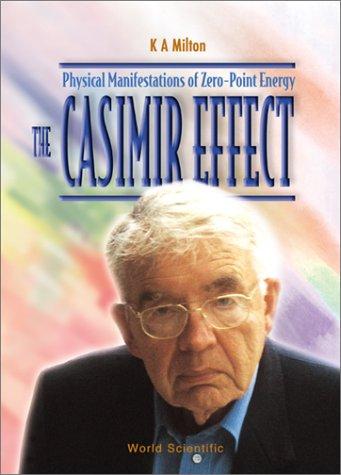
As an Amazon Associate, OverClassified may earn from qualifying purchases made through this link, at no extra cost to you.
Why This Is Essential Reading
The Casimir Effect earns its place on this list not as a source of UFO-adjacent claims but as the rigorous physics foundation against which this site's own Zero-Point Energy Extraction Hypothesis and Vacuum Polarizability theory pages evaluate far more speculative extraction and propulsion proposals. Kimball Milton's own credentialed standing within mainstream theoretical physics, combined with the book's continued citation in serious later assessments like Moddel and Dmitriyeva's 2019 reappraisal, together support this site's own judgment that the book has earned lasting reference status as the single most technically rigorous title in this site's library -- valuable precisely because it draws the clearest possible line between the genuinely confirmed Casimir effect and the unproven, and in some cases thermodynamically impossible, applications later authors have proposed building on top of it.
Related Cases & Theories
Essential Viewing

Sources Cited
- Milton, Kimball A. The Casimir Effect: Physical Manifestations of Zero-Point Energy. World Scientific, 2001 (ISBN 978-981-02-4397-5, cited here).
- "The Casimir Effect." Goodreads (checked August 2026). goodreads.com
- "The Casimir effect." Open Library (bibliographic record confirming the 2001 World Scientific edition, pagination, and subject classification). openlibrary.org
- Milton, Kimball A. Faculty research page, University of Oklahoma (biography, credentials, and research interests). nhn.ou.edu
- Moddel, Garret, and Olga Dmitriyeva. "Extraction of Zero-Point Energy from the Vacuum: Assessing Stability of Casimir Cavities." 2019 (cited in this site's own Zero-Point Energy Extraction Hypothesis theory page).
- "Negative Energy from the Casimir Effect: Still a Mystery." Sabine Hossenfelder, YouTube (physicist-authored explainer on the Casimir effect and its limits; video verified via oEmbed). youtube.com
- This site's own resources library: Full Reading List, where this exact edition is cited across 2 separate theory pages.
- This site's own theory page: Zero-Point Energy Extraction Hypothesis, the primary source of this article's technical content on Forward's and Haisch/Moddel's proposals.
- This site's own theory page: Vacuum Polarizability (PV Model).
- This site's own location entry: Los Alamos National Laboratory, one of the sites funded under DARPA's Casimir Effect Enhancement program.
- Lamoreaux, S. K. "Demonstration of the Casimir Force in the 0.6 to 6 µm Range." Physical Review Letters, 78, 5 (1997), the landmark precision measurement confirming the Casimir effect's existence to high precision.
- This site's own essential-reading entry: Frontiers of Propulsion Science, a comparable technical survey of speculative propulsion physics for further reading.
Have corrections, additional research, or peer-reviewed sources? Help improve this entry.
Suggest an Edit