
Swamp Gas My Ass
Alien Shades of Greys — Two F-106 Pilots and the 1966 Michigan Case, Fifty-Five Years Later
Core Thesis
Swamp Gas My Ass makes one substantial claim and this article exists to state it precisely and then say what can and cannot be checked about it. Raymond Szymanski — a retired senior electronics engineer whose Defense Department civil service career at Wright-Patterson Air Force Base ran from 1973 to 2011 — says that a senior Air Force officer and fighter-interceptor pilot broke fifty-five years of silence to describe intercepting, in an F-106 Delta Dart, the object behind the March 1966 Michigan 'swamp gas' sightings. The book is self-published, carries a foreword by Nick Pope, and is the final volume of a trilogy. The author's career and his public lecture programme are independently documented. The pilot testimony at the book's centre is not corroborated by any source outside the book, and no reader should treat it as established.
About the Author
Raymond Szymanski spent his working life inside the Department of Defense. His civil service career at Wright-Patterson Air Force Base ran from 1973 until his retirement in 2011 as a Senior Electronics Engineer — thirty-eight years across five decades, in the base's scientific and engineering establishment rather than in any intelligence or investigative role.
By his own account his interest in the subject began in his first week as a student employee, when a mentor told him that the base had housed Project Blue Book — the Air Force's UFO investigation office, which operated there for twenty-two years under the Foreign Technology Division — and that a crash in the 1940s in the American west had resulted in a craft and its occupants being brought to Wright-Patterson. The first part of that is a matter of public record. The second is the base's oldest and least verifiable rumour, and it has been the organising premise of Szymanski's writing ever since.
He has published three books on the subject: Fifty Shades of Greys: Evidence of Extraterrestrial Visitation to Wright-Patterson Air Force Base and Beyond, Alien Shades of Greys, and this volume, which completes the trilogy. All three are self-published. He lectures regularly at public libraries and community venues in Ohio and Michigan and receives local press coverage when he does.
The distinction that matters for a reader is between his credentials and his subject. Szymanski is genuinely what he says he is: a career defence engineer at the base at the centre of American UFO folklore. Nothing in that career gave him access to classified UFO material, and he does not claim otherwise. What he has is proximity, longevity and a network of contacts, and what he has done with them is collect testimony.
The foreword is by Nick Pope, formerly of the British Ministry of Defence and now the most widely quoted commentator on official UFO policy in the English-speaking world. A Pope foreword is a marketing asset rather than a verification, and readers should treat it as such — he has supplied them to a large number of books of varying quality.
Historical Context & Origins
The March 1966 Michigan sightings are among the most consequential events in American UFO history, and their consequence has nothing to do with what was seen. On the nights of March 20 and 21, 1966 there were two mass sightings: the first near marshland at Dexter, where the farmer Frank Mannor and his son watched a lighted object over a swamp, and the second, about fifty miles away, near the campus arboretum at Hillsdale College, witnessed by more than eighty people including students, college administrators and police officers.
J. Allen Hynek, the Air Force's civilian scientific consultant, offered marsh gas as a possible explanation for some of the reports at a press conference. The press stripped the qualifiers; the phrase 'swamp gas' entered the language as a synonym for official evasion; the ridicule was national and immediate; and the resulting congressional pressure produced the hearings that led directly to the Condon Committee and, through it, to the closure of Project Blue Book in 1969. The Michigan case did not settle anything about UFOs. It destroyed the Air Force's ability to be believed about them.
Observers at Selfridge Air Force Base in Harrison Township reported seeing the same lights as police officers in Michigan and in Sylvania, Ohio. That much is documented and it is the foundation on which the book's central claim is built: military observation of the events is on the record, and the question is what, if anything, was done about it.
The F-106 Delta Dart is the right aircraft for the period. It was Air Defense Command's primary all-weather interceptor through the 1960s, designed precisely for the mission of being scrambled at an unidentified radar return over the continental United States, and Selfridge was an active air-defence installation. An F-106 intercept over southern Michigan in March 1966 is entirely plausible as a matter of order of battle. Plausibility is not evidence.
The case has stayed alive locally in a way most 1960s cases have not. Michigan press outlets return to it regularly, surviving witnesses give interviews, and public libraries in the affected towns host talks about it. Szymanski's book emerged from that local circuit rather than from ufology's national institutions, which is unusual and worth noting.
The book's publication in November 2021 also placed it in a specific national moment. The June 2021 preliminary assessment on unidentified aerial phenomena delivered by the US intelligence community had, for the first time in fifty years, put the subject back into the category of legitimate national-security reporting. Szymanski's promotional framing invokes that report explicitly, and the argument he draws from it — that the witnesses of 1966 were dismissed for describing what the government now concedes it cannot explain — is the book's emotional core.
For completeness: Wright-Patterson's actual documented UFO history is Project Blue Book, which was administered there under the Foreign Technology Division from 1947 to 1969 and whose files are public. The recovered-craft rumour that has attached itself to the base for seventy-five years has never been substantiated by any released document, and Szymanski's earlier books do not substantiate it either.
Core Arguments & Key Concepts
The 1966 witnesses were dismissed rather than investigated, and the dismissal was the scandal. This is the book's strongest and least contestable argument, and it does not depend on the pilot testimony at all. More than eighty people at Hillsdale, a farm family at Dexter, police officers in two states and observers at an active air-defence base reported the same lights, and the institutional response was a press-conference phrase that made them figures of fun for the rest of their lives. Whatever was in the sky, the handling of the people who reported it was indefensible.
An interceptor was scrambled and the encounter has never been in the public record. The book's central factual claim, and the one everything else rests on. Szymanski presents recorded testimony from an Air Force officer and fighter-interceptor pilot describing the intercept, given after fifty-five years of silence. This article can confirm that the claim is made in the book and that the author is who he says he is. It can confirm nothing about the testimony's contents, because no independent source references it.
Proximity to the institution is a research asset. Szymanski's implicit argument for his own standing is that thirty-eight years inside Wright-Patterson's engineering community gave him access to people who would not talk to an outside journalist. This is a real phenomenon — institutional trust does open doors — but it cuts both ways, because it also produces sources who can be neither named nor checked, and a body of testimony that exists only in the author's possession.
The 2021 UAP assessment retroactively vindicates the 1966 witnesses. Szymanski's framing argument, made in his lectures and press interviews as much as in the book. It is rhetorically effective and logically weak: a 2021 report acknowledging that some contemporary military sensor observations are unexplained says nothing about whether a specific 1966 observation was correctly or incorrectly attributed. The two propositions are independent.
The recovered-craft premise underlies everything and is never established. Szymanski's trilogy is built on the proposition, told to him in 1973 and repeated in every book, that material from a 1940s crash was brought to Wright-Patterson. He has never produced a document, a named first-hand witness, or any evidence beyond the base's own long-circulating rumour. Readers should be clear that this premise is assumed rather than argued, and that it colours the interpretation of everything else in the trilogy.
The book's evidential structure is single-source and unverifiable, and it does not acknowledge this. The most serious criticism available. A first-person account given fifty-five years after the fact, by a witness whose identity and testimony the reader cannot check, is the weakest category of evidence in this subject — weaker than contemporaneous documentation, weaker than multiple-witness accounts, weaker than the 1966 press record the book is arguing against. A book advancing such testimony should say so plainly, and this one does not.
The title is the argument, and that is a problem. Swamp Gas My Ass is a good title and an honest signal of register: this is advocacy written from indignation on behalf of ridiculed witnesses. The indignation is warranted. It is not a method, and a reader looking for one will not find it here.
Key Cases & Evidence Discussed
The Dexter sighting, March 20–21, 1966. Frank Mannor and his son Ronald watching a lighted object over the swamp near their rented farmhouse outside Dexter, and the score of other people reporting similar objects over Michigan the same nights. Covered in this site's case file.
The Hillsdale College sighting, March 21, 1966. The mass observation near the campus arboretum at Hillsdale College by more than eighty witnesses including students, administrators and police, about fifty miles from Dexter and on the same night.
The Selfridge and Sylvania observations. Reports of the same lights by observers at Selfridge Air Force Base in Harrison Township and by police officers in Sylvania, Ohio — the documented military and multi-state element of the event, and the point from which the book's intercept claim proceeds.
The claimed F-106 intercept. The book's centrepiece: testimony Szymanski says he recorded from an Air Force officer and fighter-interceptor pilot, describing an intercept of the Michigan object in a supersonic F-106 Delta Dart. Presented as a first-person account given after fifty-five years of silence; not corroborated by any source outside the book.
The swamp-gas press conference and its consequences. Hynek's qualified marsh-gas suggestion, its reduction by the press to a blanket verdict, the national ridicule, the congressional response, and the chain that ran from there to the Condon Committee and the closure of Project Blue Book.
Project Blue Book at Wright-Patterson. The Air Force UFO office's twenty-two years at the base under the Foreign Technology Division — the documented institutional history that Szymanski was told about in his first week of employment and that anchors the trilogy.
The Wright-Patterson recovered-material rumour. The claim, told to Szymanski in 1973 and never substantiated, that a craft and its occupants from a 1940s crash were brought to the base. The trilogy's founding premise and its least supported element.
The Cold War intercept context. The book's subtitle also promises the two pilots' encounters with North Korean MiGs and Soviet nuclear bombers, and the conventional-aviation material is the part of the book most amenable to checking against service records — and the part reviewers have found most engaging.
Critical Reception & Controversies
There is no critical reception in any formal sense. The book is self-published, has never been reviewed in a newspaper, magazine or journal, and exists on reader platforms with a small number of ratings. Everything written about it publicly has been either promotional or local-events coverage of Szymanski's lecture appearances.
That local coverage is nevertheless real and is the reason this article treats the book as documented rather than unverifiable. Michigan and Ohio press outlets have reported on Szymanski's talks and summarised his claims; public libraries in the affected communities, including Dexter's own, have hosted him; and his professional biography — the 1973–2011 Wright-Patterson engineering career — is consistently reported and has never been disputed.
The Nick Pope foreword is the book's only endorsement from a recognised figure, and it should be weighted accordingly. Pope is a former Ministry of Defence official who has become the field's most prolific supplier of forewords and blurbs; his name on a book establishes that he was asked, not that he checked anything.
The substantive criticism is the one this article has already made and will make again because it is decisive: the central claim is single-source, anonymous, retrospective by fifty-five years, and unavailable for examination. Nothing about Szymanski's career makes that testimony better evidence. An engineer's credentials attest to an engineer's competence; they do not transfer to the reliability of a story someone told him.
There is a second and subtler problem. Szymanski's trilogy proceeds from a premise — recovered material at Wright-Patterson — that he has never established across three books, and a researcher who has spent decades assuming a conclusion is not well placed to evaluate testimony that confirms it. The intercept account arrives to a listener who was primed to find it.
Against all of that, the book's non-evidential contribution is genuine and should be acknowledged. The people who reported the Michigan lights in 1966 were treated shabbily, publicly, and for the rest of their lives, and remarkably little has been written that takes their side without also making extravagant claims. Szymanski makes extravagant claims, but the indignation is directed at something that actually happened.
The fair placement is this: as a piece of advocacy for eighty ridiculed witnesses it is worth reading; as a source for the Michigan case it should not be cited without the qualification that its central testimony is uncorroborated; and as support for the Wright-Patterson recovered-craft tradition it adds nothing that the previous seventy-five years of rumour had not already supplied.
Influence & Legacy
The book's real effect has been local and rhetorical rather than evidential. It has helped keep the 1966 Michigan case in circulation in the communities where it happened, and it has given surviving witnesses and their families a published account that treats them as credible rather than comic. In a case whose defining feature is public humiliation, that is not nothing.
It also belongs to a recognisable post-2021 genre: books that reframe old, dismissed cases in the light of the US intelligence community's acknowledgement that some contemporary observations are unexplained. That reframing is rhetorically powerful and logically invalid, and the genre is worth recognising as a genre because a great deal more of it is coming.
For the Wright-Patterson tradition specifically, Szymanski's trilogy is now the most extended modern statement of the recovered-material rumour by someone who actually worked at the base. That gives it a durability in the folklore that better-evidenced books do not have, and it is the reason the trilogy will keep being cited. It should be cited for what it is: an account of what a long-serving employee was told, not of what was there.
The cautionary legacy is about the transfer of authority. A thirty-eight-year engineering career at the relevant institution reads, to most readers, as verification of everything the author subsequently says about that institution. It is not, and the gap between what Szymanski's credentials actually establish and what they are taken to establish is the single most useful thing a critical reader can take away from this book.
The Book
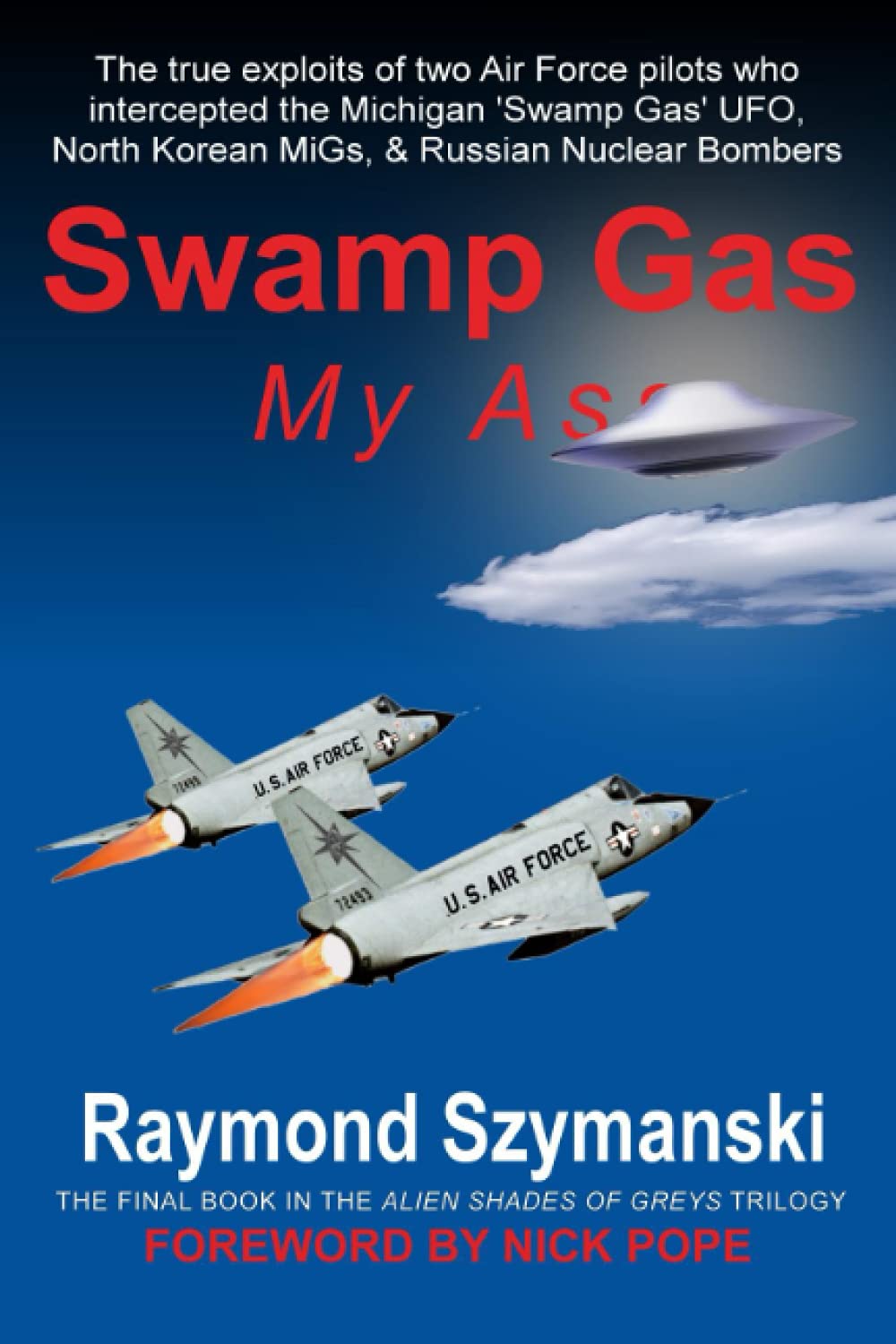
Swamp Gas My Ass
Alien Shades of Greys — Two F-106 Pilots and the 1966 Michigan Case, Fifty-Five Years Later
Find on Amazon →As an Amazon Associate, OverClassified may earn from qualifying purchases made through this link, at no extra cost to you.
Why This Is Essential Reading
Read it with the qualification attached at all times. Swamp Gas My Ass is a self-published advocacy book by a genuinely credentialled Wright-Patterson engineer, arguing that the eighty-plus witnesses ridiculed in March 1966 deserved better than a press-conference phrase — and on that, he is right. Its central claim, that an Air Force fighter-interceptor pilot broke fifty-five years of silence to describe intercepting the Michigan object in an F-106, is specific, plausible in terms of order of battle, and corroborated by nothing outside the book. Treat that testimony as a claim in the literature rather than a fact in the record, treat the trilogy's founding recovered-craft premise as unestablished, and read the book alongside this site's Michigan case file and Brad Steiger's contemporaneous 1966 account, which records what was actually being said at the time. The indignation is earned; the evidence is not there yet.
Related Cases & Theories
Sources Cited
- Szymanski, Raymond. Swamp Gas My Ass: Alien Shades of Greys. Self-published, November 22, 2021. ISBN-13 9798711224563. Foreword by Nick Pope. amazon.com
- Goodreads edition record, Swamp Gas My Ass — publication date, the identification of the book as the final volume of the Alien Shades of Greys trilogy, the Nick Pope foreword, and the description of the two Air Force fighter-interceptor pilots and the F-106 claim. goodreads.com
- Goodreads author record for Raymond Szymanski — the full trilogy: Fifty Shades of Greys, Alien Shades of Greys and this volume. goodreads.com
- ThriftBooks author record for Raymond Szymanski — independent bibliographic listing of his published titles. thriftbooks.com
- Fairborn Daily Herald, "Retired base scientist and engineer Ray Szymanski gives UFO lecture in Bellbrook," January 19, 2026 — his Wright-Patterson civil service career from 1973 to his 2011 retirement as a Senior Electronics Engineer, and his current lecture programme. fairborndailyherald.com
- "Award-winning author of UFO research to speak at Hillsdale Community Library" — Szymanski's account of how his interest began as a student employee at Wright-Patterson, the Project Blue Book connection, the 1940s crash claim, the March 21 1966 Hillsdale College sighting by more than eighty witnesses, and his invocation of the 2021 US government UAP report. news.yahoo.com
- Wikipedia, "Michigan 'swamp gas' UFO reports" — the March 20 and 21, 1966 mass sightings near Dexter marshland and the Hillsdale College arboretum, the Selfridge Air Force Base and Sylvania, Ohio observations, and J. Allen Hynek's marsh-gas attribution and the derision that followed. en.wikipedia.org
- ClickOnDetroit, "'I'll believe this to the day I die': The Michigan UFO craze of 1966," March 13, 2024 — surviving-witness interviews and the case's continuing standing in Michigan. clickondetroit.com
- Wikipedia, "Convair F-106 Delta Dart" — the Air Defense Command all-weather interceptor named in the book's central claim, and its operational role in the 1960s. en.wikipedia.org
- Wikipedia, "Selfridge Air National Guard Base" — the Harrison Township, Michigan installation whose observers reported the same lights in March 1966. en.wikipedia.org
- Wikipedia, "Wright-Patterson Air Force Base" — the base's history, its Foreign Technology Division, and its administration of Project Blue Book. en.wikipedia.org
- Wikipedia, "Project Blue Book" — the twenty-two-year Air Force UFO investigation programme run from Wright-Patterson and closed in 1969. en.wikipedia.org
- Wikipedia, "Nick Pope" — the former UK Ministry of Defence official who supplied the book's foreword. en.wikipedia.org
- Amazon edition record for Alien Shades of Greys: Evidence of Extraterrestrial Visitation to Wright-Patterson Air Force Base and Beyond (ISBN 1686377592) — the second volume of the trilogy, establishing the series premise. amazon.com
Have corrections, additional research, or peer-reviewed sources? Help improve this entry.
Suggest an Edit