
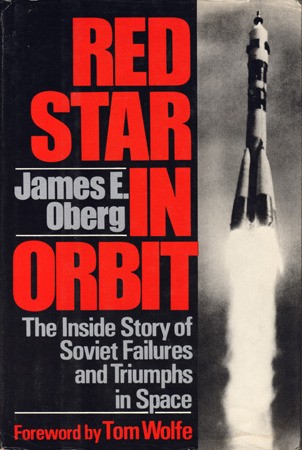
Red Star in Orbit
The Inside Story of Soviet Failures and Triumphs in Space
Core Thesis
Red Star in Orbit is James E. Oberg's 1981 history of the Soviet space program, written with a foreword by Tom Wolfe and documenting the systemic secrecy and disinformation Oberg argues defined that program from its earliest years: hidden launch disasters, cosmonaut deaths concealed or falsely explained, purged cosmonauts airbrushed from official photographs, and a Moon-race pursuit the USSR publicly denied while secretly conducting. This site cites the book not for any UFO content -- it has none -- but for the same institutional secrecy culture that underlies its own leading conventional explanation for the Petrozavodsk Phenomenon: Oberg's own independent identification of the Kosmos-955 satellite's launch from the secret Plesetsk Cosmodrome as the sighting's likely stimulus, confirmed by directly checking the launch time against NASA's own satellite-tracking data.
About the Author
This site's own James Oberg key-figures entry documents his career as a NASA Johnson Space Center flight controller and one of the few Western analysts of his era able to read Soviet space activity from open-source and tracking data alone. At the time of this book's 1981 publication, contemporary reviewers specifically identified Oberg as a computer specialist at NASA's Johnson Space Center writing this book concurrently with his day job there, synthesizing official Soviet announcements, defector statements, photographic analysis, and his own orbital-mechanics expertise into the book's account.
That same expertise is what led Oberg, working independently, to identify the Kosmos-955 rocket's exhaust plume as the likely stimulus for the Petrozavodsk Phenomenon after confirming the Plesetsk launch time directly with NASA's own tracking center -- documented in full on this site's own case file for that 1977 sighting. This site's key-figures entry also credits him as author of UFOs and Outer Space Mysteries: A Sympathetic Skeptic's Report (1982), a separate later book, and as a prolific skeptical analyst of Soviet-era UFO reports who wrote OMNI magazine's "UFO Update" column in the late 1970s.
Historical Context & Origins
The book arrived in May 1981, well before the Gorbachev-era archive openings of the later 1980s that would eventually confirm a fuller death toll for incidents like the 1960 Nedelin catastrophe -- the launch-pad explosion at Baikonur that killed Nedelin and a still-disputed number of engineers, which Oberg documents using the figures knowable at the time. This article treats Oberg's period-specific casualty figures as reflecting the best available 1981 knowledge rather than as a discrepancy to be corrected against later, post-Soviet archival findings.
This article was not able to independently confirm that the book contains a specific passage discussing Plesetsk Cosmodrome by name, despite the site's own case file crediting Oberg's broader expertise in exactly this kind of secret-facility launch analysis; readers should treat that specific connection as inferred from Oberg's well-documented method and expertise rather than as a directly quoted passage this article verified.
Core Arguments & Key Concepts
The book's central argument, per contemporary reviews, treats the Soviet space program as a microcosm of a closed, propaganda-driven state apparatus: individual cosmonauts and engineers subordinated to state messaging, failures hidden or falsely explained, and secrecy applied as systematically to space activity as to any other Cold War-era Soviet institution.
That same disinformation culture is precisely the operating assumption behind Oberg's own Kosmos-955 explanation for Petrozavodsk: a secret launch facility, an unannounced rocket firing, and a resulting light display that Soviet civilian witnesses -- lacking any official explanation -- interpreted as anomalous, exactly the kind of gap between state secrecy and public perception this book documents at length across the broader space program.
Key Cases & Evidence Discussed
This site's own Petrozavodsk Phenomenon case file documents the 1977 sighting and Oberg's Kosmos-955/Plesetsk explanation in far greater depth than this book, which does not discuss the case at all -- the connection between the two is Oberg's method and institutional expertise, not shared subject matter. Readers wanting the full record of that case, including the technical objections later raised by Felix Ziegel and Lev Gindilis, should consult that case file directly.
What is specific to this book is its documented history of the secrecy apparatus itself: the 1960 Nedelin catastrophe, Sergei Korolev's concealed identity and suspicious 1966 surgical death, the Voskhod 1 crew's lack of spacesuits, and the Soyuz 11 crew's fatal depressurization -- each an example of the same institutional information-control culture Oberg's Petrozavodsk analysis presupposes.
Critical Reception & Controversies
As of this article's research (August 2026), the book holds a well-documented, strongly positive contemporary critical reputation. The Christian Science Monitor's natural science editor Robert C. Cowen called it, in a July 13, 1981 review, "one of the most important studies of the Soviet space program yet made for general readers," while Reason magazine's March 1982 review by G. Harry Stine called it "perhaps the best of the Western accounts of the Soviet space program."
The book's standing within the aerospace community itself is further evidenced by NASA's own Johnson Space Center -- Oberg's employer -- cataloging it in the NASA Technical Reports Server, an unusual step for a commercially published trade title. The PBS "Red Files" documentary companion site later described Oberg as "the Dean of American experts on Soviet space efforts," and the book was adapted for television twice: as a three-part BBC "Horizon" documentary in December 1990 and as PBS/WGBH's "Nova" miniseries "The Russian Right Stuff" in February 1991. This article found no documented literary award specifically for this title, despite Oberg's other recognitions, and does not claim one.
Influence & Legacy
The book's legacy rests on its early, rigorously sourced documentation of Soviet space secrecy years before the archive openings of the Gorbachev era would confirm much of what Oberg had pieced together from open sources and tracking data alone -- a track record of methodological rigor this site's own case file draws on directly when crediting his Petrozavodsk analysis.
Set alongside this site's own Petrozavodsk Phenomenon case file, which documents the specific application of Oberg's Soviet-space expertise to a UFO case, this book is best read as the foundational demonstration of the analytical method -- open-source synthesis, tracking-data verification, and skepticism toward official Soviet silence -- that Oberg later brought to bear on Cold War-era UFO reports generally.
The Book
As an Amazon Associate, OverClassified may earn from qualifying purchases made through this link, at no extra cost to you.
Why This Is Essential Reading
Red Star in Orbit earns its place on this reading list not as a UFO book but as the essential background for understanding why its author was uniquely positioned to solve one: a rigorously documented, contemporaneously well-reviewed history of the exact secrecy culture that produced the unexplained light display over Petrozavodsk in 1977. Read alongside this site's own Petrozavodsk Phenomenon case file, which applies Oberg's expertise directly to that case, it remains valuable as the clearest single demonstration of the open-source analytical method that made James Oberg one of ufology's most consequential conventional-explanation researchers.
Related Cases & Theories
Sources Cited
- Oberg, James E. Red Star in Orbit: The Inside Story of Soviet Failures and Triumphs in Space. Random House, 1981. amazon.com
- Open Library, edition record and cover image for ISBN 0394514297. openlibrary.org
- Cowen, Robert C. "Oberg's inside story of the Soviet space program." The Christian Science Monitor, July 13, 1981. csmonitor.com
- Stine, G. Harry. "The Soviet Space Horror Show." Reason, March 1982. reason.com
- NASA Technical Reports Server (NTRS), accession 81A41872 (Johnson Space Center's own catalog record for the book). ntrs.nasa.gov
- PBS, "Red Files" documentary companion bibliography. pbs.org
- Wikipedia. "Red Star In Orbit." en.wikipedia.org
- This site's own James Oberg key-figures entry (his NASA career and Petrozavodsk analysis).
- This site's own Petrozavodsk Phenomenon case file (the full case record and Oberg's Kosmos-955/Plesetsk explanation).
- This site's own Coyne Helicopter Incident case file (Oberg's OMNI magazine defense of Philip J. Klass's explanation).
- This site's own Plesetsk Cosmodrome location entry (the secret Soviet launch site central to both the book's subject matter and Oberg's Petrozavodsk analysis).
- Goodreads listing for Red Star in Orbit (edition record and cover image). goodreads.com
Have corrections, additional research, or peer-reviewed sources? Help improve this entry.
Suggest an Edit