
Rain of Iron and Ice
The Very Real Threat of Comet and Asteroid Bombardment
Core Thesis
Rain of Iron and Ice: The Very Real Threat of Comet and Asteroid Bombardment is planetary scientist John S. Lewis's 1996 case, built from spacecraft flyby data, lunar cratering records, and Earth's own geological and fossil evidence, that catastrophic comet and asteroid impacts are a real, recurring, and statistically predictable feature of Solar System history rather than a rare or hypothetical curiosity. On this site, it supplies the physics baseline against which the 2011 UNAM reanalysis of the 1883 Bonilla solar transit photographs — which proposed the 447 objects José Bonilla photographed crossing the Sun were fragments of a comet passing catastrophically close to Earth — can be evaluated on its own physical merits.
About the Author
John Simpson Lewis Jr. (born June 27, 1941, in Trenton, New Jersey) built his scientific career at the intersection of chemistry and planetary science. He earned a B.S. in Chemistry from Princeton University in 1962 as a National Merit Scholar, an M.A. in Inorganic Chemistry from Dartmouth College in 1964, and a Ph.D. in Geochemistry and Cosmochemistry from the University of California, San Diego in 1968, studying under Nobel laureate Harold Urey — the chemist whose own work on solar-system composition and the origin of life underpins much of modern cosmochemistry.
Lewis taught space sciences and cosmochemistry at the Massachusetts Institute of Technology before moving to the University of Arizona's Lunar and Planetary Laboratory, where he spent the bulk of his academic career and became Professor Emeritus of Planetary Science. His research focused on the chemical composition of asteroids and comets, the formation history of the Solar System, and, increasingly through the 1990s and 2000s, the practical question of what near-Earth objects mean both as a hazard and as a potential resource.
That dual interest — impact risk and space-resource economics — produced two closely related books in successive years: this one in 1996, and Mining the Sky: Untold Riches from the Asteroids, Comets, and Planets in 1997, which argued the same near-Earth objects capable of catastrophic impact could, if properly understood and eventually intercepted, become a source of raw materials for space industry. In February 2013 Lewis became Chief Scientist at Deep Space Industries, a commercial asteroid-mining venture, putting his decades of impact-hazard research directly into a business plan for the objects his own book had spent 1996 warning readers to take seriously.
Over his career Lewis received the James B. Macelwane Award from the American Geophysical Union and NASA's Exceptional Scientific Achievement Medal, and authored roughly a dozen books spanning planetary chemistry, textbooks such as Planets and Their Atmospheres: Origins and Evolution, and popular-science works including Worlds Without End and, later, Asteroid Mining 101: Wealth for the New Space Economy.
Beyond his published books, Lewis logged more than sixty television and radio appearances discussing space science and technology for outlets including the Science Fiction Channel, the History Channel, and Discovery's UK, Canada, and US networks, and lectured at more than a hundred colleges, universities, and research centers worldwide — a public-communication record that placed him, alongside figures like Carl Sagan and David Levy, among the small group of working planetary scientists willing to translate technical impact-hazard research for a mass audience during the 1990s, precisely the period this book was written and released.
Historical Context & Origins
The book arrived in 1996, three years after comet Shoemaker-Levy 9 broke apart and struck Jupiter in July 1994 in full view of Earth-based and space telescopes — the first time humanity directly observed a cometary impact on another planet in real time, and an event that transformed impact risk from an abstract geological inference into something the public had just watched happen. David H. Levy, co-discoverer of that comet, praised Lewis's book as "an engaging story of how our Earth has been hit by comets and asteroids before," a review that situates the book squarely within that immediate post-Shoemaker-Levy 9 surge of public and scientific attention to impact hazards.
The book also followed closely on the heels of the 1980 Alvarez hypothesis linking the Cretaceous-Paleogene mass extinction to a large asteroid impact, by 1996 substantially reinforced by the identification of the Chicxulub crater in Mexico's Yucatán Peninsula as the impact site. Lewis's book extends that same evidentiary logic — comparing Earth's geological and fossil record against the cratering histories of the Moon, Mars, and other airless or thin-atmosphere bodies where craters survive far longer — into a broader argument about how frequently large impacts should be expected to recur.
This site's interest in the book is narrower and more specific: its careful treatment of what the actual physics of a close cometary or asteroidal near-miss would look like — the fragmentation patterns, the atmospheric effects, the visual signatures — against which claims like the 2011 UNAM Bonilla reanalysis can be measured, rather than simply accepted or dismissed on reputation alone.
The book's 1996 publication also predates, and in some ways anticipates, the 1998 U.S. Congressional mandate directing NASA to catalog 90 percent of near-Earth asteroids larger than one kilometer within ten years — the so-called Spaceguard goal, formally proposed in a 1992 NASA workshop report but not codified into a funded federal mandate until two years after Lewis's book had already made the public case for exactly that kind of systematic detection effort.
Core Arguments & Key Concepts
Lewis's central argument is that the geological and astronomical record, properly read, shows Earth has been struck by objects large enough to cause regional or global catastrophe far more often than 20th-century intuition assumed, and that the relative rarity of such events within any single human lifetime has led to a systematic underestimation of the risk rather than evidence the risk is low.
The book traces the history of scientific resistance to impact catastrophism itself: for much of the 19th and early 20th centuries, mainstream geology favored uniformitarian, gradualist explanations for Earth's surface features and fossil record, actively resisting suggestions of sudden cosmic violence — a resistance Lewis presents as a genuine scientific overcorrection against earlier, less rigorous catastrophist theories, only reversed by hard evidence like the Barringer Crater in Arizona and, decades later, Chicxulub.
A recurring methodological theme is Lewis's use of comparative planetology: because the Moon, Mercury, and the outer planets' airless moons lack the erosion and plate tectonics that erase craters on Earth, their heavily cratered surfaces preserve a far more complete record of impact frequency across Solar System history than Earth's own geology does alone. Lewis argues that reading Earth's true impact history requires importing that off-world cratering data rather than relying on Earth's incomplete and erosion-biased record.
On near-Earth asteroids specifically, Lewis lays out the observational challenge of detecting objects large enough to cause serious damage before they are discovered on a collision course, and argues for sustained, systematic sky-survey funding as the only realistic mitigation available at the time of writing — a policy argument later substantially vindicated by the creation and expansion of NASA's own Near-Earth Object Observations Program in the years following the book's publication.
Kirkus Reviews called the book "an apocalyptic vision that should be taken with the utmost seriousness," while The Atlantic Monthly credited Lewis with taking "long views and mak[ing] them exciting" — both reviews reflecting the book's core rhetorical strategy of grounding an alarming statistical argument in patient, well-documented planetary science rather than speculative doomsaying.
Key Cases & Evidence Discussed
This site's own Bonilla Solar Transit Photographs (Case File #219, August 12–13, 1883) is the case this book's physics most directly bears on: in October 2011, a team at Mexico's UNAM proposed that the 447 dark objects José Bonilla photographed crossing the Sun over two days were fragments of a comet that had broken apart during an extraordinarily close pass by Earth. Lewis's book, published fifteen years earlier, lays out in detail what the actual fragmentation and observational signature of such a near-Earth cometary breakup would look like — evidence this site's own case file notes mainstream astronomers have used to challenge the UNAM team's arithmetic, since a fragmenting comet close enough to produce 447 distinct, telescopically resolved objects over three and a half hours would be expected to produce effects (a visible coma, a debris trail, corroborating observations from other observatories) that the historical record of the Bonilla event does not show.
The book's general discussion of the 1908 Tunguska event in Siberia — the largest impact event in recorded history, which flattened roughly 2,000 square kilometers of forest without leaving an impact crater, consistent with an airburst from a relatively small, weak cometary or asteroidal body — offers a useful independent comparison for evaluating the Bonilla case: Tunguska demonstrates that an actual close-range cometary fragmentation event produces well-documented, unambiguous physical effects at ground level, effects entirely absent from the 1883 Zacatecas observations beyond the photographic plates themselves.
This site's own Green Fireballs (Case File #156, beginning December 5, 1948) offers a different, methodologically useful contrast: when brilliant green fireballs began appearing over Los Alamos and Sandia Base in late 1948, University of New Mexico meteor astronomer Lincoln La Paz personally witnessed one and judged it "most certainly not a conventional meteorite fall" — a specialist's real-time physical assessment, grounded in exactly the kind of trajectory, color, and behavior analysis Lewis's book applies systematically to impact-related phenomena, and a useful demonstration of what it looks like when a credentialed meteor scientist, rather than a later statistical reanalysis, examines an anomalous sky event directly.
Critical Reception & Controversies
The book drew strong endorsements from figures directly credentialed in the subject: David H. Levy, co-discoverer of Comet Shoemaker-Levy 9, called it "an engaging story of how our Earth has been hit by comets and asteroids before," a notable endorsement given Levy's own comet had just demonstrated a live impact event on Jupiter two years before the book's publication.
Kirkus Reviews described the book as "an apocalyptic vision that should be taken with the utmost seriousness," and The Atlantic Monthly praised Lewis for taking "long views and mak[ing] them exciting," reflecting a broadly favorable critical reception across both specialist and general-audience science outlets.
A retrospective assessment published by the Space Studies Institute noted that despite substantial new impact-hazard data accumulated in the two decades following the book's 1996 publication, Lewis's original book still "more convincingly demonstrated" the true dimensions and urgency of the impact threat than some of the more technical literature that followed it — a notable claim about the book's enduring persuasive power as a work of science communication specifically.
No source located in researching this article disputes the book's core scientific claims about impact frequency or cratering-record methodology; criticism located concerns only the degree of alarm warranted by the risk, not the underlying physics Lewis presents.
Reader reviews collected on Goodreads and similar platforms in the decades since publication have remained largely consistent with the professional critical reception, describing the book as dense but rewarding, with occasional notes that some of its specific statistical risk estimates have since been refined by subsequent near-Earth object survey data — the same kind of measured, expected revision any quantitative risk estimate published nearly three decades ago would be expected to receive as observational data accumulates.
Influence & Legacy
This exact title is cited in this site's own Bonilla Solar Transit Photographs case file's Further Reading section as directly relevant background for assessing whether the 2011 UNAM near-miss hypothesis is physically plausible — the specific role this book's careful treatment of real impact-event physics plays for this site's coverage of a case where the object's real nature (birds, insects, debris near the telescope lens, or something more exotic) remains honestly unresolved.
The book's central policy argument — that sustained, systematic sky-survey funding was the only realistic near-term mitigation against undetected hazardous asteroids — anticipated the substantial expansion of NASA's Near-Earth Object Observations Program and international sky-survey efforts (including the later Catalina Sky Survey and Pan-STARRS programs) that followed in the fifteen years after the book's publication.
Lewis's own subsequent career path, moving from documenting impact risk in this book to becoming Chief Scientist at the asteroid-mining company Deep Space Industries in 2013, traces a direct intellectual line from this book's core argument — that near-Earth objects are a serious physical reality requiring sustained attention — through to the commercial space-resource industry his later work helped found, treating the same population of objects first as a hazard to be tracked and eventually as a resource to be exploited.
More broadly, the book stands as an early and influential entry in a now well-established genre of impact-risk popular science that includes later works addressing planetary defense strategy, asteroid deflection technology, and the ethics of near-Earth object mining — a genre this site's own Bonilla case file draws on precisely because evaluating a 19th-century astronomical anomaly against modern impact physics requires the same rigorous, non-speculative grounding Lewis brought to the subject nearly three decades ago.
The Book
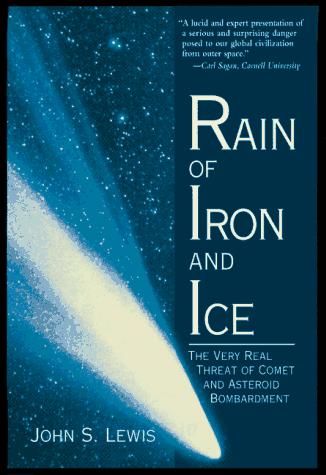
As an Amazon Associate, OverClassified may earn from qualifying purchases made through this link, at no extra cost to you.
Why This Is Essential Reading
Rain of Iron and Ice earns its place on this list as a rigorously grounded, well-reviewed work of planetary science that supplies exactly the physical baseline this site's own Bonilla Solar Transit Photographs case file needs to evaluate the 2011 UNAM comet-fragment hypothesis honestly — not by dismissing it out of hand, but by weighing it against what real cometary near-misses and fragmentation events actually look like when documented with the completeness Lewis's book demands.
Related Cases & Theories
Sources Cited
- Lewis, John S. Rain of Iron and Ice: The Very Real Threat of Comet and Asteroid Bombardment. Addison-Wesley (Helix Books), 1996 (ISBN-13 9780201154948). amazon.com
- "John S. Lewis." Wikipedia (full biography: education, career, honors, bibliography). en.wikipedia.org
- "National Space Society Governor John S. Lewis Biography." National Space Society. space.nss.org
- "Rain of Iron and Ice." Space Studies Institute (retrospective review). ssi.org
- "Rain of iron and ice: the very real threat of comet and asteroid bombardment." Internet Archive (digitized copy, bibliographic record). archive.org
- "Rain Of Iron And Ice." Goodreads (reader ratings and reviews). goodreads.com
- "Rain of Iron and Ice." Open Library (bibliographic record and cover art source). openlibrary.org
- "Mining the Sky." Wikipedia (Lewis's 1997 follow-up book on space-resource economics). en.wikipedia.org
- "Tunguska event." Wikipedia (comparative case for cometary/asteroidal airburst physics referenced in this article). en.wikipedia.org
- "Chicxulub crater." Wikipedia (Cretaceous-Paleogene impact evidence referenced in this article's historical context). en.wikipedia.org
- This site's own case file: Bonilla Solar Transit Photographs, for the full 1883 observation and 2011 UNAM reanalysis this book's physics bears on.
- This site's own key-figures entry: John S. Lewis, for his full biography and further case connections.
Have corrections, additional research, or peer-reviewed sources? Help improve this entry.
Suggest an Edit