
Heavenly Lights
The Apparitions of Fátima and the UFO Phenomenon
Core Thesis
Heavenly Lights: The Apparitions of Fátima and the UFO Phenomenon is historian Joaquim Fernandes and researcher Fina d'Armada's book-length argument that the 1917 Fátima apparitions — already documented in full on this site's own Fatima Miracle of the Sun case file — are better read as an early close-encounter case than as a purely devotional Marian vision. First published in Portuguese in 1995 as the culmination of research the authors had pursued since the late 1970s, and later published in English by Anomalist Books in 2007 with a foreword by Dimensions author Jacques F. Vallée, it is Volume I of what Anomalist Books calls the "Fátima Trilogy" — a series this site has already partly covered through its Volume III entry, Fatima Revisited. This article treats Heavenly Lights as the trilogy's foundational volume: the book where Fernandes and d'Armada's original thesis, and the archival research behind it, was first laid out in full.
About the Author
Joaquim Fernandes's broader career as a founder of Portuguese organized ufology — CEAFI in 1973, its successor CNIFO, and the Ota Air Base investigation — is documented in depth on this site's own case file for that case; what matters specifically for this book is his separate, formal academic credential in the subject: a PhD in History of Science from the University of Porto, with a dissertation on the "extraterrestrial imaginary" in Portuguese culture, and a faculty post at Universidade Fernando Pessoa, where he still co-edits the transdisciplinary consciousness-studies journal Cons-sciências and directs a research initiative on Marian-apparition phenomena. That academic standing is part of what distinguishes this book's paratextual credibility from most self-published ufology: its central author holds an actual university post built substantially around this exact research question.
Fina d'Armada, born Josefina Teresa Fernandes Moreira, was a University of Porto-trained historian and schoolteacher whose connection to Fátima began almost by accident: a 1977-1980 national research fellowship to study Portuguese women of the First Republic gave her direct access to the Fátima shrine's own archive of original 1917-era depositions, material she had not set out to find. She went on to a long career as a prolific author of Portuguese-language history and women's-studies work before her death in 2014, but her collaboration with Fernandes on the Fátima material — beginning with a 1982 book and continuing through this volume and its two sequels — remained the project she is most widely cited for outside Portugal.
One detail worth stating plainly about the English edition specifically: it was translated and edited by Andrew D. Basiago, working with Eva M. Thompson. Basiago is also, independently and on the public record since 2004, the source of a separate and unrelated set of claims to have traveled through time and visited Mars as a child participant in a purported government program. That fact has no bearing on Fernandes or d'Armada's own credentials or research, and no reviewer located for this article raises it as a criticism of the book itself — but it is a real, verifiable detail about who shaped the specific English text most readers encounter today, and this site's own standing practice is to surface such connections rather than quietly omit them.
Historical Context & Origins
Fernandes and d'Armada's public case for a Fátima-as-UFO reading did not begin with this book: an earlier, more limited Portuguese volume, Intervenção Extraterrestre em Fátima, appeared from Bertrand in 1982, meaning the argument this book presents in its fullest form was already thirteen years into development by the time of the 1995 edition, and had been building since d'Armada's original 1977-1980 archival access — closer to forty years of sustained research by the time of the 2007 English translation than the roughly twenty-five years Anomalist Books' own marketing copy tends to cite.
The "Fátima as UFO event" reading is a recognized, if minority, subgenre within ufology rather than an argument original to Fernandes and d'Armada alone: Jacques Vallée's own 1988 book Dimensions: A Casebook of Alien Contact discusses the Fátima apparitions in similar terms, treating reported details — a disc-shaped object's "falling-leaf" descent, an accompanying buzzing sound, a sudden fragrance, threads of "angel hair" that reportedly dissolved on contact with the ground, and localized heat — as recognizable UFO close-encounter parameters rather than purely visionary embellishment. That prior, independent treatment is the direct reason Vallée agreed to write this book's foreword rather than a coincidental endorsement.
Read as Volume I of a trilogy, the book's own project became more academically ambitious over time rather than less: Volume II, Celestial Secrets (2007), extends the argument into a claim that the Catholic Church itself constructed a more devotional "cover story" around 1941, while Volume III, Fatima Revisited (2008, already covered in full elsewhere on this site), reframes the whole project as a multidisciplinary academic anthology co-edited with engineer Fernando Fernandes and researcher Raul Berenguel. Read in that sequence, Heavenly Lights is best understood as the original, single-thesis argument that the later two volumes both build on and complicate — the place to start for any reader wanting to see Fernandes and d'Armada's case in its first, least mediated form.
Core Arguments & Key Concepts
The book's central claim is that the earliest surviving 1917-era depositions — taken before Lucia dos Santos's own much later, more elaborately theological memoirs were written in the 1930s and 1940s under close guidance from her religious superiors — describe a discrete, luminous, apparently controlled aerial phenomenon closer to a modern close-encounter report than to a purely visionary or hallucinatory experience. Fernandes and d'Armada frame the case explicitly as, in their own words, the first major UFO/close-encounter case of the twentieth century, and at points characterize the culminating vision witnessed by the three children as potentially resembling what the book's own promotional description calls a holographic projection cast from a beam of light originating in a physical craft — a specific, testable-sounding claim this article presents as the authors' own framing rather than as an established fact.
Their evidentiary method leans on the same category of source this site's own case file weighs directly: contemporary press coverage, the roughly sixty documented eyewitness depositions compiled between 1917 and the 1950s, and the Church's own archival record, to which d'Armada had direct access. Where the book's argument diverges most sharply from this site's own case file is in causal interpretation: the case file treats the October 13 solar effect and the earlier private apparitions to the three children as two related but analytically separable phenomena, while Heavenly Lights treats them as a single continuous encounter narrative reshaped over time by religious institutional framing.
As with the trilogy's later volumes, the book's argument explicitly does not claim the three children were lying, nor does it dismiss the crowd's shared October 13 experience as mass hallucination; its stated position is that both the private apparitions and the public solar phenomenon are better explained as a genuine encounter with an unidentified physical phenomenon than as either a purely subjective religious vision or a purely psychological crowd effect — a middle position between devotional acceptance and skeptical dismissal that the book's champions and critics alike tend to agree is its most distinctive feature, whatever they make of it.
Key Cases & Evidence Discussed
This site's own Fatima Miracle of the Sun case file documents the full event — the six 1917 apparitions, the October 13 crowd of an estimated 30,000 to 100,000 witnesses, journalist Avelino de Almeida's famous anticlerical-press account, and the Church's own thirteen-year canonical investigation — in far greater depth than a book review needs to repeat, and readers wanting the complete, evenly weighted account should read that case file directly.
What is specific to this book is its systematic cataloguing of the phenomena Fernandes and d'Armada treat as diagnostic of a close encounter rather than incidental religious detail: the reported buzzing or humming sound preceding several apparitions, a sudden and otherwise unexplained fragrance, threads of gossamer-like "angel hair" that observers said dissolved before it could be examined, localized heat felt by witnesses near the phenomenon, and a disc-shaped descent pattern likened to a falling leaf. Whether or not a reader accepts the book's ultimate interpretation, this catalogue is a genuine contribution distinct from either the devotional or purely meteorological accounts of the same testimony.
Critical Reception & Controversies
As of this article's research (August 2026), the book carries a 4.33-out-of-5 average rating on Goodreads, though across a small base of only 24 ratings and 5 written reviews — a modest sample worth stating plainly rather than treating as a robust consensus. This article could not independently confirm a current Amazon customer-rating figure despite repeated attempts; a number surfacing in casual search results appears to be contaminated by an unrelated product listing, and per this site's Amazon Rating Display Protocol, no Amazon rating is displayed in this article's Book Profile for that reason.
A review attributed to Bob Rickard in Fortean Times is widely quoted online as calling the book "priceless" and commending the authors "for their important contribution to understanding what goes on in the minds of those undergoing visionary experiences," adding that it "deserves to be read by perceptual and social psychologists and historians." This article located that quotation only through secondary aggregation rather than the original Fortean Times text itself, and presents it with that caveat rather than as an independently re-verified primary-source quote.
Notably, the mainstream skeptical literature on the Fátima "miracle" itself does not engage with Fernandes and d'Armada's specific UFO reinterpretation at all: Benjamin Radford's 2019 Skeptical Inquirer piece "Fatima Miracle Claims All Wet," for instance, argues the famous claim that soaked crowds and ground dried instantly is a later folkloric embellishment inconsistent with contemporary photographs, but never mentions Fernandes, d'Armada, or a UFO-based reading at all. This article likewise found no Catholic-outlet review directly targeting this specific book, and no academic historian's published critique of Fernandes and d'Armada's methodology in particular — an absence worth stating explicitly, since it means the book's central thesis has drawn considerably less direct scholarly engagement, in either direction, than its author's own institutional standing might suggest it would.
A more substantial scholarly-adjacent review, by Hilary Evans for the Journal of the Society for Psychical Research, is documented by multiple booksellers as addressing this trilogy's third volume, Fatima Revisited, specifically, around January 2009; this article could not retrieve that review's full text and does not attribute its content to this earlier volume.
Influence & Legacy
The book's most direct legacy is structural: it is the founding volume of a three-book project that grew progressively more academically ambitious, from this book's single-thesis argument, through Celestial Secrets's claim about a Church-constructed "cover story," to Fatima Revisited's multidisciplinary anthology format — already covered in full on this site, with a companion foreword by UFO Hunter host William J. Birnes rather than Vallée's.
Within Portuguese ufology specifically, the book's argument is inseparable from Fernandes's own institutional position: few UFO-reinterpretation theses of any national apparition case are advanced by an author holding an active university faculty post built substantially around the same research question, and that standing is part of why the book continues to be cited, however contested its conclusions remain, as a serious rather than fringe entry in the broader "Fátima as UFO event" literature Vallée helped originate.
Set alongside this site's own Zeitoun Marian Apparitions case file — a later Marian apparition case this site examines through a similarly evenhanded, non-devotional lens — Heavenly Lights represents one of the most sustained and institutionally credentialed attempts anywhere in the literature to apply that same treatment to the single most historically significant Marian apparition of the twentieth century.
The Book
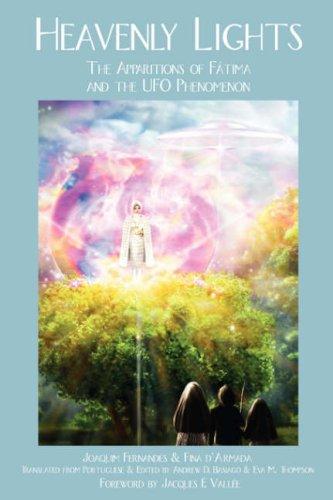
As an Amazon Associate, OverClassified may earn from qualifying purchases made through this link, at no extra cost to you.
Why This Is Essential Reading
Heavenly Lights earns its place on this reading list not because its central thesis is broadly accepted — it remains, by the authors' own acknowledgment and this article's own research, a minority position that neither the Catholic Church nor most mainstream historians of the apparitions have adopted, and this site's own case file treats the case file's evidentiary questions as genuinely open rather than settled in either direction — but because it is the clearest, most direct statement of an argument advanced by one of the few UFO-reinterpretation theses in this entire genre built by an author with an actual, ongoing university appointment centered on the same question. Read alongside this site's own far more evenly weighted Fatima Miracle of the Sun case file and its own Fatima Revisited entry, it is best approached as the founding document of a decades-long research project, not as a closing argument.
Related Cases & Theories
Sources Cited
- Fernandes, Joaquim, and Fina d'Armada. Heavenly Lights: The Apparitions of Fátima and the UFO Phenomenon. Translated and edited by Andrew D. Basiago and Eva M. Thompson, foreword by Jacques F. Vallée. Anomalist Books, 2007 (ISBN 1933665211 / 9781933665214; Portuguese original, Editorial Estampa, 1995). amazon.com
- "Heavenly Lights." Anomalist Books, official publisher product page (bibliographic details, translator/editor credit). anomalistbooks.com
- "The Fatima Trilogy." Anomalist Books (official trilogy overview page). anomalistbooks.com
- "Heavenly Lights." Goodreads (reader rating 4.33/5, 24 ratings, 5 reviews, as fetched Aug 2026). goodreads.com
- "Heavenly Lights: The Apparitions of Fatima and the UFO Phenomenon." AbeBooks (EcceNova Editions 2005 first English-edition bibliographic record). abebooks.com
- "Fatima Revisited." Goodreads (trilogy Volume III listing, cross-referenced for publication details). goodreads.com
- "Miracle of the Sun." Wikipedia (historical background on the October 13, 1917 event and crowd estimates). en.wikipedia.org
- Radford, Benjamin. "Fatima Miracle Claims All Wet." Skeptical Inquirer, 2019 (mainstream skeptical treatment of the underlying 1917 event, not engaging this book's UFO reinterpretation). skepticalinquirer.org
- "Joaquim Fernandes, Curriculum Vitae." Academia.edu, Universidade Fernando Pessoa (academic credentials, PhD dissertation title; page no longer live as of Aug 2026, no archived mirror found).
- "Joaquim Fernandes." Exopolítica Portugal (biographical profile). exopoliticsportugal.com
- "Fina d'Armada (1945-2014)." Exopolítica Portugal (biographical profile, death date). exopoliticsportugal.com
- "Dimensions: A Casebook of Alien Contact." Goodreads, Jacques Vallée (1988 book independently discussing Fatima in UFO-report terms, explaining Vallée's foreword to this book). goodreads.com
- "Wash. attorney: 'I have physically traveled in time.'" KOMO News (independent confirmation of English-edition editor Andrew D. Basiago's separate, unrelated public claims). komonews.com
- This site's own Fatima Miracle of the Sun case file, drawing on contemporary press accounts and the Church's own canonical-process record (full sourcing documented there).
Have corrections, additional research, or peer-reviewed sources? Help improve this entry.
Suggest an Edit