
The Dyfed Enigma
Unidentified Objects in West Wales
Core Thesis
The Dyfed Enigma: Unidentified Objects in West Wales is the first book-length account of the 1977 "Broad Haven Triangle" UFO wave, co-authored by local BUFORA coordinator Randall Jones Pugh, who personally interviewed witnesses within hours of the original school sighting, and naturalist-author F.W. Holiday, already known for his paranormal-leaning later work on the Loch Ness Monster. The book covers the wave's full range, from the Broad Haven Primary School sighting of February 1977 through the wider Pembrokeshire reports that followed, including the Ripperston Farm encounters, while explicitly framing the phenomenon as something closer to genuine, unresolved high strangeness — tall, faceless humanoid figures, severe unexplained animal distress, and a striking geographic correlation with ley-lines and ancient sites — than a straightforward nuts-and-bolts extraterrestrial-craft narrative. This site's own research draws on the book for exactly that on-the-ground documentary value: both citing case files use it as the earliest and most direct written record of a wave its own investigator worked in person, rather than a secondhand retrospective compiled years later.
About the Author
Randall Jones Pugh was born in Haverfordwest, Pembrokeshire, in 1915, served four years in the RAF during the Second World War, and trained as a veterinary surgeon at Glasgow University before retiring to practice locally in the very region this book investigates. As the area's BUFORA (British UFO Research Association) coordinator, he was the first outside investigator contacted after the Broad Haven school sighting, driving out to interview a witness family and inspect the field the same evening, and he went on to conduct the bulk of the book's direct witness interviews across the wider wave. This site's research also finds, via researcher David Clarke's own later account, that Pugh's interpretation of the case shifted substantially in the years after this book's publication: by the early 1980s he had concluded the phenomenon he investigated was not extraterrestrial at all, but represented, in his own later view, "demonic visions sent by the Devil" — a striking interpretive turn from the more measured field-investigator tone of this specific 1979 volume, and one this site's research treats as relevant context for readers rather than a detail to omit.
F.W. Holiday (Frederick "Ted" William Holiday, 1921–1979) was born in Stockport, England, served in the RAF from 1939 to 1946, and spent fifteen years as a columnist for The Western Mail before becoming one of Britain's best-known cryptozoological writers. His decades-long fascination with the Loch Ness Monster, dating to the 1933 Hugh Gray photograph, led him to join the Loch Ness Phenomena Investigation Bureau in 1963 and to publish The Great Orm of Loch Ness (1968), initially proposing the creature was an enormous invertebrate. By his 1972 follow-up, The Dragon and the Disc, Holiday had abandoned a purely zoological explanation in favor of a paranormal one, arguing that lake-monster sightings, ancient dragon folklore, and UFO reports were connected expressions of the same underlying, non-physical phenomenon — the same interpretive lens he brought to this book's treatment of the Pembrokeshire wave five years later.
Holiday's involvement in the Dyfed investigation carries an unusually direct, verifiable personal footnote: per Wikipedia's own biographical record, he died in 1979 in Haverfordwest, Pembrokeshire — the same West Wales town Pugh called home and the same region this book investigates — the very year The Dyfed Enigma was published. A further book, The Goblin Universe, appeared posthumously with an introduction by Colin Wilson, extending Holiday's paranormal interpretation of anomalous phenomena beyond either lake monsters or UFOs specifically.
Historical Context & Origins
Faber & Faber published The Dyfed Enigma in 1979, two years after the wave of sightings it documents began with the Broad Haven school sighting on February 4, 1977, and roughly a year and a half after the Ministry of Defence's own S4(Air) branch had quietly requested a "discreet enquiry" from RAF Police into the wider Pembrokeshire reports in June 1977 — official interest this site's own case file documents concluded a local prankster was a plausible explanation for at least the humanoid-figure element of the wave, without resolving the sightings themselves.
The book arrived into a genuinely competitive field of quick, popular treatments of the same material: journalist Clive Harold's The Uninvited: The True Story of Ripperston Farm and author Peter Paget's more sensationalized The Welsh Triangle, which popularized speculation about a submerged base beneath St Bride's Bay, were both published the same year. Among these, this site's own research treats Pugh and Holiday's book as carrying particular evidentiary weight specifically because Pugh was not a journalist reconstructing the case from a distance but the actual BUFORA investigator who had worked the sightings directly and interviewed witnesses himself, in several cases within hours of the events described.
The wave's specific cultural moment mattered too: February 1977 saw a short-lived cluster of British schoolyard UFO reports, including a separate, unconnected sighting at Rhosybol School on Anglesey twelve days after Broad Haven, giving Pugh and Holiday's fieldwork a live, still-unfolding phenomenon to document contemporaneously rather than reconstruct from memory years later.
Core Arguments & Key Concepts
The book's central argument, per independent secondary analysis of its content, is that the Pembrokeshire wave's individual elements — tall, faceless or helmeted humanoid figures reported as roughly nine feet in height, severe and specific psychological trauma in animals (most notably the Coombs family's dog, Blackie, at Ripperston Farm), and electromagnetic-seeming vehicle and equipment disruptions — cohere into a pattern too internally consistent across independent witnesses to dismiss as simple hoaxing or misperception, even as the authors stop well short of endorsing a literal extraterrestrial-visitation explanation.
A second, more distinctive argument is geographic and folkloric rather than purely testimonial: per an independent review of the book's content, Pugh and Holiday document a striking correlation, described as exceeding 80 percent, between sighting locations and pre-existing archaeological sites and mapped ley-lines across the region, alongside a deliberate exploration of how older Welsh fairy folklore describes phenomena strikingly similar to the 1977 encounters. This reflects Holiday's own established interpretive framework, carried over from his contemporaneous Loch Ness writing, that treats UFO waves as a modern expression of a much older, recurring category of anomalous human experience rather than a purely late-twentieth-century phenomenon.
A third theme is the authors' explicit characterization of the encountered figures as unnerving rather than threatening: per the same independent review, witnesses across the wave describe the humanoid figures as completely unnerving those who saw them, yet never causing direct physical harm — a specific behavioral pattern the book treats as itself evidential, on the reasoning that a deliberate hoax staged for local publicity would more plausibly aim for either dramatic threat or unambiguous friendliness rather than this narrower, harder-to-fake register of pure unsettling strangeness.
This site's own research treats these arguments as most valuable for their direct-witness grounding rather than as a settled explanatory framework: Pugh's fieldwork credibility as the on-the-ground BUFORA investigator is real and independently corroborated by this site's own case files, but the book's specific ley-line and folkloric interpretive apparatus reflects Holiday's own established paranormal framework as much as it reflects anything uniquely discovered in Pembrokeshire in 1977.
Key Cases & Evidence Discussed
The Broad Haven School Sighting (Friday, February 4, 1977, lunchtime) at Broad Haven Primary School, Pembrokeshire, receives the book's founding treatment. Roughly fifteen children, mostly ten-year-old boys, reported watching a silver, cigar-shaped object with a domed top come to rest in a field behind the school during their lunch break, with six of the group additionally describing a tall figure in a silver suit standing beside it. A parent contacted Randall Jones Pugh that same afternoon, and Pugh's evening visit to the field — conducted before national press attention, before headmaster Ralph Llewellyn's more formal written interviews the following Monday, and before the case reached the Ministry of Defence via Dyfed-Powys Police — gave this book access to the sighting's earliest, least-mediated investigative record. This site's own case file finds the book's proximity to the original event a genuine documentary asset, distinct from the several later, more sensationalized popular treatments that followed once the story had already reached Newsround and national television.
Ripperston Farm and the wider Broad Haven Triangle wave (April–December 1977) receive the book's most extensive treatment of any single location beyond the school itself. The Coombs family reported repeated encounters at their farm, including a seven-foot silver-suited figure at a window, unexplained vehicle breakdowns, livestock displacement, and severe, lasting psychological trauma in the family dog, Blackie, that this site's own case file treats as one of the wave's more striking and harder-to-fabricate secondary details precisely because animal behavioral evidence is difficult for a hoaxer to stage convincingly across multiple separate incidents. This site's own case file also documents the wave's eventual partial resolution: in 1982, researcher Hilary Evans reported that two members of a local social club had privately admitted responsibility for at least some of the "spacemen" sightings at the nearby Haven Fort Hotel and Ripperston Farm, using borrowed silver-coated asbestos suits from oil-refinery workers — a specific, named, if only partial, mundane explanation for one strand of the wave this book, published three years earlier in 1979, could not yet have incorporated.
Critical Reception & Controversies
On Goodreads, the book carries a solid 4.16-out-of-5 average from 19 ratings and 1 written review (checked August 2026). The sole review, from reader Sam Rhys, offers a memorably mixed but ultimately positive assessment: "Quite badly written but very interesting to read - spooky Mulder would approve!" — a characterization this site's research finds broadly consistent with the book's reputation as a genuinely strange, evocative primary account whose prose style has drawn less praise than its underlying material.
This site's research attempted to verify an Amazon rating for this title but Amazon's bot-detection system repeatedly blocked automated requests to the listing during this session, returning a CAPTCHA challenge across multiple attempts. Per this site's own Amazon Rating Display Protocol, this gap is disclosed honestly here rather than fabricated or silently omitted.
The book's reception has not been uniformly positive on evidentiary grounds specifically: a 2020 retrospective on the wider Pembrokeshire wave states plainly that this book and its contemporary, Clive Harold's The Uninvited, were "later shown to be either full of factual errors, inconsistencies or, in several instances, were sheer fabrication" — a serious charge this site's research was unable to trace to a single named, dated source with specific examples, and which should therefore be read as a real, published characterization rather than an independently verified finding. What this site's own case files can independently confirm is narrower but still substantive: researcher Hilary Evans's 1982 finding that at least some of the wave's humanoid sightings had a specific, mundane, locally sourced explanation, and researcher David Clarke's documented account that co-author Pugh himself later abandoned even an extraterrestrial reading of the case in favor of a demonic one — both of which complicate, without fully resolving, how much evidentiary weight this specific 1979 account should carry on its own.
Influence & Legacy
The clearest evidence of this book's lasting relevance on this site specifically is that it remains, alongside Clive Harold's The Uninvited and Peter Paget's The Welsh Triangle, one of only three book-length contemporary accounts of the Broad Haven Triangle wave, and the only one written by the investigator who conducted the bulk of the original fieldwork himself — a distinction this site's own two citing case files both treat as significant when weighing the book against later, more secondhand retellings.
The wave the book documents has had a long afterlife in its own right: Netflix's 2023 documentary series Encounters featured Broad Haven as one of its central cases, citing testimony from more than 450 individuals across the wider phenomenon, and researcher David Clarke's own continued published analysis, including his 2015 book How UFOs Conquered the World and his ongoing newsletter writing, keeps returning to this book and its authors as the case's foundational written record.
This site's own Government Deception Hypothesis and broader case-file network treat the book's earliest-documented status as its most durable contribution: whatever weight a reader ultimately assigns to its ley-line and folkloric interpretive framework, its status as the first-written, investigator-authored account of the Broad Haven Triangle wave has made it the base text every subsequent treatment, skeptical or credulous, has had to engage with directly.
The Book
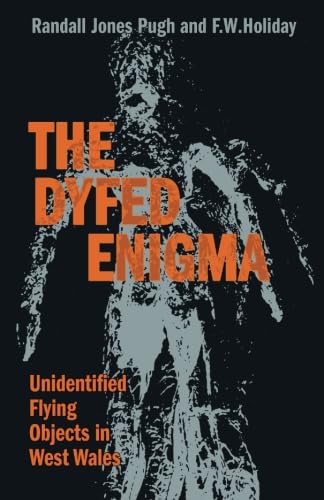
As an Amazon Associate, OverClassified may earn from qualifying purchases made through this link, at no extra cost to you.
Why This Is Essential Reading
The Dyfed Enigma: Unidentified Objects in West Wales earns its place on this list as the first, and most directly investigator-authored, book-length account of the 1977 Broad Haven Triangle wave. Randall Jones Pugh's on-the-ground fieldwork, beginning the very afternoon of the Broad Haven school sighting, gives this book an evidentiary proximity to the original events that no later retelling can match, while F.W. Holiday's established paranormal framework, carried over from his Loch Ness writing, shapes the book's distinctive ley-line and folkloric interpretive lens. This site's own research finds real reasons for caution alongside real reasons for engagement: Pugh's own later shift toward a demonic interpretation of the case, Hilary Evans's 1982 partial debunking of the "silver man" sightings at Ripperston Farm, and a published, if not fully sourced, later claim of factual errors and fabrication all complicate how much weight the book's specific interpretive conclusions should carry, even as its underlying witness interviews remain a genuine primary record this site's own case files continue to draw on directly. Its solid 4.16/5 Goodreads reception, built on a small but positive sample, reflects a book readers still find genuinely strange and engaging more than four decades on. Read as a primary field record rather than a settled final word, this book remains essential precisely because it captured a still-unfolding, high-strangeness wave through the eyes of the one investigator who worked it in person.
Related Cases & Theories
Essential Viewing

Sources Cited
- Pugh, Randall Jones, and F.W. Holiday. The Dyfed Enigma: Unidentified Objects in West Wales. Faber & Faber, 1979 (CreateSpace 2016 reprint, ISBN 978-1-530511-87-7, cited here).
- "The Dyfed Enigma: Unidentified Flying Objects in West Wales." Goodreads (rating 4.16/5, 19 ratings, 1 written review quoted, checked August 2026). goodreads.com
- "The Dyfed Enigma." AbeBooks (ISBN 9781530511877, marketplace listing photograph used for this article's cover image). abebooks.com
- "The Dyfed Enigma: RJ Pugh and FW Holiday." ProfessorWHAM (independent content review and summary). professorwham.com
- "The Dyfed Enigma." Pembrokeshire.Online, 2020 (retrospective on the book and the wider wave, including its later-disputed reliability). pembrokeshire.online
- Clarke, David. "Did the Village See Aliens?" Dr David Clarke (Substack), on Randall Jones Pugh's later interpretive shift and Hilary Evans's 1982 findings. drclarke.substack.com
- "Fredrick William Holiday." Wikipedia (author biography, death in Haverfordwest, 1979). en.wikipedia.org
- "Randall Jones Pugh Welsh Triangle UFO." TheSecretVault, YouTube (archival interview with the book's co-author, video verified via oEmbed). youtube.com
- This site's own resources library: Full Reading List, where this exact 1979 edition is cited across 2 separate case-file pages.
- This site's own key-figures entry: Randall Jones Pugh, for his full biography and site-wide case connections.
- This site's own key-figures entry: F.W. Holiday, for his full biography and site-wide case connections.
- This site's own case file: Broad Haven School Sighting (1977), which documents Pugh's same-day investigation.
- This site's own case file: Ripperston Farm & the Broad Haven Triangle Wave, which documents Hilary Evans's 1982 partial debunking.
Have corrections, additional research, or peer-reviewed sources? Help improve this entry.
Suggest an Edit