
Debunked!
Conspiracy Theories, Urban Legends, and Evil Plots of the 21st Century
Core Thesis
Debunked!: Conspiracy Theories, Urban Legends, and Evil Plots of the 21st Century is journalist and film critic Richard Roeper's 2008 breezy, fact-driven dissection of more than two dozen popular conspiracy theories and urban legends of the 2000s. This book does not itself discuss the Campeche FLIR incident or Jaime Maussan; this site's own Campeche Military FLIR Incident case file cites it instead for its general analytical framework, described there as "a general framework for evaluating high-profile 'official' anomaly claims released through unofficial or improvised disclosure channels, directly applicable to how the Campeche footage reached the public via Jaime Maussan rather than any formal government process."
About the Author
Richard E. Roeper (born October 17, 1959, in Chicago) earned a journalism degree from Illinois State University before beginning a Chicago Sun-Times career in 1986 that spanned 39 years, working first as an editorial assistant and news reporter before becoming a general-interest columnist. He won the National Headliner Award for Best News Columnist in the country during his tenure there.
Roeper is best known nationally as Roger Ebert's on-air movie-review partner: after meeting Ebert at the Sun-Times in the 1980s, he became permanent co-host of Ebert & Roeper in 2000, following Gene Siskel's death, co-hosting the syndicated At the Movies format through 2008. He later succeeded Ebert as the Sun-Times's own principal film critic in 2013, a role he held until leaving the paper in 2025 while continuing to review films independently.
Beyond film criticism, Roeper has authored nine books spanning humor, sports, and popular nonfiction, and remains an active broadcast personality, contributing to ABC7 Chicago and hosting his own podcast, with three local Emmy Awards to his name. This book represents his foray into the popular skeptical-nonfiction genre, applying the same plainspoken, fact-checking journalistic voice that characterized his decades of newspaper columns to conspiracy theories and urban legends rather than film or politics specifically.
That newspaper-columnist background is itself relevant to how this book approaches its subject matter: unlike an academic skeptic or a specialist paranormal investigator, Roeper spent decades writing for a mass daily readership under tight deadlines, a discipline that rewards clear, accessible argument over exhaustive technical documentation — a genuinely different set of professional skills than those brought to this genre by figures like Robert A. Baker or Joe Nickell, and one that gives this book a distinctly different register from more specialist skeptical-press titles covered elsewhere on this site.
Historical Context & Origins
The book was published in 2008 by Chicago Review Press, arriving amid a mid-2000s surge of conspiracy-theory-adjacent popular culture — a period that included widespread 9/11 "truther" claims, ongoing JFK Jr. plane-crash speculation, and viral internet-driven urban legends spreading faster and further than in any previous decade thanks to early social media and forum culture.
Roeper's own platform as a nationally recognizable Chicago Sun-Times columnist and television personality gave the book mainstream visibility relatively rare for skeptical-nonfiction titles, which more typically emerge from specialist presses like Prometheus Books rather than general-interest publishers with a built-in newspaper-column readership.
The book's more than two dozen featured cases — ranging from 9/11 conspiracy claims and the JFK Jr. crash to Barack Obama "secret Muslim" rumors, American Idol vote-rigging claims, and the Curt Schilling "bloody sock" controversy — reflect Roeper's own broad newspaper-columnist range across politics, sports, and entertainment, rather than any specialized focus on UFO or paranormal claims specifically; no chapter of the book addresses the Campeche incident, Jaime Maussan, or UFO phenomena generally.
That breadth is itself methodologically significant for this site's purposes: because Roeper's framework was developed and tested across such a genuinely wide range of unrelated conspiracy theories and urban legends — political, entertainment, sports, and internet-driven claims alike — rather than within any single specialized domain like ufology, its core analytical principles about how and why unverified claims spread and gain credibility carry a generality that a UFO-specific skeptical text might not, making it a genuinely useful cross-domain reference tool.
Core Arguments & Key Concepts
The book's stated method, consistent across its more than two dozen chapters, lays out each conspiracy theory's or urban legend's basic claims, quotes representative true believers directly, and then subjects the theory to fact-based scrutiny — a format Booklist-style reviewers have described as Roeper "tearing the theory apart with his bare hands" once its basic premises are established.
Although the book does not address the Campeche case directly, its general analytical framework for evaluating claims that reach the public through unofficial, improvised, or personally brokered channels — rather than formal institutional disclosure — applies directly to how General Clemente Vega García personally selected Jaime Maussan, a television ufologist rather than any independent scientific body, to receive and publicize the Campeche sensor tapes.
Roeper's consistent method across the book's disparate case studies treats the specific mechanism by which a claim reaches public attention — who released it, through what channel, with what incentives — as itself a critical piece of evidence worth scrutinizing, independent of the claim's own surface plausibility, a framework this site's own case file applies directly when weighing the significance of Maussan's unusual, personally brokered access to the Campeche footage.
The book's final section, reviewing conspiracy-themed films, extends its analytical approach into popular culture's own treatment of unofficial-disclosure narratives, including Men in Black's depiction of secret alien-related knowledge deliberately withheld from ordinary channels — a fictional treatment of the same basic pattern this site's own case file identifies in the real-world Campeche disclosure process.
Key Cases & Evidence Discussed
This site's own Campeche Military FLIR Incident (Case File #197, March 5, 2004), which occurred during a Mexican Air Force patrol flight out of Ciudad del Carmen, Campeche, is the case this book's general framework is cited for, not because the book discusses it directly, but because the case's own defining feature — footage kept internal within the Mexican military for six weeks before Gen. Clemente Vega García personally authorized television ufologist Jaime Maussan, rather than any independent scientific body, to receive the sensor tapes and interview the crew — is precisely the kind of "official claim released through an unofficial or improvised disclosure channel" pattern this book's methodology is built to scrutinize.
This site's own case file notes that the footage's disclosure through Maussan specifically, rather than through SEDENA's own formal channels or an independent scientific body, deserves the same skeptical scrutiny this site applies given Maussan's own subsequent record of promoting hoaxed material, most notably the 2023 "alien mummies" he presented to the Mexican Congress — a pattern of unofficial, personally brokered disclosure this book's general analytical approach helps readers evaluate critically.
This site's own The Roswell Slides Hoax (Case File #330, May 5, 2015) offers the clearest possible demonstration of exactly the pattern this book's framework is built to catch: Maussan again served as the promotional centerpiece, unveiling two supposedly historic Kodachrome slides before nearly 7,000 paying attendees at a ticketed Mexico City spectacle rather than through any peer-reviewed or independently verified channel — within days, independent researchers identified the "alien body" as a mummified Native American child from a 1930s museum collection, confirming the hoax this site's own case file documents in full.
Critical Reception & Controversies
Reader reception on Goodreads has been mixed-to-positive, with an average rating around 3.1 out of 5 stars across roughly 150 ratings, reflecting a book many readers found entertaining and fact-driven but not uniformly comprehensive or rigorous across all of its more than two dozen featured topics.
Some reader reviews specifically criticized the book's concluding conspiracy-film chapter for omitting notable genre entries like Invasion of the Body Snatchers and They Live, suggesting the book's broad, journalistic-columnist approach sometimes favored breadth and topicality over the kind of exhaustive genre completism a specialist film critic's own reputation might have suggested.
The book's general reception reflects its origin as popular, general-interest skeptical nonfiction from a recognizable newspaper columnist rather than as specialist academic or investigative work; readers seeking the kind of exhaustive single-case documentation found in titles like Walter Webb's Encounter at Buff Ledge should weigh this book's breadth-over-depth approach accordingly.
No source located during this article's research disputes the book's specific factual claims about the more than two dozen conspiracy theories and urban legends it does cover; its relevance to this site's own Campeche case file rests entirely on its general analytical framework rather than on any case-specific claim requiring independent verification.
This site's own citation of the book is itself worth reading as a model of honest sourcing: rather than overstating the book's relevance by implying direct case coverage it does not contain, this site's own Further Reading practice draws a clear, stated distinction between primary-source case documentation (like Walter Webb's own Buff Ledge investigation) and general analytical-framework titles like this one, cited for their applicable methodology rather than their specific subject matter.
Influence & Legacy
This exact title is cited in this site's own Campeche Military FLIR Incident case file's Further Reading section specifically for its general framework, rather than for any direct discussion of the case — an honest citation this site makes plain rather than implying the book addresses Campeche or Maussan directly when it does not.
As a mainstream, widely distributed popular-skepticism title from a nationally recognized media figure, the book likely introduced conspiracy-theory-evaluation methodology to a general newspaper-column readership who might never encounter more specialized skeptical-press titles from publishers like Prometheus Books.
Roeper's own subsequent career, continuing as a film critic and broadcast personality well beyond this book's 2008 publication, has not centered further on conspiracy-theory or skeptical-nonfiction writing specifically, making this book something of a standalone entry within his broader nine-book bibliography rather than the start of a sustained specialization in the genre.
The book's 2008 publication, arriving in the same general era as the early growth of fact-checking journalism as a distinct genre (PolitiFact launched in 2007, and FactCheck.org had been established several years earlier), situates it within a broader mid-2000s institutional turn toward organized, methodical claim-verification across American media — a movement this book's own newspaper-columnist author was well positioned to both draw on and contribute to.
The Book
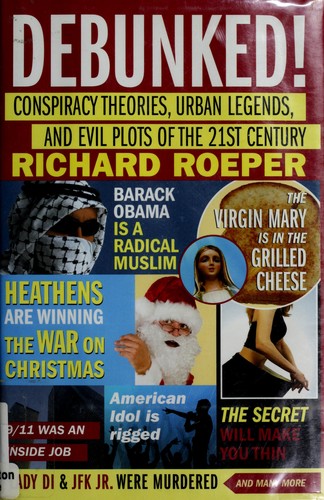
As an Amazon Associate, OverClassified may earn from qualifying purchases made through this link, at no extra cost to you.
Why This Is Essential Reading
Debunked! earns its place on this list not for any direct treatment of UFO phenomena, which it does not address, but as a useful general framework for evaluating exactly the kind of unofficial, personally brokered disclosure pattern this site's own Campeche Military FLIR Incident case file documents — a reminder that how a claim reaches the public can be as evidentially significant as the claim's own surface content.
Related Cases & Theories
Sources Cited
- Roeper, Richard. Debunked!: Conspiracy Theories, Urban Legends, and Evil Plots of the 21st Century. Chicago Review Press, 2008 (ISBN-13 9781556527074). amazon.com
- "Debunked!" Chicago Review Press (official publisher page). chicagoreviewpress.com
- "Debunked!: Conspiracy Theories, Urban Legends, and Evil Plots of the 21st Century." Goodreads (reader ratings, topics list). goodreads.com
- "Richard Roeper." Wikipedia (full biography: career, Ebert partnership, bibliography). en.wikipedia.org
- "Debunked!" Internet Archive (digitized copy, bibliographic record). archive.org
- "Mexican Air Force Pilots Film 11 UFOs." UFO Evidence (background on the Campeche case and Maussan's role). ufoevidence.org
- "UFO video causes a stir in Mexico." NBC News, 2004. nbcnews.com
- This site's own case file: Campeche Military FLIR Incident, for the full 2004 case this book's general framework applies to.
- This site's own case file: The Roswell Slides Hoax, a second Maussan-linked case exemplifying the same unofficial-disclosure pattern this book's methodology addresses.
- This site's own essential-reading entry: Encounter at Buff Ledge, for a contrasting example of exhaustive single-case UFO investigation.
- This site's own key-figures entry: Jaime Maussan, the television ufologist central to the Campeche case's unofficial disclosure pattern this book's framework addresses.
- "Richard Roeper to leave Sun-Times, vows to keep reviewing movies." Chicago Sun-Times, March 19, 2025. chicago.suntimes.com
- "Debunked!" AbeBooks (bibliographic listing, cover art source). abebooks.co.uk
Have corrections, additional research, or peer-reviewed sources? Help improve this entry.
Suggest an Edit