
Chupacabras and Other Mysteries
Scott Corrales's 1997 Chronicle of Puerto Rico's Goat-Sucker Wave — and the UFO Sightings, Government Theories, and Field Investigations Documented Alongside It
Core Thesis
Chupacabras and Other Mysteries is Scott Corrales's 1997 book-length chronicle of the vampiric, livestock-killing entity that became a hemispheric sensation after a wave of animal deaths swept Puerto Rico beginning in March 1995 — but it is not, at bottom, a monster book. Corrales, already a working translator and chronicler of Mexican, Puerto Rican, and Spanish UFO research through his early-1990s SAMIZDAT bulletin, approaches the chupacabra explosion the way he approached everything else on his beat: as one more eruption of high-strangeness activity in a region he'd already been documenting, folding into the same chapters the livestock mutilations, the eyewitness descriptions of a spined, red-eyed biped, the UFO sightings — luminous discs and unidentified craft reported near the same towns in the same months — and the government-conspiracy rumors that Puerto Rico's own UFO investigators, chiefly journalist Jorge Martín and the Puerto Rico Research Group (PRRG), were independently compiling in real time. The book's central, if implicit, argument is that treating the 1995 wave as a discrete cryptozoological mystery misses how the witnesses and investigators on the ground actually experienced it: as inseparable from a broader flap of unexplained aerial activity, alongside speculation — which Corrales documents as circulating field testimony rather than his own established fact — that the attacks were linked to covert genetic experimentation on an island with a real documented history of U.S. pharmaceutical and military testing. Written and published only two years after the wave broke, before Benjamin Radford's later investigative debunking and before DNA testing had definitively resolved several mainland U.S. "chupacabra" carcasses as mange-afflicted coyotes, the book stands today as a valuable primary-source snapshot of the phenomenon in its rawest, least-resolved form — a document of what Puerto Rican ufologists and the wider public believed and reported before the mundane explanation caught up with the legend.
About the Author
Scott Corrales is a Pennsylvania-based bilingual translator, editor, and researcher who has spent more than three decades as one of English-language ufology's principal conduits into Hispanic-world paranormal and UFO research. He attended George Washington University and Rutgers University, and by his own account first became interested in the UFO phenomenon through direct exposure to heavy sighting activity while living in Mexico and Puerto Rico. He has cited two Mexican researchers as early influences: broadcaster and ufologist Pedro Ferriz, and Salvador Freixedo, a former Jesuit priest whose work argued for a paranormal, interdimensional interpretation of the UFO phenomenon rather than a strictly nuts-and-bolts extraterrestrial one — a framing that shaped Corrales's own tendency, visible throughout Chupacabras and Other Mysteries, to treat cryptid, UFO, and high-strangeness reports as facets of one wider phenomenon rather than separate fields.
Corrales's career as a translator of record began in 1990, when he started rendering Freixedo's Spanish-language writing into English for readers who otherwise had no access to it. That work grew into SAMIZDAT, a research bulletin he founded in 1993, through which he collaborated with Mexico's CEFP research group, Puerto Rico's PRRG, and members of Spain's so-called "third generation" of UFO researchers — building, over the first half of the 1990s, exactly the cross-border network of field contacts that would let him respond quickly when the Puerto Rico chupacabra wave broke in 1995. In October 1998 he relaunched SAMIZDAT as Inexplicata: The Journal of Hispanic Ufology, the flagship publication of the Institute of Hispanic Ufology, which he continues to direct; the blog-based successor to that journal remains active today, with contributing editors described as spanning more than a dozen Spanish-speaking countries, and continues to translate and publish Latin American UFO and paranormal case material for English-language readers.
Corrales moved unusually fast on the chupacabra story: between 1995 and 1997 he produced three books on the phenomenon in rapid succession — The Chupacabras Diaries, Nemesis: The Chupacabras at Large, and finally Chupacabras and Other Mysteries, published by the small Tennessee press Greenleaf Publications in 1997 with an introduction by fellow paranormal author Marc Davenport. He followed it in 1998 with Flashpoint: High Strangeness in Puerto Rico, extending the same documentary approach to the island's wider UFO record. Unlike some other authors covered in this site's Essential Reading library, Corrales does not currently have a dedicated key-figures profile on OverClassified; his name appears here as plain text throughout, reflecting his primary standing as this field's most prolific English-language translator and documentarian rather than as the central figure of any one headline case.
Historical Context & Origins
The 1995 wave was not, strictly speaking, Puerto Rico's first chupacabra-pattern livestock scare. In 1975, animal deaths in the town of Moca were attributed locally to "el vampiro de Moca" (the vampire of Moca); affected animals reportedly bore small, circular puncture wounds and appeared to have been drained of blood, and rumors at the time pointed toward a Satanic cult rather than any cryptid. That earlier scare faded from wide public memory, but it established, two decades ahead of time, the exact wound pattern and blood-loss narrative that would define the far larger 1995 event — a continuity Corrales's book, written by an author already tracking Puerto Rican high-strangeness reporting, was positioned to place in context for English-language readers who had no memory of Moca at all.
The modern wave began on March 11, 1995, in the central Puerto Rican town of Orocovis, when farmer Juan Cedeño found eight of his sheep dead overnight, each reportedly bearing several small, neat puncture wounds and appearing to have been completely drained of blood. Similar livestock deaths spread through Orocovis and neighboring Morovis over the following months. By August 1995, the town of Canóvanas — in Puerto Rico's northeast — had become the wave's epicenter, with roughly 150 animal deaths reported in the area that year alone; it was there, in the second week of August, that resident Madelyne Tolentino reported seeing the creature itself through a window, describing a bipedal, three-to-four-foot being with large red eyes, spines running down its back, thin clawed arms, and powerful hind legs. Puerto Rican comedian and radio personality Silverio Pérez is widely credited with coining the name "chupacabra" (literally "goat-sucker," from chupar, to suck, and cabras, goats) on air in late 1995 as the reports multiplied; by year's end, more than 200 individual sightings and roughly 1,000 dead animals had been reported across the island, and the term had spread into Mexico and the wider Spanish-speaking Caribbean.
Corrales published Chupacabras and Other Mysteries in 1997, just two years after the wave crested and while its central claims were still almost entirely unresolved by any independent scientific body. That timing matters for how the book reads today: it was written before Benjamin Radford's later multi-year investigation (discussed in full in this entry's Critical Reception section) traced key elements of Tolentino's description to a 1995 horror film, and before DNA testing on several mainland-U.S. "chupacabra" carcasses, starting in the mid-2000s, identified them as mange-afflicted coyotes. Corrales was not working in a vacuum, however; he drew on, and helped bring to English-language readers, primary field material already being gathered on the island by Puerto Rico's PRRG and by journalist Jorge Martín, editor of Evidencia Ovni, whose own investigative reporting had from the outset folded the chupacabra attacks into a wider narrative of UFO sightings, unexplained underground vibrations, and alleged covert government activity across the island.
Core Arguments & Key Concepts
The book's organizing move — and the one this site's editorial framing singles it out for — is refusing to treat the chupacabra as a self-contained cryptozoological mystery. Corrales repeatedly places livestock-mutilation reports alongside contemporaneous UFO sightings from the same towns and, in some cases, the same nights: unidentified discs and other craft reported hovering near mutilation sites, unusual lights witnesses associated with the creature's appearances, and reports of unmarked helicopters that residents and PRRG investigators alike treated as related rather than coincidental. Whether or not that association reflects any real causal link, Corrales's decision to document it as reported — rather than filter it out to produce a tidier monster-book narrative — is the throughline that separates this book from most other chupacabra-era paperbacks and is exactly the reason it belongs in a UFO/UAP research library rather than a pure cryptozoology one.
A substantial portion of the book's evidentiary material is not Corrales's own fieldwork but material gathered by Puerto Rico's PRRG and by Jorge Martín, the island's most prominent chupacabra-and-UFO investigator of the period. Most notably, the book includes an interview PRRG investigators conducted with Madelyne Tolentino in March 1996, giving English-language readers direct access to her account only months after her original August 1995 sighting — material that later became central to the skeptical re-examination of her story detailed below. Corrales's role here is largely that of translator, compiler, and English-language publisher of record for a body of Puerto Rican field investigation that would otherwise have remained almost entirely inaccessible outside the island.
The book also chronicles, without fully endorsing, a specific conspiratorial strand that PRRG and Martín's own reporting had already been developing: the theory that the attacks stemmed from covert genetic or biological experimentation, tied to Puerto Rico's real, documented history as a site for U.S. pharmaceutical and military testing programs, compounded by residents' reports that government veterinarians and officials examining afflicted animals were unresponsive or evasive about their findings. Corrales presents this as circulating belief and field testimony from named and unnamed sources on the island, not as an investigative conclusion the book itself proves — an important distinction this entry's Critical Reception section returns to.
True to its subtitle-in-spirit, the book ranges beyond the chupacabra proper into "other mysteries": shapeshifting entities, Bigfoot-type reports, and additional high-strangeness cases from Puerto Rico and the wider Hispanic world, reflecting Corrales's broader role as a chronicler-translator rather than a narrow monograph author. Contemporary reviewers have noted the book holds together well on a sentence-by-sentence level for a work drawing on translated field notes and news clippings, though the material grows repetitive in stretches — one chapter in particular is built almost entirely from chronological snippets lifted from a single Puerto Rican news publication, a journalistic-chronicle structure that maximizes primary-source density at some cost to narrative pacing.
Key Cases & Evidence Discussed
The March 11, 1995 Orocovis attack, in which farmer Juan Cedeño found eight sheep dead and drained overnight, is the case most often cited as the modern wave's opening incident, and the book situates it as the point at which isolated livestock deaths in Orocovis and neighboring Morovis first cohered into a single, named phenomenon.
Madelyne Tolentino's August 1995 sighting in Canóvanas, Puerto Rico — a spined, red-eyed biped glimpsed through a window — is the book's central witness case, presented via the March 1996 PRRG field interview Corrales republished for English-language readers. It is simultaneously the book's most important piece of primary testimony and, as detailed below, the case later skeptical investigation would most thoroughly complicate.
The book documents the broader 1995 statistical picture — more than 200 individual sightings and roughly 1,000 reported animal deaths across the island by year's end — alongside the specific UFO and unexplained-phenomena reports that Puerto Rico's PRRG and Jorge Martín had been logging in parallel, including sightings of unconventional aerial craft near mutilation sites and reported unexplained underground disturbances that Martín's own later investigative work would connect to El Yunque rainforest.
Because it predates the mainland-U.S. cases that eventually produced hard forensic evidence, the book does not and could not discuss the DNA-confirmed mangy-coyote identifications made in Texas in the following decade — the 2004 "Elmendorf Beast" near San Antonio, a 2007 case near Cuero, and a 2010 case in Hood County — each covered in this entry's Critical Reception section as the scientific resolution that arrived after Corrales's book went to press.
Critical Reception & Controversies
Reader response to the book itself has been mixed but largely respectful of its research base. Reviewers have described it as a genuinely well-sourced compilation — combining indirect reports relayed by other researchers, first-hand interview material, and direct excerpts from Puerto Rican news coverage — and noted that, unlike some translated field research, the English prose reads cleanly rather than like a rough or mechanical translation. The same reviewers have also flagged real unevenness: the wealth of primary material grows dry in stretches, and at least one chapter consists almost entirely of chronological news-clipping snippets rather than analysis, a structural choice that favors documentary completeness over readability.
The book's most serious reception problem, however, is one it could not have anticipated: the subsequent, fairly thorough unraveling of its own central witness case. Skeptical investigator Benjamin Radford conducted a multi-year investigation, published as Tracking the Chupacabra (2011), that identified specific, documented inconsistencies between Madelyne Tolentino's 1996 account — the version Corrales's book itself preserves — and her later 2010 retelling, including changes to the number of claws, finger count, and whether other witnesses corroborated the sighting or attempted to capture the creature. Radford also traced key visual details of her description to Species, a 1995 science-fiction film featuring a creature designed by artist H. R. Giger that had been in theatrical release in Puerto Rico shortly before her sighting; Tolentino herself later acknowledged the resemblance. None of this proves fabrication, but it substantially weakens the evidentiary weight of the interview Corrales's book treats as its centerpiece.
On the underlying biological question, the mainstream scientific verdict — developed almost entirely after this book's 1997 publication — is that the great majority of chupacabra carcasses recovered and tested in the United States have been coyotes, and in some cases coyote-dog hybrids, suffering from advanced sarcoptic mange, a disease caused by the mite Sarcoptes scabiei that produces severe hair loss, skin thickening, emaciation, and a foul odor consistent with witness descriptions of a hairless, monstrous animal. University of Michigan evolutionary biologist Barry O'Connor, whose 2010 analysis was widely reported, concluded that weakened, mange-afflicted coyotes turn to slower livestock as easier prey than the wild game they would normally hunt, which independently accounts for the pattern of goat and poultry kills without requiring any unknown organism. DNA testing by University of California, Davis on specific recovered specimens — the 2004 "Elmendorf Beast" near San Antonio, a 2007 carcass from Cuero, Texas, and a 2010 animal from Hood County, Texas — confirmed coyote and coyote-wolf/dog ancestry with mange in each case. Texas A&M AgriLife wildlife biologist Dr. John Tomeček, discussing the phenomenon in 2024, put the visual effect plainly: afflicted coyotes can look like "an otherworldly beast — especially if you see it in the dusky hours." Separately, Puerto Rican veterinarian Dr. David Morales examined roughly 300 reported chupacabra victims and found they had not, in fact, been bled dry, directly undercutting the vampiric blood-loss claim at the center of the original 1995 reports and, by extension, of this book's own opening chapters.
It is worth stating the honest relationship between these two bodies of work plainly: Corrales's book does not argue against the mange explanation, because the mange explanation as a broadly accepted, DNA-supported finding did not yet exist in 1997. What the book offers instead is a faithful record of what Puerto Rican witnesses, investigators, and officials were reporting and believing while the wave was still active and unresolved — UFO sightings, government-experiment theories, and an unverified vampiric creature treated as a single, unified mystery — a record whose value as primary-source ufological documentation is separate from, and not diminished by, the naturalistic explanation later research established for most of the physical evidence.
Influence & Legacy
Chupacabras and Other Mysteries established Corrales as the field's principal English-language chronicler of the phenomenon at the exact moment international interest in it peaked, and it remains the book most frequently cited when English-speaking researchers need a documentary starting point for the 1995 Puerto Rico wave specifically, as distinct from the broader pop-culture chupacabra mythology that followed. Corrales's parallel and much longer-running achievement — relaunching his SAMIZDAT bulletin as Inexplicata: The Journal of Hispanic Ufology in 1998 and continuing to direct the Institute of Hispanic Ufology today — means this book functions less as a standalone artifact than as the visible early product of a translation and documentation project that has now run for more than three decades.
Within this site's own case-file library, the book's role as a hemispheric-context reference is reflected directly: this site's own case files on the 1991 Mexico City Eclipse UFO Wave and the Petare Close Encounter both independently cite Chupacabras and Other Mysteries in their own further-reading sections — not because either incident involves a chupacabra encounter, but because both sit within the same bilingual, cross-border Latin American UFO research tradition Corrales's career has documented, translated, and helped introduce to English-language readers.
The book's most consequential downstream legacy may be the gap it exposes between two research traditions that rarely engage each other directly: the Puerto Rican-based, UFO-linked, high-strangeness framing Corrales, Jorge Martín, and PRRG developed in real time during 1995 and 1996, and the mainland-U.S. wildlife-biology research community that, starting roughly a decade later, resolved most physical "chupacabra" evidence as ordinary, mange-afflicted canids. Read together with the Critical Reception section above, the book stands as a useful marker of exactly how much of the chupacabra phenomenon's early UFO-adjacent framing depended on testimony and theory that later, unrelated forensic science would go on to substantially narrow.
The Book
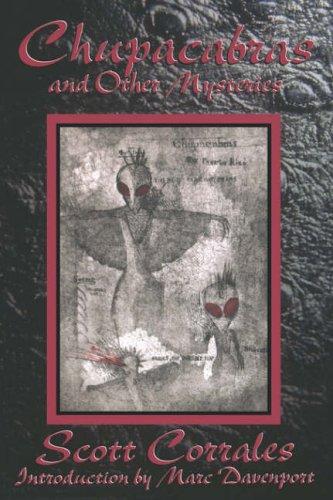
Chupacabras and Other Mysteries
Scott Corrales's 1997 Chronicle of Puerto Rico's Goat-Sucker Wave — and the UFO Sightings, Government Theories, and Field Investigations Documented Alongside It
Find on Amazon →As an Amazon Associate, OverClassified may earn from qualifying purchases made through this link, at no extra cost to you.
Why This Is Essential Reading
Chupacabras and Other Mysteries earns its place on this list not as a reliable field guide to an undiscovered cryptid, but as the clearest surviving English-language snapshot of a specific historical moment when a Latin American UFO research tradition, a livestock-mutilation panic, and a wave of aerial sightings were treated by the people living through them as a single, unified mystery. Scott Corrales did not invent that framing; he translated, compiled, and preserved it, drawing directly on Puerto Rico's PRRG and on Jorge Martín's own contemporaneous investigative work, including the March 1996 interview with Madelyne Tolentino that later skeptical research would substantially complicate. Read today, alongside Barry O'Connor's DNA-supported mange explanation and Benjamin Radford's documented inconsistencies in the book's own central witness, this book is essential less as a solved case than as an honest artifact of the moment before it was solved — a reminder that this site's own UFO/UAP case files and a cryptid panic three states away from any flying saucer can, in the actual historical record, turn out to be the same story told by the same witnesses in the same towns during the same months.
Related Cases & Theories
Sources Cited
- "Chupacabra." Wikipedia (1975 Moca precursor, 1995 Puerto Rico wave chronology, DNA-confirmed Texas mange cases). en.wikipedia.org
- "Chupacabra Revisited: Dueling Origin Stories of the Hispanic Vampire." Skeptical Inquirer, April 2025 (Madelyne Tolentino's changing 1996–2010 accounts, the Species film connection, Jorge Martín's illustration, Corrales's publication of the 1996 interview). skepticalinquirer.org
- "'Goat Sucker' May Just Be A Mangy Coyote." NPR, October 29, 2010 (Barry O'Connor's University of Michigan sarcoptic-mange finding and behavioral explanation). npr.org
- "Unmasking the Chupacabra." Texas A&M AgriLife Today, October 15, 2024 (Dr. John Tomeček on mange symptoms and the "otherworldly beast" quote). agrilifetoday.tamu.edu
- "From spooky lore to science fact: Unmasking the 'chupacabra'." Phys.org, October 2024 (mange research context, DNA-tested Texas specimens). phys.org
- "Chupacabras and other mysteries." Open Library, edition record OL707038M (bibliographic record: Greenleaf Publications, Murfreesboro, TN, 1997, 248 pp., ISBN 1883729068 / 9781883729066, OCLC 37923418, cover art source). openlibrary.org
- "Chupacabras and Other Mysteries by Scott Corrales; Introduction by Marc Davenport." Biblio.com (publisher, introduction credit, edition details). biblio.com
- "Chupacabras: And Other Mysteries." Amazon.com (product listing, ISBN, reader reviews). amazon.com
- "Chupacabras: And Other Mysteries by Scott Corrales." Goodreads (synopsis, reader reviews). goodreads.com
- "Scott Corrales." Coast to Coast AM, guest biography (education, career background, influence of Pedro Ferriz and Salvador Freixedo, SAMIZDAT/Inexplicata history). coasttocoastam.com
- Inexplicata: The Journal of Hispanic Ufology, "About Me" (Institute of Hispanic Ufology founding, October 1998, Corrales's role as director). inexplicata.blogspot.com
- "Corrales, Scott." Occult World (biographical summary, published works including Chupacabras and Other Mysteries and Flashpoint: High Strangeness in Puerto Rico). occult-world.com
- "Scott Corrales: Hispanic Ufology and the State Of UFO Studies." Radio Misterioso, August 21, 2012 (interview covering Corrales's research focus and career). radiomisterioso.com
- "UFO's, the government, and the conspiracy." A Chupas Time-Line, Princeton University archive of Jorge Martín's OVNI Evidencia reporting (government cover-up claims, UFO sightings near mutilation sites, genetic-experimentation theory). princeton.edu
- This site's own key-figures entry: Jorge Martín, for his role documenting Puerto Rican UFO and chupacabra-linked cases.
- This site's own key-figures entry: Benjamin Radford, for his investigative background relevant to his chupacabra research.
- This site's own locations entry: Puerto Rico, for the island's broader UAP sighting history.
- This site's own case file: The Petare Close Encounter (Case File #182), for a companion Latin American humanoid-encounter case from the same bilingual research tradition.
- This site's own case file: 1991 Mexico City Eclipse UFO Wave (Case File #162), for the Mexican civilian ufology explosion Corrales tracked in the same period.
- This site's own case file: Amaury Rivera Abduction (Case File #023), for another Puerto Rico case documented by Jorge Martín.
Have corrections, additional research, or peer-reviewed sources? Help improve this entry.
Suggest an Edit