
Carrying the Fire
An Astronaut's Journeys
Core Thesis
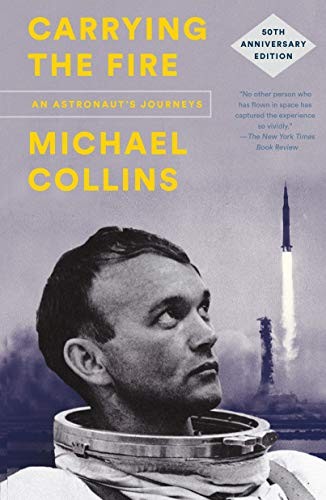
Carrying the Fire is Michael Collins's own 1974 memoir of his path from West Point cadet to Air Force test pilot to Gemini 10 and Apollo 11 astronaut, written without a ghostwriter and widely regarded, including by fellow astronauts and spaceflight historians, as the single best-written of all the Apollo-era memoirs. Its relevance to this site is specific and direct: Collins is the crewmember who, during Apollo 11's translunar coast, descended to the Command Module's Lower Equipment Bay and examined the mission's unidentified object through the ship's optical sextant — the observation this site's own Apollo 11 UAP Sighting case file treats as the case's single most important piece of evidence. This article evaluates the book on its own terms as a memoir and as a primary source, distinct from the case file's own analysis of the sighting itself.
About the Author
Michael Collins was born October 31, 1930, in Rome, Italy, where his father was serving as a U.S. Army officer and military attaché. He graduated from the U.S. Military Academy at West Point in 1952, then transferred into the Air Force rather than the Army — a decision he wrote later shaped his entire subsequent career — and trained as a fighter pilot, flying F-86 Sabres out of Nellis Air Force Base, Nevada, after advanced day-fighter training.
Collins became an experimental test pilot at Edwards Air Force Base, California, graduating from the Air Force Experimental Flight Test Pilot School in 1960 and the Aerospace Research Pilot School shortly after, testing the performance, stability, and control characteristics of Air Force jet fighters over the Mojave Desert's dry lakebeds alongside contemporaries who would go on to NASA's own astronaut corps, several of whom he writes about in the book with the same unvarnished candor he applies to himself. He was selected into NASA's third group of astronauts in 1963, and flew twice: as pilot of Gemini 10 in July 1966, during which he performed two spacewalks and set a temporary world altitude record, and as Command Module Pilot of Apollo 11 in July 1969, the mission that put Neil Armstrong and Buzz Aldrin on the lunar surface while Collins orbited alone in Columbia overhead, a role he describes in the book with a mixture of professional pride and genuine, unresolved solitude.
After leaving NASA, Collins served as Assistant Secretary of State for Public Affairs and then as the founding director of the Smithsonian's National Air and Space Museum, overseeing the museum's construction and 1976 opening, before a subsequent stint as Under Secretary of the Smithsonian Institution as a whole. He wrote Carrying the Fire himself, without a collaborator or ghostwriter, a genuinely unusual choice among astronaut memoirists of the era and one reviewers consistently single out as the reason for the book's distinctive, literary voice.
Collins went on to write several further books over the following decades, including Liftoff: The Story of America's Adventure in Space (1988), a broader institutional history of the U.S. space program written from his own insider's vantage point, Mission to Mars (1990), an argument for continued human spaceflight beyond the Moon, and Flying to the Moon: An Astronaut's Story of Adventure (1994), a version of his own story adapted for younger readers. None of these later books ever displaced Carrying the Fire's own reputation as his defining work, a fact Collins himself seemed to accept with characteristic wry humor rather than resentment in later interviews. He died April 28, 2021, in Naples, Florida, at age 90, having outlived both of his Apollo 11 crewmates.
Historical Context & Origins
Collins wrote Carrying the Fire in the years immediately following Apollo 11, publishing it in 1974 with a foreword by aviator Charles Lindbergh — a deliberate passing-of-the-torch gesture linking Collins's own transatlantic-scale journey to Lindbergh's 1927 solo Atlantic crossing. The book arrived at a moment when public interest in the Apollo program was already cooling; NASA had cancelled the final three planned lunar landings, and the astronaut memoir as a genre was still finding its footing, with most contemporaneous accounts either ghostwritten or built around press-office talking points rather than a single author's own reflective voice.
The book's frank, occasionally self-deprecating candor was itself unusual for its time: Collins wrote openly about fear, boredom, interpersonal friction within the tightly controlled astronaut corps, and his own ambivalence about fame, rather than presenting the sanitized, uniformly heroic public image NASA's own press apparatus generally cultivated. This candor is directly relevant to how this site treats the book as a source: Collins had no evident institutional incentive to either invent or suppress an unusual observation, and wrote about the mission's unidentified-object sighting in the same unvarnished register he applied to everything else in the book.
The book was reissued in 2009 for Apollo 11's fortieth anniversary and again in 2019, with a new author's preface, for the fiftieth — the same fiftieth-anniversary wave of renewed attention that also prompted fresh scrutiny of the mission's own declassified technical debriefing, the primary document this site's own case file draws its central sextant-observation quotes from.
The book's foreword by Charles Lindbergh carries its own specific historical weight beyond simple celebrity endorsement. Lindbergh had, by the 1970s, become a controversial figure for his prewar isolationist politics and public statements, and his willingness to publicly endorse Collins's book in particular reflected Lindbergh's own long-standing fascination with the technical and philosophical dimensions of solo flight — a theme he clearly recognized in Collins's own account of orbiting the Moon alone, out of radio contact with the rest of humanity, once every lunar revolution.
Core Arguments & Key Concepts
The book is structured in three roughly chronological movements: Collins's West Point and Air Force test-pilot years, his 1966 Gemini 10 mission, and Apollo 11 itself, which occupies the book's second half. Rather than a simple mission-by-mission log, Collins builds each section around specific sensory and emotional detail — the physical experience of high-G flight, the disorienting beauty of orbital sunrise, the claustrophobia of the Command Module's cramped interior — that most contemporaneous astronaut writing omitted in favor of procedural summary.
A recurring argument threaded through the book is that the astronaut's actual lived experience of spaceflight was routinely flattened by NASA's own public messaging and by press coverage built around a small set of repeatable, reassuring phrases. Collins wrote pointedly about wanting readers to understand what test-piloting and spaceflight genuinely felt like, technically and emotionally, rather than the version filtered through mission-control transcripts and post-flight press conferences.
Collins is also candid about the specific isolation of his own role on Apollo 11: as Command Module Pilot, he alone did not walk on the Moon, orbiting overhead during Armstrong and Aldrin's lunar surface excursion and passing behind the Moon's far side, out of all radio contact with both his crewmates and Earth, once every orbit. He wrote about this solitude without self-pity but also without pretending it was simply a footnote to the mission's more famous moments — a candor this site's own case file references when describing the crew's generally composed, methodical temperament even when confronted with an unexplained observation.
Within this candid, technically detailed frame, Collins recounts the mission's translunar sighting in the same voice he applies throughout: a specific, first-person account of descending to the Lower Equipment Bay to examine the object through the Command Module's optical sextant, an instrument built for precision star sightings and rendezvous navigation rather than casual visual confirmation.
Collins is equally frank throughout the book about the practical, unglamorous mechanics of test-piloting and spaceflight — checklists, fuel margins, equipment failures, the physical discomfort of a pressure suit worn for hours at a stretch — interleaved with passages of genuine lyricism about the view of Earth from lunar orbit. Reviewers have consistently noted this tonal range as the book's defining structural achievement: few memoirs of any genre move as fluidly between precise technical description and reflective, almost meditative prose without either mode undercutting the other.
Key Cases & Evidence Discussed
This site's own Apollo 11 UAP Sighting (Case File #102, July 19, 1969) is this book's central point of overlap with this site's catalog. The case file's own account of the sighting draws directly on the Apollo 11 Technical Crew Debriefing rather than the book itself for its verbatim quotes, but Collins's memoir is the fullest first-person narrative treatment of the same event available anywhere, written by the one crewmember who personally examined the object through an optical instrument and is quoted in the case file's own Key Witnesses section describing the view as resolving from a point of light into what "appeared to be a cylinder" as the sextant's focus shifted.
The book is also relevant to this site's own NASA UAP Independent Study Team Report (Case File #303, 2023) in a more indirect, institutional sense: both works represent NASA-connected figures engaging candidly, in their own words rather than through a public-affairs filter, with an unresolved observation or open scientific question — Collins in 1974 describing what he personally saw and could not fully explain, and NASA's own 2023 independent panel describing, decades later, the same institutional discipline of reporting genuine uncertainty rather than manufacturing false closure.
Critical Reception & Controversies
Carrying the Fire is widely regarded, including by fellow astronauts and by spaceflight historian Andrew Chaikin (author of A Man on the Moon, also cited elsewhere on this site), as the best-written of all the Apollo-era astronaut memoirs. The New York Times Book Review wrote that "no other person who has flown in space has captured the experience so vividly," and The New Yorker called it "profoundly affecting" — a critical reception genuinely unusual for a genre more often praised for its historical value than its prose.
Reviewers have consistently credited the book's quality specifically to Collins having written it himself, without a collaborator, in contrast to several contemporaneous astronaut memoirs produced with a ghostwriter's assistance. This distinction matters for how this site treats the book's account of the sighting: the sextant-observation passage carries Collins's own unmediated voice and word choices, not a co-writer's paraphrase, though this site's own case file still treats the formal Technical Crew Debriefing transcript, recorded within days of the mission, as the more forensically reliable primary source for exact wording.
Some later critical commentary has noted the book's relative reticence on the more overtly political and interpersonal tensions of the Apollo program — funding fights, the astronaut corps' internal rivalries, and NASA's own institutional anxieties about public perception — areas later documentary biographies treat in greater depth. This is a fair limitation of any first-person memoir: Collins wrote from inside his own experience and temperament, not as an institutional historian with access to internal NASA correspondence.
No published critical source located in researching this article treats Collins's account of the sighting itself as anomalous, embellished, or inconsistent with his own later or contemporaneous statements; his description in the book is broadly consistent with the debriefing transcript's own wording, differing mainly in narrative framing rather than in any specific factual claim about what he observed.
The book's reputation has also benefited from a kind of reviewer consensus rare among memoirs from any genre: unlike many contested UFO-adjacent or paranormal titles elsewhere on this site's Essential Reading list, Carrying the Fire draws no meaningful negative critical faction. Its praise is remarkably uniform across five decades of reviews, general readers, and fellow astronauts alike, a consistency this article notes precisely because it stands in such contrast to the more contested reception histories typical of this site's other Essential Reading entries.
Influence & Legacy
The book has remained continuously in print for five decades, reissued for both Apollo 11's fortieth and fiftieth anniversaries, and is routinely cited as the reference standard against which later astronaut memoirs, including Buzz Aldrin's own Magnificent Desolation, are measured for literary quality.
On this site specifically, this exact 1974 first edition and its 2019 anniversary reissue are cited as a primary crew-perspective source in the Apollo 11 UAP Sighting case file's own Further Reading and Sources sections, reflecting its standing here as the default first-person account for readers who want Collins's own fuller narrative context beyond the debriefing transcript's clipped, procedural exchange.
Collins's later career as founding director of the Smithsonian's National Air and Space Museum extended his influence well beyond his own writing, shaping how an entire generation of museum visitors encountered the Apollo program's material history — a legacy distinct from, but complementary to, the personal, literary account of the same missions this book preserves in his own words.
Within the specific, narrower literature this site catalogs — primary-source astronaut and program-insider accounts touching on unexplained aerial observations — Carrying the Fire occupies an unusual position: it is the earliest published crew-perspective book to describe, in the observer's own words, an unresolved in-flight sighting later scrutinized by this site's own case-file methodology, predating by decades the more recent wave of insider disclosure memoirs this site covers elsewhere, including David Grusch's 2023 congressional testimony and the accounts examined in this site's own coverage of AAWSAP and AATIP. Collins's account differs from that later literature in one important respect worth stating plainly: he wrote as a technically trained observer describing a specific, bounded, instrumented observation he ultimately could not resolve, not as an advocate for any broader claim about extraterrestrial technology or government concealment — a distinction this site's own case file treats as central to why the Apollo 11 sighting remains one of its more credible, carefully self-documented entries even as its underlying object was very likely ordinary mission debris.
The Book
As an Amazon Associate, OverClassified may earn from qualifying purchases made through this link, at no extra cost to you.
Why This Is Essential Reading
Carrying the Fire earns its place on this list as the fullest first-person account, in the words of the one Apollo 11 crewmember who personally examined the mission's unexplained object through an optical instrument, of a sighting this site's own case file treats as one of the best-documented and most rigorously self-investigated UAP encounters on record. Read alongside the Apollo 11 UAP Sighting case file's own debriefing-transcript analysis, this widely-praised memoir supplies exactly what a formal transcript cannot: the observer's own reflective, unmediated voice, written with no evident motive to either sensationalize or suppress what he saw.
Related Cases & Theories
Essential Viewing
Sources Cited
- Collins, Michael. Carrying the Fire: An Astronaut's Journeys. Farrar, Straus and Giroux, 1974 (2019 50th-anniversary edition, ISBN-13 9780374537760). amazon.com
- "Carrying the Fire." Wikipedia (publication history, foreword, anniversary editions). en.wikipedia.org
- "Michael Collins (astronaut)." Wikipedia (full biography: West Point, Air Force test-pilot career, Gemini 10, Apollo 11, Smithsonian directorship). en.wikipedia.org
- "Michael Collins." Britannica (biography and Apollo 11 role). britannica.com
- "Former Astronaut Michael Collins." NASA. nasa.gov
- "MICHAEL COLLINS (MGEN, USAF, RET.) NASA ASTRONAUT (FORMER)." NASA biographical PDF. nasa.gov
- "Carrying the Fire by Michael Collins." Five Books (expert reviews and recommendation context). fivebooks.com
- "Carrying the Fire." Macmillan Publishers (publisher's own book page, critical blurbs). us.macmillan.com
- "Carrying the Fire: An Astronaut's Journey." Goodreads (reader ratings and reviews). goodreads.com
- "Book Review: Carrying the Fire by Michael Collins." Man of la Book. manoflabook.com
- "Carrying the Fire." Open Library (bibliographic record and cover art source). openlibrary.org
- "'Fresh Air' Remembers Apollo 11 Astronaut Michael Collins." NPR, April 30, 2021. npr.org
- This site's own case file: Apollo 11 UAP Sighting, for the full debriefing-transcript analysis of the sighting Collins describes in this book.
- This site's own key-figures entry: Michael Collins, for his full biography and further case connections.
Have corrections, additional research, or peer-reviewed sources? Help improve this entry.
Suggest an Edit