
A Savage War of Peace
Algeria 1954–1962
Core Thesis
A Savage War of Peace: Algeria 1954–1962 is Sir Alistair Horne's 1977 history of the Algerian War, immediately proclaimed by experts across the political spectrum as the definitive account and still regarded that way nearly five decades later. On this site, it supplies the essential wartime context — the atmosphere of a French Foreign Legion outpost in the Sud-Oranais region under active insurgency conditions — behind the March 1958 Bouamama Algerian War UFO Sighting, in which a lone sentry reported an enormous silent object hovering over his post.
About the Author
Sir Alistair Horne (1925–2017) was born in London and educated at Jesus College, Cambridge, after wartime service in the Royal Air Force (1943–44) and as an officer in the Coldstream Guards (1944–47). He worked as a Berlin correspondent for The Daily Telegraph from 1952 to 1955, during which period MI6 recruited him and used his journalism as cover for intelligence work — a dual career that ended in 1955 when he was dismissed from the Telegraph.
Horne went on to become a senior member, then fellow, of St Antony's College, Oxford, and wrote more than twenty books on 19th- and 20th-century French and European history, including The Price of Glory: Verdun 1916 (1962), winner of the Hawthornden Prize, and the official two-volume biography of British Prime Minister Harold Macmillan (1988). His honors included the CBE in 1992, appointment as Chevalier of the French Légion d'honneur in 1993, and a knighthood in 2003 "for services to Anglo-French relations."
This book, published in 1977, won both the Yorkshire Post Book of the Year Prize and the 1978 Wolfson History Award, and drew extensive academic review coverage in journals including The American Historical Review, Journal of Peace Research, and International Affairs between 1978 and 1980. Decades later, in mid-2007, Horne met with U.S. President George W. Bush, at the administration's request and on the recommendation of Henry Kissinger, to discuss lessons the Algerian War held for the Iraq War — a direct line from this book's original scholarly reception to its later, unexpected life as required reading in a different war entirely.
Horne's fluency in French, and his years living and reporting from continental Europe, gave him direct access to French-language primary sources, participants, and archives that many English-language historians of the period lacked, a research advantage reviewers consistently credited as central to the book's authority. His parallel career as an MI6-connected journalist in the early 1950s, though unrelated to Algeria specifically, reflects the same close, firsthand engagement with mid-century European intelligence and political culture that later informed his historical writing more broadly.
Historical Context & Origins
The book covers the Algerian War from its background through its 1962 conclusion, opening with three introductory chapters on the "Prelude, 1830–1954" before its main 22 chapters, divided into "The War 1954–1958" and "The Hardest of All Victories, 1958–1962." The war it documents brought down six French governments, caused the collapse of the Fourth Republic, returned Charles de Gaulle to power, and came close to provoking civil war on French soil itself — while more than a million Algerian Muslims died in the conflict and a comparable number of European settlers were ultimately driven into exile.
This site's own Bouamama Algerian War UFO Sighting falls squarely within the book's "The War 1954–1958" section: the March 1958 incident, in which French Foreign Legionnaire "N.G." reported an enormous object hovering over his isolated outpost near Bouamama, in Algeria's Sud-Oranais region, occurred during a period the book documents in detail as one of escalating insurgency, French military reprisal, and the psychological strain such conditions placed on soldiers stationed at remote, frequently threatened posts.
The war's defining characteristic, in Horne's own account, was what he termed "an unholy marriage of revolutionary terror and repressive torture" — a mutually escalating cycle of insurgent attacks and French counterinsurgency methods, including systematic torture, that the book documents as reshaping French military and political culture for a generation. Understanding that specific atmosphere of sustained psychological and physical strain is directly relevant to evaluating any anomalous report, including a UFO sighting, made by a soldier serving under those conditions.
The Sud-Oranais region specifically, where the Bouamama outpost this site's case file documents was located, sat near Algeria's border with Morocco — a border-adjacent desert frontier that, consistent with the broader pattern of infiltration-route tension the book documents across Algeria's frontiers generally, would have placed an isolated sentry post there among the war's more consistently exposed and heavily patrolled positions, even by the standards of a conflict fought almost entirely through irregular, small-unit engagements rather than conventional large-scale battles.
Core Arguments & Key Concepts
Horne's central argument is that the Algerian War represents one of the 20th century's most consequential and least understood conflicts in the English-speaking world, despite its outsized effect on French politics, its role as a formative case study in insurgency and counterinsurgency, and its lasting influence on later conflicts fought under broadly similar conditions.
The book pays particular attention to the psychological and moral costs the war imposed on individual French soldiers — including conscripts and professional legionnaires serving in isolated, exposed outposts much like the one this site's Bouamama case file describes — treating the war's effect on the men who fought it as inseparable from its broader political and military narrative rather than a secondary detail.
The New York Times Book Review praised the book as "a highly readable, toughly edited history that blends the pace and sweep of a work of fiction with a relentless pursuit of every main actor still alive and willing to talk about the war," while The Financial Times called Horne "one of the best writers of history in the English speaking world," showing him "at the peak of his powers" in this specific book — both reviews reflecting the book's reputation for combining narrative readability with genuinely exhaustive original research, including direct interviews with surviving participants.
The book's account of French counterinsurgency methods, including its unflinching documentation of systematic torture during the Battle of Algiers, became directly relevant to a much later American policy debate: in the preface to the 2006 edition, Horne relates that a copy of the book was sent to U.S. Defense Secretary Donald Rumsfeld in 2005, on the theory that the French experience with torture in Algeria might prove instructive during the Abu Ghraib scandal — a case of a nearly thirty-year-old history book being read for direct, urgent policy relevance rather than as settled historical background.
Beyond its treatment of high policy and military strategy, the book is also frequently credited with a sustained, almost novelistic attention to individual human experience within the war — interviews with surviving French officers, Algerian nationalist leaders, conscripted soldiers, and settler-community civilians alike, woven into a single continuous narrative rather than segregated into separate thematic chapters. That structural choice is part of why reviewers repeatedly described the book as reading with the pace of fiction despite its exhaustive scholarly apparatus and 604-page length.
Key Cases & Evidence Discussed
This site's own Bouamama Algerian War UFO Sighting (Case File #306, March 1, 1958) is the case this book's historical detail most directly supports: Legionnaire N.G.'s report of an enormous, roundish object hovering silently above his post for nearly an hour, followed by his week of neurological and psychiatric observation at the Val-de-Grâce military hospital in Paris (with every test returning normal), occurred during exactly the period of sustained, high-tension counterinsurgency operations this book documents in its "The War 1954–1958" section — conditions under which isolated sentries faced genuine, near-constant threat, and under which an anomalous report was taken seriously enough by his own superiors to warrant both a physical site search and extended medical evaluation, rather than being dismissed out of hand.
This site's own Foo Fighters (WWII Aerial Phenomena) (Case File #160, beginning November 1944) offers a useful comparative case from an earlier conflict: like the Bouamama sighting, the Foo Fighters reports came from military personnel under sustained combat stress in an active theater, reinforcing this site's broader pattern of treating wartime conditions themselves — sleep deprivation, hypervigilance, and the routine presence of unfamiliar aircraft and ordnance — as a genuine, relevant variable in evaluating anomalous aerial reports from serving soldiers, a variable this book's detailed account of Algerian War conditions helps make concrete for the Bouamama case specifically.
N.G.'s specific case also illustrates something the book's broader narrative helps contextualize: French military authorities in 1958 took his report seriously enough to conduct a physical site search and order a full week of neurological and psychiatric evaluation at a major Paris military hospital, rather than dismissing it outright. That institutional response is more legible against the book's account of a French military establishment already stretched thin, deeply concerned with troop morale and reliability under sustained insurgent pressure, and consequently motivated to rule out any medical or psychological explanation for a report from a soldier it needed to trust at his post.
Critical Reception & Controversies
The book was, on original 1977 publication, "immediately proclaimed by experts of varied political sympathies to be the definitive history of the Algerian War," a rare consensus for a work covering so politically fraught a conflict, and it won both the Yorkshire Post Book of the Year Prize and the 1978 Wolfson History Award.
Its academic reception across the following several years was similarly strong, with substantive reviews appearing in The American Historical Review, Journal of Peace Research, International Affairs, and Political Science Quarterly between 1978 and 1980 — a spread across military history, political science, and peace-studies journals reflecting the book's cross-disciplinary relevance.
The book's most unusual later reception came decades after publication, when it became what multiple sources describe as "an underground bestseller among U.S. military officers" and "the read of choice for many U.S. military officers serving in Iraq" during the 2000s — a striking second life for a nearly thirty-year-old history book, driven by its detailed treatment of counterinsurgency warfare rather than by any UFO-related content, which the book does not address at all.
No source located during this article's research disputes the book's core historical scholarship or its status as the standard English-language account of the Algerian War; such critical engagement as exists concerns interpretive emphasis on specific political figures and events within the war, rather than the book's fundamental reliability as a historical source.
The book's continued presence on university history and international-relations syllabi, alongside its ongoing availability across multiple formats — the 2006 NYRB Classics paperback, a 2008 audiobook edition, and a Kindle ebook — nearly five decades after its original 1977 publication reflects a sustained, active readership well beyond the initial wave of scholarly and prize-committee recognition that greeted it on first release.
Influence & Legacy
This exact title is cited in this site's own Bouamama Algerian War UFO Sighting case file's Further Reading section as providing essential context for the wartime conditions under which that sighting occurred — a direct, deliberate pairing of rigorous conventional military history with an anomalous individual report from within that same documented conflict.
The book's unexpected second life as required or informally recommended reading for U.S. military officers deploying to Iraq in the 2000s, and Horne's own 2007 meeting with President George W. Bush to discuss its lessons directly, demonstrate a work of history actively shaping real-world policy discussion roughly thirty years after its original publication — a rare trajectory for a single-conflict regional history to follow.
Horne's broader body of work, including his official Macmillan biography and his later book on a pivotal year in Henry Kissinger's career, situates this book within a career-long pattern of writing history with direct relevance to how policymakers and military leaders actually think about power, conflict, and negotiated settlement — a pattern this specific book, given its Rumsfeld and Bush-era afterlife, exemplifies more concretely than perhaps any other single title in Horne's bibliography.
Horne died in May 2017 at age 91, having established the Alistair Horne Fellowship at St Antony's College, Oxford to support young historians writing on modern history — an institutional legacy ensuring the same rigorous, archive-and-interview-driven historical method this book exemplifies continues to be funded and practiced by a new generation of scholars working on twentieth-century conflicts.
The Book
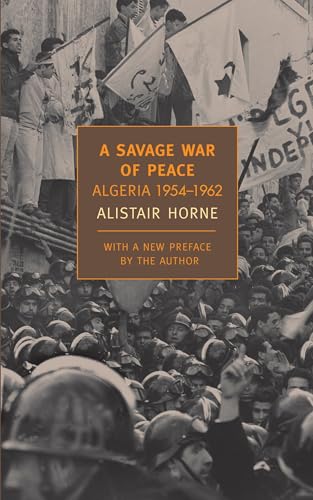
As an Amazon Associate, OverClassified may earn from qualifying purchases made through this link, at no extra cost to you.
Why This Is Essential Reading
A Savage War of Peace earns its place on this list as the acknowledged definitive history of a conflict most English-language readers know only vaguely, and as essential, rigorously documented context for the specific wartime conditions surrounding this site's own Bouamama Algerian War UFO Sighting case file — a case that can only be properly weighed with a clear understanding of just how strained, dangerous, and psychologically taxing service at an isolated Algerian War outpost genuinely was.
Related Cases & Theories
Sources Cited
- Horne, Alistair. A Savage War of Peace: Algeria 1954–1962. New York Review Books Classics, 2006 (orig. Macmillan/Viking Press, 1977; ISBN-13 9781590172186). amazon.com
- "A Savage War of Peace: Algeria, 1954–1962." Wikipedia (publication history, structure, awards). en.wikipedia.org
- "Alistair Horne." Wikipedia (full biography: education, career, honors, bibliography, 2007 Bush meeting). en.wikipedia.org
- "A Savage War of Peace." New York Review Books (publisher description, critical blurbs). nyrb.com
- "A Savage War of Peace: Algeria 1954-1962." Air University Press (military-audience book review). airuniversity.af.edu
- "Torture in a Savage War of Peace: Revisiting the Battle of Algiers." War on the Rocks (essay on the book's counterinsurgency and torture relevance). warontherocks.com
- "A Savage War of Peace: Algeria 1954-1962." Goodreads (reader ratings and reviews). goodreads.com
- "A savage war of peace: Algeria, 1954-1962." Internet Archive (digitized copy, bibliographic record). archive.org
- This site's own case file: Bouamama Algerian War UFO Sighting, for the full 1958 incident this book's history provides essential context for.
- This site's own case file: The Foo Fighters (WWII Aerial Phenomena), for a comparative wartime aerial-anomaly case from an earlier conflict.
- This site's own key-figures entry: Alistair Horne, for his full biography and further case connections.
- This site's own key-figures entry: Joel Mesnard, the French UFO researcher who tracked down and interviewed the Bouamama sighting's witness in 1970.
Have corrections, additional research, or peer-reviewed sources? Help improve this entry.
Suggest an Edit