
The "Jellyfish" UAP Over Al Taqaddum Air Base
In early October 2017, an MX-20 infrared sensor mounted on a tethered force-protection aerostat over Al Taqaddum Air Base, Iraq, recorded roughly seventeen minutes of an amorphous, three-legged thermal signature drifting across the base — cycling in appearance from stark black to gray to a nearly transparent white as it moved. Base personnel privately nicknamed it the "Spaghetti Monster" and treated it as unremarkable enough that no one scrambled to defensive positions; among them was Marine Sgt. Michael Cincoski, an ISR Tactical Controller who watched the full recording after arriving at the base in January 2018 and later called it "the ghost story of the base." Secondhand, cell-phone-recorded copies of the footage reached filmmaker Jeremy Corbell and journalist George Knapp, who publicized it in January 2024 as the "Jellyfish UAP." In April 2025, the Pentagon's All-domain Anomaly Resolution Office (AARO) released the full, unredacted government file, and in a subsequent official case resolution report concluded — using full-motion video analysis, pixel examination, and the aerostat's own geolocation telemetry — that the object was a cluster of partially and fully inflated balloons, with strings and deflated balloons hanging beneath them, that did not demonstrate any anomalous performance characteristics.
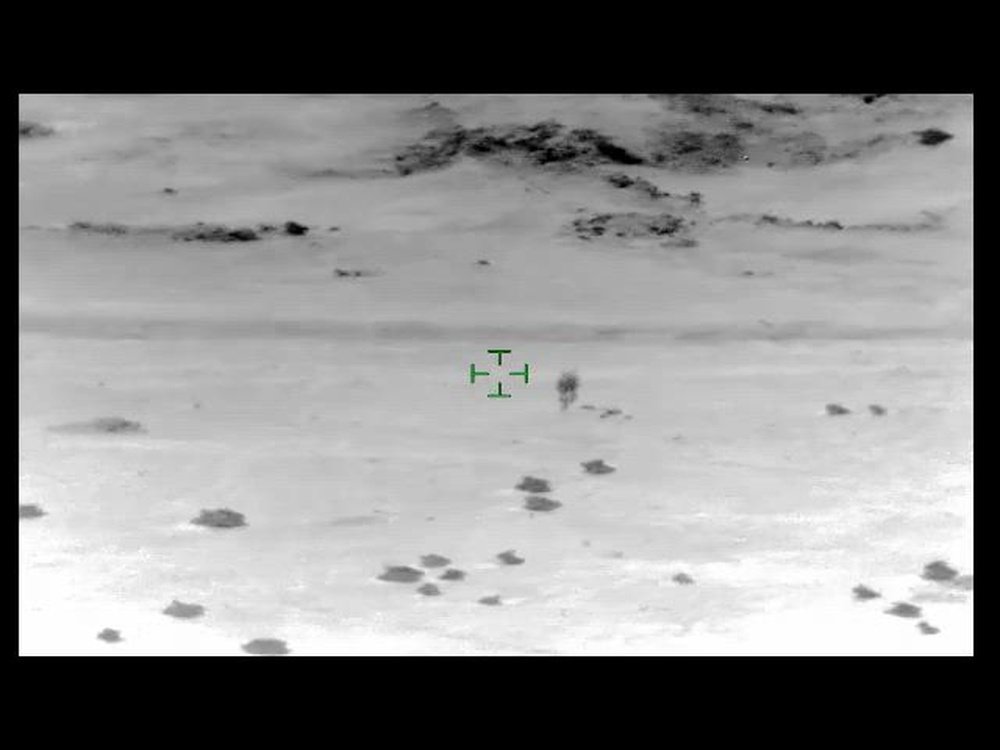
Pictured: an actual frame extracted directly from "Al Taqaddum Object," the real, unredacted infrared video AARO released via the Defense Visual Information Distribution Service on April 29, 2025 — not a reconstruction or artist's rendering. The dark thermal signature is visible at center frame just right of the sensor's green targeting reticle. No frame showing the object's more famous "three-legged," high-contrast appearance from the earlier, lower-resolution leaked copies is used here, since this frame can be verified against the official government release itself.
Theoretical Alignment
Low alignment with the Extraterrestrial and Interdimensional Hypotheses: the object exhibited no propulsion, no powered maneuvering, and no behavior inconsistent with a lightweight object drifting on wind currents near the aerostat's own tether. Moderate alignment with the Psycho-Social Hypothesis is warranted not because any individual witness fabricated an account, but because the case's public life — the "Spaghetti Monster" base legend, the "Jellyfish" rebrand under a more evocative name, and the amplification of a secondhand, low-resolution copy years removed from the original context — illustrates how an ambiguous sensor artifact can accrete meaning through retelling before the underlying government file is ever examined directly.
Background
Al Taqaddum Air Base ("TQ") is a former Iraqi Air Force installation in Anbar Province, roughly midway between Ramadi and Fallujah and adjacent to Lake Habbaniyah, that became one of the U.S. military's principal forward operating hubs in Iraq after 2003. During the anti-ISIS campaign that began in 2014, the base hosted Task Force Al Taqaddum, operating out of Camp Manion, as American and coalition advisors trained and assisted Iraqi Security Forces retaking Anbar Province, including the cities of Ramadi and Fallujah in 2015–2016. Force protection for Al Taqaddum and other Operation Inherent Resolve bases in Iraq fell in significant part to U.S. Marine Corps Special Purpose Marine Air-Ground Task Force – Crisis Response – Central Command (SPMAGTF-CR-CC) units, and bases across this network faced a recurring, well-documented threat of indirect rocket and mortar fire and, later, small unmanned aircraft incursions from Iran-aligned militia groups.
That threat picture is the direct reason a base like Al Taqaddum would operate a tethered surveillance aerostat at all. The Persistent Threat Detection System (PTDS), developed by Lockheed Martin (later TCOM), is a helium-filled, tethered airship flown at several thousand feet above a base perimeter, carrying an electro-optical/infrared turret that gives force-protection watch officers a continuous, elevated vantage point over the surrounding terrain — precisely to catch rocket and mortar launch points, suspicious vehicle movement, and airborne threats before they reach the base. Some press accounts of this case use the similar-sounding term "Tethered Aerostat Radar System (TARS)," but that is a distinct, decades-older U.S. Customs and Border Protection/Air Force radar-surveillance program flown along the southern U.S. border and the Florida Straits for drug-interdiction and air-defense radar coverage, unrelated to force-protection aerostats like the PTDS deployed at forward bases in Iraq and Afghanistan; the platform actually in question at Al Taqaddum was a PTDS unit carrying an MX-20 multispectral targeting and imaging turret, an ultra-long-range electro-optical/infrared system built by L-3 Wescam and capable of carrying up to seven interchangeable sensor payloads.
It was this PTDS aerostat's MX-20 turret — on continuous overwatch of the base and its perimeter, exactly as designed — that happened to capture an unusual thermal signature drifting through its field of view in early October 2017.
PTDS aerostats are large, roughly 74-meter helium-filled airships, typically flown tethered at altitudes of several thousand feet, and were fielded widely across U.S. and coalition bases in Iraq and Afghanistan through the 2010s as a comparatively low-cost, persistent alternative to fixed-wing manned or unmanned overwatch aircraft. Their onboard turrets, in this case an MX-20, are dual-band systems capable of switching between visible-spectrum electro-optical imaging and mid-wave or long-wave infrared, with multiple selectable display "polarities" that render heat as either light-on-dark or dark-on-light depending on which gives an operator the best contrast against a given background — a detail directly relevant to how this object's own appearance shifted across the recording, discussed further below. Al Taqaddum itself sits a short distance from the site of the former RAF Habbaniya, a British colonial-era air base built in the 1930s on the shore of the same Habbaniyah reservoir, whose creation in the 1980s by damming part of the Euphrates flood plain gives the modern base its distinctive lakeside geography — the very body of water Corbell would later claim, without corroboration from anyone who watched the original footage, that the object entered.
The nickname base personnel actually used for the object — the "Spaghetti Monster" — is itself a small, telling detail about how the case was originally understood on the ground. It is a reference to the Flying Spaghetti Monster, a tongue-in-cheek parody deity from the 2000s "Pastafarian" internet meme, invoked whenever something looks like a loose tangle of noodle-like strands rather than any organized craft. Personnel who actually watched the object live were reaching for a joke about a stringy, formless blob, not for language implying a structured, purposeful vehicle — the "Jellyfish" branding, and the more dramatic reading that came with it, only attached years later, once Corbell's promotional framing reached an audience with no first-hand memory of the original event.
Complete Timeline
| Date | Event |
|---|---|
| Early October 2017 | An MX-20 infrared turret aboard a Persistent Threat Detection System aerostat over Al Taqaddum Air Base, Iraq, tracks an amorphous object with three dangling, tendril-like appendages for roughly 17 minutes. Base watch personnel monitor it but do not treat it as a hostile threat; no defensive posture is scrambled. The video is stored on base systems and, per Michael Cincoski, "never explained" at the time. |
| January 2018 | Marine Sgt. Michael Cincoski arrives at Al Taqaddum as an Intelligence, Surveillance, and Reconnaissance (ISR) Tactical Controller. Fellow Marines who witnessed the October 2017 event show him a secondhand recording — filmed with a cell phone pointed at a monitor during playback — of the full 17-minute video. On base, personnel refer to the object informally as the "Spaghetti Monster," not the "Jellyfish." |
| 2018–2023 | The object becomes an informal legend among rotating units at the base — what Cincoski later calls "the ghost story of the base" — with no official explanation ever circulated to personnel and no further sighting reported. Secondhand copies of the phone-recorded footage circulate privately. |
| January 9, 2024 | Filmmaker Jeremy Corbell and journalist George Knapp publicize a roughly two-minute excerpt of the leaked, secondhand footage, branding it the "Jellyfish UAP." The clip airs as part of TMZ's UFO Revolution series and on Corbell and Knapp's own Weaponized podcast, describing the object as executing a "controlled descent" into a nearby lake before shooting back into the sky. |
| January 12, 2024 | NewsNation's Vargas Reports broadcasts an on-camera interview with Cincoski, who confirms he saw the full 17-minute recording on base but directly disputes Corbell's water-entry framing: "at no point could you see it drop into the water and shoot off into the sky, as has been claimed." He describes the object as simply receding into the distance and growing smaller. |
| Mid-to-late January 2024 | NewsNation runs multiple follow-up segments, including one reporting that the Pentagon declined to comment on the footage. Physicist Matthew Szydagis and other outside observers note that the rapid black-to-white thermal shifts are consistent with, though not proof of, an ordinary object's changing infrared signature under shifting sensor settings. |
| November 19, 2024 | AARO Director Dr. Jon Kosloski testifies before the Senate Armed Services Subcommittee on Emerging Threats and Capabilities that the "vast majority" of AARO's resolved caseload consists of balloons and unmanned aircraft systems, and details a separate, methodologically similar 2013 case – the Aguadilla, Puerto Rico incident – in which an object that appeared to dive into water was resolved to two balloons. |
| April 29, 2025 | AARO releases the complete, unredacted original government video — 17 minutes, 27 seconds, titled simply "Al Taqaddum Object" — via the Defense Visual Information Distribution Service (DVIDS), superseding the blurry secondhand phone recordings that had circulated since 2024. |
| 2025 (report undated within the released document) | AARO publishes its official Al Taqaddam Case Resolution report (the report's own filename uses this alternate spelling of the base name), concluding the object is a cluster of partially and fully inflated balloons with strings and deflated balloons visible hanging beneath them, based on full-motion video analysis, pixel examination, and geolocation data from the aerostat itself. AARO assesses the object did not demonstrate anomalous performance characteristics. |
| September 19, 2025 | AARO publishes a four-page information paper, "AARO and the Declassification Process," using a screenshot from the 2:53 mark of the "Al Taqaddum Object" video as its lead example of the office's declassification and public-transparency efforts. |
What the Sensor Recorded
The raw material of this case is a single, continuous infrared recording. Multiple witnesses and secondary accounts describe the same core visual: an amorphous, roughly ovoid thermal mass with three thin, dangling, tendril-like appendages trailing beneath it — the detail that eventually earned it the "jellyfish" label from Corbell and Knapp, though base personnel who watched it in real time called it the "Spaghetti Monster," a reference more to its stringy underside than to any marine-animal resemblance. Over the course of the recording, the object's thermal contrast repeatedly shifts: at times it renders as a stark, high-contrast black shape against a lighter background; at other points it fades to gray, and at others it becomes nearly transparent, blending into a white background. This kind of shift is a known characteristic of infrared video — it can result from the sensor's own polarity setting (white-hot versus black-hot display modes), from an operator or automated system adjusting gain and contrast, or from genuine changes in an object's own thermal profile relative to its background as its aspect changes.
The object moves slowly and without any sudden acceleration across the roughly 17-minute recording, consistent across every account of the footage, official and unofficial alike. Toward the end of the video, per Cincoski's own description, it "seemingly continued into the distance and got smaller and smaller," and he says he could not tell "whether that was because the sensor was zooming out or it was getting further away." The dramatic framing that Corbell and Knapp attached to the clip in January 2024 — that the object performed a "controlled descent" into Lake Habbaniyah, the body of water adjacent to the base, and then "blasted back into the sky at a 45-degree angle" — is not corroborated by Cincoski, the only publicly identified on-scene witness to have seen the complete original recording in real time rather than a promotional excerpt. He has stated plainly that no such water entry and exit is visible in the footage he watched.
Only a roughly two-minute excerpt of a secondhand, cell-phone-recorded copy of the video circulated publicly between January 2024 and April 2025 — itself several generations removed from the original sensor file, having been filmed off a monitor during playback on base, then presumably copied and re-copied before reaching Corbell. This chain of custody matters directly to how the object's appearance was interpreted: a recompressed, off-screen recreation degrades fine pixel detail and can visually exaggerate or distort a source object's apparent shape, edges, and contrast in ways a direct copy of the original sensor file would not. AARO's April 2025 release of the complete, unredacted original file was the first time the public could examine the actual government sensor data rather than a multiply-degraded copy of it.
Corbell, Knapp, and the Provenance of Leaked Military UAP Footage
Assessing how much weight to give Jeremy Corbell and George Knapp's framing of this specific case requires understanding their broader track record, since that record cuts in two different directions at once. On one hand, both journalists have repeatedly obtained genuine government UAP footage well before it was officially released, and the Pentagon has subsequently confirmed several of their releases as authentic: the "Gimbal" and "GoFast" videos recorded by Navy F/A-18 pilots, first published via To The Stars Academy in 2017–2019, were officially released and confirmed by the Department of Defense in April 2020; a "pyramid"-shaped object filmed near the USS Russell and companion "sphere" footage, which Corbell released in 2021, were likewise confirmed as authentic Navy-recorded material; and the "Mosul Orb," a 2016 recording from a military reconnaissance aircraft over Mosul, Iraq that Corbell first revealed publicly in 2023, became — in Corbell's own description — the first-ever released U.S. military UAP footage from an active conflict zone to receive an official UAP designation. Former UK Ministry of Defence UFO investigator Nick Pope has summarized this pattern by saying Corbell and Knapp "have a proven track record of getting authentic Pentagon footage in the public domain," an assessment echoed by multiple mainstream outlets that have covered their releases.
On the other hand, that track record establishes the authenticity of the underlying government files Corbell and Knapp obtain — it does not establish the accuracy of the interpretive claims they layer on top of those files when presenting them to an audience. This case is a clear example of that distinction in practice: the "Al Taqaddum Object" video is a genuine government sensor recording, later confirmed in full by AARO's own release of the original file, but the specific narrative claim Corbell attached to it in January 2024 — a "controlled descent" into water followed by a high-speed departure — is a claim about what the footage shows, not a claim about whether the footage itself is real, and it is precisely that interpretive claim, not the file's authenticity, that Cincoski disputes. Readers evaluating this case, and others like it, are best served by treating provenance and interpretation as two separate questions with two separate evidentiary bars, rather than assuming that a confirmed-authentic source file automatically validates every claim made about its contents.
Key Witnesses
Sgt. Michael Cincoski
Arrived at Al Taqaddum Air Base in January 2018 and was shown the full, uncut 17-minute recording by fellow Marines who had been present for the October 2017 event. He is the only publicly identified eyewitness to have described watching the complete video in real time rather than the short promotional excerpt Corbell and Knapp later circulated. Cincoski's account is notably measured: he describes the object as unthreatening ("it didn't seem to be posturing to threaten us at all"; personnel were tasked to keep an eye on it but "it wasn't like we were scrambling to defensive positions"), and he directly contradicts the more dramatic "dove into the lake and shot back out" framing that made the clip go viral in January 2024, stating flatly that "at no point could you see it drop into the water and shoot off into the sky, as has been claimed." He has said he personally leaned toward a mundane, "artifact"-type explanation even before AARO's official resolution was published, while acknowledging some details of the footage did not perfectly fit that hypothesis either. He broke his public silence in a January 2024 interview with NewsNation's Vargas Reports, describing the object as "the ghost story of the base" and noting that base personnel called it the "Spaghetti Monster," not the "Jellyfish" — a nickname that only attached after Corbell's 2024 release.
Jeremy Corbell
Obtained a secondhand, degraded copy of the October 2017 footage from a source and publicized it on January 9, 2024, coining the "Jellyfish UAP" name and framing the object as demonstrating a "controlled descent" into a nearby lake and a subsequent high-speed departure — a characterization the base's own on-scene witness, Cincoski, has since directly disputed. Corbell has released numerous other military UAP videos over the years, several of which the Pentagon has separately confirmed as authentic government footage, giving his releases a track record of provenance even when his own interpretive framing of a given clip is independently contested.
George Knapp
Co-published the "Jellyfish UAP" story with Corbell via their Weaponized podcast and helped drive the story's national pickup in January 2024, including coverage on NewsNation, TMZ, and numerous syndicated radio outlets. Knapp's decades of reporting on Area 51, Bob Lazar, and Skinwalker Ranch give him one of the field's longest track records, though as with Corbell, his role in this specific case was as a publicist and interpreter of secondhand footage rather than a firsthand witness.
The Five Observables Assessment
The Five Observables framework, developed by former AATIP director Luis Elizondo, is used to classify UAP encounters based on performance characteristics that exceed known technology:
Assessment: Across every account of the footage — including the on-scene witness's own description — the object never displays powered acceleration, hypersonic speed, or any lift mechanism inconsistent with a lightweight body drifting on wind. Some UAP-community secondary sources have claimed the aerostat's own tracking system could not automatically lock onto the object and required manual panning by an operator, which would be a mild anomaly if independently confirmed; this claim, however, traces to promotional secondary reporting rather than to Cincoski's own account or to AARO's resolution, and it is rated here only as Speculative pending stronger sourcing. The most consequential observable is Trans-Medium travel: Corbell's 2024 framing explicitly claimed the object performed a controlled dive into Lake Habbaniyah and a subsequent high-speed re-ascent — the single most dramatic claim attached to this case — but it is directly and specifically disputed by Cincoski, the only publicly named witness who watched the complete original video, and it appears nowhere in AARO's own analysis. It is rated Disputed rather than Present or even Speculative because the strongest available primary testimony contradicts it outright.
Evidence Assessment
Supporting Anomalous Origin
- The object's rapid shifts between black, gray, and near-transparent thermal contrast were visually striking enough to become a persistent, years-long base legend among rotating Marine units
- Some secondary reporting claims the aerostat's automated tracking could not lock onto the object and required manual operator panning, which would be unusual if independently confirmed
- The three dangling, tendril-like appendages gave the object an organic, unfamiliar silhouette unlike any standard aircraft, drone, or balloon most observers would recognize on sight
- The video was compelling enough that AARO devoted a full, methodologically detailed case-resolution report to it rather than a one-line dismissal
Supporting Conventional Explanation
- AARO's official case resolution, based on full-motion video analysis, pixel examination, and the aerostat's own geolocation telemetry, identifies the object as a cluster of partially and fully inflated balloons with strings and deflated balloons visible hanging beneath — a description that matches the "three dangling legs" reported by every witness
- The object never displays powered flight, acceleration, or any maneuver inconsistent with wind-driven drift over its full 17-minute observation
- The single most dramatic claim attached to the case — a controlled dive into the water and high-speed re-ascent — is directly disputed by the only publicly named witness who watched the complete original footage in real time
- The publicly circulated 2024 clip was a multiply-degraded, secondhand, cell-phone recording of a monitor, not the original sensor file, which can visually exaggerate an object's apparent shape and contrast
- Base personnel treated the object as low-threat in real time: no defensive response was scrambled, and it was informally dismissed as the "ghost story of the base" rather than treated as a serious incursion
- The witness closest to the case, Cincoski, has stated he personally favored a mundane explanation even before AARO's resolution was published
- Rapid black-to-white thermal contrast shifts of this kind are a recognized characteristic of infrared sensors and are not, on their own, evidence of anomalous behavior
- No physical evidence, radar corroboration, or independent sensor confirmation of any kind exists for this case — only the single infrared recording
Why "Debunked"
This case is classified DEBUNKED because, unlike many disputed or unresolved UAP cases on this site, the balance of evidence here is not actually close. Three independent lines of evidence converge on a mundane explanation rather than one alone: first, the primary on-scene witness's own testimony is itself skeptical of the case's most dramatic claims and consistent with a wind-driven object rather than a controlled craft; second, the object's visual signature — a slow-moving, amorphous thermal mass with multiple dangling strand-like appendages that changes contrast as it drifts — is a documented, recurring pattern in prior AARO-resolved balloon misidentifications, not a one-off; and third, no credentialed independent researcher has published a rigorous rebuttal of AARO's specific pixel-level analysis, in contrast to cases like this site's own "Chandelier" UAP, where a detailed independent technical counter-argument exists.
It is worth being explicit about what this case's more sensational framing actually rested on. The "controlled descent into water, then high-speed departure" narrative that made this case go viral in January 2024 was Corbell's own interpretive gloss on a secondhand, multiply-degraded copy of the footage — not a claim made by AARO, not a claim in the original government file's own description, and not a claim corroborated by the one publicly named witness who watched the complete original recording. When that claim is set aside, what remains is a slow-drifting thermal mass with dangling appendages that a formal government video-forensic and geolocation analysis identifies as consistent with balloons, that no on-scene witness treated as a genuine threat, and that even Cincoski himself leaned toward explaining conventionally. That combination of independent witness skepticism, a documented misidentification pattern, and an unrebutted technical analysis is what earns the low score here — not AARO's conclusion in isolation. A case with the same official balloon-cluster resolution but an on-scene witness who insisted the water-entry account was accurate, or a credentialed technical rebuttal of AARO's pixel analysis comparable to the one this site documents for the Chandelier case, would reasonably be scored and stamped very differently, regardless of what the government itself concluded.
Sensor & Instrumentation Detection Profile
The only sensor system involved in this case is a single MX-20 multispectral electro-optical/infrared targeting turret (manufactured by L-3 Wescam), mounted on a Persistent Threat Detection System (PTDS) tethered aerostat maintaining continuous overwatch of Al Taqaddum Air Base. No radar, acoustic, seismic, or other sensor modality recorded the event; there is no corroborating instrument data of any kind beyond this single infrared feed. The aerostat's own onboard geolocation telemetry — used by AARO to assess the object's speed, direction of travel, and approximate range from the sensor — is the only supplementary instrument data available, and it was central to AARO's conclusion that the object's motion was consistent with wind-driven drift rather than powered flight.
It is worth noting what this platform was and was not designed to do. A PTDS aerostat's mission is force protection — giving a base's watch officers early warning of indirect-fire launches, suspicious vehicles, and airborne threats such as small drones, not conducting dedicated scientific study of an ambiguous aerial signature. Its MX-20 turret has no purpose-built means of measuring an unidentified object's range independent of geometric estimation, no onboard radar to cross-check a visual/infrared track, and no capability to sample or otherwise physically interrogate an object at a distance. This is a meaningful limitation shared by nearly every single-sensor military UAP case on this site, this one included: a genuinely compelling recording is not, by itself, a multi-instrument scientific dataset, and claims of anomalous performance drawn from a single infrared feed — in either direction, anomalous or mundane — necessarily carry more uncertainty than a case with independent radar, multi-witness, or physical corroboration would.
Environmental & Geospatial Context
Al Taqaddum Air Base sits in the flat, arid terrain of Anbar Province's Euphrates River valley, immediately adjacent to Lake Habbaniyah, a large reservoir that has historically served as a regional flood-control basin. Neither the original AARO release nor any secondary reporting discloses specific wind speed, temperature, or atmospheric data for the October 2017 event, though the region's autumn weather is typically dry with intermittent moderate winds — conditions readily capable of carrying lightweight, partially inflated balloons and their trailing strings across a multi-mile field of view over a 17-minute period.
The base's geospatial position is also directly relevant to why an object of this kind could plausibly originate nearby without any need for a deliberate, hostile launch. Al Taqaddum sits within a heavily populated agricultural and semi-urban corridor along the Euphrates, where celebratory balloon releases, children's party balloons, weather balloons from regional meteorological stations, and improvised signaling or decorative balloon clusters are all unremarkable, everyday objects capable of drifting for miles on prevailing winds before losing altitude or bursting. A base the size of Al Taqaddum, actively conducting Task Force operations and hosting hundreds of coalition personnel, would also itself be a routine source of stray balloons — weather balloons, morale-event decorations, and similar items are common on any large forward operating base — without requiring any external or hostile origin at all.
Observer Credibility & Occupational Profile
Michael Cincoski served in a technical intelligence role directly relevant to this case: as an ISR Tactical Controller, his job involved interpreting exactly this kind of aerial sensor feed as part of daily duties, giving his skeptical read of the footage's most dramatic claims real professional weight. Unnamed additional watch personnel who monitored the object in real time in October 2017 have not been publicly identified. Corbell and Knapp, while experienced UAP journalists with a documented track record of obtaining and publicizing authentic government footage, were not present for the original event and are best understood as publicists and interpreters of secondhand material in this specific case rather than firsthand witnesses.
This profile matters for how much interpretive weight each account should carry. Cincoski's account is neither a casual bystander's impression nor an advocate's promotional framing — it is the report of a trained sensor analyst, describing a video he watched in full and close to the time it was recorded, delivered years later with no evident financial or reputational stake in the outcome either way (he has never published a book, run a paid podcast, or otherwise monetized the case). Corbell and Knapp, by contrast, have a direct professional interest in maximizing the dramatic appeal of the material they publish, which does not make their underlying source material fraudulent — their broader authenticity track record argues against that — but does mean their specific interpretive claims about what a piece of footage shows should be weighed independently from whether the footage itself is real, exactly as this case's own record demonstrates.
Physical & Material Assays
No physical evidence exists for this case in any form. Nothing was recovered, collected, or submitted for laboratory analysis; the sole surviving record is the sensor's own video file. What analysis exists is entirely video-forensic in nature — AARO's pixel-level examination of the recorded footage — rather than metallurgical, isotopic, or trace-material testing of any kind.
Historical Precedents & Archive Matches
This case sits within a well-documented pattern of AARO case resolutions in which slow-moving, amorphous, or multi-appendaged infrared signatures are identified as balloon clusters or similar lighter-than-air objects. Two close analogues on this site itself: the Aguadilla CBP FLIR Encounter (2013), in which a Customs and Border Protection infrared video appearing to show an object splitting in two and diving into the Atlantic was resolved by AARO in 2025 to a pair of sky lanterns, motion parallax, and thermal crossover — the same water-entry illusion pattern disputed in this case by Cincoski himself; and the January 2023 Eglin UAP case, in which an Air Force pilot's sighting near Eglin Air Force Base, Florida was resolved by AARO with "moderate confidence" to a large commercial lighting balloon, supported by laboratory testing that reproduced the reported heat signature. Both cases, like this one, involved an initial impression of anomalous behavior that a formal video-forensic and physical-reconstruction analysis subsequently attributed to a mundane lighter-than-air object.
The pattern is far older than AARO itself. Balloon and other lighter-than-air misidentifications have been the single largest resolved category across essentially every systematic U.S. government UAP study on record, from Project Blue Book's tens of thousands of case files through the 1969 Condon Report, and AARO's own annual reports to Congress have repeatedly stated that the large majority of cases it fully resolves — Director Kosloski cited roughly this proportion in his November 2024 Senate testimony — end up attributed to balloons and small unmanned aircraft rather than to any exotic craft. Weather balloons, radiosonde balloons, sky lanterns, and improvised cluster-balloon rigs share several properties that make them disproportionately likely to be misread as structured, purposeful craft on infrared sensors in particular: they are large enough to register clearly at range, they carry strings, ribbons, or partially deflated companion envelopes that can read as legs, tentacles, or "appendages" exactly as this case's own witnesses described, and their slow, wind-driven drift can look deliberate to an observer with no reference altitude or airspeed to judge it against. None of this proves any individual unresolved case is a balloon — but it establishes that this explanation category is not a rare or exotic outlier being reached for opportunistically; it is, by a wide margin, the modal outcome whenever this type of signature is formally investigated.
Material Analysis
Because no physical debris or recovered material exists for this case, "material analysis" here refers exclusively to forensic examination of the video file itself — the same evidentiary category applied to this site's "Chandelier" UAP case, where the analyzable "material" is likewise a single sensor recording rather than any physical sample.
Pixel-Level and Full-Motion Video Analysis
AARO's case resolution report states its conclusion rests on full-motion video analysis and pixel examination of the recorded footage. Applied to an infrared video, this method typically involves frame-by-frame tracking of an object's apparent size, edge definition, and thermal contrast over time, compared against the sensor's own known optical and thermal characteristics, to determine whether an object's changing appearance is more consistent with a physical shape genuinely changing (e.g., balloons rotating, partially deflating, or overlapping as they drift) or with sensor artifacts alone. AARO's report specifically describes the object's visible strings and partially/fully deflated balloon shapes as directly observable in this analysis — not inferred indirectly — which is a materially stronger evidentiary claim than a purely behavioral argument (e.g., "it moved like wind-blown debris") would be on its own.
Geolocation and Kinematic Reconstruction
The PTDS aerostat's own telemetry allowed AARO to calculate the object's real-world speed and direction of travel rather than relying on apparent, unscaled motion within the video frame alone — the same category of analysis that resolved the Aguadilla case's water-entry illusion to ordinary parallax between a moving sensor platform and a stationary or slow-moving object. AARO's report states this kinematic reconstruction supported, rather than contradicted, the conclusion that the object's motion was consistent with wind-driven drift.
The Physics Behind the Color Shifts
The object's repeated shifts from stark black, through gray, to nearly white are frequently cited by the case's more sensational proponents as evidence of an exotic, actively cloaking technology. Infrared imaging systems like the MX-20, however, have two well-documented, entirely mundane phenomena that independently explain contrast changes of exactly this kind. The first is polarity switching: virtually every thermal imager, including the MX-20, allows an operator to toggle between "white hot" (warmer objects render lighter) and "black hot" (warmer objects render darker) display modes, chosen for whichever gives better contrast against a given background — a single polarity toggle mid-recording, common practice for an operator trying to track a hard-to-see object, would by itself invert an object's apparent brightness from one moment to the next. The second is thermal crossover, a well-known effect in which an object's apparent temperature relative to its background changes over the course of a day (or, for a rapidly cooling or heating small object like a balloon, over a period of minutes) to the point where the object and its background emit nearly identical infrared radiation, causing the object to visually fade into near-transparency on the display before contrast returns as temperatures diverge again. AARO's own resolution of the Aguadilla case explicitly cites thermal crossover as a contributing factor to that object's confusing appearance, and the same mechanism — a balloon envelope's thin, low-mass material cooling and warming faster than the desert terrain around it — is a straightforward, well-precedented explanation for why this object would cycle between high-contrast black, indistinct gray, and near-invisible white over a 17-minute recording, without requiring any change in polarity or operator setting at all.
Supporting Genuine Anomaly
- The object's silhouette, with three distinct dangling appendages, does not immediately resemble a single conventional balloon to a casual viewer
- The video is compelling enough on its own terms that it became persistent base folklore for years without any official resolution being circulated to the personnel who watched it
- The original chain of custody for the earliest publicly circulated copy is poor — a cell-phone recording of a monitor, several generations removed from the source file — leaving room, in principle, for detail lost or distorted in re-recording to matter
Supporting Mundane Origin
- AARO's pixel-level examination reports directly observing strings and partially/fully deflated balloon shapes in the source video, not merely inferring them from behavior
- Independent geolocation telemetry from the aerostat itself supports a wind-driven-drift kinematic profile
- The object's three-appendage silhouette and shifting thermal contrast closely match the documented signature of other AARO-resolved balloon-cluster and lantern-cluster cases (Aguadilla, Eglin)
- The most dramatic claim attached to the case (water entry/exit) is specifically disputed by the on-scene witness who watched the un-degraded original footage
The Conventional Explanation Candidate
This case has one dominant, well-documented conventional explanation candidate — a cluster of balloons caught in or near the aerostat's own tether lines — supported by a formal government video-forensic analysis, and one secondary, far weaker candidate reflecting the case's more sensational public framing.
Balloon Cluster (AARO's Official Finding)
AARO's Al Taqaddam Case Resolution report concludes the object was a cluster of partially and fully inflated balloons, with strings and deflated balloons visible hanging beneath them, whose appearance is consistent with other AARO-recorded observations of balloon clusters. The report states that AARO employed full-motion video analysis and pixel examination to inform this assessment, and used geolocation data from the aerostat itself to determine the object's speed and direction of travel. AARO's stated conclusion is that the object did not demonstrate anomalous performance characteristics, and that the balloons' position changes across the recording are consistent with a cluster shifting position relative to the sensor's own point of view as both drifted with the wind. This explanation directly accounts for the case's most consistently reported visual detail — the three dangling "legs" or "tendrils," described identically by witnesses who had no contact with one another across a seven-year span — as the balloons' own trailing strings and partially deflated companion balloons. It is also consistent with the object's slow, non-accelerating drift, and with the shifting black-gray-white thermal contrast, which is readily explained by balloons rotating and changing aspect, and by ordinary sensor gain/polarity behavior, as they moved through the field of view.
A caveat on official government findings: AARO's case resolution is a genuinely detailed, methodologically transparent analysis, and it is treated here as the strongest single explanation on offer — but it is not treated as automatically dispositive simply because it is the government's own conclusion. Government and military bodies investigating UAP reports have a documented history of incomplete, delayed, or later-revised explanations, from Project Blue Book-era misidentification rulings that even some Air Force-linked scientists later criticized, to the CIA's own 1997 acknowledgment that it had deliberately left a substantial share of Cold War-era "UFO" reports misattributed rather than correct the record about classified U-2 and OXCART reconnaissance flights. Institutions investigating their own airspace also carry a structural incentive toward the least alarming available explanation, and a classified investigative process cannot be independently audited by outside researchers for completeness or rigor. None of this means AARO's specific finding here is wrong — nothing about this case suggests deliberate concealment, and the analysis is unusually specific and falsifiable (a cluster of balloons is either visible in the pixel data or it is not) — but it is weighed here as one strong input among several converging lines of evidence, including the independent, pre-existing skepticism of the base's own on-scene witness, rather than as a single authoritative word that ends the inquiry on its own.
Deliberate Misrepresentation by Corbell (Secondary Framing Candidate)
A minority reading holds that Corbell's "controlled descent into water, then high-speed departure" framing reflects either a distinct, more dramatic segment of the video not captured in the publicly circulated clip, or simply promotional embellishment layered onto an already-ambiguous secondhand recording. Corbell has a long track record of obtaining and publicizing government UAP footage whose authenticity the Pentagon has separately confirmed in other cases, which argues against dismissing his role in this one outright — but in this specific case, his signature claim is directly and specifically contradicted by the only publicly named eyewitness who watched the complete original recording, and it appears nowhere in AARO's own examination of the full unredacted file. This candidate is treated as a real but weak explanation for why the case became as viral and dramatic as it did in January 2024, rather than as a claim about what the underlying sensor actually recorded.
A related, more charitable version of this same candidate is simple degradation-driven misinterpretation rather than deliberate embellishment: a source watching a poor-quality, multiply re-recorded copy of the video, at a remove of years from the original event, could plausibly and honestly perceive a water-adjacent disappearance where the original sensor operator and the government's own later pixel-level analysis found none. Nothing in the public record specifically distinguishes between an honest misreading of degraded footage and a deliberately embellished pitch to a media audience, and this case file does not take a position on which explanation better fits Corbell's own state of mind — only on the fact, independently established by both AARO's analysis and Cincoski's own testimony, that the water-entry claim itself does not hold up.
Balloon Cluster (AARO)
Highly PlausibleSupported by a formal, falsifiable video-forensic analysis directly describing observed strings and deflated balloons, corroborated by independent geolocation-based kinematic reconstruction, consistent with the object's non-accelerating drift and shifting thermal contrast, unrebutted by any independent technical analysis, and broadly consistent with the base's own on-scene witness's pre-existing skepticism. Weighed as strong but not automatically dispositive, per this site's standing caution about treating any single official government conclusion as final.
Corbell's Water-Entry / Trans-Medium Framing
ImplausibleDirectly and specifically disputed by the only publicly named witness who watched the complete original recording, absent from AARO's own review of the unredacted footage, and built on a secondhand, multiply-degraded copy of the video rather than the original government file.
Related Cases
Confirmed Documents & Official Records
The official AARO case resolution report (note the report's own filename uses the alternate spelling "Taqaddam"), concluding the object was a cluster of partially and fully inflated balloons based on full-motion video analysis, pixel examination, and aerostat geolocation data. Weighed here as a strong but not automatically dispositive finding, per the caveat above.
UNCLASSIFIED (declassified 2025)The complete, unredacted 17-minute, 27-second original government sensor file, publicly hosted on the Defense Visual Information Distribution Service, superseding the degraded secondhand copies that circulated 2024–2025.
UNCLASSIFIED / Public DomainA four-page AARO information paper on its declassification and transparency process, using a screenshot from the 2:53 mark of the "Al Taqaddum Object" video as its lead illustrative example.
UNCLASSIFIEDTestimony and supporting case slides from AARO Director Jon Kosloski on the office's resolved caseload, including the closely analogous Aguadilla, Puerto Rico balloon-misidentification case.
UNCLASSIFIEDSearch Government Archives Directly
Further Reading — Recommended Literature
Imminent: Inside the Pentagon's Hunt for UFOs
A firsthand account from AATIP's former director on how the Pentagon's UAP investigative apparatus — the institutional lineage AARO grew out of — actually functions from the inside.
Skinwalkers at the Pentagon
An insider account of the AAWSAP program by three of its own participants, including this case's co-publicist George Knapp, documenting the Pentagon's classified UFO study from within.
UFO: The Inside Story of the US Government's Search for Alien Life Here—and Out There
A comprehensive institutional history of U.S. government UAP investigation, situating offices like AARO within a much longer arc of Pentagon secrecy and partial disclosure.
American Cosmic: UFOs, Religion, Technology
An academic study of how belief forms and spreads around ambiguous UAP evidence — directly relevant to how a secondhand phone recording of a training-base sensor feed became years of base legend before its formal resolution.
Escaping the Rabbit Hole (Revised & Updated Edition)
A practical guide to the pixel-level, forensic debunking methodology — full-motion video analysis, artifact identification, kinematic reconstruction — that AARO applied to this case's own footage.
DISCLOSURE: Some links above are affiliate links. If you purchase through them, OverClassified receives a small commission at no additional cost to you. This helps support independent research.
Essential Viewing
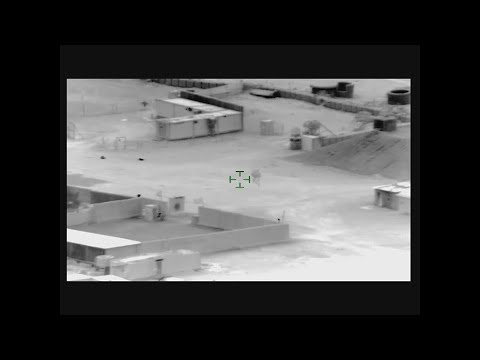
Full Uncut Tracking Video of the "Jellyfish" UAP over Iraq
Jeremy Corbell's Media Magik Entertainment channel's upload of the leaked footage that first made this case public in January 2024.
Marine Confirms He Saw the "Jellyfish" UAP Video | Vargas Reports
NewsNation's January 2024 on-camera interview with Michael Cincoski, the case's key on-scene witness, including his direct dispute of the video's water-entry claims.

Dept. of Defense Addresses "Jellyfish" UFO | NewsNation Prime
NewsNation's coverage of the Pentagon's initial "no comment" response to the viral 2024 footage, before AARO's later formal case resolution.
Sources
- All-domain Anomaly Resolution Office. "Al Taqaddam Case Resolution," official case resolution report, 2025. aaro.mil
- All-domain Anomaly Resolution Office. "AARO and the Declassification Process," information paper, September 19, 2025. aaro.mil
- Defense Visual Information Distribution Service. "Al Taqaddum Object," full unredacted video, released April 29, 2025 (date taken October 1, 2017). dvidshub.net
- U.S. Senate Armed Services Committee, Subcommittee on Emerging Threats and Capabilities. Testimony of AARO Director Jon T. Kosloski, November 19, 2024. armed-services.senate.gov
- NewsNation. "Marine says 'jellyfish' UAP video was 'ghost story of the base,'" January 2024. newsnationnow.com
- NewsNation. "Pentagon: No comment on 'jellyfish' UAP video," January 2024. newsnationnow.com
- NewsNation. "Pentagon 'Jellyfish' UAP response raises questions," January 2024. newsnationnow.com
- NewsNation (YouTube). "Marine confirms he saw 'Jellyfish' UAP video during Iraq deployment | Vargas Reports," January 2024. youtube.com
- NewsNation (YouTube). "Dept of Defense addresses 'jellyfish' UFO | NewsNation Prime," January 2024. youtube.com
- Arab News. "'Jellyfish' UFO sighted in Iraq was 'ghost story' at base, says former Marine," January 2024. arabnews.com
- Global News. "Leaked 'jellyfish' UFO video leaves the internet enthralled," January 2024. globalnews.ca
- Unknown Country (Whitley Strieber). "New Details Regarding Enigmatic 'Jellyfish UAP' Released by Jeremy Corbell and George Knapp," January 2024. unknowncountry.com
- iUFODB. "Jellyfish UAP" case summary, referencing MX-20/PTDS sensor details. iufodb.com
- Weaponized (Jeremy Corbell & George Knapp). "The 'Jellyfish' UAP," January 2024. weaponizedpodcast.com
- Corbell, Jeremy (Media Magik Entertainment, YouTube). "Full Uncut Tracking Video of the Infamous 'Jellyfish' UAP over Iraq." youtube.com
- All-domain Anomaly Resolution Office. "Eglin UAP Case Resolution," official case resolution report. aaro.mil
- NewsNation. "UAP sighting at Eglin Air Force Base was commercial light balloon: AARO." newsnationnow.com
- The War Zone (TWZ). "Eglin AFB Pilot Likely Saw A Lighting Balloon, Not A UFO Pentagon Concludes." twz.com
- OverClassified. "Aguadilla CBP FLIR Encounter" case file (cross-referenced AARO balloon/lantern misidentification precedent). overclassified.org
- OverClassified. "The 'Chandelier' UAP" case file (cross-referenced independent technical rebuttal methodology). overclassified.org
- Combined Joint Task Force – Operation Inherent Resolve, Public Affairs Office. "TQ Fact Sheet." inherentresolve.mil
- DVIDS / U.S. Marine Corps. "Task Force Al Taqaddum: The Role of U.S. Troops During Operations in Anbar Province." dvidshub.net
- Marines.mil. "Task Force Al Taqaddum: Role of U.S. troops during operations in Anbar Province." marines.mil
- Army Times. "US hands over another air base to Iraqi forces," April 2020 (Al Taqaddum handover context). armytimes.com
- World Airport Codes. "Al Taqaddum Air Base – Iraq" (ORAT/TQD identifiers and coordinates). world-airport-codes.com
- YouTube oEmbed API verification records for video IDs nb45rXZX6Yw, d0V9mhk9Hm0, and yWZjvlnt3BY, accessed August 2026.
See something inaccurate? Have additional information or sources?
Suggest an Edit →Last Updated: August 2026