
Unconventional Flying Objects
A Scientific Analysis — The NASA Langley Aerodynamicist's Posthumous Case That UFOs "Obey, Not Defy" the Laws of Physics
Core Thesis
Unconventional Flying Objects: A Scientific Analysis is Paul R. Hill's attempt to do something almost no one else in the field's history has had the standing to do: apply thirty-one years of real NACA and NASA Langley Research Center aerodynamics experience directly to the physical mechanics of reported UFO behavior, treating witness-described flight characteristics as engineering data to be modeled rather than mysteries to be marveled at. Hill's central claim, restated throughout the book's twenty chapters, is that reported UFO maneuvers — the tilt-to-move flight pattern, the absence of sonic booms at claimed supersonic speeds, the survivability of accelerations that should crush a human occupant — are not violations of physics but strong circumstantial evidence for an unidentified propulsion method he called "force field propulsion," a directed, gravity-like field acting uniformly on every particle of the craft and everything inside it. He finished the manuscript by the mid-1970s; it was rejected by a string of publishers during his lifetime and did not reach print until 1995, five years after his death, when Hampton Roads Publishing brought it out at his family's decision. That publication history is now as much a part of the book's reputation within ufology as its physics: one of the only book-length UFO propulsion analyses ever written by a career aerospace engineer with real institutional standing, and one that institution would not let him publish while he still worked there.
About the Author
Paul Richard Hill was born in February 1909 in Odebolt, Iowa, and earned a B.S. in mechanical engineering from the University of California, Berkeley, in 1936, after which he taught aeronautics for three years at the Polytechnic College of Engineering in Oakland. He joined the National Advisory Committee for Aeronautics (NACA) in 1939 and remained with the agency and its 1958 successor, NASA, for thirty-one consecutive years, retiring in 1970 as Associate Chief of the Applied Materials and Physics Division at NASA's Langley Research Center in Hampton, Virginia. This was not a peripheral career: Hill co-authored NACA technical papers on aircraft aerodynamics during World War II, consulted with Republic Aircraft on the P-47 Thunderbolt's aerodynamic design, established and supervised the Wallops Island ramjet flight-test program and wrote NACA's first ramjet technology paper, advised Sandia National Laboratories on hydrogen-bomb design problems in the early 1950s, contributed to the HYWARDS hypersonic-aircraft project, sat on a 1959 lunar-mission study group, and co-developed a 24-foot inflatable "erectable torus" manned space-station concept with engineer Emanuel Schnitzer in the early 1960s. In 1969 NASA awarded him its Exceptional Service Medal, cited the following year for "outstanding scientific leadership for directing research applicable to space laboratories and other spacecraft." None of that record is disputed; it is the credential the entire book leans on.
The engineering work that connects most directly to the book began in the early 1950s, when Hill co-initiated a NASA Langley "flying platform" project with fellow engineer Charles Zimmerman — a legitimate, officially sanctioned VTOL research effort whose kinesthetically controlled, ducted-fan platforms fed directly into later Apollo Lunar Module and vertical-takeoff aircraft design work. Hill, by his own and others' accounts, acted as an early test pilot on these platforms himself. What made the project personally significant to him was narrower and more private: he used the same tilt-to-vector-thrust control principle the platforms demonstrated to test, on his own initiative, whether a human-built craft tilting its entire body could reproduce the tilt-forward-to-accelerate, tilt-back-to-decelerate maneuver he and other witnesses had reported seeing UFOs perform. That the platforms could do it, at least in miniature and at low speed, became one of the book's recurring pieces of physical, testable evidence — distinguishing Hill's approach from the purely theoretical propulsion speculation common elsewhere in the genre.
Hill's own account holds that his UFO interest began involuntarily, with a sighting he did not seek out and could not simply set aside. He remained a NASA Langley employee until his 1970 retirement, and by every published account of his career, he never left the mainstream of legitimate aerospace engineering to pursue the subject openly; he pursued it quietly, alongside a full and honored technical career, for a full quarter-century before he was free to write about it under his own name. He was married to Frances Hoback Hill, who witnessed the 1952 sighting alongside him and whom he would later marry; she died in 1999. Their daughter, Julie M. Hill, has spoken publicly about her father's UFO research since his death. Hill died on April 9, 1990, in Newport News, Virginia, at age 81; his papers are held in a dedicated special collection at the Archives of American Aerospace Exploration.
Historical Context & Origins
The event that redirected the rest of Hill's career happened on July 16, 1952, at the height of that summer's record-setting American UFO wave. Two days earlier and a few miles away, Pan American pilots William B. Nash and William H. Fortenberry had reported eight glowing discs maneuvering in formation over Chesapeake Bay near Langley Field — the case this site covers in full in its own Nash-Fortenberry Sighting case file. On the 16th, Hill and his future wife, Frances Hoback, independently watched two amber-colored objects approach from the south, turn west overhead, and begin to "revolve around a common center" before switching to vertical maneuvers, at which point two more objects joined the first pair. Project Blue Book director Edward Ruppelt later singled the sighting out in his own writing, noting that the observer "from the National Advisory Committee for Aeronautics was a very famous aerodynamicist" — a credentialed, professionally trained witness whose report the Air Force could not wave away as easily as it waved away most. Hill's own later line about the experience, quoted repeatedly in secondary accounts of his career, was characteristically understated for an engineer: "There is a lot of truth in the old saying, 'It's different when it happens to you.'"
What followed was not a career change but a second, unofficial one running alongside his real job. For roughly the next twenty-five years, colleagues and later biographers describe Hill acting as an informal, self-appointed clearinghouse at Langley for UFO sighting reports, collecting and evaluating them for their physical, aerodynamic, and propulsion implications using the same engineering discipline he brought to ramjets and lunar-mission studies. According to the book's own publisher description and multiple secondary accounts of his career, official NASA policy prevented him from publishing his UFO conclusions while he remained an employee — a genuinely unusual position for a working aerospace engineer to be in: professionally forbidden from putting his own name to research he was, by every account, still quietly conducting. He finished the manuscript that became this book by the mid-1970s, only to have it rejected by a series of publishers over the following two decades — a genre-wide problem in an era before UFO physics analysis by credentialed insiders had any real commercial track record to point to.
Hill did not live to see it published. He died in 1990, and the manuscript remained unpublished for five more years until Hampton Roads Publishing, a Charlottesville, Virginia press with a track record in metaphysical and esoteric nonfiction, brought it out in 1995 at his family's decision — the same decision-making pattern that has produced several other posthumously published books in this genre, though few with as long a gap between an author's institutional silencing and his family's choice to finally let the work speak. Physicist Robert M. Wood, a Cornell-trained physicist who spent forty-three years at McDonnell Douglas and had run his own internal, company-funded UFO propulsion study there in the late 1960s, wrote the book's foreword, giving it a second credentialed aerospace-physicist endorsement on top of Hill's own résumé before a reader reached chapter one.
Core Arguments & Key Concepts
The book's spine is a twenty-chapter argument built from observed kinematics rather than speculative theory: Hill starts from what witnesses across hundreds of collected reports consistently described — UFOs tilting their entire body forward to accelerate and backward to decelerate or reverse, rather than banking or angling a wing the way a conventional aircraft must — and works outward from there. Chapters titled "Direct Evidence of Force Field Propulsion" and "Force Field Evaluation: Which Type?" make his central case explicit: a craft that maneuvers by tilting its whole airframe, with no visible control surfaces and no aerodynamic explanation for how it generates lift or thrust in the reported way, is behaving exactly as it would if the entire craft were riding inside a self-generated, directional field rather than pushing against the surrounding air. Hill's term for this, used throughout, was simply "force field" — a general, gravity-like directed field capable of acting uniformly on every particle of matter within its influence, including a hypothetical occupant's own internal organs, which is how he proposed such a craft could survive the roughly 100-g accelerations his own performance calculations, discussed in "Saucer Dynamics" and "High-Acceleration Loading on Occupants," suggested some reported maneuvers would require under conventional physics.
Later chapters extend that same field hypothesis to explain other reported anomalies that have no easy conventional answer: "Silent Subsonic Operation" and "Silent Supersonic Operation" address the frequently reported absence of sonic booms and engine noise from craft moving at or above the speed of sound, which Hill argues a surrounding force field could suppress by altering the local pressure gradient around the craft rather than pushing air aside the way a jet or rocket must; "The Aerodynamic Heating of UFOs" tackles the reported absence of the glowing, radiant heating that ordinarily accompanies hypersonic flight through atmosphere; and "The Saucer Hum and the Cyclic Field" attempts to connect a specific, frequently reported acoustic detail — a low humming sound many witnesses describe — to a cyclic, oscillating component of the same field mechanism. Hill was explicit that he had no laboratory demonstration of the force field itself; his case rests on showing that a single, consistent hypothetical mechanism could account for a wide spread of independently reported effects more economically than treating each anomaly as a separate unexplained phenomenon.
Hill backed the theoretical chapters with real physical experimentation of a kind almost no other UFO-propulsion author before or since has been positioned to attempt. Drawing on his own NASA Langley "flying platform" work with Charles Zimmerman, he built and personally test-flew small tilt-controlled platforms to see whether the tilt-forward/tilt-back control scheme witnesses described could actually produce the reported maneuver pattern in a real, physical craft — and reported that it could, at least at the small scale and low speed his platforms were capable of. He supplemented that hardware testing with detailed trajectory calculations, computer simulations of reported flight paths, and wind-tunnel work on disc-shaped lifting-body geometries, giving the book's central chapters a mixed-methods, working-engineer's texture that reviewers on both sides of the UFO debate have consistently singled out as unusual for the genre.
The book's closing chapters step back from propulsion mechanics into more openly speculative territory: "UFO Artifacts" surveys physical trace evidence, including the well-documented 1957 Ubatuba magnesium fragments from Brazil; "The Humanoid Occupants" and "Time Requirements for Interstellar Travel" engage directly, and far more speculatively than the earlier chapters, with the extraterrestrial-origin question Hill largely bracketed elsewhere in the book. Hill was careful throughout to frame the extraterrestrial hypothesis as the interpretation his engineering analysis pointed toward rather than a premise he assumed from the outset — a methodological ordering (evidence first, hypothesis second) that both his supporters and his critics have generally agreed is genuine, even where they disagree sharply about whether the evidence actually supports the conclusion he drew from it.
Key Cases & Evidence Discussed
Hill's own July 16, 1952 sighting near Langley Field, examined at length in this site's own Nash-Fortenberry Sighting case file as independent professional corroboration of the pilots' encounter two days earlier, functions as the book's origin story and its most personally documented case: Hill treats his own observation with the same evidentiary caution he applies to secondhand reports, but it is unmistakably the experience that convinced a career aerodynamicist the subject deserved a real engineering answer rather than a dismissal.
The Ubatuba Magnesium Fragments (Case File #157, 1957) supply the book's principal physical, laboratory-testable evidence chapter. Hill's foreword writer and fellow physicist Hal Puthoff, reviewing the book, specifically highlighted Hill's discussion of the fragments' unusually high magnesium purity and an isotope-composition claim then circulating in the literature as "at least anomalous, and possibly evidence for extraterrestrial manufacture." This site's own Ubatuba case file, drawing on a peer-reviewed 2022 Journal of Scientific Exploration isotope re-analysis using high-resolution mass spectrometry unavailable in Hill's lifetime, reaches a more measured conclusion: the material is genuinely, unusually pure magnesium with a trace strontium impurity that has never been definitively explained, but its magnesium isotope ratios are consistent with a terrestrial origin, not the anomalous enrichment earlier researchers Hill relied on had reported. The gap between what Hill's sources claimed about Ubatuba in the 1970s and what modern instrumentation has since found is one of the clearest, most concrete illustrations available of how the book's physical-evidence chapters have aged relative to its purely kinematic, witness-report-based propulsion analysis.
Hill's flying-platform experiments with Charles Zimmerman are not a "case" in the sightings-database sense, but they function as the book's one piece of reproducible, physically tested evidence rather than analysis of secondhand testimony: a real, NASA-documented VTOL research program that Hill leveraged, on his own initiative, to test whether a tilt-vectored control scheme could physically reproduce a specific reported UFO maneuver — the same evidentiary standard the book's more purely theoretical chapters could not meet.
The book's underlying data set beyond these individual cases was the broader body of Blue Book-era and NICAP-collected witness reports Hill consulted during his quarter-century as Langley's unofficial UFO clearinghouse, treating the aggregate pattern of independently reported tilt-to-maneuver behavior across many separate witnesses and locations, rather than any single spectacular sighting, as his strongest evidence that the pattern was real rather than an artifact of a handful of unreliable observers.
Critical Reception & Controversies
The book's warmest and most technically substantive endorsements have come from other credentialed physicists working the same general propulsion-physics territory. Hal Puthoff, the SRI International physicist who later contributed to the Pentagon's AATIP-linked research effort, called it "the most reliable, concise summary of engineering-type data" available on reported UFO flight characteristics, praising Hill's careful separation of consistently reported observations from speculation and endorsing the force-field hypothesis as "compatible with," though not proven by, established physics. Robert M. Wood's foreword calls the book "an excellent reference guide for the researcher, a wakeup call for the skeptic… and a great mystery story for all trying to understand how the UFOs can really work," and the book's original cover carried a blurb from Apollo 14 astronaut and Sc.D. Edgar Mitchell, praising Hill's "masterful job ferreting out the basic science and technology behind the elusive UFO characteristics."
The book's most consistently identified weakness, raised even by writers otherwise sympathetic to its approach, is that Hill's central mechanism is named rather than explained: he demonstrates, at real technical length, that a directed, gravity-like repulsive field would account for the tilt-to-maneuver pattern, the missing sonic booms, and the survivable high-g accelerations reported across hundreds of witness cases — but he offers no physical account of how such a field could actually be generated, and nothing in mainstream physics before or since Hill's writing has identified a "fifth force" of the kind his hypothesis requires. That gap does not, on its own, invalidate Hill's kinematic observations about reported UFO behavior, which several reviewers have called genuinely careful and internally consistent; it does mean the book's title claim — that UFOs "obey, not defy" known physics — describes physics Hill hoped existed rather than physics that has since been confirmed.
A second limitation, less often stated explicitly but structurally present throughout, is that Hill's entire evidentiary base is witness testimony rather than instrumented data: he brought a genuinely rigorous engineering method to that testimony, cross-checking reported performance figures against real aerodynamic and structural constraints the way he would have evaluated a colleague's flight-test data at Langley, but the underlying reports themselves carry all the ordinary limitations of unaided visual observation under stress that this site's own case files — including Nash-Fortenberry's own contested visual-versus-optical-illusion debate — document repeatedly elsewhere. Hill's method improves on how that testimony is analyzed; it cannot improve on how reliable the testimony itself is.
The book's physical-evidence chapter has also not aged uniformly well against the field's own later research. As detailed in this entry's Key Cases section, the Ubatuba magnesium isotope claim Hill and his contemporaries treated as corroborating evidence has since been substantially undercut by a 2022 peer-reviewed re-analysis this site's own Ubatuba case file documents in full — a reminder that even the book's most concrete, laboratory-testable claim was built on the best data available in the 1970s, not on data that has held up unmodified in the fifty years since.
Influence & Legacy
Within ufology, Unconventional Flying Objects occupies a genuinely narrow niche: a book-length UFO propulsion analysis written by a career aerospace engineer with real, verifiable institutional standing, rather than by a self-taught enthusiast, a journalist, or a witness recounting a single event. That combination has given it durable credibility across several decades of UFO physics literature that cite it as a serious, if ultimately unproven, engineering treatment of the subject, distinct from the far larger body of speculative antigravity and free-energy writing it is sometimes shelved alongside.
The book's influence runs most directly into the small, recurring circle of credentialed physicists and engineers who have taken UFO propulsion seriously as an engineering question rather than a cultural one. Hal Puthoff's own published review situates Hill's work as a foundational reference point for that later research; Robert M. Wood's own decades-long, independently documented UFO-propulsion investigation at McDonnell Douglas gave the book's foreword an authority beyond ordinary publisher back-cover praise. The book's continued presence in that lineage is part of why it was reissued in 2014, under the retitled subtitle A Former NASA Scientist Explains How UFOs Really Work, with a new joint foreword by Wood and McGill University psychologist Don C. Donderi — keeping the original 1995 text in print with an updated framing for a new generation of readers nearly two decades after its first publication.
The book's publication history has itself become part of how later researchers frame the broader question of institutional secrecy around UFO research: a credentialed NASA engineer, prevented by his own employer's policy from publishing his findings while employed, whose family had to make the decision to finally release his work five years after his death, is now cited almost as often for what that timeline says about mainstream science's institutional caution around the subject as for the book's own technical content.
Within this site's own catalogue, the book connects most directly to the Nash-Fortenberry Sighting case file, where Hill's own July 16, 1952 observation is treated as independent professional corroboration; to the Ubatuba Magnesium Fragments case file, whose 2022 isotope re-analysis directly updates one of the book's central physical-evidence claims; and to this site's own Plasma Sheath & MHD Propulsion theory page, which examines later, independently tested engineering approaches to the same broad category of field-based propulsion Hill's force-field hypothesis first proposed in book-length form.
The Book
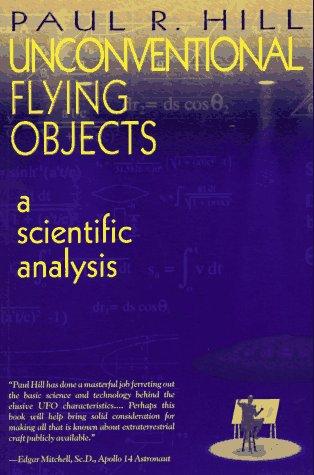
Unconventional Flying Objects
A Scientific Analysis — The NASA Langley Aerodynamicist's Posthumous Case That UFOs "Obey, Not Defy" the Laws of Physics
Find on Amazon →As an Amazon Associate, OverClassified may earn from qualifying purchases made through this link, at no extra cost to you.
Why This Is Essential Reading
Unconventional Flying Objects earns its place on this list because of who wrote it and under what constraints, as much as for what it actually proves. Paul R. Hill spent thirty-one honored years as a working NASA Langley aerodynamicist, brought that same rigorous engineering discipline to a subject his own employer would not let him publish on, built and personally test-flew hardware to check at least one of his own hypotheses, and produced a book his family had to decide, five years after his death, was worth finally releasing. Read the propulsion-mechanics chapters — "Direct Evidence of Force Field Propulsion," "Silent Supersonic Operation," "High-Acceleration Loading on Occupants" — for what they are: a genuinely careful, internally consistent kinematic argument built from real aerospace-engineering method, undermined only by the one thing Hill himself could never supply, a physical account of how his proposed force field could actually be generated. Read the Ubatuba chapter alongside this site's own updated case file, where a 2022 isotope re-analysis has substantially revised the physical-evidence claim Hill relied on. And read the book's entire publication history — finished by the 1970s, rejected repeatedly, released only posthumously in 1995 — as its own quiet argument about how much institutional caution still surrounds this subject, even when the person doing the analyzing has exactly the credentials mainstream science says it wants.
Related Cases & Theories
Essential Viewing
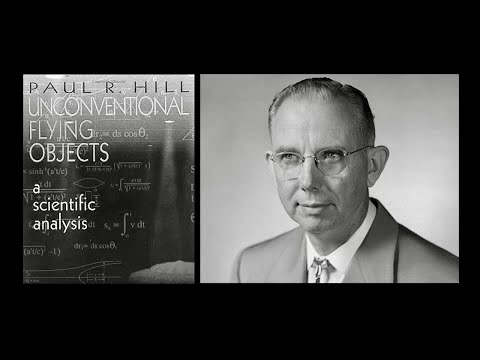
NASA scientist Paul R. Hill secretly wrote a manuscript on UFOs: "Unconventional Flying Objects"
Eyes On Cinema — A summary of Hill's NASA career, his 1952 sighting, and the decades-long delay before his manuscript reached print. Verified via YouTube oEmbed before inclusion.
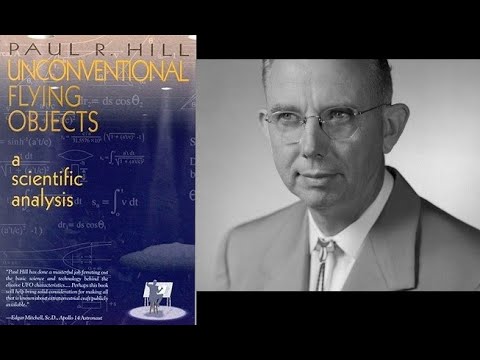
Unconventional Flying Objects: A Scientific Analysis
Unidentified Anomalous Phenomena — A dedicated breakdown of the book's central force-field propulsion argument and Hill's own case for it. Verified via YouTube oEmbed before inclusion.
Sources Cited
- Hill, Paul R. Unconventional Flying Objects: A Scientific Analysis. Hampton Roads Publishing Company, Charlottesville, VA, 1995 first ed. (ISBN 1571740279 / 9781571740274, cited here, matching the edition already cited in this site's own Nash-Fortenberry Sighting case file).
- "Paul R. Hill." Wikipedia (biography: birth/death dates, education, 31-year NACA/NASA career, Exceptional Service Medal, flying-platform project with Charles Zimmerman, 1952 and 1962 sightings, and the book's rejection-then-posthumous-publication history). en.wikipedia.org
- "Paul R. Hill Collection." ArchivesSpace, Virginia Tech (special collections finding aid documenting Hill's career, papers, and family details). aspace.lib.vt.edu
- "Hill, Paul Richard." Anomaly Archives (biographical and archival summary of Hill's NASA career and UFO research collection). anomalyarchives.org
- Puthoff, Hal. "Review of Paul Hill's Unconventional Flying Objects." Hosted at ldolphin.org (detailed physicist's review discussing the force-field propulsion hypothesis, Hill's flying-platform testing, and the Ubatuba magnesium fragment analysis). ldolphin.org
- "Unconventional Flying Objects: A Scientific Analysis." Amazon.com (1995 Hampton Roads Publishing trade paperback listing, ISBN 9781571740274, foreword by Robert M. Wood, cover blurb from Edgar Mitchell). amazon.com
- "Unconventional Flying Objects: A Former NASA Scientist Explains How UFOs Really Work." Amazon.com (2014 Hampton Roads/Red Wheel Weiser reissue, ISBN 9781571747136, with new joint foreword by Robert M. Wood and Don C. Donderi). amazon.com
- "Unconventional flying objects: a scientific analysis." Internet Archive (digitized copy and bibliographic record, Hampton Roads Publishing, 1995, ~429 pp.). archive.org
- "Unconventional flying objects : a scientific analysis." WorldCat (library bibliographic record). search.worldcat.org
- "Robert M. Wood." Grokipedia / MUFON obituary sources (biography: Cornell physics Ph.D. 1953, 43-year McDonnell Douglas career as Director of R&D, the internal "Boys in the Back Room" UFO propulsion study, October 13, 1967 Condon Committee briefing). mufon.com
- This site's own case file: The Nash-Fortenberry Sighting (Case File #088), which documents Hill's own July 16, 1952 sighting as independent professional corroboration and already cites this exact book directly.
- This site's own case file: The Ubatuba Magnesium Fragments (Case File #157), including the 2022 peer-reviewed Journal of Scientific Exploration isotope re-analysis that updates the physical-evidence claim Hill's book relied on.
- This site's own theory page: Plasma Sheath & MHD Propulsion (Theory File PSM-001), for later, independently tested engineering approaches to field-based propulsion in the same broad category as Hill's force-field hypothesis.
- This site's own key-figures entry: Paul R. Hill, for his full biography and further case connections.
- This site's own resources library: Full Reading List, where this exact 1995 first edition (ISBN 1571740279) is cited across this site's own case-file library.
Have corrections, additional research, or peer-reviewed sources? Help improve this entry.
Suggest an Edit