
UFO Crash in Brazil
A Genuine UFO Crash with Surviving ETs
Core Thesis
UFO Crash in Brazil: A Genuine UFO Crash with Surviving ETs is podiatric surgeon and UFO researcher Dr. Roger Leir's field account of the case this site's own Varginha UFO Incident file documents in full: the January 20, 1996 sighting of a small, red-eyed humanoid creature by three teenagers in Varginha, Minas Gerais, followed by rumors of a military creature-capture operation and hospital treatment of an injured being. Leir traveled to Brazil himself in 2002 as part of a speaking tour, making a dedicated trip to Varginha with California optometrist Phil Serrins, and relying on local investigator Ubirajara "Bira" Franco Rodrigues and his son Rudolfo as guides and interpreters, since Leir did not speak Portuguese. The book's stated thesis, stated bluntly in its own closing chapter, is unambiguous: "the Varginha case is no hoax."
About the Author
Roger Krevin Leir (1935–2014) held a genuine science degree from USC and qualified as a podiatrist in 1964, serving as Chief of Podiatry at several Southern California hospitals — real, verifiable medical credentials, though not those of a physician. His broader reputation in ufology, as this site's own key-figures entry documents, rests on a separate and widely rejected body of work: beginning in 1995, he led a series of surgeries he said recovered sixteen candidate "alien implants" from self-described abductees, submitting several for elemental analysis to a lab whose own report described the objects as "composed of commonly found elements" without endorsing his extraterrestrial-origin conclusion. This site's own coverage of his implant work, and of his account of a 2009 sighting in Kumburgaz, Turkey, treats his involvement as a credibility complication rather than independent corroboration — context this article carries forward rather than omits when assessing his Varginha investigation.
For the Varginha trip specifically, Leir worked alongside A.J. Gevaerd, editor of Brazil's Revista UFO (Brazilian UFO Magazine) and a longtime collaborator who had earlier arranged Portuguese translation of one of Leir's prior books, though Gevaerd is credited in the book's acknowledgments rather than depicted as present for the Varginha leg itself. The book also includes a separate chapter, explicitly flagged as a guest contribution rather than Leir's own view, from nuclear physicist and veteran UFO researcher Stanton T. Friedman, comparing Varginha to the 1947 Roswell case.
Historical Context & Origins
Leir's investigation consisted of recorded witness interviews, conducted through his interpreters and transcribed in the book with himself labeled "Dr. L," including an anonymized group of hospital medical staff and an on-the-record interview, conducted by Rodrigues, with Dr. Cesário Lincoln Furtado. He did not personally review original hospital charts; in at least one interview, a subject was asked to produce x-rays or records, and none were produced on camera. The book is therefore best understood as a secondhand-witness compilation assembled through interpreters rather than an investigation built on documentary or physical evidence Leir independently verified.
The book's most specific evidentiary claim beyond what is already widely reported concerns Corporal Marco Eli Chereze of the 24th Military Police Battalion, who died on February 15, 1996, five days after being hospitalized for an unrelated, pre-scheduled cyst removal. The book presents Dr. Furtado's on-record account of Chereze's unusually aggressive post-operative infection and abnormal blood-test findings (toxic granulations in neutrophils) as suggestive of contact with the alleged creature. This site's own case file, drawing on the documented medical record, reaches a different conclusion: Chereze's February 16, 1996 autopsy identified Staphylococcus schleiferi in a post-surgical wound culture, with sepsis recorded as the official cause of death — an ordinary, if serious, surgical complication rather than an exotic exposure. This article presents both accounts plainly: the book's contact-linked framing, and the case file's own citation of the documented autopsy finding, without asserting either resolves the question definitively on its own.
Core Arguments & Key Concepts
Leir's central claim, per the book's own final chapter, is threefold: that a genuine non-terrestrial craft crashed near Varginha on January 20, 1996; that at least one living being was captured, treated at a local hospital, and later died; and that Brazilian military and government authorities engaged in a cover-up including witness intimidation. The book's chapter-length Roswell comparison, contributed by Stanton Friedman at Leir's request, argues Varginha is in some respects more evidentially promising than Roswell: far more surviving eyewitnesses reachable decades later, a populated city rather than a remote desert site, and a culture Friedman argues is "much harder to keep a secret" than the 1947 American context — alongside acknowledged differences in the creature descriptions, number of hospitals involved, and timeline.
Beyond the Chereze material, the book's more dramatic secondary claims — an alleged secret military video of an alien autopsy reportedly seen by an officer's teenage daughter, and an alleged NASA–Brazil technology-sharing agreement tied to recovered material — are presented in the book itself as anecdotal and secondhand rather than independently documented, and this article does not treat them as established fact.
Key Cases & Evidence Discussed
This site's own Varginha UFO Incident case file documents the full record in far greater depth than this book review needs to repeat: the January 20, 1996 sighting by three teenagers, the zoo-animal deaths investigated by biologist Leila Cabral, the two formal military inquiries (the May 1996 internal sindicância led by Colonel René Jairo Fagundes and the 1997 Military Police Inquiry), and the 2010 official report identifying a local resident with a documented disability as the likely source of the original sighting. Readers wanting the complete, independently sourced record, including its own Five Observables-style assessment, should consult that case file directly.
What is specific to this book is that it is the first English-language work devoted entirely to the case, built from Leir's own 2002 field trip rather than from secondhand compilation of press reports — giving it real documentary value as a snapshot of how the case's key Brazilian investigators and witnesses characterized events roughly six years after they occurred, even as this article treats Leir's own broader credibility problems as relevant context for weighing his interpretive conclusions.
Critical Reception & Controversies
As of this article's research (August 2026), the book carries a Goodreads rating of 3.93 out of 5 across 121 ratings and 9 reviews — a genuine, organically sized review base. Reader reviews found in this research were mixed: one called it "a well-rounded report... meticulous," while another argued the book "violates every principle of writing" and that a substantial share of the text is Brazil travel narrative rather than case analysis, with the crash evidence itself "surprisingly limited" relative to the title's claims.
More specific to the book's central claims: Ubirajara Rodrigues, Leir's own lead collaborator and interpreter and the case's chief investigator quoted throughout the book, has since publicly walked back the strength of the case, described in secondary coverage as having conceded the lack of scientific proof for any creature capture. This article could not independently verify a stronger, more specific quote attributed to Rodrigues in a 2025 documentary and does not repeat it as fact. Separately, and independently of the book, this site's own case file's citation of Chereze's documented autopsy record stands in direct tension with the book's contact-linked framing of his death — a tension this article treats as unresolved rather than settled in the book's favor.
Influence & Legacy
The book's clearest legacy is as the first sustained English-language field account of Varginha, introducing the case to an English-reading UFO-research audience years before later documentaries, including James Fox's Moment of Contact, brought it wider attention. Its inclusion of Stanton Friedman's Roswell-comparison essay also helped cement Varginha's now-common informal nickname among some researchers as "Brazil's Roswell," a framing this site's own case file treats as a useful point of comparison rather than an equivalence.
Set alongside this site's own case file, which draws on the original 1996 Portuguese-language account by Vitório Pacaccini and Maxs Portes, the 1997 Military Police Inquiry, and the 2010 official report, this book is best read as an early, interpreter-mediated field account — valuable for its direct, on-the-ground access in 2002, and correspondingly best balanced against both the case file's more skeptical documented findings and Leir's own broader, independently documented credibility problems as a UFO researcher.
The Book
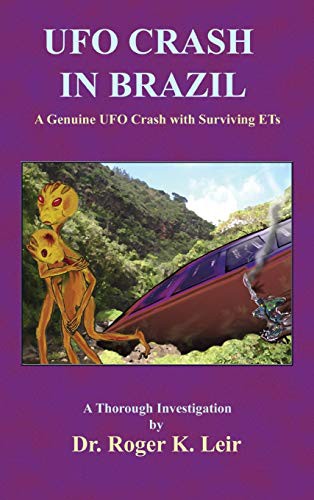
As an Amazon Associate, OverClassified may earn from qualifying purchases made through this link, at no extra cost to you.
Why This Is Essential Reading
UFO Crash in Brazil earns its place on this reading list as the first English-language field investigation of one of Latin America's most enduringly discussed UFO cases, built from Leir's own 2002 trip and direct access to local investigators and witnesses. Readers should weigh that direct access against Leir's own separately documented history of over-interpreting ambiguous physical and medical evidence, most notably the Chereze material, which this site's own case file traces instead to a documented, ordinary post-surgical infection. Read alongside this site's own Varginha UFO Incident case file, which supplies the fuller documentary record and the more skeptical medical findings this book's on-the-ground vantage does not fully engage, it remains a genuinely useful primary account of how the case's key participants told their story in the years before it became internationally famous.
Related Cases & Theories
Sources Cited
- Leir, Roger K. UFO Crash in Brazil: A Genuine UFO Crash with Surviving ETs. Book Tree, March 2005 (ISBN-13 9781585095742). amazon.com
- "UFO Crash in Brazil." Goodreads (rating 3.93/5, 121 ratings). goodreads.com
- Leir, Roger K. UFO Crash in Brazil, full scanned text. Avalon Library (primary source for the book's own chapter content, Chapters 3, 6, 11–13, 15; site removed, archived copy). web.archive.org
- "Roger Leir." Wikipedia (biographical detail, career, and the 2002/2003 Brazil trips). en.wikipedia.org
- "Varginha UFO incident." Wikipedia (case overview, 2010 official report, and Corporal Chereze's documented cause of death). en.wikipedia.org
- "UFO Crash in Brazil: The Varginha Incident." Hangar 1 Publishing (case background and Ubirajara Rodrigues's later public comments on the case's evidentiary weakness). hangar1publishing.com
- "Varginha 1996: Brazil UFO Incident." The Exclusion Zone (case background and skeptical treatment). theexclusionzone.com
- Pacaccini, Vitório & Portes, Maxs. Incidente em Varginha, 1996 (the original Portuguese-language book that triggered the case's 1997 Military Police Inquiry, cited directly in this site's own case file). goodreads.com
- Pratt, Bob. UFO Danger Zone: Terror and Death in Brazil, 1996 (independent contemporaneous account of the case).
- Clark, Jerome. The UFO Encyclopedia, 4th Edition. Visible Ink Press, 2023 (reference-work entry on the case).
- This site's own Roger Leir key-figures entry (independent context on his broader, separately documented credibility history as a UFO researcher).
- This site's own Varginha UFO Incident case file (full sourcing, the two military inquiries, and Corporal Chereze's documented autopsy record).
Have corrections, additional research, or peer-reviewed sources? Help improve this entry.
Suggest an Edit